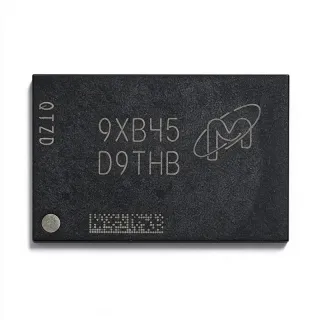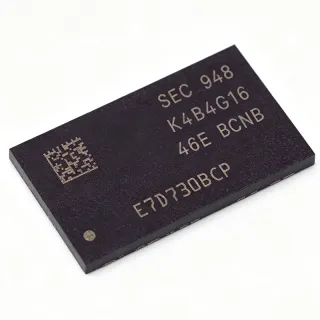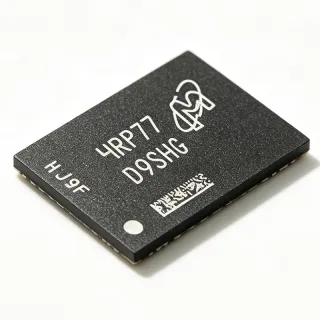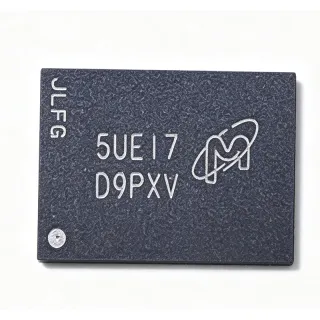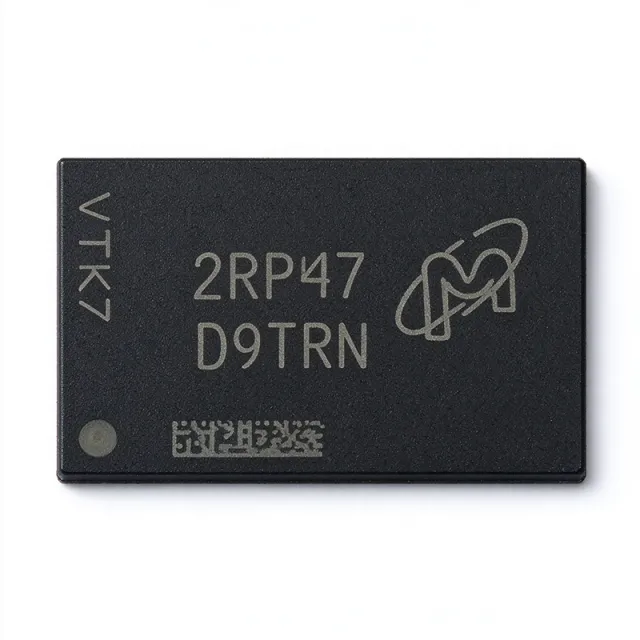
MT41K256M16TW-107 AUT:P - DDR3L 4Gb 933MHz SDRAM | Micron
MPN: MT41K256M16TW-107 AUT:P ✓ Active| Qty | Unit Price | Extended |
|---|---|---|
| 1 | $14.0625 | $14.06 |
| 10 | $10.1563 | $101.56 |
| 100 | $8.9844 | $898.44 |
| 500 | $8.5938 | $4,296.90 |
| 1,000 | $8.2031 | $8,203.10 |
MT41K256M16TW-107 AUT:P Overview
DDR3L SDRAM (Double Data Rate 3 Low Voltage) is a type of synchronous dynamic random-access memory that transfers data on both the rising and falling edges of the clock, doubling effective bandwidth compared to SDR memories. Within the memory hierarchy, DRAM sits between processor caches and non-volatile storage, serving as the main working memory in embedded, industrial, and automotive computing platforms. The L suffix denotes a reduced core voltage of 1.35V (versus 1.5V for standard DDR3), lowering dynamic power consumption by roughly 17 percent while remaining backward-compatible with 1.5V operation per JEDEC DDR3L definitions.
Key differentiating features of this device include its 4 Gbit density in a single x16 die, the 933 MHz maximum clock rate (DDR3L-1866 data rate class), the AUT automotive temperature grade of -40C to +125C, and lead-free (P suffix) RoHS-compliant construction. The x16 organization simplifies bus design for single-controller systems by providing full 16-bit data width from one device.
Architecturally, the part implements a standard DDR3L core with eight internal banks, on-die termination (ODT), CAS and address pipelining, and programmable burst lengths, enabling efficient precharge and refresh management at high data rates. The 96-ball FBGA package provides low parasitic inductance for signal integrity at 1866 MT/s and a compact 9 x 14 mm footprint for space-constrained boards.
Typical applications include automotive infotainment and ADAS memory, telematics gateways, industrial HMI and automation controllers, and embedded networking equipment, where the automotive temperature grade and DDR3L power efficiency directly extend system reliability and battery or rail power budgets.
A key design consideration is fly-by termination routing and DQS/data-group length matching at DDR3L-1866 speeds; ensure the PCB controller supports ODT calibration and the 96-FBGA footprint follows Micron layout guidelines for ball-via placement.
This page synthesizes distributor availability, drop-in alternatives, and practical design notes not found in the manufacturer datasheet.
Drop-in alternatives for MT41K256M16TW-107 AUT:P — same package, pin-to-pin compatible. Different-package parts requiring PCB rework are excluded.
Quick Comparison Tool — Select alternative parts for side-by-side comparison:
MT41K256M16TW-107:P
✓ In Stock
$16 / Unit
View Datasheet →K4B4G1646E-BYK000
✓ In Stock
$0.5619 / Unit
View Datasheet →MT41K256M16TW-125 AUT:P
📋 Reference alternative (not in catalog)
MT41K512M16TW-107 AUT:P
📋 Reference alternative (not in catalog)
MT41K256M16TW-107 AUT:P Maximum Ratings & Electrical Characteristics
| Memory Type | DDR3L SDRAM |
| Memory Size | 4 Gbit |
| Organization | 256M x 16 |
| Clock Frequency | 933 MHz |
| Access Time | 20 ns |
| Supply Voltage | 1.35 V (1.283 V to 1.45 V) |
| Interface | Parallel |
| Package | 96-FBGA (9 x 14 mm) |
| Operating Temperature | -40C to +125C (AUT automotive grade) |
| Mounting Type | Surface Mount |
| Lead-Free / RoHS | Yes (P suffix) / Compliant |
| Memory Organization Banks | 8 |
| Data Rate | 1866 MT/s (speed grade -107) |
| Termination | On-Die Termination (ODT) |
| Refresh | Auto refresh / self refresh |
| Technology | DRAM - DDR3L (Double Data Rate 3 Low Voltage) |
MT41K256M16TW-107 AUT:P 96-fbga (9 x 14 mm) Pin Configuration Guide
Pin configuration for MT41K256M16TW-107 AUT:P (96-fbga (9 x 14 mm) package). This digital IC includes GPIO, communication interfaces (UART, SPI, I2C), and power pins. Refer to the manufacturer datasheet for alternate pin functions and configuration options. Essential for embedded system design and PCB layout.

No detailed pinout data available for MT41K256M16TW-107 AUT:P.
Refer to the datasheet for full pin configuration.
Typical Applications
MT41K256M16TW-107 AUT:P is suitable for 6 applications: Automotive ADAS and Camera Buffering, Automotive Infotainment and Cluster, Industrial HMI and Automation Controllers, Telematics and Gateway ECUs, Embedded Networking Equipment, Test and Measurement Instruments.
Automotive ADAS and Camera Buffering
The MT41K256M16TW-107 AUT:P fits ADAS image-processing pipelines because its 4 Gbit capacity buffers multi-camera frames while its 1866 MT/s data rate keeps readout latency low enough for real-time object detection. The AUT -40C to +125C qualification covers under-hood and sun-exposed camera modules that consumer DRAM cannot survive. Placed as the main working memory beside an ADAS SoC with DDR3L support, the 1.35 V rail reduces module heat dissipation, and the x16 organization delivers the full 16-bit bus from a single 96-FBGA device, minimizing part count. At full bandwidth the interface can sustain roughly 3.7 GB/s of aggregate throughput, sufficient for HD camera streams processed by mid-range automotive vision processors.
Recommended
Automotive Infotainment and Cluster
Digital cockpits and infotainment head units require both capacity and bandwidth for graphics frame buffers, map tiles, and media decoding. The MT41K256M16TW-107 AUT:P provides 4 Gbit per device, and two devices on a 32-bit bus double bandwidth while sharing the same footprint. Its 933 MHz clock supports 60 fps HMI rendering on mid-tier SoCs, while DDR3L 1.35 V operation cuts static versus dynamic power on circuits that remain powered in hybrid-sleep modes. The automotive grade ensures operation through -40C cold cranks and +125C instrument-cluster enclosures, making it a common main-memory choice for entry-level instrument clusters and infotainment sub-displays where LPDDR cost/performance trade-offs favor discrete DDR3L.
Recommended
Industrial HMI and Automation Controllers
Industrial panel PCs, PLCs, and robotics controllers benefit from the MT41K256M16TW-107 AUT:P's wide -40C to +125C range, which comfortably covers unconditioned factory floors and outdoor cabinets that exceed commercial DRAM limits. Its 4 Gbit density holds Linux-based HMI stacks, real-time control code, and logging buffers, while the 1866 MT/s rate serves vision inspection nodes. In circuit terms, the SDRAM sits on the controller's DDR3L bus with fly-by routing and on-die termination, and the 1.35 V rail is typically derived from a point-of-load buck converter; the reduced voltage lowers both heat inside sealed enclosures and the rating burden on the power tree. The 96-FBGA 9 x 14 mm footprint fits dense control boards.
Recommended
Telematics and Gateway ECUs
Connected vehicle gateways aggregate CAN, Ethernet, and cellular backhaul traffic, needing memory that tolerates harsh environmental profiles while sustaining packet-buffer workloads. The MT41K256M16TW-107 AUT:P's automotive grade and 4 Gbit capacity make it well suited to buffering V2X message streams, firmware staging for OTA updates, and diagnostic logs. Its DDR3L 1.35 V operation keeps gateway quiescent power low enough to respect vehicle keep-alive current budgets when the ECU remains partially powered. The single-device x16 organization simplifies dual-redundant memory banks in safety-relevant gateway architectures, and the 20 ns access time supports deterministic lookup tables for message routing tables implemented in RAM by the gateway processor.
Recommended
Embedded Networking Equipment
Switches, routers, and industrial wireless access points use DDR3L as packet-buffer and control-plane memory. The MT41K256M16TW-107 AUT:P supplies 4 Gbit at up to 3.7 GB/s effective bandwidth from one 96-FBGA device, enough for a compact managed switch's forwarding tables and frame buffers. The -40C to +125C range suits outdoor wireless infrastructure (pole-mounted APs, roadside units), and DDR3L's 1.35 V rail aligns with the low-power budgets of passive-cooled network hardware. Designers typically pair it with a DDR3L-capable network SoC using fly-by address/command topology with two to three devices, and the x16 bus width keeps PCB layer count low because only the data groups require tight length matching at 1866 MT/s.
Recommended
Test and Measurement Instruments
Bench instruments such as oscilloscopes, logic analyzers, and data acquisition units use DDR3L as deep capture memory. The MT41K256M16TW-107 AUT:P's 1866 MT/s rate matches the sustained streaming demands of waveform capture front ends, and its 4 Gbit density provides seconds of record length at moderate sample rates. Although instruments operate indoors, designers frequently select the automotive AUT grade for its tighter screening and reliability margin in products specified for 10-year service lives. The 1.35 V DDR3L operation reduces internal heating, which protects adjacent analog circuitry from thermal drift. The 96-FBGA footprint allows straight-through fly-by routing on the instrument's multilayer stack with on-die termination absorbing far-end reflections.
Recommended
Recommended Products Summary
Engineering reference data for MT41K256M16TW-107 AUT:P — comparison, design guidance, and compliance information.
Selection Guide
Comparison with Alternatives
| Parameter | This Product | MT41K256M16TW-125 AUT | MT41K256M16TW-107 | MT41K512M16TW-107 AUT | K4B4G1646E-BYK000 |
|---|---|---|---|---|---|
| Package | 96-FBGA (9 x 14 mm) | P: 96-FBGA (9 x 14 mm) - same | P: 96-FBGA (9 x 14 mm) - same | P: 96-FBGA (9 x 14 mm) - same | 96-FBGA (9 x 14 mm) - same |
| Brand | Micron Technology | P: Micron Technology | P: Micron Technology | P: Micron Technology | Samsung Electronics |
| Memory Size | 4 Gbit | P: 4 Gbit | P: 4 Gbit | P: 8 Gbit | 4 Gbit |
| Organization | 256M x 16 | P: 256M x 16 | P: 256M x 16 | P: 512M x 16 | 256M x 16 |
| Supply Voltage | 1.35 V (DDR3L) | P: 1.35 V (DDR3L) | P: 1.35 V (DDR3L) | P: 1.35 V (DDR3L) | 1.5 V (DDR3) |
| Temperature Range | -40C to +125C (AUT) | P: -40C to +125C (AUT) | P: Industrial/commercial (narrower) | P: -40C to +125C (AUT) | Commercial/industrial |
Key Differentiators
- Automotive -40C to +125C qualification in commodity DRAM footprint (vs K4B4G1646E-BYK000)
- DDR3L 1.35 V operation lowers dynamic power (vs K4B4G1646E-BYK000)
- Highest speed grade in family enables controller headroom (vs MT41K256M16TW-125 AUT:P)
Design Notes
Route the DDR3L interface using fly-by topology for address/command/control with on-die termination (ODT) enabled at the controller, and length-match each DQS-to-DQ byte group within the tolerance stated in the Micron DDR3L design guide for -107 (1866 MT/s) operation. Keep the 96-FBGA footprint vias on a standard 0.5 mm ball pitch grid and avoid stub traces on DQ lines. Maintain a solid, unbroken VSS reference plane under all data groups; split-plane crossings at this data rate are the most common cause of eye-diagram failures in bring-up.
Supply VDD and VDDQ from a 1.35 V rail with the JEDEC window of approximately 1.283 V to 1.45 V; use a point-of-load buck converter with remote sense if the rail feeds multiple SDRAMs. Estimated: at 1866 MT/s with significant bank activity, peak current per device can reach the ampere range during simultaneous read/write bursts, so size the inductor and bulk capacitance for transient rather than average current. Decouple each VDD/VDDQ ball group with at least one 0.1 uF ceramic plus distributed bulk capacitance near the package.
Do not confuse the AUT automotive grade with lower-temperature industrial variants when qualifying the BOM - the -40C to +125C rating must match the module's worst-case enclosure temperature, including solar loading. Also verify that the memory controller explicitly supports the -107 speed grade timing tables; running a -125 schedule on a -107 device is safe, but the reverse causes marginal CAS latency violations. Finally, implement RESET# correctly: DDR3L requires the reset pin driven low during power-up to limit leakage and guarantee deterministic initialization.
Compliance Information
P suffix denotes lead-free packaging per Micron suffix decoding; distributor listings (DigiKey/Mouser) confirm RoHS compliance. REACH, halogen-free, and conflict-minerals declarations must be taken from Micron's current environmental certificates.