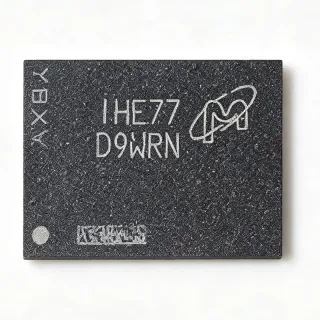
MT53D512M32D2DS-046 - 16Gb LPDDR4 2133MHz DRAM | Micron
MPN: MT53D512M32D2DS-046 ✓ Active| Qty | Unit Price | Extended |
|---|---|---|
| 1 | $75.8 | $75.80 |
| 10 | $72.02 | $720.20 |
| 100 | $68.42 | $6,842.00 |
| 500 | $65 | $32,500.00 |
| 1,000 | $61.75 | $61,750.00 |
MT53D512M32D2DS-046 Overview
LPDDR4 SDRAM (Low Power Double Data Rate 4) is a member of the synchronous DRAM family of volatile memory ICs, positioned within the broader memory hierarchy under mobile DRAM. It is optimized for bandwidth-per-watt efficiency, making it the dominant main-memory technology in smartphones, tablets, embedded systems, and automotive infotainment platforms.
Key features include automatic self-refresh, a built-in temperature sensor for optimized refresh timing, auto precharge, write leveling, and ZQ calibration for output driver impedance matching. The die is a DDP (Dual Die Package) configuration, doubling density without increasing the ball footprint.
Technically, the device uses LPDDR4 signaling at 1.1V VDD core with a separate 1.1V I/O rail, bank-group architecture, and burst length 8 (BL8) and 16 (BL16) access modes per the JEDEC LPDDR4 standard family. The 32-bit bus at 2133 MHz delivers substantial peak bandwidth for application processors.
Typical applications include mobile handset main memory paired with application processors, automotive cluster and infotainment systems, industrial HMI, and networking line-card buffering.
Design consideration: LPDDR4 signal integrity requires length-matched fly-by or point-to-point routing with VTT termination discipline; verify the controller supports DDP die selection.
This page synthesizes distributor pricing, drop-in alternative grades, and practical design notes not found in the manufacturer datasheet alone.
Drop-in alternatives for MT53D512M32D2DS-046 — same package, pin-to-pin compatible. Different-package parts requiring PCB rework are excluded.
Variants in this series
Same-series models that are drop-in compatible with MT53D512M32D2DS-046 (same form factor and footprint) — differing in Memory Type, Organization, Package, Clock Frequency, Die Configuration.
Quick Comparison Tool — Select alternative parts for side-by-side comparison:
MT53D512M32D2DS-046 AIT:D
✅ Drop-In📋 Reference alternative (not in catalog)
MT53D512M32D2DS-046 AAT:D
✅ Drop-In📋 Reference alternative (not in catalog)
MT53D512M32D2DS-046 IT:D
✅ Drop-In📋 Reference alternative (not in catalog)
MT53D512M32D2DS-046 AUT:D
✅ Drop-In📋 Reference alternative (not in catalog)
MT53D512M32D2DS-053 WT:D
✅ Drop-In✓ In Stock
$6.05 / Unit
View Datasheet →MT53D512M32D2DS-046 Maximum Ratings & Electrical Characteristics
| Memory Type | SDRAM - Mobile LPDDR4 |
| Memory Size | 16 Gbit |
| Organization | 512M x 32 |
| Clock Frequency | 2.133 GHz |
| Supply Voltage | 1.1 V |
| Package | 200-WFBGA (10 x 14.5 mm) |
| Mounting Type | Surface Mount |
| Operating Temperature | -30C to +85C (WT grade) |
| Die Configuration | DDP (Dual Die Package) |
| Auto Self-Refresh | Yes |
| Built-in Temperature Sensor | Yes |
| Auto Precharge | Yes |
| Write Leveling | Yes |
| ZQ Calibration | Yes |
| Interface | LPDDR4 (JEDEC mobile SDRAM) |
MT53D512M32D2DS-046 200-wfbga (10 x 14.5 mm) Pin Configuration Guide
Pin configuration for MT53D512M32D2DS-046 (200-wfbga (10 x 14.5 mm) package). This digital IC includes GPIO, communication interfaces (UART, SPI, I2C), and power pins. Refer to the manufacturer datasheet for alternate pin functions and configuration options. Essential for embedded system design and PCB layout.

No detailed pinout data available for MT53D512M32D2DS-046.
Refer to the datasheet for full pin configuration.
Typical Applications
MT53D512M32D2DS-046 is suitable for 6 applications: Smartphone and Tablet Main Memory, Automotive Infotainment and Cluster, Industrial HMI and Edge Computing, Networking and Telecom Line Cards, Wearable and IoT Smart Devices, Test, Measurement and Development Platforms.
Smartphone and Tablet Main Memory
The MT53D512M32D2DS-046 is purpose-built as main memory for application processors in smartphones and tablets. Its 16Gbit density in a single 512M x 32, 200-WFBGA package lets designers reach 2GB per package while conserving board area in the 10 x 14.5 mm footprint. The 2.133 GHz clock delivers the bandwidth Android and iOS SoCs demand for 4K video, gaming, and multitasking, while the 1.1V core rail and auto self-refresh with built-in temperature sensor minimize standby power - the dominant battery drain in mobile suspend states. Point-to-point PoP-style routing with the SoC is standard; the WT:D -30C to +85C range covers typical handheld thermal environments.
Recommended
Automotive Infotainment and Cluster
Automotive digital clusters and infotainment head units require high-bandwidth DRAM that survives cabin thermal extremes. The AIT:D and AUT:D grades of the MT53D512M32D2DS ballout are Micron's automotive-qualified counterparts, sharing the identical 16Gbit, 512M x 32, 2133 MHz electrical definition of this WT:D part, so the same footprint supports both consumer and automotive variants. The built-in temperature sensor enables the memory controller to adapt refresh rate across -40C to +105C cabin environments, preserving data retention while limiting self-refresh current during key-off. ZQ calibration keeps output impedance matched despite wide thermal swings, protecting signal integrity on long flex or board routes.
Recommended
Industrial HMI and Edge Computing
Industrial human-machine interfaces, edge AI gateways, and machine-vision modules use the MT53D512M32D2DS-046 as 2GB-class main memory for Linux-based SoCs and embedded MPUs. The IT:D industrial temperature grade of the same footprint extends operation to -40C for factory-floor and outdoor installations, providing a drop-in qualification path from this WT:D part. The 32-bit bus at 2133 GHz-class clock provides the memory bandwidth neural-network inference accelerators and multi-display HMI stacks require, while DDP dual-die organization maximizes density per ball. Auto precharge reduces controller overhead in random-access workloads typical of protocol conversion and logging.
Recommended
Networking and Telecom Line Cards
Switch, router, and 5G small-cell control-plane cards buffer packet descriptors and running tables in LPDDR4. The MT53D512M32D2DS-046 offers 16Gbit of buffer memory with a 32-bit wide bus, giving network processors high sequential bandwidth at 1.1V power discipline critical for confined, fanless access equipment. Write leveling and ZQ calibration maintain timing margin across the electrically noisy environment of high-port-count boards, while the built-in temperature sensor allows adaptive refresh as chassis ambient rises. Its 200-WFBGA 10 x 14.5 mm package reflows alongside standard SMT passives, avoiding the socketed DIMM approach of older designs.
Recommended
Wearable and IoT Smart Devices
Smartwatches, AR/VR viewers, and smart-home hubs combine small SoCs with LPDDR4 for responsive multitasking within tight power budgets. In suspend, the MT53D512M32D2DS-046's automatic self-refresh, steered by the built-in temperature sensor, cuts refresh overhead versus fixed-rate refresh, directly extending battery life between charges. The single-package 16Gbit DDP construction avoids stacking multiple lower-density parts, saving Z-height in wearable enclosures. Designers pair it with low-power PMICs and place VDDQ decoupling close to the ball cluster; the -30C to +85C WT:D range comfortably covers wearable body-adjacent thermal profiles.
Recommended
Test, Measurement and Development Platforms
Protocol analyzers, arbitrary waveform generators, and FPGA-based development boards use the MT53D512M32D2DS-046 as a memory subsystem exercising real LPDDR4 controllers. Its standard JEDEC-aligned LPDDR4 interface, 512M x 32 organization, and 2133 MHz operation make it a reference target for controller IP validation, eye-diagram characterization, and training-algorithm development. ZQ calibration and write leveling features allow instrument makers to demonstrate full JEDEC feature compliance. For lab environments the WT:D -30C to +85C range suffices; engineers building temperature-chamber test fixtures can qualify the IT:D grade of the same footprint for extended range coverage.
Recommended
Recommended Products Summary
Engineering reference data for MT53D512M32D2DS-046 — comparison, design guidance, and compliance information.
Selection Guide
Comparison with Alternatives
| Parameter | This Product | MT53D512M32D2DS-046 AIT:D | MT53D512M32D2DS-046 AAT:D | MT53D512M32D2DS-046 IT:D | MT53D512M32D2DS-053 WT:D |
|---|---|---|---|---|---|
| Package | 200-WFBGA (10 x 14.5 mm) | 200-WFBGA (10x14.5) - same | 200-WFBGA (10x14.5) - same | 200-WFBGA (10x14.5) - same | 200-WFBGA (10x14.5) - same |
| Brand | Micron Technology | Micron Technology | Micron Technology | Micron Technology | Micron Technology |
| Density / Organization | 16 Gbit / 512M x 32 | 16 Gbit / 512M x 32 | 16 Gbit / 512M x 32 | 16 Gbit / 512M x 32 | 16 Gbit / 512M x 32 |
| Supply Voltage | 1.1 V | 1.1 V | 1.1 V | 1.1 V | 1.1 V |
| Operating Temperature | -30C to +85C (WT) | Automotive IT grade (extended) | Automotive AAT grade (extended) | Industrial grade (extended) | -30C to +85C (WT) |
| Qualification Target | Consumer / mobile | Automotive infotainment | Automotive | Industrial | Consumer / mobile |
Key Differentiators
- Consumer cost-optimized WT grade with wide availability (vs MT53D512M32D2DS-046 AAT:D)
- Full 2133 MHz operation for maximum bandwidth (vs MT53D512M32D2DS-053 WT:D)
- DDP dual-die integration halves package count per GB (vs Two lower-density single-die LPDDR4 parts)
Design Notes
At 2133 MHz operation, LPDDR4 routing demands strict length matching within the DQ byte lanes (typically +/-2 mm intra-byte) and controlled 40-60 ohm single-ended impedance on a dedicated memory layer pair. Use the fly-by style address/command topology supported by LPDDR4 controllers and simulate eye margins at the package ball, not only at the connector. ZQ calibration must reference a precision 240-ohm (per Micron system guidance) resistor to GND with a quiet return path; do not share its ground via noisy digital returns, or drive impedance will drift across temperature.
Estimated: with a 32-bit DQ bus switching at 2133 MHz at 1.1V VDDQ, simultaneous switching current peaks in the hundreds of milliamps per device. Budget a dedicated buck regulator (LPDDR4-capable PMIC) per rail with at least 22 uF bulk capacitance near the device plus 0.1 uF per power ball cluster placed within 2-3 mm. Sequencing requirements of LPDDR4 (VDD before/with VDDQ per datasheet) must be enforced by the PMIC power-good chain to avoid latch-up risk during hot-plug or brownout events.
Confirm your SoC memory controller supports DDP (dual die package) chip configurations before adopting the -046 device; mode-register programming and address mapping differ from single-die parts. Second, WT:D is a consumer grade: do not substitute it into automotive platforms - select the AIT:D/AUT:D grades which are the same footprint. Finally, mobile DRAM is a frequent target of remarking in the gray market; source only from authorized distributors (DigiKey, Mouser, LCSC) and verify date codes against Micron traceability to avoid recycled parts with degraded retention.
Compliance Information
Compliance statements were not present in the retrieved listing data. Current-production Micron BGA memory sold through authorized distributors is typically RoHS-compliant and lead-free, but this must be confirmed against Micron's official material declaration for the exact grade before relying on it.