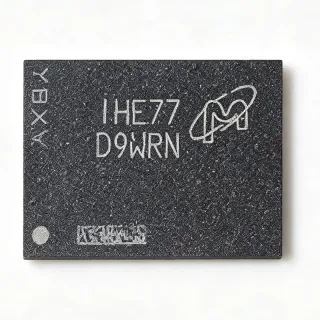
MT53E256M32D2DS-046 - 8Gb LPDDR4 SDRAM | Micron Technology
MPN: MT53E256M32D2DS-046 ✓ Active| Qty | Unit Price | Extended |
|---|---|---|
| 1 | $12.5 | $12.50 |
| 10 | $11.4 | $114.00 |
| 100 | $10.6 | $1,060.00 |
| 500 | $9.8 | $4,900.00 |
| 1,000 | $9.1 | $9,100.00 |
MT53E256M32D2DS-046 Overview
LPDDR4 (Low Power Double Data Rate 4) is a JEDEC-defined DRAM standard optimized for mobile and battery-powered systems. In the memory hierarchy, LPDDR4 sits below DDR4/DDR5 server DRAM in terms of raw bandwidth density but offers significantly lower standby and self-refresh power, making it the dominant main-memory technology for smartphones, tablets, automotive infotainment, and edge AI modules.
Key features of this part include 8Gb density in a single-die configuration, an x32 wide I/O organization that simplifies controller routing, and a -046 speed bin supporting the highest LPDDR4 clock rates. The D2DS suffix denotes the Micron LPDDR4/LPDDR4X unified die generation, which also supports LPDDR4X 0.6V VDDQ operation per the unified datasheet, reducing I/O power in compatible systems.
Architecturally, the device uses a 32-bit interface with bank groups to enable concurrent access, dual 16-bit channels, and standard LPDDR4 commands (ACTIVATE, READ/WRITE bursts, REFRESH, self-refresh with automatic exit). Automotive (AUT:B), industrial (IT:B), and commercial (WT:B, AAT:B) temperature grades share the same silicon and package footprint, allowing single-board designs across market segments.
Typical applications include automotive infotainment and ADAS processors (QNX, Android Automotive platforms), embedded vision modules, industrial gateways, and high-resolution display systems requiring gigabyte-class frame buffers.
When designing with this device, ensure the memory controller supports LPDDR4 gear-down mode selection, proper on-die termination (ODT) settings, and VDDQ termination compliance for signal integrity at 4266 MT/s.
This page synthesizes distributor pricing, drop-in grade alternatives, and practical layout/design notes not consolidated in the manufacturer datasheet.
Drop-in alternatives for MT53E256M32D2DS-046 — same package, pin-to-pin compatible. Different-package parts requiring PCB rework are excluded.
Variants in this series
Same-series models that are drop-in compatible with MT53E256M32D2DS-046 (same form factor and footprint) — differing in Density, Memory Type, Package, Organization, Mounting Type.
Quick Comparison Tool — Select alternative parts for side-by-side comparison:
MT53E256M32D2DS-046 AUT:B
✅ Drop-In📋 Reference alternative (not in catalog)
MT53E256M32D2DS-046 IT:B
✅ Drop-In📋 Reference alternative (not in catalog)
MT53E256M32D2DS-046 AAT:B
✅ Drop-In📋 Reference alternative (not in catalog)
MT53E256M32D2DS-046 WT:B
✅ Drop-In📋 Reference alternative (not in catalog)
MT53E128M32D2DS-046
✅ Drop-In✓ In Stock
Contact for price
View Datasheet →MT53D512M32D2DS-046
✅ Drop-In✓ In Stock
$61.75 / Unit
View Datasheet →MT53E256M32D2DS-046 Maximum Ratings & Electrical Characteristics
| Memory Type | LPDDR4 SDRAM (Mobile DRAM) |
| Density | 8 Gbit |
| Organization | 256M x 32 |
| Clock Frequency | 2133 MHz |
| Core Supply Voltage (VDD) | 1.1 V |
| Package | 200-WFBGA (10 x 14.5 mm) |
| Mounting Type | Surface Mount |
| Speed Grade | -046 |
| Product Generation | MT53E (LPDDR4/LPDDR4X unified die, supports 0.6V VDDQ LPDDR4X operation) |
| Automotive Qualification (AUT grade variant) | AEC-Q100 qualified (AUT:B variant) |
| Packaging (TR suffix) | Tape & Reel (TR) or Tray |
MT53E256M32D2DS-046 200-wfbga (10 x 14.5 mm) Pin Configuration Guide
Pin configuration for MT53E256M32D2DS-046 (200-wfbga (10 x 14.5 mm) package). This digital IC includes GPIO, communication interfaces (UART, SPI, I2C), and power pins. Refer to the manufacturer datasheet for alternate pin functions and configuration options. Essential for embedded system design and PCB layout.

No detailed pinout data available for MT53E256M32D2DS-046.
Refer to the datasheet for full pin configuration.
Typical Applications
MT53E256M32D2DS-046 is suitable for 6 applications: Automotive Infotainment, ADAS Camera and Sensor Processing, Industrial Gateways and Edge AI Modules, Mobile and Portable Devices, Networking and Communication Equipment, Display and Vision Systems.
Automotive Infotainment
The AUT:B grade of the MT53E256M32D2DS-046 is AEC-Q100 qualified, making it a primary main-memory choice for automotive infotainment SoCs running Android Automotive or QNX. Its 8Gb density and 2133 MHz x32 interface supply the bandwidth required for multi-display clusters, navigation rendering, and audio/video pipelines. Paired with an automotive PMIC that provides the 1.1V core and sequenced I/O rails, the dual-channel 32-bit organization lets one WFBGA device serve both memory channels of typical cockpit SoCs, simplifying routing on the 200-ball footprint.
Recommended
ADAS Camera and Sensor Processing
Advanced driver assistance systems buffer high-resolution camera frames in DRAM before vision processing; the MT53E256M32D2DS-046 AUT:B provides 8Gb per x32 device with LPDDR4-class bandwidth at 2133 MHz, enough for surround-view stitching at multi-megapixel frame rates. The MT53E die's LPDDR4X 0.6V VDDQ capability reduces I/O power, lowering thermal load in sealed camera modules. Use the AUT:B grade with automotive PMICs and follow strict length-matched DQS/DQ routing to maintain eye margins at full data rate in high-EMI vehicle environments.
Recommended
Industrial Gateways and Edge AI Modules
The IT:B industrial grade suits factory gateways, edge inference modules, and IIoT controllers that run Linux on ARM SoCs. The 8Gb x32 configuration delivers gigabyte-class main memory in a compact 10 x 14.5 mm footprint, and the -046 speed bin provides headroom for neural-network accelerator DMA traffic. Because MT53E silicon is the successor to the EOL-prone MT53D family, new industrial designs gain long-term supply continuity. Pair with industrial NOR flash and a wide-input DC-DC module to build a complete, RoHS-oriented edge computing memory subsystem.
Recommended
Mobile and Portable Devices
LPDDR4 was designed for smartphones and tablets, and the MT53E256M32D2DS-046 WT:B commercial grade delivers the canonical mobile DRAM profile: 1.1V core operation, self-refresh for low standby current, and LPDDR4X 0.6V VDDQ capability for battery-life-critical I/O power reduction. The 256M x32 organization maps directly onto application processors with 32-bit LPDDR4 controllers. Its WFBGA package's low profile suits thin portable hardware, while the dual-channel arrangement enables full-rate burst throughput for UI rendering and media decode workloads.
Recommended
Networking and Communication Equipment
Edge routers, 5G small-cell units, and network-attached processing cards use LPDDR4 as packet-buffer and control-plane memory. The MT53E256M32D2DS-046's 2133 MHz x32 interface supplies burst bandwidth for deep packet buffers, while 8Gb density accommodates flow tables and firmware working sets. The IT:B grade covers extended ambient conditions typical of telecom cabinets. Designers should reserve ample mid-plane decoupling and use gear-down mode when controller frequency limits make full-rate operation unnecessary, trading bandwidth for timing margin.
Recommended
Display and Vision Systems
High-resolution displays and embedded vision pipelines require large frame buffers with sustained readout bandwidth. The MT53E256M32D2DS-046 provides 8Gb in a single x32 device, letting one IC hold multiple 4K frames while its 2133 MHz interface keeps up with 60 Hz refresh and concurrent capture. The AAT:B automotive temperature grade covers displays used in vehicles, and industrial IT:B suits digital signage. MT53E silicon's LPDDR4X VDDQ option reduces I/O switching power in always-on signage deployments, cutting enclosure thermal design cost.
Recommended
Recommended Products Summary
Engineering reference data for MT53E256M32D2DS-046 — comparison, design guidance, and compliance information.
Selection Guide
Comparison with Alternatives
| Parameter | This Product | MT53E256M32D2DS-046 AUT:B | MT53E256M32D2DS-046 IT:B | MT53E256M32D2DS-046 AAT:B | MT53E256M32D2DS-046 WT:B | MT53E128M32D2DS-046 | MT53D512M32D2DS-046 |
|---|---|---|---|---|---|---|---|
| Package | 200-WFBGA (10 x 14.5 mm) | 200-WFBGA (10 x 14.5 mm) - same | 200-WFBGA (10 x 14.5 mm) - same | 200-WFBGA (10 x 14.5 mm) - same | 200-WFBGA (10 x 14.5 mm) - same | 200-WFBGA (10 x 14.5 mm) - same | 200-WFBGA (10 x 14.5 mm) - same |
| Brand | Micron Technology | Micron Technology | Micron Technology | Micron Technology | Micron Technology | Micron Technology | Micron Technology |
| Density | 8 Gbit | 8 Gbit | 8 Gbit | 8 Gbit | 8 Gbit | 4 Gbit | 8 Gbit class (MT53D generation) |
| Organization | 256M x 32 | 256M x 32 | 256M x 32 | 256M x 32 | 256M x 32 | 128M x 32 | 512M x 32 |
| Clock Frequency | 2133 MHz | 2133 MHz | 2133 MHz | 2133 MHz | 2133 MHz | 2133 MHz | 2133 MHz |
| Core Supply (VDD) | 1.1 V | 1.1 V | 1.1 V | 1.1 V | 1.1 V | 1.1 V | 1.1 V |
| Memory Generation | MT53E (LPDDR4/LPDDR4X unified, 0.6V VDDQ capable) | MT53E - same | MT53E - same | MT53E - same | MT53E - same | MT53E - same | MT53D (prior generation, EOL path) |
Key Differentiators
- LPDDR4X-capable unified die for lower I/O power (vs MT53D512M32D2DS-046)
- Automotive AEC-Q100 option on identical footprint (vs MT53E256M32D2DS-046 IT:B)
- Highest-speed -046 bin at 2133 MHz (vs MT53D512M32D2DS-053 WT:D)
- Lower-cost 4Gb footprint-identical option exists (vs MT53E128M32D2DS-046)
Design Notes
At the -046 speed bin (2133 MHz clock / full LPDDR4 data rate), DQ/DQS/DM traces must be length-matched within the controller vendor's spec (typically a few mils intra-byte). Maintain 40-50 ohm single-ended impedance on DQ nets and route CA/CK differentially with controlled spacing. Simulate with IBIS models from Micron's product page before tape-out; the 200-WFBGA (10 x 14.5 mm) ball-out concentrates DQ buses on package edges, so plan layer transitions early.
Provide separate 1.1V VDD core and I/O (VDDQ/VDD2) rails from a memory-dedicated PMIC with correct power-up sequencing per the Micron LPDDR4 datasheet (VDD before VDDQ-dependent rails, RESET# held low during ramp). If the controller supports LPDDR4X mode, the MT53E die's 0.6V VDDQ capability reduces I/O power significantly - estimate savings as proportional to V^2 (0.6/1.1)^2, roughly a 70% reduction in I/O switching power, but only in LPDDR4X-capable systems.
Do not mix MT53D (prior generation) and MT53E dies in dual-die socketed designs without validating controller timing tables - the icallin migration guide documents that MT53D-to-MT53E migration requires firmware updates because the MT53D family is end-of-life. Also confirm ODT and drive-strength register settings in the boot loader match the -046 speed bin; defaults written for -053 or -062 bins will fail margin at full rate.
Place the WFBGA within 50 mm of the SoC to keep fly-by CA stubs short, and pour solid reference planes under all DQ/DQS/CA routing - do not split memory nets across plane gaps. Use via-in-pad or dog-bone fanout consistently; the 0.5 mm-class ball pitch of the 200-ball package demands fine-geometry PCB capability (typically 4/4 mil lines). Add bulk decoupling (22-47 uF) plus per-rail ceramic arrays close to the ball field.
Compliance Information
The AUT:B grade variant is AEC-Q100 qualified per datasheets.com and Arrow listings. RoHS/REACH status not stated in provided web data - confirm on Micron part-detail page.