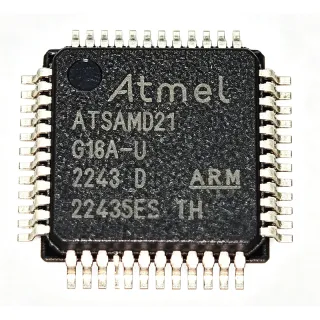
RTAX1000SL-LG624E - 1M-Gate Rad-Tolerant FPGA 624-LGA | Microchip
MPN: RTAX1000SL-LG624E ✓ Active| Qty | Unit Price | Extended |
|---|---|---|
| 1 | $0 | $0.00 |
| 10 | $0 | $0.00 |
| 100 | $0 | $0.00 |
| 500 | $0 | $0.00 |
| 1,000 | $0 | $0.00 |
RTAX1000SL-LG624E Overview
A radiation-tolerant FPGA is a field-programmable gate array engineered to survive the ionizing radiation environment of space: it maintains configuration through single-event upsets (SEU) and total ionizing dose (TID) exposure that would corrupt commercial devices. Within the power-management-of-space-systems hierarchy, the RTAX-SL family sits between commercial/industrial FPGAs and full radiation-hardened (RH) parts, offering space-flight-grade reliability at lower cost and higher density. The family descends from the Actel AX architecture and uses antifuse programmability, which makes the device live-at-power-up with no external configuration flash required.
Key features of the RTAX1000SL-LG624E include 12,096 logic cells, 125,000 ASIC-equivalent gates for higher-utilization designs, a maximum combinatorial delay of just 0.93 ns per CLB module, and a true single-chip form factor that eliminates external configuration devices. Low power consumption and live-at-power-up operation are hallmarks of the family, as stated on the Microchip product page.
Architecturally, the device is built on 0.15 um CMOS process technology with a 1.5V core. The Sea-of-Modules fabric combines combinational and sequential modules, enabling fast 581 MHz operation with deterministic timing. Antifuse interconnect contributes inherently low power and high SEU immunity compared with SRAM-based FPGAs.
Typical applications include satellite payload processing, spacecraft on-board data handling, telemetry and command (TMTC) electronics, and downlink/uplink communication baseband processing, where radiation tolerance and single-chip reliability are mission-critical.
Design consideration: the LG624 ceramic LGA package demands rigorous PCB land-pattern and thermal design; ceramic column/ball packages for space typically require certified assembly houses and compliance with the manufacturer's qualification flow.
This page synthesizes verified distributor data, family drop-in alternatives, and practical design guidance not found in any single source.
Drop-in alternatives for RTAX1000SL-LG624E — same package, pin-to-pin compatible. Different-package parts requiring PCB rework are excluded.
Variants in this series
Same-series models that are drop-in compatible with RTAX1000SL-LG624E (same form factor and footprint) — differing in Package, Equivalent System Gates, Configuration, Embedded Memory, Family.
Quick Comparison Tool — Select alternative parts for side-by-side comparison:
RTAX1000SL-LG624V
✅ Drop-In✓ In Stock
$2025 / Unit
View Datasheet →RTAX1000SL-1LG624V
✅ Drop-In✓ In Stock
$975 / Unit
View Datasheet →RTAX1000S-LG624V
✅ Drop-In✓ In Stock
$2600 / Unit
View Datasheet →RTAX1000S-1LG624V
✅ Drop-In✓ In Stock
$3600 / Unit
View Datasheet →RTAX1000SL-CGS624E
✅ Drop-In✓ In Stock
$3970 / Unit
View Datasheet →RTAX1000SL-LG624E Maximum Ratings & Electrical Characteristics
| Family | RTAX-SL Radiation-Tolerant FPGA |
| Equivalent System Gates | 1,000,000 |
| ASIC Gates | 125,000 |
| Logic Cells (CLBs) | 12,096 |
| Maximum Combinatorial Delay per CLB | 0.93 ns |
| Maximum Frequency | 581 MHz |
| Process Technology | 0.15 um CMOS |
| Core Supply Voltage | 1.5 V |
| Package | 624-Pin LGA (CBGA624), Ceramic |
| Mounting Type | Surface Mount |
| Packaging | Box |
| Technology Base | CMOS, Antifuse |
| Configuration | Live-at-power-up (no external configuration device) |
RTAX1000SL-LG624E 624-pin lga (cbga624), ceramic Pin Configuration Guide
Pin configuration for RTAX1000SL-LG624E (624-pin lga (cbga624), ceramic package). This digital IC includes GPIO, communication interfaces (UART, SPI, I2C), and power pins. Refer to the manufacturer datasheet for alternate pin functions and configuration options. Essential for embedded system design and PCB layout.

No detailed pinout data available for RTAX1000SL-LG624E.
Refer to the datasheet for full pin configuration.
Typical Applications
RTAX1000SL-LG624E is suitable for 6 applications: Satellite Payload Data Processing, On-Board Data Handling (OBDH), Telemetry, Tracking and Command (TT&C) Electronics, Downlink/Uplink Baseband Processing, Instrument Control and Sequencing, Launch Vehicle Avionics Logic.
Satellite Payload Data Processing
The RTAX1000SL-LG624E fits satellite payload processing because it pairs a large 1M-gate / 12,096-cell fabric with radiation-tolerant antifuse configuration that cannot lose its bitstream under single-event upsets. Its 581 MHz fabric and 0.93 ns per-CLB combinatorial delay support real-time DSP chains such as image compression, filtering, and framing at payload data rates. Used as the payload's main processing element between sensor front-ends and downlink formatters, it adds no configuration-read latency at power-on, and its single-chip form factor removes the external configuration flash that would otherwise be a radiation weak point. Designers trade fixed-function flexibility for guaranteed upset-free operation across the mission dose profile.
Recommended
On-Board Data Handling (OBDH)
For spacecraft on-board data handling, the RTAX1000SL-LG624E provides deterministic glue logic, bus bridging, and protocol processing between the flight computer, telemetry encoders, and peripheral units. The live-at-power-up antifuse fabric means command and control logic is functional the instant power arrives - critical for launch-vehicle sequencing and power-on self-test windows. With 125,000 ASIC gates of usable capacity, a complete OBDH interface layer fits in one 624-pin LGA device, cutting board count and solder-joint failure modes. The 1.5V core keeps static power low, which matters for eclipse-phase power budgets; designers should budget I/O standards and termination currents from the datasheet DC tables.
Recommended
Telemetry, Tracking and Command (TT&C) Electronics
TT&C chains demand absolute reliability at power-up and long-duration operation under total ionizing dose, exactly the RTAX1000SL-LG624E's design center. Its antifuse configuration is immune to configuration-memory upsets, so command decoders and security logic remain valid for the whole mission without scrubbers. The 12,096-cell fabric comfortably implements CCSDS framing, convolutional encoding, and command authentication pipelines, while 0.15 um CMOS at 1.5V limits quiescent draw during idle beacon operation. Integration on a CBGA624 ceramic package withstands the thermal cycling of low-Earth-orbit missions. Per the Microchip datasheet migration methodology, teams prototype the TT&C netlist on commercial equivalents before committing flight silicon.
Recommended
Downlink/Uplink Baseband Processing
Communication baseband functions - Reed-Solomon codecs, interleavers, and modulators - map efficiently onto the RTAX1000SL-LG624E's 581 MHz Sea-of-Modules fabric, whose fast carry logic supports the arithmetic inside encoder datapaths. The 1M-gate capacity holds full transmit and receive chains in one device, simplifying radiation analysis to a single component. Antifuse fabric shows inherently low susceptibility to configuration upsets, and the deterministic routing keeps encoder latency fixed, which simplifies end-to-end link timing budgets. The trade-off versus SRAM-based space FPGAs is loss of in-orbit reconfiguration, so channel changes must be parameterized rather than reprogrammed; the 0.93 ns CLB delay gives comfortable setup margins at typical baseband symbol rates.
Recommended
Instrument Control and Sequencing
Science instruments such as imagers and spectrometers need precise, repeatable control sequencing that survives radiation, and the RTAX1000SL-LG624E delivers both. Its live-at-power-up behavior guarantees detector clocks and bias sequencing are available during the critical first milliseconds after power application, without waiting for configuration load. The 12,096-cell fabric implements timing generators, histogramming logic, and safety interlocks; the 581 MHz ceiling supports sub-microsecond detector timing resolution. Low 1.5V core power reduces heat rejection load on instrument thermal control. Placing this single 624-pin LGA device at the instrument interface replaces multiple rad-hard ASICs, shortening qualification cycles while the ceramic package tolerates the bake-outs instruments undergo.
Recommended
Launch Vehicle Avionics Logic
Launch-vehicle avionics share many space-flight requirements - vibration, radiation from belt passages, and unforgiving power-up windows - making the RTAX1000SL-LG624E a strong fit for flight-critical logic such as redundancy management, majority voting, and safe-and-arm interface monitoring. The antifuse configuration cannot be corrupted in flight, which is a certification advantage over SRAM devices in single-fault-tolerant architectures. Its 1M gates host triple-modular-redundancy-wrapped control state machines with capacity to spare, and the 0.93 ns per-CLB delay permits hard real-time voting loops. Engineers should follow the manufacturer's qualification flow for the CBGA624 ceramic assembly and validate board-level land patterns directly against the datasheet package tables.
Recommended
Recommended Products Summary
Engineering reference data for RTAX1000SL-LG624E — comparison, design guidance, and compliance information.
Selection Guide
Comparison with Alternatives
| Parameter | This Product | RTAX1000SL-LG624V | RTAX1000SL-1LG624V | RTAX1000S-LG624V | RTAX1000SL-CGS624E |
|---|---|---|---|---|---|
| Package | 624-Pin LGA (CBGA624), Ceramic | 624-Pin LGA (CBGA624) - same | 624-Pin LGA (CBGA624) - same | 624-Pin LGA (CBGA624) - same | 624-Pin CGA (CGS624) - same die, column variant |
| Brand | Microchip Technology (Actel/Microsemi) | Microchip Technology | Microchip Technology | Microchip Technology | Microchip Technology |
| Equivalent Gates | 1,000,000 | 1,000,000 | 1,000,000 | 1,000,000 | 1,000,000 |
| Logic Cells (CLBs) | 12,096 | 12,096 | 12,096 | 12,096 | 12,096 |
| Max Frequency | 581 MHz | 581 MHz | Higher (speed grade -1) | 581 MHz class | 581 MHz |
| Core Voltage | 1.5 V | 1.5 V | 1.5 V | 1.5 V | 1.5 V |
| Screening / Qualification Level | E (engineering level) | V (flight level) | V (flight level) | V (flight level) | E (engineering level) |
| Power (SL low-power process) | Yes (SL process) | Yes (SL) | Yes (SL) | No (S process, higher power) | Yes (SL) |
Key Differentiators
- Lower-power SL process at same density (vs RTAX1000S-LG624V)
- Faster timing available in same footprint (vs RTAX1000SL-LG624V)
- Flight screening option on the same die (vs RTAX1000SL-CGS624E)
Design Notes
The CBGA624 ceramic LGA package requires a precisely defined land pattern and column/ball collapse management. Follow the package mechanical drawing in the Microchip RTAX-S/SL datasheet exactly, and have the assembly performed by a facility qualified for ceramic column grid array (CCGA/CBGA) rework. Use balanced via fanout under the package to minimize warpage-induced solder joint stress during thermal cycling, and define the stack-up so controlled-impedance I/O banks meet the signal integrity targets of your I/O standard before routing.
RTAX-SL devices are one-time programmable: unlike SRAM FPGAs, a design change after programming requires a new device. Complete full static timing analysis at your chosen speed grade and freeze the netlist before ordering programmed parts. Use the manufacturer's documented prototyping methodology - footprint-compatible adaptor board with an EDIF netlist and pinout converter - to validate logic on commercial equivalents first. Also confirm the screening suffix (E vs V vs B) matches your program's parts-assurance requirements before purchase; they are not interchangeable downward.
The RTAX1000SL uses a 1.5V core with 0.15 um antifuse CMOS, so static core power is low, but I/O power can dominate at high toggle rates with heavily loaded banks. Estimated: calculate per-bank I/O power from datasheet current tables using your actual edge rates, fanout, and switching activity, then size the core and I/O rails with appropriate derating for the mission's worst-case temperature. Provide independent, well-decoupled I/O bank supplies and sequence rails per the datasheet power-up specification to avoid latch-up risk during cold start.
Compliance Information
Space-grade ceramic package; compliance declarations (RoHS/REACH) must be obtained from Microchip for this specific screening suffix. AEC-Q100 is not applicable to space-flight rad-tolerant products, which follow aerospace qualification flows instead.