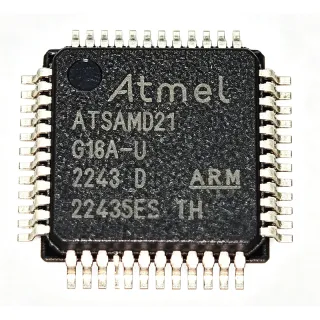
RTAX2000SL-1CQ256V - 2M-Gate Rad-Tolerant FPGA | Microchip
MPN: RTAX2000SL-1CQ256V ✓ Active| Qty | Unit Price | Extended |
|---|---|---|
| 1 | $0 | $0.00 |
| 10 | $0 | $0.00 |
| 100 | $0 | $0.00 |
| 500 | $0 | $0.00 |
| 1,000 | $0 | $0.00 |
RTAX2000SL-1CQ256V Overview
A radiation-tolerant FPGA is a field-programmable gate array engineered to survive the total ionizing dose (TID), single-event latchup (SEL), and single-event upset (SEL/SEU) environment of orbital and deep-space missions. Within the power-management-of-systems hierarchy, FPGAs sit at the digital processing layer above ASICs (lower NRE risk) and below microcontrollers (higher parallelism). The RTAX-S/SL family is derived from the commercial Axcelerator architecture and uses one-time-programmable antifuse interconnect, which is inherently immune to configuration-memory upset.
Key features include live-at-power-up operation (no configuration load time, unlike SRAM FPGAs), a true single-chip form factor requiring no external configuration device, embedded SRAM blocks with built-in FIFO control logic, segmentable clocks, chip-wide highway routing, and dedicated carry logic for arithmetic-intensive designs.
Technically, the SL variant of the RTAX2000 die reduces static power consumption versus the standard RTAX2000S, a decisive advantage for solar- and battery-powered spacecraft payloads. Densities in the family reach four million equivalent system gates, and the RTAX-DSP variants add dedicated multiply-accumulate blocks for onboard signal processing.
Typical applications include satellite payload data processing, spacecraft bus controllers, telemetry and telecommand interfaces, and instrument control in low-Earth-orbit and deep-space science missions.
A key design consideration is that antifuse FPGAs are one-time programmable: all prototyping must be done on the companion RTAX2000SL-1CQ256PROTO device or a footprint-compatible ProASIC3E-based adaptor board before committing flight units.
This page synthesizes distributor pricing, drop-in alternatives, design notes, and AI-optimized FAQs not found in the manufacturer datasheet.
Drop-in alternatives for RTAX2000SL-1CQ256V — same package, pin-to-pin compatible. Different-package parts requiring PCB rework are excluded.
Variants in this series
Same-series models that are drop-in compatible with RTAX2000SL-1CQ256V (same form factor and footprint) — differing in Package, Configuration, Technology, Radiation Tolerance, Embedded Memory.
Quick Comparison Tool — Select alternative parts for side-by-side comparison:
RTAX2000S-CQ256V
✅ Drop-In ⚠️ Specs Unverified✓ In Stock
Contact for price
View Datasheet →RTAX2000SL-1CQ256
✅ Drop-In ⚠️ Specs Unverified📋 Reference alternative (not in catalog)
RTAX2000SL-1CQ256V Maximum Ratings & Electrical Characteristics
| Equivalent System Gates | 2,000,000 (approx.) |
| Logic Cells | 32,256 |
| Configurable Logic Blocks (CLBs) | 21,504 |
| Maximum Clock Frequency | 649 MHz |
| Technology | CMOS, antifuse (one-time programmable) |
| Family | RTAX-S/SL Radiation-Tolerant FPGA |
| Speed Grade | -1 |
| Package | 256-pin Ceramic CQFP (CQ256) |
| Radiation Tolerance | Radiation-tolerant (TID/SEE characterized) |
| Configuration | Live-at-power-up, single-chip (no external config device) |
| Embedded Memory | Embedded SRAM with built-in FIFO control logic |
| Mounting Type | Surface Mount |
RTAX2000SL-1CQ256V 256-pin ceramic cqfp (cq256) Pin Configuration Guide
Pin configuration for RTAX2000SL-1CQ256V (256-pin ceramic cqfp (cq256) package). This digital IC includes GPIO, communication interfaces (UART, SPI, I2C), and power pins. Refer to the manufacturer datasheet for alternate pin functions and configuration options. Essential for embedded system design and PCB layout.

No detailed pinout data available for RTAX2000SL-1CQ256V.
Refer to the datasheet for full pin configuration.
Typical Applications
RTAX2000SL-1CQ256V is suitable for 6 applications: Satellite Payload Data Processing, Spacecraft Bus Control and Housekeeping, Onboard Instrument Control and Signal Processing, Defense and Military Avionics Logic, Launch Vehicle and Reentry Systems, Deep-Space Science Missions.
Satellite Payload Data Processing
The RTAX2000SL-1CQ256V fits payload data-processing chains where 2,000,000 equivalent gates of parallel logic must run continuously in orbit with zero configuration risk. Its antifuse fabric is immune to configuration upsets, and the SL die's reduced static power directly extends limited solar-array and battery budgets. The 649 MHz architectural clock capability and 32,256 logic cells support framing, FEC, and compression engines at line rates of modern downlink chains. The device is placed as the glueless bridge between sensor front ends and downlink modulators, using embedded SRAM with FIFO control for cross-clock-domain buffering. Because it is live-at-power-up, payload logic is operational immediately after eclipse exit without a boot sequence or external configuration flash, eliminating a single-point failure mode common to SRAM FPGA payloads. Designers typically prototype on the RTAX2000SL-1CQ256PROTO before committing OTP flight units.
Recommended
Spacecraft Bus Control and Housekeeping
Spacecraft attitude-control, power-management, and telemetry/telecommand subsystems favor the RTAX2000SL-1CQ256V because bus logic must be available from the instant of launch-vehicle separation. The 2,000,000-gate fabric implements redundant command decoders, watchdog logic, mode-state machines, and MIL-STD-style bus interfaces, while the CQ256 hermetic ceramic package withstands thermal cycling and launch vibration environments qualified for flight. Low static power of the SL die suits bus controllers that remain powered through eight-year cruise phases, as in deep-space science missions. Segmentable clocks let a single 649 MHz-capable device host independent, isolation-separated clock domains for avionics and payload sections. Designers partition bus functions across RTAX devices and pair them with rad-hard analog companions; the single-chip, no-configuration-device architecture removes the SEU-soft configuration store that SRAM FPGA bus controllers would otherwise require.
Recommended
Onboard Instrument Control and Signal Processing
Science instruments on orbital platforms and interplanetary probes use the RTAX2000SL-1CQ256V for detector timing, sequencing, and front-end signal conditioning logic. The 21,504 CLBs and dedicated carry chains implement high-throughput accumulation and correlation pipelines, while embedded SRAM blocks with built-in FIFO control absorb bursts between detector readout and downlink formatting. The hermetic CQ256 package suits instruments exposed to vacuum and radiation where plastic encapsulants are prohibited. The antifuse OTP fabric guarantees deterministic behavior after a solar particle event: no configuration scrubber is needed, so the FPGA resumes operation without intervention. The SL variant's low static power is critical for instruments that must keep logic alive during long integration windows on limited power. Typical systems pair this FPGA with a rad-tolerant ADC front end and prototype designs on the PROTO companion device first.
Recommended
Defense and Military Avionics Logic
The RTAX2000SL-1CQ256V is qualified into defense logistics flows: Microchip's DLA Cross Reference Guide lists RTAX parts with Defense Logistics Agency drawing numbers qualified per MIL-PRF-38535 on the QML class Q and class V lists. This makes the device a natural choice for flight avionics, guided munitions, and reconnaissance payloads that demand traceable, document-qualified components. The 2,000,000-gate fabric hosts MIL-STD-1553-style interfaces, ARINC glue logic, and secure boot state machines, and the 649 MHz fabric ceiling covers high-rate sensor aggregation. The hermetic 256-pin ceramic CQFP is compatible with high-reliability solder and inspection processes used in military assembly lines. One-time programmability is also a security advantage: the configured bitstream cannot be read out or overwritten, unlike SRAM FPGA configuration memory.
Recommended
Launch Vehicle and Reentry Systems
Launch-vehicle avionics and reentry instrumentation demand logic that survives extreme vibration, total ionizing dose, and single events with no configuration latency. The RTAX2000SL-1CQ256V's live-at-power-up behavior means flight logic executes from the moment power is applied - essential for sequencers that must act within milliseconds of separation events. The antifuse OTP interconnect cannot lose its configuration under radiation burst environments that would corrupt an SRAM FPGA mid-flight, and the hermetic CQ256 package meets the thermal and mechanical screening typical of launch qualification. The 32,256 logic cells and 649 MHz capability host redundant majority-voted sequencers, pyrotechnic firing logic, and high-rate IMU data paths. Designers implement triple modular redundancy in the fabric itself since the OTP architecture permits permanent, verified TMR structures without scrubbing infrastructure.
Recommended
Deep-Space Science Missions
Deep-space missions such as planetary probes and observatories operate for a decade or more in high-radiation environments with strictly limited power, making the RTAX2000SL-1CQ256V a strong fit. The SL die's low static power keeps logic alive during multi-year cruise phases, while the radiation-tolerant antifuse fabric tolerates cumulative TID and single-event fluxes at distances where solar shielding is weak. The 2,000,000-gate capacity hosts autonomous fault-management logic that must run without ground intervention: safe-mode controllers, fault-tree decoders, and science-data preprocessing. Its single-chip, live-at-power-up architecture removes configuration-device failure modes over missions where no repair is possible. Embedded FIFO-controlled SRAM supports cross-domain data paths between instrument interfaces and deep-space transponders. Programs typically use Aldec ProASIC3E-based adaptor boards for flash-based prototyping before committing one-time-programmable flight units.
Recommended
Recommended Products Summary
Engineering reference data for RTAX2000SL-1CQ256V — comparison, design guidance, and compliance information.
Selection Guide
Comparison with Alternatives
| Parameter | This Product | RTAX2000S-CQ256V | RTAX2000SL-1CQ256 | RTAX2000SL-1CG1152V |
|---|---|---|---|---|
| Package | CQFP-256 (CQ256) ceramic | CQFP-256 (CQ256) - same | CQFP-256 (CQ256) - same | CCG1152 - different package (upgrade path) |
| Brand | Microchip Technology (Actel/Microsemi) | Microchip Technology | Microchip Technology | Microchip Technology |
| Equivalent System Gates | 2,000,000 (approx.) | 2,000,000 (approx.) | 2,000,000 (approx.) | 2,000,000 (approx.) |
| Logic Cells / CLBs | 32,256 / 21,504 | 32,256 / 21,504 | 32,256 / 21,504 | 32,256 / 21,504 |
| Static Power | Low (SL low-power die) | Higher (standard S die) | Low (SL die) | Low (SL die) |
| Configuration | Antifuse OTP, live-at-power-up, single chip | Antifuse OTP, live-at-power-up | Antifuse OTP, live-at-power-up | Antifuse OTP, live-at-power-up |
Key Differentiators
- Low-power SL die for power-limited missions (vs RTAX2000S-CQ256V)
- Configuration-immune OTP fabric vs SRAM space FPGAs (vs RTAX2000SL-1CG1152V (same family, SRAM-based alternatives like Xilinx Virtex-QV))
- Live-at-power-up single-chip operation (vs RTAX2000SL-1CG1152V)
Design Notes
The RTAX2000SL-1CQ256V is one-time programmable: once programmed, the antifuse interconnect cannot be corrected. Never program flight units with unverified bitstreams. Follow Microchip's application note 'Prototyping for RTAX-S and RTAX-SL Devices', which uses a footprint-compatible adaptor board plus an EDIF netlist and pinout converter, or use the RTAX2000SL-1CQ256PROTO reprogrammable companion. Aldec's ProASIC3E flash-based adaptors provide a second prototyping path. Budget the prototyping loop into the program schedule.
Choose the SL die precisely for its low static power advantage over the RTAX2000S; if your board was designed around the standard S die, power re-verification is still required when migrating in either direction. Estimated: in a battery-limited spacecraft, a static-power delta between S and SL dies of even tens of milliwatts per device compounds across multiple FPGAs into a meaningful power-budget line. Obtain exact static current figures from the RTAX-S/SL datasheet (DS2169) for your speed grade and temperature before closing the power budget.
The CQ256 ceramic quad flat pack is a high-pin-count hermetic package: verify land-pattern design against the manufacturer datasheet, and plan for elevated junction-to-ambient thermal resistance compared with flip-chip packages, since heat exits primarily through the ceramic body and leads. Use generous copper pour on the board for heat spreading and confirm the assembly house supports the inspection and soldering profiles used for ceramic space-flight packages (per MIL-PRF-38535 qualified flows referenced in Microchip's DLA Cross Reference Guide).
With up to 649 MHz fabric capability in a 256-pin package, I/O switching at high rates on CQFP leads requires careful termination and return-path planning. Assign fast edges to pins with adjacent ground returns, keep stub lengths short on the ceramic leadframe side, and simulate worst-case drive strengths from the datasheet IBIS models. Segmentable clocks let you separate noisy domains; route each clock domain with its own shielded resource rather than sharing long single-ended traces.
Compliance Information
Space-flight part in hermetic ceramic CQFP; Microchip's DLA Cross Reference Guide indicates qualification per MIL-PRF-38535 class Q/V via DLA drawing numbers for RTAX family parts. Commercial RoHS/REACH status not stated in verified data - confirm with Microchip.