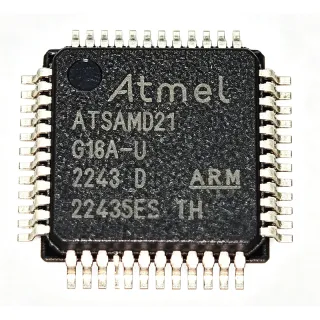
RTAX250S-CG624EV - 250K-Gate Rad-Tolerant FPGA | Microchip
MPN: RTAX250S-CG624EV ✓ Active| Qty | Unit Price | Extended |
|---|---|---|
| 1 | $0 | $0.00 |
| 10 | $0 | $0.00 |
| 100 | $0 | $0.00 |
| 500 | $0 | $0.00 |
| 1,000 | $0 | $0.00 |
RTAX250S-CG624EV Overview
A radiation-tolerant FPGA is a programmable logic device engineered to survive the single-event upset (SEU) and total-ionizing-dose environment of orbital and deep-space missions. Within the space electronics hierarchy, the RTAX-S family sits under radiation-tolerant FPGAs -> space-flight programmable logic -> flight hardware, offering a true single-chip, live-at-power-up alternative to reprogrammable devices that require configuration storage.
Key features include SEU-hardened flip-flops that eliminate the need for Triple Module Redundancy (TMR) in many designs, SEU immunity up to a specified LET threshold with an SEU rate below 10-10 errors per bit-day, and the anti-fuse, live-at-power-up architecture that removes configuration readback vulnerabilities. The ceramic column grid array package supports the high pin count needed for wide data buses and spacewire-style payloads.
Technically, the device uses the Axcelerator-derived fabric with fine-grained logic clusters, and designs are prototyped on equivalent commercial Axcelerator devices via Microchip's documented migration flow and Extender circuit boards.
Typical applications include satellite payload processing, spacecraft telemetry and command interfaces, and instrument control in launch vehicles and deep-space probes.
Design consideration: verify speed-grade suffix, power budget, and radiation report applicability before layout, since EV/evaluation ordering variants carry specific flow requirements.
This page adds value beyond the datasheet by consolidating drop-in CG624 family alternatives, comparison tables, and sourcing guidance not present in the manufacturer documentation.
Drop-in alternatives for RTAX250S-CG624EV — same package, pin-to-pin compatible. Different-package parts requiring PCB rework are excluded.
Variants in this series
Same-series models that are drop-in compatible with RTAX250S-CG624EV (same form factor and footprint) — differing in Family, Process Technology, Package, Radiation Tolerance, Embedded Memory.
Quick Comparison Tool — Select alternative parts for side-by-side comparison:
RTAX250S-CG624E
✅ Drop-In✓ In Stock
Contact for price
View Datasheet →RTAX250S-1CG624E
✅ Drop-In✓ In Stock
$960 / Unit
View Datasheet →RTAX250SL-CG624E
✅ Drop-In✓ In Stock
$1375 / Unit
View Datasheet →RTAX250SL-CG624V
✅ Drop-In✓ In Stock
$10000 / Unit
View Datasheet →RTAX250SL-CG624B
✅ Drop-In✓ In Stock
$3950 / Unit
View Datasheet →RTAX250S-CG624EV Maximum Ratings & Electrical Characteristics
| System Gates | 250000 gates |
| Logic Cells | 4224 cells |
| Configurable Logic Blocks (CLBs) | 2816 |
| Maximum Clock Frequency | 649 MHz |
| Process Technology | 0.15 um CMOS |
| Core Supply Voltage | 1.5 V |
| Package Type | 624-pin Ceramic Grid Array (CGA/CCGA) |
| Pin Count | 624 |
| Operating Temperature | -55C to +125C |
| Logic Family | CMOS |
| Radiation Tolerance | SEU-hardened registers; SEU rate < 10-10 errors per bit-day |
| Configuration | Anti-fuse, live-at-power-up, single chip |
| Mounting Type | Surface Mount (ceramic column grid array) |
| Family | RTAX-S RadTolerant FPGA |
RTAX250S-CG624EV 624-pin ceramic grid array (cga/ccga) Pin Configuration Guide
Pin configuration for RTAX250S-CG624EV (624-pin ceramic grid array (cga/ccga) package). This digital IC includes GPIO, communication interfaces (UART, SPI, I2C), and power pins. Refer to the manufacturer datasheet for alternate pin functions and configuration options. Essential for embedded system design and PCB layout.

No detailed pinout data available for RTAX250S-CG624EV.
Refer to the datasheet for full pin configuration.
Typical Applications
RTAX250S-CG624EV is suitable for 6 applications: Satellite Payload Data Processing, Spacecraft Telemetry, Tracking and Command (TT&C), Instrument Control for Science Missions, Launch Vehicle Avionics, Deep-Space Probe Flight Logic, Radiation-Tolerant Prototyping and Emulation.
Satellite Payload Data Processing
The RTAX250S-CG624EV fits satellite payload processing because its 250,000 system gates and 2816 CLBs provide enough fabric for framing, encryption, and compression pipelines, while the 649 MHz fabric clock support sustains high-throughput data paths. The SEU-hardened registers keep the single-event upset rate below 10-10 errors per bit-day, so payload logic does not require blanket Triple Module Redundancy, saving area and timing margin. In a typical topology, the FPGA sits between the payload sensor chain and the downlink formatter, implementing glueless interfaces over its 624 CCGA I/O. The trade-off versus SRAM-based space FPGAs is one-time programmability, but that yields live-at-power-up, single-chip operation with no external configuration storage to fail.
Recommended
Spacecraft Telemetry, Tracking and Command (TT&C)
For spacecraft TT&C subsystems, the RTAX250S-CG624EV provides deterministic, live-at-power-up logic for command decoders, telemetry encoders, and safe-mode controllers - functions that must be functional the instant the spacecraft powers on, which the anti-fuse architecture guarantees without any configuration device. Its -55C to +125C ceramic package rating suits the thermal environment of external equipment shelves. The 624-terminal CCGA offers abundant I/O for redundant MIL-STD-1553, CAN, and UART interfaces implemented in fabric. With 1.5V core operation on a 0.15 um CMOS process, static power remains low, which matters for battery-limited eclipse operations. Designers should reserve margin in the 250K-gate budget for redundant interface instantiations required by mission assurance policies.
Recommended
Instrument Control for Science Missions
Science instruments on planetary probes and observatories use the RTAX250S-CG624EV as a central sequencer and detector-interface controller. The 4224 logic cells implement detector clocking, ADC framing, and histogram engines, while the fabric's 649 MHz capability supports high-rate timestamping. Because the die uses SEU-hardened flip-flops immune to single-event upsets to the specified LET threshold, long-duration acquisition runs are not corrupted by particle strikes - a decisive advantage over non-hardened SRAM FPGAs. The 624-pin ceramic grid array supports wide parallel detector buses and multiple redundant science-data interfaces. Teams commonly prototype the design on a commercial Axcelerator device using Microchip's documented migration flow and Extender boards before committing to the one-time-programmable flight part.
Recommended
Launch Vehicle Avionics
Launch vehicles demand logic that is operational within milliseconds of power application and tolerant of the heavy trapped-belt and solar-particle flux encountered during ascent trajectories. The RTAX250S-CG624EV meets both needs: the anti-fuse configuration is live-at-power-up with no boot delay, and SEU-hardened registers deliver an SEU rate below 10-10 errors per bit-day. The -55C to +125C CCGA package survives the thermal transients of stage separation environments and vacuum exposure. The 2816 CLB fabric implements flight-event sequencers, discrete I/O conditioning, and redundant-voting voter logic. Engineers should budget power at 1.5V core conditions and confirm that vibration-qualified column-grid-array attach methods match the launch provider's mechanical specification before board release.
Recommended
Deep-Space Probe Flight Logic
Deep-space missions encounter radiation environments far beyond LEO, making device-level SEU hardness mandatory. The RTAX250S-CG624EV's SEU-immune registers (immune to single-event upsets to the device LET threshold, with error rates under 10-10 per bit-day) form the first line of defense, and for the harshest trajectories the RTAX250SL variants in the same 624-pin CCGA footprint add additional TID and SEE margin without any PCB change. The 250K-gate fabric runs fault-managed command loops, memory scrubbing controllers, and bus bridges between the flight computer and science payload. Because the part is one-time programmable and configuration-locked, it also resists configuration-upset mechanisms that affect SRAM FPGAs, simplifying the mission FDIR (fault detection, isolation, recovery) architecture.
Recommended
Radiation-Tolerant Prototyping and Emulation
Before committing one-time-programmable flight silicon, teams use the Microchip-documented flow to target RTAX-S designs onto equivalent commercial Axcelerator devices, with Microchip Extender circuit boards mapping the commercial package to the appropriate RTAX-S ceramic package. This lets RTL validation, timing closure, and hardware-in-the-loop testing proceed on reprogrammable devices while preserving pin-mapping to the RTAX250S-CG624EV footprint. The Aldec/Microchip collaboration additionally offers flash-based ProASIC3E adaptor boards for iterative RTAX prototyping. This workflow substantially de-risks the flight lot: functional bugs are found on the prototype device, and only the verified netlist is programmed into the CG624 flight parts, protecting the schedule of expensive, long-lead-time ceramic space components.
Recommended
Recommended Products Summary
Engineering reference data for RTAX250S-CG624EV — comparison, design guidance, and compliance information.
Selection Guide
Comparison with Alternatives
| Parameter | This Product | RTAX250S-CG624E | RTAX250SL-CG624E | RTAX250SL-CG624V |
|---|---|---|---|---|
| Brand | Microchip Technology (Actel/Microsemi) | Microchip Technology | Microchip Technology | Microchip Technology |
| Package | 624-pin CCGA (CG624) | 624-pin CCGA - same | 624-pin CCGA - same | 624-pin CCGA - same |
| System Gates | 250000 | 250000 | 250000 | 250000 |
| CLBs / Logic Cells | 2816 / 4224 | 2816 / 4224 | 2816 / 4224 | 2816 / 4224 |
| Max Clock Frequency | 649 MHz | 649 MHz | 649 MHz | 649 MHz |
| Core Supply Voltage | 1.5 V | 1.5 V | 1.5 V | 1.5 V |
| Radiation Class | RTAX-S (SEU rate < 10-10 errors/bit-day) | RTAX-S (same class) | RTAX-SL (enhanced TID/SEE) | RTAX-SL (enhanced TID/SEE) |
| Operating Temperature | -55C to +125C | -55C to +125C | -55C to +125C | -55C to +125C |
| Ordering Flow Suffix | EV (engineering/evaluation flow) | E (standard engineering flow) | E (standard engineering flow) | V (production flow variant) |
Key Differentiators
- Live-at-power-up single-chip operation (vs SRAM-based space FPGAs)
- SEU-hardened registers eliminate most TMR (vs RTAX1000SL-class lower-density parts)
- Same-footprint radiation-upgrade path (vs RTAX250SL-CG624V)
Design Notes
RTAX-S devices are one-time programmable: there is no rework path after programming, so exhaustively verify the netlist on a commercial Axcelerator prototype (per Microchip's documented migration flow and Extender boards) before committing flight parts. Also confirm the ordering suffix (EV vs E vs V) matches your program's flow and documentation requirements - suffixes denote different manufacturing flows, and substituting them without program-office approval can invalidate lot traceability.
The device operates from a nominal 1.5V core supply on a 0.15 um CMOS process. Estimated: budget power using Libero SoC power analysis with your actual toggle rates rather than worst-case fabric numbers, since anti-fuse RTAX-S static power is low but I/O power on a 624-terminal package with heavily loaded banks can dominate. Provide dedicated power planes and follow the datasheet decoupling recommendations for each VCC/VCCA bank.
The 624-terminal ceramic column grid array requires controlled-expansion substrate materials and column-grid land patterns per the datasheet package drawing. Estimated: follow the CGA attach process qualified for your launch environment (column height, solder volume, and inspection criteria), and route high-speed payload interfaces with length-matched, impedance-controlled traces. Verify JTAG programming access is preserved for factory programming before final layout release.
SEU-hardened registers largely eliminate the need for TMR, but the LET threshold in the provided data is truncated; obtain the full radiation report (LET threshold in MeV-cm2/mg) for your specific lot and orbit, then run mission SEU-rate prediction. Apply TMR selectively to configuration-critical state machines if program policy demands defense in depth beyond device-level hardening.
Compliance Information
Space-grade ceramic-package device; compliance declarations must be obtained from Microchip's product compliance portal for the exact ordering code, as ceramic hermetic packaging typically follows different exemption rules than commercial packages.