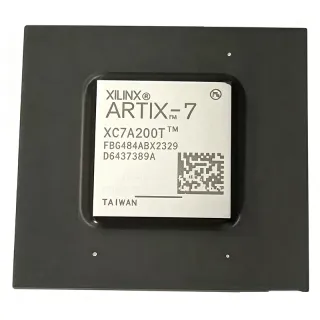
RTAX250S-1CG624E - 250K-Gate Rad-Tolerant FPGA 624-CCGA | Microchip
MPN: RTAX250S-1CG624E ✓ Active| Qty | Unit Price | Extended |
|---|---|---|
| 1 | $1200 | $1,200.00 |
| 10 | $1140 | $11,400.00 |
| 100 | $1080 | $108,000.00 |
| 500 | $1020 | $510,000.00 |
| 1,000 | $960 | $960,000.00 |
RTAX250S-1CG624E Overview
A radiation-tolerant FPGA is a field-programmable gate array designed to survive the harsh radiation environment of space flight, where single-event upsets (SEUs) caused by cosmic rays and trapped protons can flip configuration or user registers in commercial silicon. Within the power-management hierarchy of spacecraft avionics, these FPGAs sit alongside rad-hard microcontrollers and ASICs as the primary onboard data-processing and interface-logic platform, and the RTAX-S family is Microchip's (formerly Actel/Microsemi) antifuse-based, single-chip rad-tolerant offering.
Key features of the RTAX250S-1CG624E include SEU-hardened registers that largely eliminate the need for triple-module redundancy (TMR), live-at-power-up operation enabled by the non-volatile antifuse fabric, and embedded SRAM blocks with built-in FIFO control logic. The antifuse architecture also provides low power consumption and a true single-chip form factor with no external configuration device, which simplifies board design and reduces board-level parts count for satellites and space probes.
Technically, the device is based on Microchip's commercial Axcelerator architecture with a segmentable clock structure and chip-wide routing resources. The maximum combinatorial delay of a CLB is 0.930 ns, and the 0.15 um metal-to-metal antifuse process yields both high speed and inherent configuration immutability - a significant security and reliability benefit in launch environments where configuration corruption is unacceptable.
Typical applications include satellite on-board data handling, payload processing, spacecraft bus telemetry and telecommand interfaces, and radiation environment instrumentation. The CG624 ceramic column grid array package provides the hermetic, high-reliability enclosure and terminal count demanded by space-qualified hardware.
A key design consideration is that RTAX-S devices are one-time programmable: the design must be fully validated (typically using an Aldec ProASIC3E-based prototyping adaptor such as the ACT-H3Ki-CG624) before committing to antifuse programming.
This page synthesizes distributor specifications, same-package drop-in alternatives, prototyping-tool references, and practical design notes not found in the manufacturer datasheet.
Drop-in alternatives for RTAX250S-1CG624E — same package, pin-to-pin compatible. Different-package parts requiring PCB rework are excluded.
Variants in this series
Same-series models that are drop-in compatible with RTAX250S-1CG624E (same form factor and footprint) — differing in Package, Family, Radiation Tolerance, Process Technology, Equivalent System Gates.
Quick Comparison Tool — Select alternative parts for side-by-side comparison:
RTAX250S-CG624E
✅ Drop-In✓ In Stock
Contact for price
View Datasheet →RTAX250S-1CG624V
✅ Drop-In✓ In Stock
Contact for price
View Datasheet →RTAX250SL-1CG624B
✅ Drop-In✓ In Stock
Contact for price
View Datasheet →RTAX250SL-1CG624E
✅ Drop-In✓ In Stock
$1 / Unit
View Datasheet →RTAX250SL-CG624E
✅ Drop-In✓ In Stock
$1375 / Unit
View Datasheet →RTAX250SL-CG624V
✅ Drop-In✓ In Stock
$10000 / Unit
View Datasheet →RTAX250S-1CG624E Maximum Ratings & Electrical Characteristics
| Family | RTAX-S Radiation-Tolerant FPGA |
| Equivalent System Gates | 250,000 |
| Logic Cells | 2816 |
| Maximum Toggle Frequency | 649 MHz |
| CLB Combinatorial Delay (Max) | 0.930 ns |
| Core Supply Voltage | 1.5 V |
| Process Technology | 0.15 um CMOS antifuse |
| Speed Grade | -1 (approximately 15% faster than standard) |
| Package | 624-pin Ceramic Column Grid Array (CCGA) |
| Operating Temperature | -55C to +125C |
| Configuration Type | One-time programmable antifuse, live at power-up |
| Logic Family | CMOS |
| SEU Hardening | SEU-hardened registers, immune to single-event upsets |
| Embedded Memory | Embedded SRAM with built-in FIFO control |
| Mounting Type | Surface Mount |
| Application Domain | Space flight / satellite systems |
RTAX250S-1CG624E 624-pin ceramic column grid array (ccga) Pin Configuration Guide
Pin configuration for RTAX250S-1CG624E (624-pin ceramic column grid array (ccga) package). This digital IC includes GPIO, communication interfaces (UART, SPI, I2C), and power pins. Refer to the manufacturer datasheet for alternate pin functions and configuration options. Essential for embedded system design and PCB layout.

No detailed pinout data available for RTAX250S-1CG624E.
Refer to the datasheet for full pin configuration.
Typical Applications
RTAX250S-1CG624E is suitable for 6 applications: Satellite On-Board Data Handling, Payload Data Processing, Spacecraft Bus Telemetry and Telecommand, Launch Vehicle Avionics, Radiation Environment Instrumentation, Small Satellite / CubeSat Flight Logic.
Satellite On-Board Data Handling
The RTAX250S-1CG624E fits spacecraft on-board data handling (OBDH) because its 250,000 gates and 2816 logic cells provide enough capacity for telemetry formatting, telecommand decoding, and memory interfaces, while its SEU-hardened registers tolerate the orbital radiation environment without consuming logic resources on triple-module redundancy. The antifuse fabric is live at power-up, so the data-handling FPGA is functional immediately after release from the launch vehicle, with no configuration device to fail or corrupt. The 624-pin CCGA package supplies the terminal count for multiple redundant MIL-STD-1553, SpaceWire, and UART interfaces, and the hermetic ceramic column array withstands launch vibration and thermal cycling from -55C to +125C. Its 649 MHz toggle capability easily covers bus clock rates, while 1.5V core operation keeps power draw within typical satellite EPS budgets.
Recommended
Payload Data Processing
For imaging, spectrometry, and communications payloads, the RTAX250S-1CG624E provides FPGA-class parallelism with radiation tolerance. Its embedded SRAM blocks with built-in FIFO control logic buffer high-rate sensor data streams, while the 649 MHz maximum toggle frequency and 0.930 ns CLB delay support front-end formatting, decimation, and channel coding at hundreds of Mbps. The -1 speed grade gives approximately 15% faster timing than the standard grade, easing timing closure on high-speed datapaths during synthesis. Because the configuration is stored in non-volatile antifuses, payload electronics power up in a known-good state - critical for autonomous spacecraft that cannot tolerate configuration corruption. The CG624 package's 624 terminals accommodate wide parallel ADC and formatter buses, and the -55C to +125C operating range covers payload bay thermal extremes during launch and eclipse transitions.
Recommended
Spacecraft Bus Telemetry and Telecommand
The RTAX250S-1CG624E is well suited to bus-level telemetry and telecommand (TM/TC) logic. The application requires only modest logic density but stringent reliability, making the 250K-gate class a cost- and power-efficient fit. SEU-hardened registers protect TM frame counters and command decoders against single-event upsets, which is essential because a corrupted command counter can cause loss of command lockout protection. Live-at-power-up antifuse operation means the TM/TC chain is available before any software runs, supporting autonomous failure detection during LEOP. The -55C to +125C range and hermetic CCGA package suit the external equipment bay environments where bus electronics reside. Designers typically validate the TM/TC RTL on the Aldec ACT-H3Ki-CG624 adaptor (ProASIC3E-based) before committing to the one-time-programmable RTAX device.
Recommended
Launch Vehicle Avionics
Launch vehicle flight computers and sequencers benefit from the RTAX250S-1CG624E's combination of deterministic live-at-power-up startup, SEU-hardened registers, and mechanical robustness. During a minutes-long ascent, the electronics pass through severe vibration and rapidly changing temperature; the hermetic 624-pin CCGA column-grid array maintains solder-joint compliance under vibration while the -55C to +125C operating range covers aerodynamic heating transients. Sequencing and flight-termination interface logic must be functional within milliseconds of power application - the antifuse architecture requires no configuration load time, unlike SRAM FPGAs. The 0.930 ns maximum CLB delay and 649 MHz capability support fast safety-interlock logic, while 1.5V core operation reduces supply distribution complexity in weight-optimized harnesses.
Recommended
Radiation Environment Instrumentation
Science instruments that measure the space radiation environment itself - dosimeters, particle telescopes, and plasma sensors - use the RTAX250S-1CG624E as their front-end processing FPGA. These instruments demand high-rate event counting and time-tagging, which the 2816 logic cells and embedded FIFO-equipped SRAM handle efficiently, while the device's own SEU immunity keeps the measurement chain trustworthy even while being bombarded by the very particles it measures. The antifuse configuration cannot be upset, so instrument calibration constants stored in FPGA logic and embedded SRAM survive the mission. Because instruments often sit on deployables or external panels, the -55C to +125C range and ceramic packaging are prerequisites. The 624 available terminals interface to multi-channel detector front ends and redundant spacecraft data buses simultaneously.
Recommended
Small Satellite / CubeSat Flight Logic
Even small LEO platforms increasingly require rad-tolerant single-chip FPGAs, and the RTAX250S-1CG624E fits CubeSat and small-sat OBC and interface boards. The true single-chip form factor eliminates the external configuration flash that is a common failure point in small satellites, and low 1.5V-core power consumption preserves the tight power budgets of nanosatellite EPS units. In LEO, trapped-proton fluence drives SEU rates; the SEU-hardened registers (with SEU rate below 10-10 errors) provide protection without the FPGA-area and schedule cost of implementing TMR in RTL - a major benefit for small teams. The 250K-gate density is sufficient for full OBC companion logic, camera interfaces, and CAN/UART hubs. Programs with tighter budgets can drop to the standard-speed RTAX250S-CG624E variant, which shares the identical footprint.
Recommended
Recommended Products Summary
Engineering reference data for RTAX250S-1CG624E — comparison, design guidance, and compliance information.
Selection Guide
Comparison with Alternatives
| Parameter | This Product | RTAX250S-CG624E | RTAX250S-1CG624V | RTAX250SL-1CG624B | RTAX250SL-CG624V |
|---|---|---|---|---|---|
| Package | 624-pin CCGA (CG624) | 624-pin CCGA (CG624) - same | 624-pin CCGA (CG624) - same | 624-pin CCGA (CG624) - same | 624-pin CCGA (CG624) - same |
| Brand | Microchip Technology | Microchip Technology | Microchip Technology | Microchip Technology | Microchip Technology |
| System Gates | 250,000 | 250,000 | 250,000 | 250,000 | 250,000 |
| Logic Cells | 2816 | 2816 | 2816 | 2816 | 2816 |
| Speed Grade | -1 (~15% faster than standard) | Standard | -1 (~15% faster) | -1 (~15% faster) | Standard |
| Core Voltage | 1.5 V | 1.5 V | 1.5 V | 1.5 V | 1.5 V |
| Operating Temperature | -55C to +125C | -55C to +125C | -55C to +125C | -55C to +125C | -55C to +125C |
| Family / Radiation Variant | RTAX-S rad-tolerant | RTAX-S rad-tolerant | RTAX-S rad-tolerant (V screening) | RTAX-SL enhanced rad-tolerant | RTAX-SL enhanced rad-tolerant (V screening) |
Key Differentiators
- Faster -1 speed grade timing (vs RTAX250S-CG624E)
- Enhanced SEU tolerance available in same footprint (vs RTAX250SL-1CG624B)
- True single-chip live-at-power-up operation (vs SRAM-based space FPGAs)
Design Notes
RTAX-S antifuse FPGAs are one-time programmable - a programming error consumes the device permanently. Always validate the complete design on a reprogrammable prototyping platform first: the Aldec ACT-H3Ki-CG624 adaptor mounts a flash-based Microchip A3PE3000 ProASIC3E on a board whose BGA balls mimic the CG624 footprint, allowing direct assembly on the target board. Reserve enough devices in your build plan for programming yield loss, and freeze the design and Libero toolchain version before committing to antifuse programming.
The RTAX250S-1CG624E uses a 1.5V core supply; supply sequencing and rail integrity across all 624 CCGA power/ground columns must follow the RTAX-S datasheet power-up requirements to avoid latch-up during turn-on. Note that live-at-power-up operation means configuration is not loaded at power-on, so inrush behavior differs fundamentally from SRAM FPGAs - plan decoupling per the manufacturer datasheet power-budget section rather than copying an SRAM-FPGA power design. Estimated: use the datasheet ICC tables for your specific utilization and toggle rates, since antifuse power scales with actual switching activity.
Ceramic column grid array packages require careful board-level handling: CG624 columns are more compliant than BGA balls but demand controlled reflow profiles and column-damage inspection under magnification before assembly. Design the PCB footprint exactly per the Microchip CG624 land-pattern datasheet tables, with symmetrical thermal relief on ground columns to avoid warpage-induced column stress during -55C to +125C thermal cycling. Space-qualified assembly flows typically add X-ray inspection of the CG624 joints after reflow.
Compliance Information
Space-grade hermetic ceramic CCGA package; specific RoHS/REACH declarations were not present in the provided web data and must be obtained from Microchip's product compliance documentation for this exact ordering code.