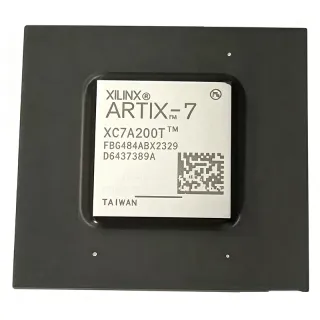
RTAX2000SL-CGS624B - 2M-Gate Rad-Tolerant FPGA, 624-CCGA | Microchip
MPN: RTAX2000SL-CGS624B ✓ Active| Qty | Unit Price | Extended |
|---|---|---|
| 1 | $0 | $0.00 |
| 10 | $0 | $0.00 |
| 100 | $0 | $0.00 |
| 500 | $0 | $0.00 |
| 1,000 | $0 | $0.00 |
RTAX2000SL-CGS624B Overview
A radiation-tolerant FPGA is a programmable logic device engineered to survive the heavy-ion, proton, and total-ionizing-dose (TID) environments encountered in Earth-orbiting and deep-space missions. Within the programmable logic hierarchy, the RTAX2000SL sits in the space-grade FPGA class, above commercial FPGA families and below full radiation-hardened ASICs, offering flight designers single-chip, live-at-power-up logic without the NRE cost of custom silicon.
Key features include a 0.15 um CMOS anti-fuse fabric for true single-chip operation, embedded SRAM blocks with built-in FIFO control logic, segmentable clock-conditioning circuitry, and chip-wide highway routing. The SL variant adds enhanced low-power and radiation performance relative to the base RTAX2000S, and the family provides densities up to four million equivalent system gates for spaceflight payloads.
Architecturally, the RTAX-S/SL fabric is based on the commercial Actel Axcelerator family, whose sea-of-modules architecture and high-performance interconnect deliver system clock rates of hundreds of megahertz while consuming low static power, a critical budget parameter for solar-powered spacecraft.
Typical applications include satellite payload processing and telemetry formatting, spacecraft bus controllers, radiation-tolerant glue logic that replaces multiple ASICs, and instrument control for science missions. The 624-pin CCGA solder-column package supports reliable board-level attachment for launch-vibration and thermal-cycling environments.
Design consideration: as a one-time-programmable (OTP) anti-fuse device, the RTAX2000SL requires rigorous pre-flight design verification; use the Aldec/Microchip flash-based ProASIC3E prototyping adaptor to iterate designs before committing flight hardware.
This page synthesizes distributor data, same-family drop-in speed-grade and temperature-grade alternatives, and practical design notes not consolidated in the manufacturer datasheet.
Drop-in alternatives for RTAX2000SL-CGS624B — same package, pin-to-pin compatible. Different-package parts requiring PCB rework are excluded.
Variants in this series
Same-series models that are drop-in compatible with RTAX2000SL-CGS624B (same form factor and footprint) — differing in Package, Configuration, Technology, Equivalent System Gates, Embedded Memory.
Quick Comparison Tool — Select alternative parts for side-by-side comparison:
RTAX2000SL-1CGS624E
✅ Drop-In✓ In Stock
$10750 / Unit
View Datasheet →RTAX2000SL-1CGS624V
✅ Drop-In✓ In Stock
Contact for price
View Datasheet →RTAX2000SL-CGS624E
✅ Drop-In✓ In Stock
Contact for price
View Datasheet →RTAX2000SL-1CGS624EV
✅ Drop-In✓ In Stock
Contact for price
View Datasheet →RTAX2000SL-1CGS624B
✅ Drop-In✓ In Stock
Contact for price
View Datasheet →RTAX2000S-CGS624V
✅ Drop-In✓ In Stock
Contact for price
View Datasheet →RTAX1000SL-CGS624E
✅ Drop-In✓ In Stock
$3970 / Unit
View Datasheet →RTAX2000SL-CGS624B Maximum Ratings & Electrical Characteristics
| Family | RTAX-S/SL Radiation-Tolerant FPGA |
| Logic Blocks (CLBs) | 21504 |
| Equivalent System Gates | 2000000 |
| ASIC Gates | 250000 |
| Maximum Clock Frequency | 350 MHz |
| Process Technology | 0.15 um CMOS |
| Supply Voltage | 1.5 V |
| Programming Technology | Anti-fuse (one-time programmable) |
| Embedded Memory | Embedded SRAM with FIFO control logic |
| Package | 624-pin Ceramic Column Grid Array (CCGA) |
| Mounting Type | Surface Mount |
| Radiation Tolerance | Radiation-tolerant (space-flight qualified family) |
| Qualification | QML per Mil Prf 38535 family (DLA cross-reference qualified program) |
RTAX2000SL-CGS624B 624-pin ceramic column grid array (ccga) Pin Configuration Guide
Pin configuration for RTAX2000SL-CGS624B (624-pin ceramic column grid array (ccga) package). This digital IC includes GPIO, communication interfaces (UART, SPI, I2C), and power pins. Refer to the manufacturer datasheet for alternate pin functions and configuration options. Essential for embedded system design and PCB layout.

No detailed pinout data available for RTAX2000SL-CGS624B.
Refer to the datasheet for full pin configuration.
Typical Applications
RTAX2000SL-CGS624B is suitable for 6 applications: Satellite Payload Data Processing, Spacecraft Bus Control Logic, Science Instrument Control, Telemetry and Telecommand Interfaces, Radiation-Tolerant Glue Logic Consolidation, Launch Vehicle and Avionics Electronics.
Satellite Payload Data Processing
The RTAX2000SL-CGS624B fits satellite payload processing because its 2,000,000 equivalent system gates and 21,504 CLBs absorb high-throughput formatting, compression, and framing functions that would otherwise require multiple ASICs or an costly rad-hard ASIC development. Its 350 MHz maximum clock rate supports real-time data pipelines, while embedded SRAM with built-in FIFO control handles buffering between acquisition and downlink chains. In a typical payload architecture, the FPGA sits between sensor front ends and the telemetry formatter, implemented with the anti-fuse fabric for live-at-power-up startup without a configuration memory device. Because the fabric is one-time-programmable, it is immune to configuration upset, a decisive benefit over SRAM FPGAs in heavy-ion environments, at the cost of no in-orbit reprogramming.
Recommended
Spacecraft Bus Control Logic
For spacecraft bus control - power switching sequencing, mode management, and command decoding - the RTAX2000SL-CGS624B offers deterministic, single-chip integration on the 624-pin CCGA, whose ceramic column construction withstands launch vibration and thermal cycling. Microchip positions the RTAX-S family as the FPGA of choice for space-flight systems due to low power consumption and true single-chip form factor, both critical on the power-constrained bus. The 21,504-CLB capacity consolidates discrete glue logic, reducing board area and solder-joint count, which directly improves reliability. Typical use places the FPGA between the onboard computer and power distribution units; its live-at-power-up behavior ensures safe state assertion immediately after battery connect, and segmentable clock circuitry supports multi-domain control timing without external PLL devices.
Recommended
Science Instrument Control
Science instruments on observation and interplanetary missions use the RTAX2000SL-CGS624B for detector timing generation, high-speed data acquisition, and instrument-to-spacecraft interface control. The 0.15 um CMOS fabric at 1.5 V delivers the timing precision needed for detector readout sequences at rates up to the 350 MHz family maximum, while 250,000 ASIC gates of equivalent capacity support on-board preprocessing such as co-adding and windowing. Embedded SRAM FIFOs buffer burst data from imagers and spectrometers toward mass storage. Radiation tolerance is the deciding parameter: instrument electronics operate outside shielded avionics bays, and the anti-fuse configuration cannot corrupt under heavy-ion fluence. Designs are verified using the Aldec flash-based ProASIC3E prototyping adaptor before flight-lot programming, avoiding costly OTP iteration cycles.
Recommended
Telemetry and Telecommand Interfaces
The RTAX2000SL-CGS624B implements CCSDS-style telemetry encoding and telecommand decoding front ends where deterministic latency and configuration robustness matter. With 2 million system gates, one device hosts frame synchronization, pseudo-randomizer stages, and parallel-to-serial conversion toward the downlink modulator. The chip-wide highway routing and segmentable clock conditioning of the RTAX-S/SL architecture maintain tight skew across wide parallel buses at hundreds of megahertz. Operating at 1.5 V core with low static consumption, it preserves link budget margins on solar-limited spacecraft. The 624 user and power pins of the CGS624 CCGA accommodate the wide I/O fan-out of telemetry frames, and the live-at-power-up anti-fuse fabric guarantees the interface is operational the moment the transponder is energized, simplifying commissioning and contingency procedures.
Recommended
Radiation-Tolerant Glue Logic Consolidation
Many space programs use the RTAX2000SL-CGS624B to replace dozens of rad-hard SSI/MSI devices with a single FPGA. At 2,000,000 equivalent gates and 21,504 CLBs, bus bridges, address decoders, and timing adapters consolidate into one 624-pin CCGA device, cutting board area, mass, and assembly cost. Compared with ASIC development, the RTAX-S flow avoids multi-million-dollar NRE and offers flight-lot lead times compatible with typical program schedules. The anti-fuse fabric removes the configuration-readout failure mode of SRAM devices, so no external configuration PROM or scrubbing controller is needed, further shrinking the parts list. Microchip qualifies the family for space flight per its rad-tolerant program, and DLA drawing-based flows exist for defense and government customers per the Microchip DLA Cross Reference Guide.
Recommended
Launch Vehicle and Avionics Electronics
Launch vehicles and flight avionics employ the RTAX2000SL-CGS624B for sequencing, redundancy management, and sensor aggregation where vibration survival and deterministic startup dominate package selection. The ceramic column grid array's compliant solder columns absorb coefficient-of-thermal-expansion mismatch between the ceramic package and organic PCB, maintaining solder-joint integrity through launch loads and thermal cycling. The 350 MHz fabric ceiling covers high-rate inertial and pressure sensor aggregation, while 1.5 V core operation keeps power within constrained avionics budgets. Because avionics often face qualification reviews, the Microchip/Microsemi heritage of the RTAX-S family, with DLA-drawing-qualified flows per Mil Prf 38535 listed in the DLA Cross Reference Guide, simplifies parts-approval documentation relative to commercial FPGAs.
Recommended
Recommended Products Summary
Engineering reference data for RTAX2000SL-CGS624B — comparison, design guidance, and compliance information.
Selection Guide
Comparison with Alternatives
| Parameter | This Product | RTAX2000SL-1CGS624E | RTAX2000SL-1CGS624V | RTAX2000S-CGS624V | RTAX1000SL-CGS624E |
|---|---|---|---|---|---|
| Package | 624-CCGA (CGS624) | 624-CCGA (CGS624) - same | 624-CCGA (CGS624) - same | 624-CCGA (CGS624) - same | 624-CCGA (CGS624) - same |
| Brand | Microchip Technology (Microsemi/Actel) | Microchip Technology | Microchip Technology | Microchip Technology | Microchip Technology |
| Die Variant | RTAX2000SL (SL low-power die) | RTAX2000SL - same | RTAX2000SL - same | RTAX2000S (base die) | RTAX1000SL (lower density) |
| Programming Technology | Anti-fuse (OTP) | Anti-fuse (OTP) | Anti-fuse (OTP) | Anti-fuse (OTP) | Anti-fuse (OTP) |
| Core Supply Voltage | 1.5 V | 1.5 V | 1.5 V | 1.5 V | 1.5 V |
Key Differentiators
- Highest logic capacity in the same 624-CCGA footprint (vs RTAX1000SL-CGS624E)
- SL low-power die for solar-limited missions (vs RTAX2000S-CGS624V)
- B-level qualification flow for flight lots (vs RTAX2000SL-CGS624E)
- Trade-off: no in-orbit reconfiguration (vs A3PE3000-1FGG896I)
Design Notes
The RTAX2000SL-CGS624B is a one-time-programmable anti-fuse device: a design or pinout error in a flight lot cannot be fixed by reprogramming. Use the Aldec/Microchip prototyping adaptor based on flash-based ProASIC3E technology to emulate and iterate the RTAX design in-system before committing flight hardware, and freeze the pinout and timing constraints only after full post-layout simulation and radiation-design review sign-off.
The 624-pin CCGA uses compliant solder columns specifically to absorb CTE mismatch between the ceramic package and organic PCB. Follow the Microchip RTAX-S/SL package land-pattern guidelines for CGS624 pad geometry and keep column pads non-solder-mask-defined where specified. Inspect columns with X-ray or angle-view inspection after reflow, since hidden column voids are the dominant assembly defect for large CCGA devices.
Estimated: RTAX-S/SL devices use a 1.5 V core with separate I/O supply rails. Budget core current from post-layout power estimation in Libero/Microsemi tools at the maximum 350 MHz activity assumption, and validate rail sequencing against the DS2169 datasheet power-up requirements - the live-at-power-up fabric does not remove the need for correct rail ramp-order per the datasheet operating conditions.
With up to 624 pins, flight I/O standards and slew settings must be constrained per-bank in the Libero project to meet SSO and crosstalk limits on the CCGA. Group high-toggle-rate outputs away from sensitive configuration and JTAG pins, and verify flight I/O timing with the datasheet's CGS624 derated output timings rather than commercial-table values, since space-grade speed files differ from Axcelerator commercial figures.
Compliance Information
Space-grade ceramic-package device; RoHS/REACH declarations were not present in the verified web data. Family qualification references DLA drawing flows per Mil Prf 38535 per the Microchip DLA Cross Reference Guide.