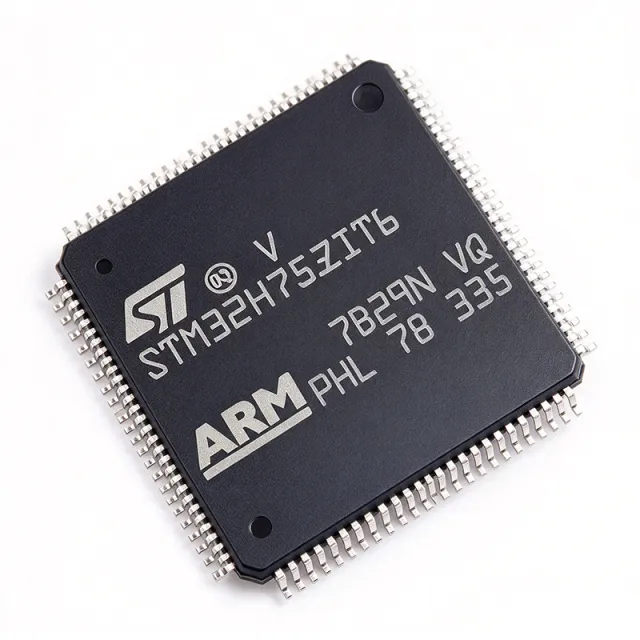
STM32H753ZIT6 - 480MHz Cortex-M7 MCU, 2MB Flash | STMicroelectronics
MPN: STM32H753ZIT6 ✓ Active| Qty | Unit Price | Extended |
|---|---|---|
| 1 | $18.42 | $18.42 |
| 10 | $16.58 | $165.80 |
| 100 | $14.75 | $1,475.00 |
| 500 | $13.28 | $6,640.00 |
| 1,000 | $11.95 | $11,950.00 |
STM32H753ZIT6 Overview
A microcontroller (MCU) is a compact integrated circuit that combines a processor core, non-volatile program memory, volatile data memory, and programmable peripherals on a single die, allowing it to govern a dedicated embedded function without external support chips. The STM32H753ZIT6 sits at the top of the STM32H7 hierarchy: Cortex-M7 core -> STM32H7 series -> STM32 32-bit MCU family -> embedded microcontroller -> semiconductor. This position makes it the natural upgrade path from Cortex-M4/M3 designs that have run out of compute headroom.
Key differentiators include the 480 MHz Cortex-M7 core with DSP and double-precision FPU instructions, 2 MB dual-bank Flash supporting read-while-write for live firmware updates, 1 MB SRAM, and a rich connectivity set: Ethernet MAC, USB OTG HS/FS, CAN FD, and multiple USART/SPI/I2C instances. A 16-bit ADC at 3.6 MSPS, a 12-bit DAC, and advanced motor-control timers round out the analog and control capability.
Technically, the device is fabricated on a 40 nm process and operates from a 1.62 V to 3.6 V supply over -40 C to +85 C. An on-chip power management unit provides Sleep, Stop, and Standby modes for battery-powered designs, while the integrated LDO/SMPS regulator architecture differs from earlier STM32F7 designs that used a BYPASS_REG pin.
Typical applications include industrial automation (PLCs, robotics), motor control (drives, pumps), medical devices (patient monitors, infusion pumps), and high-end audio equipment. The high clock speed and DSP instructions suit real-time signal processing, while the Chrom-ART Accelerator supports advanced graphical user interfaces.
When designing with this MCU, decouple every VDD pin with a 100 nF capacitor placed close to the pin plus a 4.7 uF bulk capacitor, and feed VDDA through a ferrite bead from a dedicated analog supply. For Ethernet and USB HS, follow the STM32H7 reference manual (RM0433) layout guidance to preserve signal integrity.
This page synthesizes distributor pricing, drop-in alternatives, and practical design notes not found in the manufacturer datasheet, giving engineers a single reference for selection, second-sourcing, and layout decisions.
Drop-in alternatives for STM32H753ZIT6 — same package, pin-to-pin compatible. Different-package parts requiring PCB rework are excluded.
Variants in this series
Same-series models that are drop-in compatible with STM32H753ZIT6 (same form factor and footprint) — differing in Operating Temperature, Package, ADC, Communication Interfaces, SRAM.
Quick Comparison Tool — Select alternative parts for side-by-side comparison:
STM32H743ZIT6
✓ In Stock
$10.65 / Unit
View Datasheet →STM32H753IIT6
✓ In Stock
$9.45 / Unit
View Datasheet →STM32H753BGT6
✓ In Stock
$11.5 / Unit
View Datasheet →STM32H745IIT6
✓ In Stock
$10.62 / Unit
View Datasheet →STM32H750ZBT6
✓ In Stock
$7.2 / Unit
View Datasheet →STM32H753ZIT6 Maximum Ratings & Electrical Characteristics
| Core Architecture | Arm Cortex-M7 32-bit RISC |
| Maximum CPU Frequency | 480 MHz |
| Floating Point Unit | Double-precision (IEEE 754 compliant) |
| Program Memory (Flash) | 2 MB dual-bank |
| RAM | 1 MB SRAM |
| Supply Voltage Range | 1.62 V to 3.6 V |
| Operating Temperature | -40 C to +85 C |
| Package | LQFP-144 (20x20 mm, 0.5 mm pitch) |
| Number of Pins | 144 |
| Process Technology | 40 nm |
| ADC | 16-bit, 3.6 MSPS |
| DAC | 12-bit |
| Ethernet | 10/100 MAC with DMA |
| USB | OTG HS/FS |
| CAN | CAN FD |
| Graphics Accelerator | Chrom-ART Accelerator (2D) |
| Cryptographic Accelerator | Hardware crypto processor |
| Low-Power Modes | Sleep, Stop, Standby |
| Mounting Type | Surface Mount |
| RoHS Status | Compliant |
STM32H753ZIT6 Pin Configuration
| Pin 1 | PE2 — GPIO port E bit 2 |
| Pin 2 | PE3 — GPIO port E bit 3 |
| Pin 3 | PE4 — GPIO port E bit 4 |
| Pin 4 | PE5 — GPIO port E bit 5 |
| Pin 5 | PE6 — GPIO port E bit 6 |
| Pin 6 | VBAT — Backup domain supply |
| Pin 7 | PC13 — GPIO port C bit 13 |
| Pin 8 | PC14-OSC32_IN — GPIO / 32.768 kHz crystal input |
| Pin 9 | PC15-OSC32_OUT — GPIO / 32.768 kHz crystal output |
| Pin 10 | PF0 — GPIO port F bit 0 |
| Pin 11 | PF1 — GPIO port F bit 1 |
| Pin 12 | PF2 — GPIO port F bit 2 |
| Pin 13 | PF3 — GPIO port F bit 3 |
| Pin 14 | PF4 — GPIO port F bit 4 |
| Pin 15 | PF5 — GPIO port F bit 5 |
| Pin 16 | VSS — Ground |
| Pin 17 | VDD — Digital power supply |
| Pin 18 | PF6 — GPIO port F bit 6 |
| Pin 19 | PF7 — GPIO port F bit 7 |
| Pin 20 | PF8 — GPIO port F bit 8 |
| Pin 21 | PF9 — GPIO port F bit 9 |
| Pin 22 | PF10 — GPIO port F bit 10 |
| Pin 23 | PH0-OSC_IN — GPIO / HSE crystal input |
| Pin 24 | PH1-OSC_OUT — GPIO / HSE crystal output |
| Pin 25 | NRST — Reset input (active low) |
| Pin 26 | PC0 — GPIO port C bit 0 |
| Pin 27 | PC1 — GPIO port C bit 1 |
| Pin 28 | PC2_C — GPIO / analog input |
| Pin 29 | PC3_C — GPIO / analog input |
| Pin 30 | VDD — Digital power supply |
| Pin 31 | VSSA — Analog ground |
| Pin 32 | VREF+ — ADC/DAC reference voltage |
| Pin 33 | VDDA — Analog power supply |
| Pin 34 | PA0 — GPIO port A bit 0 |
| Pin 35 | PA1 — GPIO port A bit 1 |
| Pin 36 | PA2 — GPIO port A bit 2 |
| Pin 37 | PA3 — GPIO port A bit 3 |
| Pin 38 | VSS — Ground |
| Pin 39 | VDD — Digital power supply |
| Pin 40 | PA4 — GPIO port A bit 4 |
| Pin 41 | PA5 — GPIO port A bit 5 |
| Pin 42 | PA6 — GPIO port A bit 6 |
| Pin 43 | PA7 — GPIO port A bit 7 |
| Pin 44 | PC4 — GPIO port C bit 4 |
| Pin 45 | PC5 — GPIO port C bit 5 |
| Pin 46 | PB0 — GPIO port B bit 0 |
| Pin 47 | PB1 — GPIO port B bit 1 |
| Pin 48 | PB2 — GPIO port B bit 2 |
| Pin 49 | PF11 — GPIO port F bit 11 |
| Pin 50 | PF12 — GPIO port F bit 12 |
| Pin 51 | VSS — Ground |
| Pin 52 | VDD — Digital power supply |
| Pin 53 | PF13 — GPIO port F bit 13 |
| Pin 54 | PF14 — GPIO port F bit 14 |
| Pin 55 | PF15 — GPIO port F bit 15 |
| Pin 56 | PG0 — GPIO port G bit 0 |
| Pin 57 | PG1 — GPIO port G bit 1 |
| Pin 58 | PE7 — GPIO port E bit 7 |
| Pin 59 | PE8 — GPIO port E bit 8 |
| Pin 60 | PE9 — GPIO port E bit 9 |
| Pin 61 | VSS — Ground |
| Pin 62 | VDD — Digital power supply |
| Pin 63 | PE10 — GPIO port E bit 10 |
| Pin 64 | PE11 — GPIO port E bit 11 |
| Pin 65 | PE12 — GPIO port E bit 12 |
| Pin 66 | PE13 — GPIO port E bit 13 |
| Pin 67 | PE14 — GPIO port E bit 14 |
| Pin 68 | PE15 — GPIO port E bit 15 |
| Pin 69 | PB10 — GPIO port B bit 10 |
| Pin 70 | PB11 — GPIO port B bit 11 |
| Pin 71 | VCAP — Core regulator capacitor |
| Pin 72 | VDD — Digital power supply |
| Pin 73 | PB12 — GPIO port B bit 12 |
| Pin 74 | PB13 — GPIO port B bit 13 |
| Pin 75 | PB14 — GPIO port B bit 14 |
| Pin 76 | PB15 — GPIO port B bit 15 |
| Pin 77 | PD8 — GPIO port D bit 8 |
| Pin 78 | PD9 — GPIO port D bit 9 |
| Pin 79 | PD10 — GPIO port D bit 10 |
| Pin 80 | PD11 — GPIO port D bit 11 |
| Pin 81 | PD12 — GPIO port D bit 12 |
| Pin 82 | PD13 — GPIO port D bit 13 |
| Pin 83 | VSS — Ground |
| Pin 84 | VDD — Digital power supply |
| Pin 85 | PD14 — GPIO port D bit 14 |
| Pin 86 | PD15 — GPIO port D bit 15 |
| Pin 87 | PG2 — GPIO port G bit 2 |
| Pin 88 | PG3 — GPIO port G bit 3 |
| Pin 89 | PG4 — GPIO port G bit 4 |
| Pin 90 | PG5 — GPIO port G bit 5 |
| Pin 91 | PG6 — GPIO port G bit 6 |
| Pin 92 | PG7 — GPIO port G bit 7 |
| Pin 93 | PG8 — GPIO port G bit 8 |
| Pin 94 | VSS — Ground |
| Pin 95 | VDD — Digital power supply |
| Pin 96 | PC6 — GPIO port C bit 6 |
| Pin 97 | PC7 — GPIO port C bit 7 |
| Pin 98 | PC8 — GPIO port C bit 8 |
| Pin 99 | PC9 — GPIO port C bit 9 |
| Pin 100 | PA8 — GPIO port A bit 8 |
| Pin 101 | PA9 — GPIO port A bit 9 |
| Pin 102 | PA10 — GPIO port A bit 10 |
| Pin 103 | PA11 — GPIO port A bit 11 |
| Pin 104 | PA12 — GPIO port A bit 12 |
| Pin 105 | PA13 — GPIO port A bit 13 |
| Pin 106 | VSS — Ground |
| Pin 107 | VDD — Digital power supply |
| Pin 108 | PA14 — GPIO port A bit 14 |
| Pin 109 | PA15 — GPIO port A bit 15 |
| Pin 110 | PC10 — GPIO port C bit 10 |
| Pin 111 | PC11 — GPIO port C bit 11 |
| Pin 112 | PC12 — GPIO port C bit 12 |
| Pin 113 | PD0 — GPIO port D bit 0 |
| Pin 114 | PD1 — GPIO port D bit 1 |
| Pin 115 | PD2 — GPIO port D bit 2 |
| Pin 116 | PD3 — GPIO port D bit 3 |
| Pin 117 | PD4 — GPIO port D bit 4 |
| Pin 118 | PD5 — GPIO port D bit 5 |
| Pin 119 | VSS — Ground |
| Pin 120 | VDD — Digital power supply |
| Pin 121 | PD6 — GPIO port D bit 6 |
| Pin 122 | PD7 — GPIO port D bit 7 |
| Pin 123 | PG9 — GPIO port G bit 9 |
| Pin 124 | PG10 — GPIO port G bit 10 |
| Pin 125 | PG11 — GPIO port G bit 11 |
| Pin 126 | PG12 — GPIO port G bit 12 |
| Pin 127 | PG13 — GPIO port G bit 13 |
| Pin 128 | PG14 — GPIO port G bit 14 |
| Pin 129 | VSS — Ground |
| Pin 130 | VDD — Digital power supply |
| Pin 131 | PG15 — GPIO port G bit 15 |
| Pin 132 | PB3 — GPIO port B bit 3 |
| Pin 133 | PB4 — GPIO port B bit 4 |
| Pin 134 | PB5 — GPIO port B bit 5 |
| Pin 135 | PB6 — GPIO port B bit 6 |
| Pin 136 | PB7 — GPIO port B bit 7 |
| Pin 137 | BOOT0 — Boot mode selection |
| Pin 138 | PB8 — GPIO port B bit 8 |
| Pin 139 | PB9 — GPIO port B bit 9 |
| Pin 140 | PE0 — GPIO port E bit 0 |
| Pin 141 | PE1 — GPIO port E bit 1 |
| Pin 142 | VSS — Ground |
| Pin 143 | VDD — Digital power supply |
| Pin 144 | PDR_ON — Power-down reset enable |
Typical Applications
STM32H753ZIT6 is suitable for 6 applications: Industrial Automation and PLCs, Motor Control and Drives, Medical Devices and Patient Monitors, Edge AI and Real-Time Signal Processing, High-End Audio and Graphical HMI, Networking and Communication Gateways.
Industrial Automation and PLCs
The STM32H753ZIT6 fits industrial programmable logic controllers because its 480 MHz Cortex-M7 core executes ladder-logic and motion-control loops with deterministic timing, while the 2 MB dual-bank Flash allows firmware updates without stopping the production line. Ethernet MAC and CAN FD interfaces connect directly to plant networks and fieldbus segments, and the 16-bit 3.6 MSPS ADC digitizes analog sensor inputs for process control. In a typical PLC design the MCU sits between isolated digital I/O and the backplane bus, running a real-time operating system. The trade-off is power: at 480 MHz the core draws substantially more than a Cortex-M4, so thermal vias and a copper pour under the LQFP-144 exposed pad are recommended for sealed enclosures.
Recommended
Motor Control and Drives
The STM32H753ZIT6 is designed for field-oriented control of three-phase motors: its advanced timers generate complementary PWM with programmable dead-time, the 16-bit ADC samples phase currents at 3.6 MSPS to close the current loop, and the Cortex-M7 DSP instructions execute Park/Clarke transforms in a few cycles. At 480 MHz the device can run PWM frequencies above 20 kHz while still leaving headroom for position-loop and communication tasks. The dual-bank Flash enables over-the-air firmware updates in pumps and drives that cannot be taken offline. Designers should note that the integrated SMPS/LDO regulator architecture differs from STM32F7 parts, so the power-supply schematic must be reworked when migrating from an F7 design.
Recommended
Medical Devices and Patient Monitors
The STM32H753ZIT6 suits patient monitors and infusion pumps because the hardware cryptographic accelerator provides secure boot and encrypted firmware storage, a requirement for connected medical equipment, while the 16-bit ADC and 12-bit DAC handle physiological signal acquisition and calibration output. The 2 MB dual-bank Flash supports fail-safe firmware updates in devices that must remain certified and available. In a monitor design the MCU processes ECG or SpO2 sample streams in real time and drives a graphical display through the Chrom-ART Accelerator. The main trade-off is that the -40 C to +85 C industrial grade is not AEC-Q100 qualified, so automotive-grade medical platforms should evaluate the STM32H7 automotive variants instead.
Recommended
Edge AI and Real-Time Signal Processing
The STM32H753ZIT6 brings edge-AI inference to embedded systems through its 480 MHz Cortex-M7 core with double-precision FPU and DSP extensions, which accelerate neural-network kernels and FIR/FFT filtering without an external accelerator. 1 MB of SRAM holds intermediate tensors for small convolutional models, and the 2 MB Flash stores weights and application code. In a predictive-maintenance node the MCU runs vibration FFT analysis and a classifier locally, sending only results over Ethernet or CAN FD. The trade-off versus a dedicated NPU is throughput per watt: the Cortex-M7 is flexible but slower than a fixed-function accelerator, so designers should profile model latency before committing to this part.
Recommended
High-End Audio and Graphical HMI
The STM32H753ZIT6 supports high-end audio and graphical user interfaces because the Chrom-ART Accelerator offloads 2D blitting and alpha-blending from the CPU, allowing smooth display updates on TFT panels while the Cortex-M7 core runs audio DSP. The 12-bit DAC and I2S/SAI peripherals interface directly to audio codecs, and the 480 MHz core executes sample-rate conversion and equalization in real time. In an audio mixer the MCU handles USB audio streaming, DSP effects, and a touchscreen UI concurrently. The design consideration is memory bandwidth: driving a large RGB display from internal SRAM competes with audio buffers, so external SDRAM via the FMC is often added for framebuffer storage.
Recommended
Networking and Communication Gateways
The STM32H753ZIT6 is used in industrial gateways and protocol converters because it integrates a 10/100 Ethernet MAC with DMA, USB OTG HS/FS, and CAN FD on a single die, eliminating external bridge chips. The 480 MHz core runs TCP/IP stacks, Modbus, and protocol translation with low latency, while the hardware crypto accelerator offloads TLS handshakes for secure cloud connectivity. In a gateway design the MCU bridges a CAN FD fieldbus to an Ethernet backhaul, buffering frames in the 1 MB SRAM. The trade-off is that the integrated Ethernet MAC requires an external PHY and magnetics, so board area and BOM cost must account for those components plus the RM0433-recommended layout practices.
Recommended
Recommended Products Summary
Engineering reference data for STM32H753ZIT6 — comparison, design guidance, and compliance information.
Selection Guide
Comparison with Alternatives
| Parameter | This Product | STM32H743ZIT6 | STM32H753IIT6 | STM32H750ZBT6 | STM32H753BGT6 | STM32H745IIT6 |
|---|---|---|---|---|---|---|
| Package | LQFP-144 | LQFP-144 - same | LQFP-176 | LQFP-144 - same | LQFP-208 | LQFP-176 |
| Brand | STMicroelectronics | STMicroelectronics | STMicroelectronics | STMicroelectronics | STMicroelectronics | STMicroelectronics |
| Core / Frequency | Cortex-M7 @ 480 MHz | Cortex-M7 @ 480 MHz | Cortex-M7 @ 480 MHz | Cortex-M7 @ 480 MHz | Cortex-M7 @ 480 MHz | Cortex-M7 @ 480 MHz + Cortex-M4 @ 240 MHz |
| Flash Memory | 2 MB dual-bank | 2 MB dual-bank | 2 MB dual-bank | 128 KB | 2 MB dual-bank | 2 MB dual-bank |
| SRAM | 1 MB | 1 MB | 1 MB | 1 MB | 1 MB | 1 MB |
| Hardware Crypto Accelerator | Yes (AES, HASH, RNG) | No | Yes | No | Yes | No |
| Ethernet MAC | 10/100 with DMA | 10/100 with DMA | 10/100 with DMA | 10/100 with DMA | 10/100 with DMA | 10/100 with DMA |
| Supply Voltage | 1.62 V to 3.6 V | 1.62 V to 3.6 V | 1.62 V to 3.6 V | 1.62 V to 3.6 V | 1.62 V to 3.6 V | 1.62 V to 3.6 V |
| Operating Temperature | -40 C to +85 C | -40 C to +85 C | -40 C to +85 C | -40 C to +85 C | -40 C to +85 C | -40 C to +85 C |
Key Differentiators
- Hardware cryptographic accelerator integrated on-die (vs STM32H743ZIT6)
- 2 MB dual-bank Flash with read-while-write (vs STM32H750ZBT6)
- Single-core Cortex-M7 with full 480 MHz headroom (vs STM32H745IIT6)
Design Notes
Decouple every VDD pin with a 100 nF ceramic capacitor placed as close to the pin as possible, plus at least one 4.7 uF bulk capacitor per supply domain. Feed VDDA through a ferrite bead from the digital 3.3 V rail and add a dedicated 100 nF plus 1 uF capacitor at the VDDA pin. The VCAP pin requires the regulator stabilization capacitor specified in the STM32H753xI datasheet; omitting it prevents the internal core regulator from starting.
Route the 32.768 kHz and HSE crystal traces as short, symmetric, guarded pairs with a solid ground reference directly beneath them, and keep switching nodes such as the SMPS inductor away from the crystal and analog pins. For the LQFP-144 land pattern, use the manufacturer-recommended pad geometry and place a grid of thermal vias under the exposed pad to spread heat into an internal ground plane.
Estimated: migrating from an STM32F7 design requires power-supply rework because the H7 uses an integrated LDO/SMPS regulator with software-controlled power modes instead of the F7 BYPASS_REG pin. Also verify BOOT0 and PDR_ON strapping before first power-up, and confirm that any security-peripheral initialization code is present when moving from STM32H743 to STM32H753, since the crypto block is the only functional difference.
Compliance Information
RoHS and REACH compliance confirmed from distributor listings. The STM32H753ZIT6 is industrial grade (-40 C to +85 C) and is not AEC-Q100 qualified; automotive designs should evaluate STM32H7 automotive-grade variants.