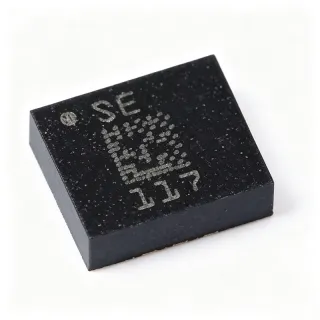
STM32MP151CAC3 - Cortex-A7 650MHz MPU TFBGA361 | STMicroelectronics
MPN: STM32MP151CAC3 ✓ Active| Qty | Unit Price | Extended |
|---|---|---|
| 1 | $14.88 | $14.88 |
| 10 | $13.6 | $136.00 |
| 100 | $12.1 | $1,210.00 |
| 500 | $11.72 | $5,860.00 |
| 1,000 | $11 | $11,000.00 |
STM32MP151CAC3 Overview
A microprocessor unit (MPU) sits above a microcontroller (MCU) in the embedded-system hierarchy: while an MCU runs bare-metal or RTOS code from internal flash, an MPU boots a full operating system such as Linux from external memory and offloads hard real-time tasks to a companion core. The STM32MP1 line bridges these worlds by pairing an application-class Cortex-A7 with a deterministic Cortex-M4 on one die, letting one chip replace an MCU-plus-processor two-chip solution.
Key features of the STM32MP151CAC3 include the dual-core asymmetric architecture (single 32-bit Cortex-A7 application core plus Cortex-M4 coprocessor), an integrated TFT display controller for graphical interfaces, and hardware secure boot with cryptographic acceleration for protected firmware images.
Technically, the device belongs to the STM32 family STM32MP1 series and is fabricrated on STs proven process technology shared with the STM32 MCU portfolio, which means the Cortex-M4 side reuses familiar STM32 peripherals and register maps, shortening the learning curve for teams migrating from STM32F or STM32H7 MCUs. Linux support is provided through the STM32 MPU OpenSTLinux distribution and the ecosystem of ST tools.
Typical applications include industrial HMI and TFT display panels, secure IoT gateways and edge nodes, and motor-control or power-conversion systems where the Cortex-M4 handles real-time control loops while the Cortex-A7 runs the user interface and connectivity stack.
When designing with this MPU, plan for the multi-rail power sequencing required by the STM32MP1 family and provide high-speed PCB layout for the DDR memory interface and the 361-ball BGA escape routing.
This page synthesizes distributor pricing, drop-in same-family alternatives, and practical design notes not found in the manufacturer datasheet.
Drop-in alternatives for STM32MP151CAC3 — same package, pin-to-pin compatible. Different-package parts requiring PCB rework are excluded.
Variants in this series
Same-series models that are drop-in compatible with STM32MP151CAC3 (same form factor and footprint) — differing in Display Controller, Number of Cores, Series.
Quick Comparison Tool — Select alternative parts for side-by-side comparison:
STM32MP151AAC3
✅ Drop-In ⚠️ 参数待验证✓ In Stock
$6.3 / Unit
View Datasheet →STM32MP151DAC3
✅ Drop-In ⚠️ 参数待验证📋 Reference alternative (not in catalog)
STM32MP151DAA3
✅ Drop-In ⚠️ 参数待验证📋 Reference alternative (not in catalog)
STM32MP151FAC3
✅ Drop-In ⚠️ 参数待验证📋 Reference alternative (not in catalog)
STM32MP151CAA3
✅ Drop-In ⚠️ 参数待验证📋 Reference alternative (not in catalog)
STM32MP151CAC3 Maximum Ratings & Electrical Characteristics
| Product Type | Microprocessor (MPU) |
| Series | STM32MP1 |
| Core | Arm Cortex-A7 (application) + Arm Cortex-M4 (real-time coprocessor) |
| Core Size | 32-bit |
| Cortex-A7 Frequency | 650 MHz |
| Cortex-M4 Frequency | 209 MHz |
| Number of Cores | 1 core (A7) + 1 coprocessor (M4) |
| Display Controller | TFT display controller |
| Security Features | Secure boot and cryptography |
| Operating Temperature | -40C to +125C |
| Package | 361-TFBGA (12 x 12 mm) |
| Mounting Type | Surface Mount |
STM32MP151CAC3 361-tfbga (12 x 12 mm) Pin Configuration Guide
Pin configuration for STM32MP151CAC3 (361-tfbga (12 x 12 mm) package). This digital IC includes GPIO, communication interfaces (UART, SPI, I2C), and power pins. Refer to the manufacturer datasheet for alternate pin functions and configuration options. Essential for embedded system design and PCB layout.

No detailed pinout data available for STM32MP151CAC3.
Refer to the datasheet for full pin configuration.
Typical Applications
STM32MP151CAC3 is suitable for 6 applications: Industrial HMI and TFT Display Panels, IoT Gateways and Edge Nodes, Motor Control and Power Conversion, Secure Embedded Systems, Building Automation and Smart Panels, Test and Measurement Instruments.
Industrial HMI and TFT Display Panels
The STM32MP151CAC3 fits industrial human-machine interface designs because its integrated TFT display controller drives color LCD panels directly from the frame buffer, while the 650 MHz Cortex-A7 runs an OpenSTLinux stack with GUI frameworks such as Qt. Unlike MCU-based HMI solutions that struggle with layered graphics, this MPU renders modern interfaces responsively, and the 209 MHz Cortex-M4 coprocessor independently scans keys, encoders, and safety inputs with deterministic latency even under Linux load. The -40C to +125C rating covers unconditioned factory cabinets and outdoor terminals. Typical topology places eMMC or NAND flash for the OS image, DDR memory for the frame buffer, and the TFT controller output routed to an LVDS or parallel panel bridge. The secure boot chain protects proprietary UI firmware on networked equipment.
Recommended
IoT Gateways and Edge Nodes
For industrial IoT gateways, the STM32MP151CAC3 provides Linux-class connectivity (Ethernet, Wi-Fi/BLE via expansion) on the Cortex-A7 while the Cortex-M4 handles sensor aggregation and protocol translation such as Modbus to MQTT with hard real-time response. Secure boot and hardware cryptography protect device identity, TLS keys, and over-the-air update images - increasingly mandatory for networked infrastructure. The single-chip asymmetric architecture replaces a separate Linux SoC plus MCU, cutting BOM count, board area, and the software integration effort of inter-processor links. Designers typically pair the MPU with external eMMC, DDR memory, and a power-management IC from the STMP1 reference designs, achieving field-deployable edge nodes with years of service life under the -40C to +125C industrial temperature range.
Recommended
Motor Control and Power Conversion
In servo drives, inverters, and digital power supplies, the STM32MP151CAC3 assigns field-oriented control loops, PWM generation, and protection fast-loops to the 209 MHz Cortex-M4 with its STM32-familiar advanced timers and ADCs, while the 650 MHz Cortex-A7 runs the drive user interface, fieldbus stack (EtherCAT, CANopen via Linux), and diagnostics. This partitioning guarantees microsecond-level loop determinism regardless of Linux activity - impossible on a single Linux-only processor. The -40C to +125C temperature rating suits drive enclosures near power stages. ST reference designs demonstrate the OpenAMP communication between the real-time core and Linux, and the secure boot feature protects proprietary control algorithms, a key IP concern for drive manufacturers competing in OEM markets.
Recommended
Secure Embedded Systems
Applications demanding firmware protection - payment terminals, smart meters, industrial controllers with valuable algorithms - benefit from the STM32MP151CAC3 hardware secure boot and cryptographic acceleration. The boot ROM verifies each immutable bootloader stage before handing control to the Linux kernel, and on-chip crypto engines accelerate AES and hashing for storage encryption and TLS without burdening the 650 MHz Cortex-A7. For designs requiring the strongest security envelope, the same-package STM32MP151FAC3 variant provides the enhanced security line while remaining pin-compatible, allowing a security upgrade without PCB redesign. Combined with the industrial -40C to +125C range and the long-lifecycle commitments of the STM32MP1 series, the CAC3 serves as the processing heart of tamper-resistant embedded platforms with multi-year production horizons.
Recommended
Building Automation and Smart Panels
Building controllers, room automation panels, and HVAC supervisory units use the STM32MP151CAC3 to run protocol stacks (BACnet, KNX, Modbus TCP) under Linux on the Cortex-A7 while the Cortex-M4 manages I/O scanning, PWM dimming outputs, and sensor acquisition in real time. The integrated TFT controller enables wall-mounted touch panels without an external display bridge chip, reducing BOM cost per node. Wide -40C to +125C operation tolerates rooftop and unconditioned electrical-room deployments. Because the STM32MP1 family shares STM32 MCU peripheral designs, teams with existing STM32 real-time code port it to the M4 coprocessor with minimal effort, and the secure boot chain meets the growing cybersecurity requirements of commercial building-management procurement specifications.
Recommended
Test and Measurement Instruments
Benchtop instruments, data loggers, and portable analyzers leverage the STM32MP151CAC3 asymmetric architecture: the Cortex-A7 at 650 MHz drives the touchscreen UI, file system, and network connectivity under Linux, while the Cortex-M4 at 209 MHz performs time-critical acquisition triggering, ADC sequencing, and calibration routines with deterministic jitter. The TFT display controller renders measurement plots and menus on embedded panels directly. Designs benefit from single-chip integration that replaces a separate applications processor plus MCU, shrinking board area in handheld form factors, while -40C to +125C rating supports field and industrial test environments. STMP1 reference designs document DDR3L routing and power sequencing, and OpenAMP messaging links acquisition data from the real-time core to the Linux application layer efficiently.
Recommended
Recommended Products Summary
Engineering reference data for STM32MP151CAC3 — comparison, design guidance, and compliance information.
Selection Guide
Comparison with Alternatives
| Parameter | This Product | STM32MP151AAC3 | STM32MP151DAC3 | STM32MP151DAA3 | STM32MP151FAC3 | STM32MP151CAA3 |
|---|---|---|---|---|---|---|
| Package | 361-TFBGA (12 x 12 mm) | 361-TFBGA (12 x 12 mm) - same | 361-TFBGA (12 x 12 mm) - same | 361-TFBGA (12 x 12 mm) - same | 361-TFBGA (12 x 12 mm) - same | 361-TFBGA (12 x 12 mm) - same |
| Brand | STMicroelectronics | STMicroelectronics | STMicroelectronics | STMicroelectronics | STMicroelectronics | STMicroelectronics |
| Cortex-A7 Frequency | 650 MHz | 650 MHz | 800 MHz (D speed grade) | 800 MHz (D speed grade) | 650 MHz | 650 MHz |
| Cortex-M4 Coprocessor | 209 MHz | 209 MHz | 209 MHz | 209 MHz | 209 MHz | 209 MHz |
| Operating Temperature | -40C to +125C | -40C to +125C | -40C to +125C | -40C to +125C | -40C to +125C | -40C to +125C |
| Security Line | Baseline (secure boot + crypto) | Baseline | Baseline | Baseline | Enhanced (F security line) | Reduced (A feature tier) |
| Display Controller | TFT display controller | TFT display controller | TFT display controller | TFT display controller | TFT display controller | TFT display controller |
Key Differentiators
- Balanced mid-tier feature set with full 650 MHz performance (vs STM32MP151CAA3)
- Cost-optimized for display-driven designs (vs STM32MP157CAC3)
- Upgrade path to enhanced security without PCB change (vs STM32MP151FAC3)
Design Notes
The STM32MP1 family requires multiple supply rails (VDDCORE, VDD, VDDA, VDDQ for DDR, and others) with controlled power-up sequencing. ST strongly recommends using the companion PMIC (STPMIC1) featured in all official STM32MP1 reference designs, which handles sequencing, DDR termination, and system power-off in one IC. Discrete-rail designs are possible but must guarantee correct core-before/after-I/O ordering per the datasheet power-up requirements; violations can cause latch-up or boot failure. Estimated: budget roughly 1-2 W total system power at 650 MHz A7 active load plus DDR, per ST evaluation-board measurements - validate against your own workload.
The 361-ball TFBGA at 12 x 12 mm with 0.8 mm ball pitch requires careful BGA escape routing: plan at least 4 PCB layers with dedicated inner layers for DDR3/DDR3L address/command length-matched groups and power planes. Follow the ST application note on DDR memory board development for trace length matching (group skew targets) and impedance control (single-ended ~50 ohm, differential pairs for DDR clock). Place the PMIC and its inductors close to the MPU to minimize high-di/dt loop area. A solid ground plane under the BGA with adequate via stitching on the thermal ball array is standard practice.
Unlike STM32 MCUs, the STM32MP151CAC3 has no internal flash for the Cortex-A7 - the boot device (SD card, eMMC, NAND, NOR, or eMMC boot pins configuration) must be correctly strapped via BOOT pins, and the FSBL/U-Boot/OpenSTLinux image chain must be signed per the secure boot configuration or the device will not boot. Teams new to MPUs often underestimate the BSP effort; start from the ST starter package rather than hand-building. The Cortex-M4 code loads at Linux runtime via remoteproc, so do not expect MCU-style standalone flashing of the coprocessor.
Compliance Information
Compliance data was not present in the provided verified web data. STMicroelectronics standard product is typically RoHS-compliant, but this must be confirmed on the official ST product page compliance dossier before use in this record.