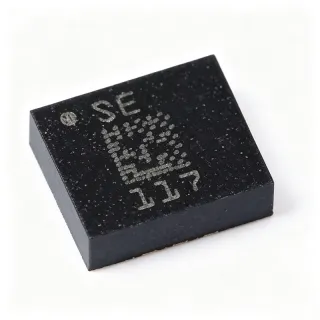
STM32MP157AAC3 - Dual Cortex-A7 650MHz MPU | STMicroelectronics
MPN: STM32MP157AAC3 ✓ Active| Qty | Unit Price | Extended |
|---|---|---|
| 1 | $8.86 | $8.86 |
| 10 | $7.63 | $76.30 |
| 30 | $6.87 | $206.10 |
| 100 | $6.24 | $624.00 |
| 1,000 | $5 | $5,000.00 |
STM32MP157AAC3 Overview
A microprocessor unit (MPU) sits above a microcontroller (MCU) in the embedded hierarchy: it executes full operating systems such as Linux while delegating hard real-time tasks to a companion core. The STM32MP1 series bridges these worlds by combining Linux-class Cortex-A7 application cores with a Cortex-M4 MCU core sharing the same peripherals, allowing developers to reuse STM32 ecosystem tooling.
Key features of the STM32MP157AAC3 include 37 communication interfaces, 29 timers, advanced analog peripherals, Arm NEON SIMD acceleration, and Arm TrustZone security. Per ST datasheet highlights, the device supports a 1-Gbps Ethernet (RGMII) interface compliant with IEEE 802.3ab, enabling industrial networking. The 32-Kbyte data cache per core with a 256-Kbyte unified level-2 cache sustains Linux workloads efficiently.
Architecturally, the part belongs to the STM32MP1 family (STM32MP157 line, A performance grade, C variant with 3D GPU). Supply voltage ranges from 1.71 V to 3.6 V on its I/O domains, and the operating temperature spans -40C to +125C per distributor parametric data, supporting industrial deployments. Boot options cover eMMC, SD card, NAND/NOR flash, and serial interfaces for flexible storage strategies.
Typical applications include industrial HMI panels using the TFT/DSI display pipeline, building automation gateways leveraging the gigabit-capable Ethernet port, and edge nodes where the Cortex-M4 handles deterministic I/O while Linux manages connectivity and user interfaces on the Cortex-A7 pair.
A key design consideration is power-supply sequencing: the multi-rail PMIC (such as the STPMIC1) is strongly recommended to enforce the required core-to-IO power-up order, and the 361-ball TFBGA requires controlled-impedance 8-layer PCB fabrication with BGA escape routing.
This page synthesizes distributor pricing, drop-in same-family alternatives, and practical design notes not consolidated in the manufacturer datasheet.
Drop-in alternatives for STM32MP157AAC3 — same package, pin-to-pin compatible. Different-package parts requiring PCB rework are excluded.
Variants in this series
Same-series models that are drop-in compatible with STM32MP157AAC3 (same form factor and footprint) — differing in Core Processor, Series, Architecture, Communication Interfaces, Core Architecture.
Quick Comparison Tool — Select alternative parts for side-by-side comparison:
STM32MP157AAA3
✅ Drop-In📋 Reference alternative (not in catalog)
STM32MP157CAA3
✅ Drop-In📋 Reference alternative (not in catalog)
STM32MP157FAC1
✅ Drop-In✓ In Stock
$28.9545 / Unit
View Datasheet →STM32MP153CAA3T
✅ Drop-In📋 Reference alternative (not in catalog)
STM32MP151AAC3
✅ Drop-In ⚠️ 参数待验证✓ In Stock
$6.3 / Unit
View Datasheet →STM32MP157AAC3 Maximum Ratings & Electrical Characteristics
| Core Processor | Dual Arm Cortex-A7 + Arm Cortex-M4 coprocessor |
| Cortex-A7 Max Frequency | 650 MHz |
| Cortex-M4 Frequency | 209 MHz |
| Architecture | 32-bit, ARM Cortex |
| Series | STM32MP1 |
| GPU | 3D GPU |
| Display Support | TFT/DSI |
| L2 Cache | 256 KB unified |
| Data Cache | 32 KB per Cortex-A7 core |
| Communication Interfaces | 37 interfaces |
| Timers | 29 timers |
| Ethernet | 1-Gbps Ethernet (RGMII), IEEE 802.3ab compliant |
| Supply Voltage | 1.71 V to 3.6 V |
| Operating Temperature | -40C to +125C |
| Package | 361-TFBGA (12 x 12 mm) |
| Mounting Type | Surface Mount |
| Packaging | Tray |
| Product Status | Active |
| Security | Arm TrustZone, Arm NEON |
STM32MP157AAC3 361-tfbga (12 x 12 mm) Pin Configuration Guide
Pin configuration for STM32MP157AAC3 (361-tfbga (12 x 12 mm) package). This digital IC includes GPIO, communication interfaces (UART, SPI, I2C), and power pins. Refer to the manufacturer datasheet for alternate pin functions and configuration options. Essential for embedded system design and PCB layout.

No detailed pinout data available for STM32MP157AAC3.
Refer to the datasheet for full pin configuration.
Typical Applications
STM32MP157AAC3 is suitable for 6 applications: Industrial HMI Touch Panels, Industrial IoT Gateways, Edge AI Vision Nodes, Building Automation Controllers, Medical Portable Instrumentation, Motor Control with Cloud Connectivity.
Industrial HMI Touch Panels
The STM32MP157AAC3 fits industrial HMI designs because its TFT/DSI display controller, 3D GPU, and 650 MHz dual Cortex-A7 can drive modern Linux GUI frameworks (Qt, LVGL via framebuffer) on touch panels, while the 209 MHz Cortex-M4 independently scans keys, manages safety interlocks, and toggles GPIOs with microsecond determinism. In a typical stack the MPU boots Linux from eMMC, renders to a DSI or parallel TFT panel, and reads capacitive touch over I2C, while the 1-Gbps Ethernet (RGMII, IEEE 802.3ab) connects to plant networks. The trade-off versus a pure MCU HMI is higher board complexity - external DDR memory and a PMIC are mandatory - but the payoff is rich UI, remote update over network, and data logging. The -40C to +125C operating range per distributor data covers industrial cabinets.
Recommended
Industrial IoT Gateways
For IoT gateways, the STM32MP157AAC3 provides the connectivity fabric an MCU cannot: a 1-Gbps Ethernet MAC with RGMII per IEEE 802.3ab, 37 communication interfaces spanning multiple UARTs, SPI, I2C, CAN-FD, and USB, all under a full Linux TCP/IP stack. The dual 650 MHz Cortex-A7 cores run protocol translation (Modbus to MQTT, OPC UA) while the Cortex-M4 coprocessor owns deterministic fieldbus timing on CAN, isolating real-time traffic from Linux jitter. In a gateway topology the part sits between field-side RS-485/CAN PHYs and cloud-side Ethernet or Wi-Fi modules, with eMMC for local buffering. The quantified benefit: one chip replaces separate Linux gateway SoC plus real-time MCU, cutting BOM count; the trade-off is mandatory external DDR3 and boot-flash design effort.
Recommended
Edge AI Vision Nodes
The STM32MP157AAC3 serves entry-level edge vision nodes where its 3D GPU offloads image composition and the Cortex-A7 pair at 650 MHz runs lightweight inference frameworks (TensorFlow Lite Micro, ONNX Runtime) on frames from a DVP or MIPI-connected camera, with the Cortex-M4 handling image sensor timing and motion triggers. The 256 KB unified L2 cache and per-core 32 KB data caches keep frame buffers streaming efficiently from external DDR3. Typically the node captures at QVGA-to-VGA rates, applies a small CNN for object presence, and alerts via the 1-Gbps Ethernet port. The honest limit: for heavy CNN models or multi-stream video, a dedicated NPU platform outperforms it; choose this MPU when the model is small, cost matters, and the same PCB must also run the HMI or control loop.
Recommended
Building Automation Controllers
Building automation controllers benefit from the STM32MP157AAC3 combination of Linux-class networking and MCU-grade I/O. The 37 communication interfaces provide enough UART, RS-485, CAN, I2C, and SPI ports to talk to BACnet/Modbus field devices simultaneously, while the 1-Gbps Ethernet (RGMII) uplinks to the building management server. The Cortex-M4 at 209 MHz executes the deterministic control loops (HVAC PID, lighting scheduling with hard deadlines) even if Linux restarts for updates, improving availability. With -40C to +125C operation per parametric data, controllers survive rooftop and mechanical-room environments. A typical implementation uses eMMC for the OS, external DDR for the application stack, and an RTC battery domain - the 29 timers support precision scheduling. Cost-wise it consolidates gateway and controller into one certified processor footprint.
Recommended
Medical Portable Instrumentation
Portable medical instruments such as vital-sign monitors and portable analyzers use the STM32MP157AAC3 to combine a touchscreen GUI (TFT/DSI plus 3D GPU) with real-time acquisition on the Cortex-M4 coprocessor. The M4 samples sensors over SPI/I2C with fixed-rate timers, applies filtering, and hands processed data to the A7 cores running Linux for display, logging to eMMC, and export over Ethernet or USB. The dual-core split guarantees acquisition continuity independent of OS activity, an architectural requirement in monitoring devices. The 1.71 V to 3.6 V I/O supply range and rich low-power modes support battery-operated designs when paired with an efficient PMIC; typical display sizes of 4 to 7 inches render smoothly. The trade-off versus an MCU-only design is board complexity, repaid by modern UI and connectivity compliance tooling.
Recommended
Motor Control with Cloud Connectivity
Advanced motor drives use the STM32MP157AAC3 in a split-architecture: the Cortex-M4 at 209 MHz runs field-oriented control with its advanced timers and ADCs at 10-20 kHz PWM rates with hard determinism, while the dual 650 MHz Cortex-A7 cores run Linux for commissioning UI, remote monitoring via the 1-Gbps Ethernet port, and OTA firmware management. Shared peripherals between cores let the M4 own the PWM/ADC pair while Linux reads telemetry through inter-processor communication - no external bridge chip is required. The 29 timers and advanced analog block cover multi-axis designs (two to three axes per MPU in smaller drives). The quantified advantage is a single-chip BOM versus MCU-plus-gateway; the design cost is DDR memory and PMIC integration, and the real-time code must be partitioned before Linux boots via the STM32Cube ecosystem.
Recommended
Recommended Products Summary
Engineering reference data for STM32MP157AAC3 — comparison, design guidance, and compliance information.
Selection Guide
Comparison with Alternatives
| Parameter | This Product | STM32MP157AAA3 | STM32MP157CAA3 | STM32MP157FAC1 | STM32MP153CAA3T |
|---|---|---|---|---|---|
| Package | 361-TFBGA (12 x 12 mm) | 361-TFBGA (12 x 12 mm) - same | 361-TFBGA (12 x 12 mm) - same | 361-TFBGA (12 x 12 mm) - same | 361-TFBGA (12 x 12 mm) - same |
| Brand | STMicroelectronics | STMicroelectronics | STMicroelectronics | STMicroelectronics | STMicroelectronics |
| Cortex-A7 Frequency | 650 MHz (dual core) | 650 MHz (dual core) | 650 MHz (dual core) | 800 MHz (dual core) | 650 MHz (dual core) |
| Cortex-M4 Coprocessor | 209 MHz | 209 MHz | 209 MHz | 209 MHz | 209 MHz |
| 3D GPU | Yes | No | Yes | Yes | No |
| Supply Voltage | 1.71 V to 3.6 V | 1.71 V to 3.6 V | 1.71 V to 3.6 V | 1.71 V to 3.6 V | 1.71 V to 3.6 V |
| Lifecycle Status | Active | Active | Active | Active | Active |
Key Differentiators
- Integrated 3D GPU for GUI acceleration (vs STM32MP157AAA3)
- Higher CPU performance option within same footprint (vs STM32MP157FAC1)
- Real-time + Linux dual-domain on one die (vs STM32MP153CAA3T)
Design Notes
The STM32MP157AAC3 requires multiple sequenced power rails (VDDCORE, VDD, VDD_DDR, VDDA, VDD_USB, VDD_SDMMC). ST recommends the STPMIC1 PMIC, purpose-built for the STM32MP1 family, which enforces the mandatory power-up ordering and provides the DDR termination regulator. Do not attempt discrete-rail sequencing without carefully verifying the boot-time ordering in the datasheet power-supply section - incorrect sequencing can prevent boot or damage I/O rings.
The 361-ball TFBGA at 12 x 12 mm uses fine ball pitch requiring controlled-impedance stack-up - typically 6 to 8 layers with dedicated DDR3 routing pairs (length-matched to within the datasheet skew budget), a solid ground plane under the BGA, and via-in-pad or dog-bone escape routing. Follow the ST application note for STM32MP1 hardware development for DDR3/DDR3L layout rules, decoupling placement, and power-plane partitioning. Plan the footprint before schematic capture to confirm fanout feasibility.
Boot media selection is fused: verify boot pin strapping or OTP programming matches your storage (eMMC, SD, NAND, NOR, or serial). A common pitfall is omitting the required external DDR memory initialization from the first-stage bootloader (TF-A/U-Boot SPL) - the MPU has no internal RAM sufficient for Linux, so a DDR misconfiguration manifests as complete boot failure. Validate with the STM32CubeMP1 ecosystem and ST evaluation boards before tape-out.
Compliance Information
Compliance status not explicitly stated in the provided verified web data; consult the ST product page compliance documentation. RoHS compliance is mentioned in third-party comparison pages but not confirmed verbatim in the retrieved snippets.