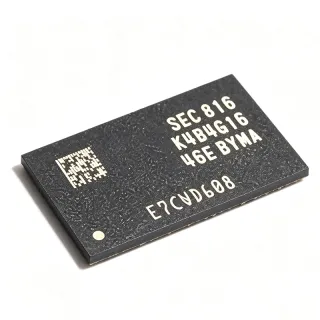
K9F6408U0B - 64Mbit 8M x8 NAND Flash 44-TSOP2 | Samsung
N.º da peça: K9F6408U0B ✗ Fim de vida| Qtd. | Preço unitário | Total |
|---|---|---|
| 1 | $4.95 | $4,95 |
| 10 | $4.45 | $44,50 |
| 100 | $3.95 | $395,00 |
| 500 | $3.55 | $1.775,00 |
| 1.000 | $3.2 | $3.200,00 |
K9F6408U0B Visão geral
NAND Flash is a non-volatile memory technology in which memory cells are connected in series, allowing very high density at low cost per bit. Within the memory hierarchy, NAND Flash sits below DRAM and NOR Flash: it cannot execute code in place like NOR, but offers far higher density and erase/program throughput, making it the dominant technology for mass-storage devices, boot media, and data logging in embedded systems.
Key features of the K9F6408U0B include a wide 2.7V to 3.6V single supply, 50ns serial-access cycle time for fast page reads, page program and block erase operations with typical 200us program and 2ms erase times, and hardware write protection via the WP pin. The ready/busy (R/B) output simplifies host control, and a command register interface accepts standard read, program, erase, and status commands.
The device uses a floating-gate cell technology with page-based programming, and endurance is specified at 100K program/erase cycles (upgraded from an earlier 1 million cycle figure in the revision history). The 44-pin TSOP2 package supports surface-mount assembly on standard PCB processes.
Typical applications include embedded system boot storage, set-top boxes, industrial data loggers, printer firmware storage, and legacy networking equipment where a small, low-cost NAND array is required.
Designers should implement ECC (error correction code) in the host controller, since raw NAND requires software-based error management, and should respect the block-erase-before-program requirement of NAND architecture.
This page adds distributor sourcing context, drop-in variant comparison, and practical design notes not found in the manufacturer datasheet.
Alternativas drop-in para K9F6408U0B — mesmo encapsulamento, compatível pino a pino. Peças de encapsulamento diferente que exigem retrabalho na PCB são excluídas.
Variantes desta série
Modelos da mesma série compatíveis como drop-in com K9F6408U0B (mesmo formato e footprint) — diferindo em Memory Type, Interface, Operating Voltage (VCC), Organization, Package.
Ferramenta de comparação rápida — selecione peças alternativas para comparação lado a lado:
K9F6408U0B-TCB0
✅ Drop-In📋 Alternativa de referência (fora do catálogo)
K9F6408U0B-TIB0
✅ Drop-In📋 Alternativa de referência (fora do catálogo)
K9F6408Q0C
✅ Drop-In✓ Em estoque
$1.31 / unidade
Ver ficha técnica →K9F6408U0B Classificações máximas e características elétricas
| Memory Organization | 8M x 8 bit (64Mbit) |
| Tipo de memória | NAND Flash |
| Operating Voltage (VCC) | 2.7 V to 3.6 V |
| Access Time / Cycle Time | 50 ns |
| Encapsulamento | 44-TSOP2 |
| Page Size | 528 bytes (512 data + 16 spare) |
| Program/Erase Endurance | 100K program/erase cycles |
| Interface | 8-bit multiplexed command/address/data I/O |
| Write Protect | Yes (WP pin) |
| Ready/Busy Output | Yes (R/B open-drain) |
| Operating Temperature (TCB0 grade) | 0C to 70C |
| Operating Temperature (TIB0 grade) | -40C to 85C |
| Tipo de montagem | Surface Mount |
| Production Status (per datasheet) | Mass Production (legacy; now obsolete) |
Guia de Configuração de Pinos do K9F6408U0B 44-tsop2
Configuração de pinos para K9F6408U0B (pacote 44-tsop2). Este CI digital inclui GPIO, interfaces de comunicação (UART, SPI, I2C) e pinos de alimentação. Consulte o datasheet do fabricante para funções alternativas dos pinos e opções de configuração. Essencial para projeto de sistemas embarcados e layout de PCB.

Nenhum dado detalhado de pinagem disponível para K9F6408U0B.
Consulte a ficha técnica para a configuração completa dos pinos.
Aplicações típicas
K9F6408U0B é adequado para 6 aplicaçãos: Embedded Boot Code Storage, Industrial Data Loggers, Set-Top Boxes and Consumer Electronics, Printer Firmware Storage, Legacy Networking Equipment, Automotive and Rugged Telematics (Legacy Retrofits).
Embedded Boot Code Storage
The K9F6408U0B stores bootloader and firmware images in embedded systems thanks to its 8MB capacity and 2.7V to 3.6V supply that matches 3.3V microcontroller and SoC rails directly. The 8-bit multiplexed command/address/data interface connects to the host memory controller with only CLE, ALE, CE, RE, and WE control lines, while the open-drain R/B output signals program and erase completion. Because it is raw NAND, the host must implement Hamming ECC in the 16-byte spare area and bad-block management, giving roughly 100K program/erase cycles of media life when wear is spread across all 1024 blocks.
Recomendado
Industrial Data Loggers
Industrial data-logging equipment uses the K9F6408U0B to retain measurement history across power cycles, valuing its non-volatile NAND storage and -40C to 85C capability in the K9F6408U0B-TIB0 industrial temperature grade. The 50ns access time supports fast sequential reads when records are uploaded, while page programming writes sensor samples efficiently in 512-byte pages. Designers should implement a power-fail routine that aborts in-flight page programs on brown-out, since interrupting a program cycle within the 2.7V to 3.6V operating window can corrupt the active page; block-level wear leveling across the device extends service life toward the specified 100K cycles.
Recomendado
Set-Top Boxes and Consumer Electronics
Set-top boxes, DVD players, and consumer appliances of the K9F6408U0B era used this device for channel maps, settings, and firmware storage, exploiting its low cost per bit and compact 44-TSOP2 footprint on cost-sensitive PCBs. The 8MB organization comfortably stores configuration plus fallback firmware, and the WP pin allows hardware write protection once provisioning is complete, preventing accidental corruption by buggy software. Replacement sourcing today is limited to residual stock; for service and repair of this equipment class, K9F6408U0B-TCB0 and K9F6408U0B-TIB0 remain the correct pin-compatible spares.
Recomendado
Printer Firmware Storage
Laser and inkjet printers used small NAND devices like the K9F6408U0B to store firmware, fonts, and page-description resources, since 8MB suffices for these assets and the device's 50ns serial access keeps boot time acceptable. The standard Samsung small-block command set allowed one host driver to manage firmware updates by reprogramming designated blocks after erase, with status-command polling confirming each successful page write. Its 2.7V to 3.6V supply integrated cleanly with 3.3V printer mainboards, and the surface-mount TSOP2 package supported automated assembly in high-volume manufacturing.
Recomendado
Legacy Networking Equipment
Routers, switches, and access points from the late 1990s and 2000s stored their OS images and configurations in K9F6408U0B-class NAND, combining 8MB of density with the economy of small-block SLC NAND. The multiplexed 8-bit I/O bus kept the host interface to about a dozen signals, simplifying layout around the network processor, while the open-drain R/B line allowed simple polling or interrupt-driven completion detection. Maintenance teams repairing this installed base should hold K9F6408U0B-TCB0/TIB0 spares, since the part is obsolete and no cross-brand 44-TSOP2 drop-in exists.
Recomendado
Automotive and Rugged Telematics (Legacy Retrofits)
Retrofit and aftermarket telematics modules requiring extended temperature range can use the K9F6408U0B-TIB0 grade, which is rated from -40C to 85C in the same 44-TSOP2 footprint as the commercial part. Its 100K program/erase endurance supports moderate write traffic when the host applies wear leveling and reserves spare blocks, and the WP pin provides a hardware interlock for calibration data written once at the factory. Note this device is not AEC-Q100 qualified; for new automotive designs, select a qualified modern NAND rather than this legacy generation.
Recomendado
Resumo dos produtos recomendados
Dados de referência de engenharia para K9F6408U0B — comparação, orientação de projeto e informações de conformidade.
Guia de seleção
Comparação com alternativas
| Parâmetro | Este produto | K9F6408U0B-TCB0 | K9F6408U0B-TIB0 | K9F6408Q0C |
|---|---|---|---|---|
| Brand | Samsung Electronics | Samsung Electronics | Samsung Electronics | Samsung Electronics |
| Density / Organization | 64Mbit (8M x 8) | 64Mbit (8M x 8) | 64Mbit (8M x 8) | 64Mbit (8M x 8) |
Principais diferenciais
- Extended industrial temperature option (vs K9F6408U0B-TCB0)
- Guaranteed same-family compatibility (vs K9F6408Q0C)
- Compact legacy footprint (vs K9F1208U0B)
Notas de projeto
The K9F6408U0B is raw NAND: the host controller must implement ECC (a Hamming code with single-bit correction per 512-byte sector stored in the 16-byte spare area) and bad-block management. The datasheet revision history notes endurance changed from 1 million to 100K program/erase cycles - do not design write budgets around the older figure. Also, never interrupt a page program or block erase; ensure VCC stays within 2.7V to 3.6V and use the WP pin during power transitions to prevent spurious writes.
Decouple VCC with 0.1uF ceramic capacitors placed within a few millimeters of each VCC pin on the 44-TSOP2 package, since program and erase operations draw transient currents on the 2.7V to 3.6V rail. Keep the CE, CLE, ALE, RE, and WE control lines short and routed away from the I/O bus to prevent glitch-induced command corruption. The open-drain R/B output requires a pull-up resistor (typical 10k ohm) to VCC.
Estimated: NAND program/erase currents are transient (tens of mA peaks on the 2.7V to 3.6V rail per legacy small-block NAND design practice). Size the 3.3V supply with headroom above the average read current and ensure supply rise-time and power-up sequencing meet the datasheet power-up waveform requirements so the internal command register initializes cleanly before the first access.
Informações de conformidade
This part predates modern RoHS/REACH documentation requirements; no compliance data was found in the provided sources. Not AEC-Q100 qualified - not designed for automotive use.