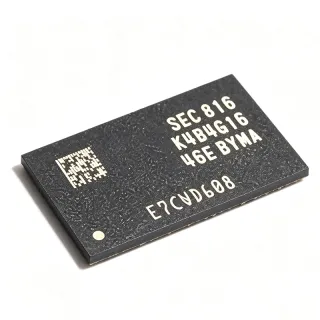
K9IUGY8J7B-CCK0 - 1Tb 3D V-NAND TLC Flash | Samsung
Артикул: K9IUGY8J7B-CCK0 ✓ Активен| Кол-во | Цена за ед. | Итого |
|---|---|---|
| 1 | $1 | $1,00 |
| 10 | $1 | $10,00 |
| 100 | $1 | $100,00 |
| 500 | $1 | $500,00 |
| 1.000 | $1 | $1.000,00 |
K9IUGY8J7B-CCK0 Обзор
Background: NAND flash is a non-volatile memory technology that retains data without power. Within the memory hierarchy, NAND sits below DRAM as mass-storage media; 3D V-NAND stacks memory cells vertically instead of shrinking cells laterally, improving density and endurance. TLC stores 3 bits per cell, tripling density per wafer versus SLC and roughly 1.5x versus MLC, at the cost of tighter program/erase margins that require ECC and controller firmware support.
Key characteristics: the 1Tb density in a single monolithic die allows compact PCB area and reduced component count in high-capacity designs. The 3-bits-per-cell TLC architecture paired with 128-layer V-NAND process offers competitive bits-per-programming throughput, and the industrial 'CC' grade suffix denotes Samsung's commercial operating temperature range qualification. Devices of this generation use an ONFI-style asynchronous/synchronous toggle interface - exact timing parameters should be taken from the official Samsung datasheet.
Technical depth: V-NAND generation 6 (4448-128L per Samsung internal data for the family) uses charge-trap flash cells with cell strings connected through vertical channels. Page organization, block sizes, and program/erase cycle ratings are die-internal details specified in the vendor datasheet and must not be assumed from prior generations.
Typical applications: client and enterprise SSDs, eMMC/UFS-based embedded storage, set-top boxes, networking appliances, and automotive infotainment mass storage (subject to temperature grade verification).
Design consideration: TLC NAND requires a controller with strong LDPC ECC, wear leveling, and bad-block management; raw NAND of this class is unsuitable for designs lacking such firmware support.
This page synthesizes family cross-references, drop-in same-family alternatives, and practical integration notes not found in the raw datasheet.
Аналоги без доработки для K9IUGY8J7B-CCK0 — тот же корпус, pin-to-pin совместимость. Компоненты в других корпусах, требующие переработки PCB, исключены.
Варианты в этой серии
Модели той же серии, совместимые без доработки с K9IUGY8J7B-CCK0 (тот же форм-фактор и посадочное место) — отличается по Memory Type, Cell Type, Product Family, RoHS Status, Technology.
Инструмент быстрого сравнения — выберите альтернативные компоненты для сравнения бок о бок:
K9IUGY8J7B-BCK0
✅ Прямая замена✓ В наличии
Уточнить цену
Открыть даташит →K9HUGY8J5B-CCK0
✅ Прямая замена ⚠️ Характеристики не проверены✓ В наличии
$9.6 / шт.
Открыть даташит →K9HUGY8J5B-BCK0
✅ Прямая замена ⚠️ Характеристики не проверены✓ В наличии
Уточнить цену
Открыть даташит →K9FGGY8J5A-CCK0
✅ Прямая замена ⚠️ Характеристики не проверены✓ В наличии
$9.95 / шт.
Открыть даташит →K9FGGY8J5A-BCK0
✅ Прямая замена ⚠️ Характеристики не проверены✓ В наличии
Уточнить цену
Открыть даташит →K9EUGY8S0M-CCK0
✅ Прямая замена ⚠️ Характеристики не проверены✓ В наличии
Уточнить цену
Открыть даташит →K9EUGY8S0M-BCK0
✅ Прямая замена ⚠️ Характеристики не проверены✓ В наличии
Уточнить цену
Открыть даташит →K9IUGY8J7B-CCK0 Характеристики
| Memory Density | 1 Tb (Tera bit) |
| Тип памяти | NAND Flash, 3D V-NAND TLC |
| Cell Type | TLC (3 bits per cell) |
| V-NAND Generation | V6 (6th generation) |
| Process Node / Layer Count | 4448-128L (128-layer) |
| Manufacturer | Samsung Electronics |
| Тип монтажа | Surface Mount (BGA) |
Руководство по цоколевке K9IUGY8J7B-CCK0 в корпусе standard
Цоколевка для K9IUGY8J7B-CCK0 (корпус standard). Нумерация выводов, функции и схемы подключения определены в техническом описании производителя. Обратитесь к нему для точного посадочного места и рекомендаций по пайке.

Нет подробных данных о распиновке для K9IUGY8J7B-CCK0.
Обратитесь к даташиту для полной конфигурации выводов.
Типичное применение
K9IUGY8J7B-CCK0 подходит для 6 применениеs: Client SSD Storage, Embedded eMMC/UFS Storage Subsystems, Networking and Communication Appliances, Set-Top Box and Smart TV Storage, Industrial Data Loggers and Gateways, Automotive Infotainment Mass Storage (Grade Verification Required).
Client SSD Storage
The K9IUGY8J7B-CCK0's 1 Terabit TLC capacity per die makes it a strong fit for client SSDs, where 4-8 packages deliver 512 GB to 1 TB of usable storage in a compact M.2 footprint. Samsung's own PM9B1 SSD platform (verified via TechPowerUp) uses 128-layer TLC NAND with a Marvell 88SS1322 controller over PCIe 4.0 x4, illustrating the exact integration pattern. The TLC cell architecture balances density and endurance for typical consumer write workloads (hundreds of TBW at drive level). Design consideration: the host controller must implement LDPC ECC tuned for V6 TLC margins, plus wear leveling and read-retry firmware; without these, raw TLC NAND cannot meet retention or endurance targets.
Рекомендуется
Embedded eMMC/UFS Storage Subsystems
Embedded storage designs such as smart appliances, set-top boxes, and industrial HMI systems aggregate several K9IUGY8J7B-CCK0 dies behind a storage controller to emulate eMMC or UFS behavior with high capacity. The 1Tb density reduces component count versus 256Gb-class dies, cutting BGA land area and reflow cost on the PCB. Because the 'CC' grade targets commercial temperature ranges, these designs should verify ambient conditions inside the enclosure; in-enclosure temperatures can exceed external ambient by 15-25 C. Samsung family data shows the V6 128-layer process (4448-128L) offering competitive bits-per-wafer economics, which matters in cost-sensitive consumer and IoT hardware. Firmware teams must qualify the specific die ID with their storage controller vendor before mass production.
Рекомендуется
Networking and Communication Appliances
Routers, switches, and SD-WAN appliances need local non-volatile storage for firmware images, logs, and configuration - typically 8-64 GB per unit. The K9IUGY8J7B-CCK0's 128 GB raw capacity (1 Tb TLC) lets one package cover the full storage budget, simplifying qualification versus multi-die solutions. The toggle/ONFI-class interface integrates with mainstream embedded controllers used in networking silicon ecosystems. Network equipment often runs 24/7 with elevated ambient temperatures inside chassis; designers must derate based on the verified commercial temperature grade and confirm thermal specifications in the Samsung datasheet, which were not captured in this page's verified web data. ECC overhead for TLC also reserves controller CPU headroom that should be budgeted in firmware sizing.
Рекомендуется
Set-Top Box and Smart TV Storage
Broadcast and streaming devices require 8-32 GB of storage for applications, DVR buffering, and caching; a single K9IUGY8J7B-CCK0 die at 1Tb (128 GB) overserves with margin for multi-boot and logging partitions. Samsung 128-layer TLC V-NAND (V6 generation per family data) provides the per-gigabyte cost point that consumer AV hardware demands. Integration typically occurs via an eMMC-style controller or SoC-integrated NAND interface, with LDPC ECC and bad-block management handled in the SoC firmware stack. Because consumer AV devices have limited airflow, the BGA package's thermal performance at sustained write rates (e.g., DVR recording) should be validated in system-level thermal testing before production release.
Рекомендуется
Industrial Data Loggers and Gateways
Industrial gateways and data loggers write sensor and telemetry streams continuously, favoring TLC NAND with robust wear-leveling firmware. The K9IUGY8J7B-CCK0's 1Tb capacity supports long retention windows of high-frequency log data, and Samsung's V-NAND cell structure offers stable read margins at typical industrial enclosure temperatures - though the commercial 'CC' grade should be verified against the actual ambient range in the Samsung datasheet. Gateways commonly implement power-fail protection circuits (bulk capacitance plus firmware-safe shutdown) because TLC program operations must complete without interruption to avoid page corruption. Pairing the NAND with a supervisor IC and brown-out detection is a recommended design pattern for these unattended, remote-deployed systems.
Рекомендуется
Automotive Infotainment Mass Storage (Grade Verification Required)
Navigation maps, media libraries, and OTA update images in automotive infotainment head units require tens of gigabytes of local storage. The K9IUGY8J7B-CCK0's 1Tb TLC density and compact BGA footprint are architecturally suitable, but the commercial 'CC' temperature grade is likely insufficient for under-dash automotive environments, which typically demand AEC-Q100-style temperature grades. Automotive designs should instead evaluate Samsung's automotive-qualified NAND variants and reserve this part for cost-optimized or non-safety consumer segments of the platform. Verified web data did not include AEC-Q100 status for this MPN, so automotive qualification must be confirmed directly with Samsung before any in-vehicle deployment decision.
Рекомендуется
Сводка рекомендуемых товаров
Справочные инженерные данные для K9IUGY8J7B-CCK0 — сравнение, рекомендации по проектированию и информация о соответствии.
Руководство по выбору
Сравнение с аналогами
| Параметр | Этот товар | K9IUGY8J7B-BCK0 | K9HUGY8J5B-CCK0 | K9FGGY8J5A-CCK0 | K9EUGY8S0M-CCK0 |
|---|---|---|---|---|---|
| Brand | Samsung Electronics | Samsung Electronics | Samsung Electronics | Samsung Electronics | Samsung Electronics |
| Package | BGA (fine-pitch, Samsung V-NAND) | BGA - identical footprint | BGA - same family, verify land pattern | BGA - same family, verify land pattern | BGA - different generation, verify footprint |
| Cell Type | TLC (3 bits/cell) | TLC (3 bits/cell) | TLC | TLC | TLC |
| Grade Suffix Class | CK0 (standard commercial) | BK0 (alternate grade/option) | CK0 | CK0 | CK0 |
| Drop-in Status | Reference part | True drop-in (same silicon) | Family swap - controller requalification | Family swap - controller requalification | Family swap - full requalification |
Ключевые отличия
- Highest density in the compared family at 1 Tb (против K9HUGY8J5B-CCK0)
- Latest V6 generation V-NAND process (против K9EUGY8S0M-CCK0)
- True drop-in sibling exists (против K9IUGY8J7B-BCK0)
Заметки по проектированию
Raw TLC NAND such as the K9IUGY8J7B-CCK0 absolutely requires controller-side LDPC ECC, wear leveling, bad-block management, and read-retry firmware. Unlike SLC parts, TLC V-NAND has tight program/erase margins and read-disturb sensitivity; a bare bus read without ECC will produce uncorrectable errors within normal usage. Never assume firmware characterized for a different V-NAND generation will work - Samsung internal die organization changes between generations and the V6 (4448-128L) generation requires its own characterization pass.
Verify the exact VCC and VCCQ rails from the Samsung datasheet before power tree design - these values were not present in the verified web data. Modern V-NAND typically uses separate core and I/O supplies with defined power-up sequencing; violating sequence can latch up the die or corrupt FTL metadata. Decouple each supply with at least 100 nF ceramic per power ball plus bulk capacitance sized for program-current surges during parallel page programming, which can draw significant transient current on multi-die buses.
For BGA-packaged NAND, follow IPC-class land pattern rules from the Samsung package drawing and keep command/address/data traces length-matched within the datasheet skew budget for toggle-mode timing. Avoid routing NAND signals adjacent to switching regulator nodes; the PSRR of the I/O rail is finite and VCCQ noise manifests as read-margin degradation. Use a solid ground plane under the BGA and connect all VSS balls. Thermal relief: NAND program/erase cycles heat the die, and sustained writes on 1Tb TLC parts benefit from at least 2 oz copper ground pour to spread heat.
Информация о соответствии
Compliance data was not present in the verified web data for this MPN. Request an environmental compliance certificate from Samsung or an authorized distributor before regulated documentation use.