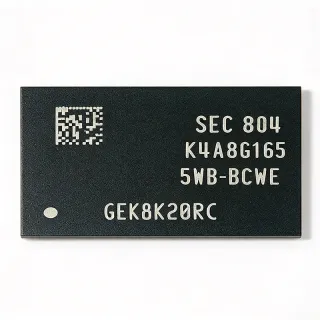
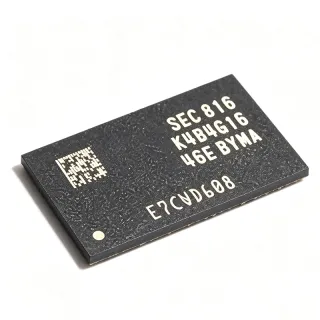
K4A8G165WC-BCTD - 8Gb DDR4 SDRAM 2666Mbps x16 | Samsung
Teilenummer: K4A8G165WC-BCTD ✓ Aktiv| Menge | Stückpreis | Gesamt |
|---|---|---|
| 1 | $51.42 | $51,42 |
| 10 | $48.85 | $488,50 |
| 100 | $45.2 | $4.520,00 |
| 500 | $42.1 | $21.050,00 |
| 1.000 | $39.5 | $39.500,00 |
K4A8G165WC-BCTD Übersicht
DDR4 SDRAM (Double Data Rate 4 Synchronous Dynamic Random Access Memory) is the fourth generation of the JEDEC DDR DRAM family, sitting within the memory IC hierarchy: DRAM -> synchronous DRAM -> DDR SDRAM -> DDR4 SDRAM. DDR4 doubles the bank count of DDR3, lowers operating voltage from 1.5 V to 1.2 V, and introduces bank groups with burst lengths of 8, improving bandwidth per watt for main memory and buffering applications.
Key features of this C-die component include CRC (cyclic redundancy check) on write data, ZQ calibration for output driver impedance accuracy, dynamic on-die termination (ODT), data mask (DM) support on the x16 organization, automatic precharge, and an asynchronous reset input. Samsung manufactures the die on its advanced 1Y nm-class process, which improves bit density, endurance, and power efficiency compared to older 2x nm generations.
Electrically, the device operates from a 1.2 V VDD with a tolerance band of 1.14 V to 1.26 V, and a clock rate of 1.333 GHz (DDR4-2666 class). The x16 organization halves the external device count needed for a 16-bit data bus versus x8 parts, simplifying layout for embedded boards, though it foregoes some of the ECC-friendly granularity of x8 components.
Typical applications include industrial controllers and IPC main memory, networking equipment line cards, set-top boxes, digital TVs, and embedded systems that pair the SDRAM with DDR4-capable SoCs, FPGAs, or memory controllers requiring mainstream DDR4-2666 throughput.
For design, keep the FBGA package's fly-by address/command routing on 4-layer or better PCBs, honor the 1.14 V minimum supply, and follow JEDEC DDR4 x16 ballout constraints for trace-length matching.
This page synthesizes distributor pricing, drop-in alternatives, and practical design notes not found in the manufacturer datasheet.
Drop-in-Alternativen für K4A8G165WC-BCTD – gleiches Gehäuse, Pin-kompatibel. Bauteile mit anderem Gehäuse, die eine PCB-Überarbeitung erfordern, sind ausgeschlossen.
Varianten dieser Serie
Modelle derselben Serie, die drop-in-kompatibel sind mit K4A8G165WC-BCTD (gleiche Bauform und Footprint) – abweichend in Data Rate, Package, Operating Temperature, Memory Type, Organization.
Schnellvergleichstool – Wählen Sie Alternativbauteile für den Direktvergleich:
K4A8G165WC-BCRC
✅ Drop-In✓ Auf Lager
$23 / Stück
Datenblatt ansehen →K4A8G165WC-BCPB
✅ Drop-In✓ Auf Lager
$1.31 / Stück
Datenblatt ansehen →K4A8G165WB-BCTD
✅ Drop-In✓ Auf Lager
$37 / Stück
Datenblatt ansehen →MT40A512M16LY-062E IT:E
✅ Drop-In📋 Referenzalternative (nicht im Katalog)
MT40A512M16LY-075E
✅ Drop-In📋 Referenzalternative (nicht im Katalog)
K4A8G165WC-BCTD Grenzwerte & elektrische Eigenschaften
| Speichertyp | DDR4 SDRAM |
| Density | 8 Gb |
| Speicherorganisation | 512M x16 |
| Datenrate | 2666 Mbps (DDR4-2666) |
| Clock Frequency | 1.333 GHz |
| Supply Voltage (VDD) | 1.2 V |
| Operating Voltage Range | 1.14 V to 1.26 V |
| Betriebstemperatur | 0C to +95C |
| Gehäuse | 96FBGA |
| Montageart | Surface Mount |
| Die Generation | C-die (1Y nm-class process) |
| CRC Function | Yes (write CRC) |
| ZQ Calibration | Yes |
| On-Die Termination | Dynamic ODT |
| Data Mask | Yes (x16 DM) |
| Auto Precharge | Yes |
| Asynchronous Reset | Yes |
| RoHS-Status | Compliant |
K4A8G165WC-BCTD 96fbga Pinbelegungsleitfaden
Pinbelegung für K4A8G165WC-BCTD (96fbga-Gehäuse). Dieser digitale IC umfasst GPIO, Kommunikationsschnittstellen (UART, SPI, I2C) und Versorgungspins. Alternative Pin-Funktionen und Konfigurationsoptionen entnehmen Sie dem Herstellerdatenblatt. Unverzichtbar für Embedded-System-Design und PCB-Layout.

Keine detaillierten Pinbelegungsdaten verfügbar für K4A8G165WC-BCTD.
Siehe die Datenblatt für die vollständige Pin-Konfiguration.
Typische Anwendungen
K4A8G165WC-BCTD ist geeignet für 6 Anwendungs: Industrial PC and Embedded Controller Main Memory, Networking Equipment Line Cards and Switches, Digital TV and Set-Top Box Systems, Test and Measurement Instrumentation Buffering, Automotive-Adjacent Infotainment and Display Systems, FPGA-Based Data Acquisition and Processing Boards.
Industrial PC and Embedded Controller Main Memory
The K4A8G165WC-BCTD fits industrial PC and embedded controller main-memory designs that require mainstream DDR4-2666 bandwidth at 1.2 V power budgets. Its 8 Gb x16 organization lets a single 16-bit memory channel be populated with one or two devices, reducing BOM count versus x8 parts. The 0C to +95C operating range covers most fanless and industrial enclosure environments, and write CRC plus dynamic ODT preserve signal integrity on longer industrial motherboards. Place the SDRAM close to the SoC with length-matched fly-by address/command routing per JEDEC x16 ballout; the trade-off versus x8 is that side-band ECC granularity requires an x8 device if your controller mandates it.
Empfohlen
Networking Equipment Line Cards and Switches
Switches, routers, and network-processor line cards use the K4A8G165WC-BCTD for packet buffering and control-plane memory where DDR4-2666 (1.333 GHz clock) throughput sustains gigabit-class traffic. The 2666 Mbps data rate provides substantial bandwidth headroom per 16-bit channel, and the asynchronous reset input supports the hot reset behavior expected in carrier-grade hardware. ZQ calibration keeps output driver impedance accurate across chassis temperature swings, reducing bit-error rates on multi-drop fly-by topologies. Designers should implement length-matched DQS/DQ strobes and use dynamic ODT during writes to simplify termination on dense line-card PCBs with constrained layer counts.
Empfohlen
Digital TV and Set-Top Box Systems
Consumer set-top boxes and digital TVs pair DDR4-capable SoCs with the K4A8G165WC-BCTD to buffer video streams and run middleware at 2666 Mbps-class bandwidth while drawing 1.2 V rail power - roughly 25% lower than DDR3 per Samsung's DDR4 platform data. The x16 organization matches the 16-bit memory buses typical of broadcast SoCs, minimizing device count and PCB area in cost-sensitive consumer boards. Data mask support enables partial writes needed by video frame buffers, and auto precharge reduces controller command overhead during sequential stream access. Verify the enclosure keeps the die within the 0C to +95C range under sustained 4K decoding workloads.
Empfohlen
Test and Measurement Instrumentation Buffering
Oscilloscopes, logic analyzers, and signal generators use the K4A8G165WC-BCTD as deep capture and waveform buffer memory. DDR4-2666 class bandwidth (2666 Mbps over a 16-bit bus) supports high sample-rate streaming to buffer, while the 8 Gb density enables long record lengths in a compact 96FBGA footprint. Write CRC and ZQ calibration protect data integrity during sustained full-bandwidth acquisition, which matters when waveform accuracy is the product's core value. Instruments benefit from the part's wide adoption and multi-source JEDEC compatibility: Micron MT40A512M16LY-062E can be second-sourced onto the same footprint for supply resilience in long-lifecycle instrument platforms.
Empfohlen
Automotive-Adjacent Infotainment and Display Systems
Non-safety infotainment head units, cluster displays, and telematics gateways that operate in cabin-temperature environments (0C to +95C) can use the K4A8G165WC-BCTD to feed graphics pipelines on DDR4-2666 bandwidth. The x16 bus matches the single-channel memory controllers common in infotainment SoCs, and the 1.2 V supply eases thermal design in sealed dash enclosures. Because this commercial-temperature part is not AEC-Q100 qualified, it should be restricted to cabin-zone applications away from under-hood extremes; for harsher zones, designers must select automotive-grade DDR4 variants instead. Dynamic ODT and CRC support clean signaling on the multi-layer flex-rigid PCBs typical of display modules.
Empfohlen
FPGA-Based Data Acquisition and Processing Boards
DDR4 memory-controller-capable FPGAs and processor modules pair with the K4A8G165WC-BCTD for high-throughput data acquisition, image processing, and machine-vision boards. The 512M x16 organization provides a 16-bit interface with 8 Gb per device, and DDR4-2666 class timing is supported by mainstream FPGA hard memory controllers after calibration training on the C-die. ZQ calibration and dynamic ODT are essential here because FPGA I/O banks drive fly-by topologies with varying trace lengths; enable write leveling during controller initialization. Keep the FBGA within the 0C to +95C envelope and budget a clean 1.14 V to 1.26 V VDD rail with fast transient response for burst-write current.
Empfohlen
Zusammenfassung der empfohlenen Produkte
Technische Referenzdaten für K4A8G165WC-BCTD – Vergleich, Designhinweise und Compliance-Informationen.
Auswahlhilfe
Vergleich mit Alternativen
| Parameter | Dieses Produkt | K4A8G165WC-BCRC | K4A8G165WB-BCTD | MT40A512M16LY-062E IT:E | MT40A512M16LY-075E |
|---|---|---|---|---|---|
| Package | 96FBGA | 96FBGA - same | 96FBGA - same | 96FBGA JEDEC footprint - same | 96FBGA JEDEC footprint - same |
| Brand | Samsung Electronics | Samsung Electronics | Samsung Electronics | Micron Technology | Micron Technology |
| Density | 8 Gb | 8 Gb | 8 Gb | 8 Gb | 8 Gb |
| Organization | 512M x16 | 512M x16 | 512M x16 | 512M x16 | 512M x16 |
| Data Rate | 2666 Mbps | 2666 Mbps class (per bin) | 2666 Mbps | 2666 Mbps (DDR4-2666) | 2133 Mbps (DDR4-2133) |
| Supply Voltage | 1.2 V (1.14 V to 1.26 V) | 1.2 V | 1.2 V | 1.2 V | 1.2 V |
| Die Generation | C-die (1Y nm-class) | C-die | B-die | Micron rev.E | Micron rev.E |
| ECC-Friendly Organization | No (x16, no side-band ECC granularity) | No (x16) | No (x16) | No (x16) | No (x16) |
Wichtigste Unterscheidungsmerkmale
- Mainstream DDR4-2666 C-die with broad adoption (vs. MT40A512M16LY-075E)
- Advanced 1Y nm-class process efficiency (vs. K4A8G165WB-BCTD)
- x16 bus for minimal device count (vs. K4A8G085WC-BCTD)
Designhinweise
Regulate the 1.2 V VDD rail to stay within 1.14 V to 1.26 V under burst-load transients; DDR4 write bursts draw fast current steps that a sluggish converter will translate into droop below the minimum. Use a dedicated step-down regulator (for example a 2 A-class device such as the TPS54218 family) with low-ESR bulk plus high-frequency ceramic decoupling at the FBGA power balls. Estimated: at 2666 Mbps a x16 DDR4 device can draw roughly several hundred milliamps average, so size the rail for your controller's activity factor rather than worst-case nameplate.
Follow JEDEC DDR4 x16 fly-by topology: route address/command in fly-by with termination at the last device, and length-match DQ/DQS/DM per byte lane (x16 provides one DQS pair per 8-bit lane). Keep trace skew within controller specifications, reference signals to a solid ground plane, and place the 96FBGA within a few centimeters of the SoC on 4-layer or better PCBs. Respect the datasheet ball map exactly - it is JEDEC-standard, which is what makes Micron MT40A512M16LY parts footprint-compatible.
Three frequent mistakes with this part: (1) treating x16 as ECC-capable - side-band ECC requires x8 devices such as K4A8G085WC-BCTD, and the ballouts are NOT interchangeable; (2) ignoring temperature derating - the 0C to +95C range is a commercial/extended bin, not automotive AEC-Q100; do not place it in under-hood zones; (3) skipping memory-controller training updates when substituting the B-die K4A8G165WB-BCTD or a Micron part for the C-die - die-revision-dependent initialization parameters can cause training failures at DDR4-2666.
Compliance-Informationen
RoHS compliance per JLCPCB part listing. Commercial-temperature DDR4 component; not AEC-Q100 qualified. REACH/halogen/conflict-minerals status not stated in provided data.