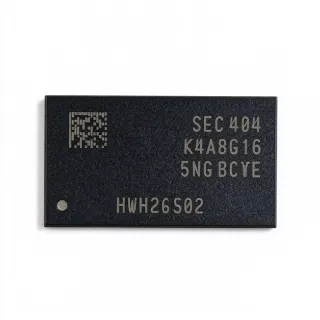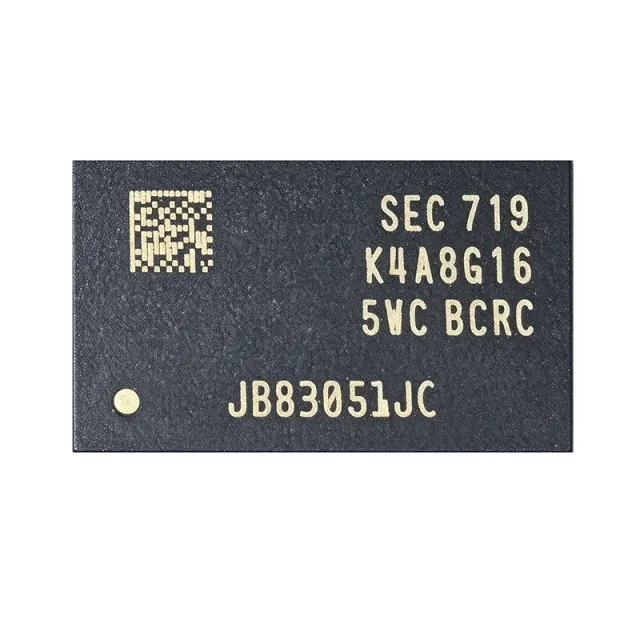
K4A8G165WC-BCRC - 8Gb DDR4 SDRAM 2400Mbps x16 | Samsung
MPN: K4A8G165WC-BCRC ✓ Active| Qty | Unit Price | Extended |
|---|---|---|
| 1 | $33.75 | $33.75 |
| 10 | $24.375 | $243.75 |
| 100 | $21.5625 | $2,156.25 |
| 500 | $20.625 | $10,312.50 |
| 1,000 | $19.6875 | $19,687.50 |
K4A8G165WC-BCRC Overview
DDR4 SDRAM (Double Data Rate 4 Synchronous Dynamic Random Access Memory) is the fourth generation of the JEDEC-defined DDR memory family. In the system hierarchy it sits under synchronous DRAM -> volatile memory IC -> semiconductor memory, serving as the main working memory for processors, SoCs and controllers. DDR4 lowered operating voltage from DDR3's 1.5 V to 1.2 V, cutting dynamic power by roughly 25% while raising data rates up to 3200 Mbps.
Key features of this C-die part include an 8 Gbit density in a x16 organization with a 16-bit data interface, auto precharge, asynchronous reset, CRC and CA parity for command/address integrity, on-die ZQ calibration, dynamic on-die termination (ODT), and data mask (DM) support per byte lane. These features improve signal integrity and data reliability at high speeds.
Technically, the device uses Samsung's C-die process and a bank-group architecture that allows faster burst access between bank groups. Ballouted per JEDEC DDR4 standards, the 96-ball FBGA is the industry-standard footprint, so JEDEC-compliant x16 8 Gb DDR4 parts from other vendors land on the same PCB land pattern. Operating current is specified around 2 mA (standby idle) and up to 64 mA operating per distributor data.
Typical applications include embedded computing modules, industrial controllers, networking and gateway equipment, set-top boxes, smart TVs, medical monitoring devices, and test and measurement instruments that need a compact, soldered-down memory.
Design tip: route the 16-bit data bus with length-matched traces to the controller, honor VTT termination (dynamic ODT helps), and decouple the 1.2 V VDD rail with low-ESR ceramics close to the ball field; verify speed-grade compatibility with your memory controller's trained timings.
This page synthesizes distributor pricing, verified drop-in alternatives, design notes and FAQs not consolidated in the manufacturer datasheet.
Drop-in alternatives for K4A8G165WC-BCRC — same package, pin-to-pin compatible. Different-package parts requiring PCB rework are excluded.
Quick Comparison Tool — Select alternative parts for side-by-side comparison:
K4A8G165WB-BCRC
✓ In Stock
$12.57 / Unit
View Datasheet →K4A8G165WB-BCPB
✓ In Stock
$2.3 / Unit
View Datasheet →K4A8G165WB-BCTD
✓ In Stock
$37 / Unit
View Datasheet →K4A8G165WC-BCTD
✓ In Stock
$41.2 / Unit
View Datasheet →MT40A1G8SA-075:E
✓ In Stock
$6.3 / Unit
View Datasheet →H5AN8G6NAFR-UHC
✓ In Stock
$5.7422 / Unit
View Datasheet →K4A8G165WC-BCRC Specifications
| Memory Type | DDR4 SDRAM |
| Memory Size | 8 Gbit |
| Organization | 512M x 16 |
| Data Rate | 2400 Mbps |
| Clock Frequency | 1333 MHz |
| Supply Voltage | 1.2 V (1.14 V to 1.26 V) |
| Interface | Parallel, 16-bit DDR |
| Standby Current (Idle) | 2 mA |
| Operating Current | 64 mA |
| Operating Temperature | 0 C to +95 C |
| Package | 96-FBGA (TFBGA) |
| Mounting Type | Surface Mount |
| Features | Auto precharge, asynchronous reset, CRC, ZQ calibration, dynamic ODT, data mask |
| Die Generation | C-die |
| Memory Format | DRAM |
| RoHS Status | Compliant |
K4A8G165WC-BCRC 96-fbga (tfbga) Pin Configuration Guide
Pin configuration for K4A8G165WC-BCRC (96-fbga (tfbga) package). Pin numbering, functions, and connection diagrams are defined in the manufacturer datasheet. Refer to it for the exact footprint and soldering guidelines.

No detailed pinout data available for K4A8G165WC-BCRC.
Refer to the datasheet for full pin configuration.
Typical Applications
K4A8G165WC-BCRC is suitable for 6 applications: Embedded Computing Modules, Industrial Controllers and PLCs, Networking and Gateway Equipment, Smart TV and Set-Top Box, Medical Monitoring Devices, Test and Measurement Instruments.
Embedded Computing Modules
The K4A8G165WC-BCRC provides 1 GB of soldered-down system memory in a single 96-ball FBGA, making it ideal for COMs and SoM modules where SO-DIMM sockets are impractical. Its 2400 Mbps data rate and x16 organization give ARM and x86 SoCs sufficient bandwidth with only a 16-bit bus, and the 1.2 V rail simplifies PMIC selection. Dynamic ODT and CA parity maintain signal integrity on four-to-six layer PCBs. Memory training in the bootloader must be re-run when substituting die generations, but the JEDEC ballout keeps the footprint unchanged across Samsung B-die and C-die variants.
Recommended
Industrial Controllers and PLCs
Industrial controllers benefit from the K4A8G165WC-BCRC's 8 Gb density for data logging, recipe storage caching and HMI frame buffers. The 0 C to +95 C operating range suits cabinet-mounted and fanless equipment, and its CRC plus CA parity features detect command/address errors caused by electrically noisy factory environments. At a typical 2 mA idle and up to 64 mA operating current, thermal design in sealed enclosures is straightforward. The device's asynchronous reset allows the system supervisor to recover the memory subsystem without a full power cycle, improving uptime in 24/7 automation lines.
Recommended
Networking and Gateway Equipment
Routers, switches and gateways use the K4A8G165WC-BCRC to buffer packets, hold routing tables and feed network processor pipelines. Its 2400 Mbps per-pin rate yields over 4 GB/s on a x16 bus, enough for multi-gigabit forwarding when paired with dual-rank or dual-chip configurations. ZQ calibration keeps output impedance matched over temperature, critical for backplane environments with long trace lengths. Because DDR4 is a JEDEC standard, second sources from the same footprint mitigate DRAM supply risk in long-life networking products without PCB respins.
Recommended
Smart TV and Set-Top Box
Consumer video platforms require dense, low-cost DDR4 for video decoding buffers and application memory. The K4A8G165WC-BCRC's single-package 1 GB capacity and 1.2 V operation reduce both BOM cost and standby power, important for ENERGY STAR-class consumer devices. Its C-die silicon is Samsung's cost-optimized generation for high-volume consumer builds. The x16 organization matches the memory interfaces of mainstream STB and TV SoCs directly, avoiding the need to pair two x8 devices and saving board area in thin form factors.
Recommended
Medical Monitoring Devices
Patient monitors and diagnostic equipment use the K4A8G165WC-BCRC for waveform buffering, GUI frame buffers and logged patient data caching. The part's CRC and CA parity protect command integrity in devices where data loss is unacceptable, and its 1.2 V rail keeps internal dissipation low inside compact, fanless medical enclosures - roughly 77 mW maximum dynamic power. The 96-ball FBGA's low profile suits handheld and bedside form factors. Designs should qualify the 0 C to +95 C range against the product's environmental specification and validate memory training across production SoC lots.
Recommended
Test and Measurement Instruments
Oscilloscopes, logic analyzers and signal generators rely on fast DRAM for acquisition memory and waveform storage. The K4A8G165WC-BCRC's 2400 Mbps rate supports high-throughput streaming from acquisition front ends, and its 8 Gb density extends record length per package. ZQ calibration maintains driver impedance accuracy during long captures that heat the instrument interior. Using the JEDEC-standard FBGA-96 footprint lets instrument makers dual-source with Samsung B-die or C-die and cross-brand x16 DDR4 parts, protecting long production runs against commodity DRAM allocation cycles.
Recommended
Recommended Products Summary
Engineering reference data for K4A8G165WC-BCRC — comparison, design guidance, and compliance information.
Selection Guide
Comparison with Alternatives
| Parameter | This Product | K4A8G165WB-BCRC | K4A8G165WB-BCPB | K4A8G165WB-BCTD | K4A8G165WC-BCTD | MT40A1G8SA-075 |
|---|---|---|---|---|---|---|
| Package | 96-FBGA | 96-FBGA - same | 96-FBGA - same | 96-FBGA - same | 96-FBGA - same | E: 96-FBGA - same (x8 org) |
| Brand | Samsung | Samsung | Samsung | Samsung | Samsung | E: Micron Technology |
| Density | 8 Gbit | 8 Gbit | 8 Gbit | 8 Gbit | 8 Gbit | E: 8 Gbit |
| Organization | 512M x 16 | 512M x 16 | 512M x 16 | 512M x 16 | 512M x 16 | E: 1G x 8 |
| Data Rate | 2400 Mbps | 2400 Mbps | 2400 Mbps class | 2666 Mbps class | 2666 Mbps class | E: 2666 Mbps class |
| Supply Voltage | 1.2 V (1.14-1.26 V) | 1.14 V to 1.26 V | 1.14 V to 1.26 V | 1.14 V to 1.26 V | 1.14 V to 1.26 V | E: 1.2 V |
| Die Generation | C-die | B-die | B-die | B-die | C-die | E: Micron DDR4 (die n/a) |
Key Differentiators
- Newer cost-optimized C-die silicon (vs K4A8G165WB-BCRC)
- 1 GB in a single low-profile package (vs K4A8G085WC-BCWE (4Gb))
- Balanced 2400 Mbps cost/performance bin (vs K4A8G165WC-BCTD)
Design Notes
Route the 16-bit data bus with length-matched traces (skew within controller spec, typically tens of picoseconds) and reference them to a solid ground plane. Enable the device's dynamic ODT and ZQ calibration to keep impedance matched over temperature; place the ZQ ball resistor with precision tolerance per the Samsung datasheet. For fly-by command/address routing on multi-chip designs, CA parity and CRC should be enabled in the controller configuration. Re-run memory training after any die-generation substitution, as C-die and B-die parts can train to slightly different read/write delays.
Supply the part from a 1.2 V rail regulated to 1.14 V to 1.26 V (e.g., a point-of-load buck such as a TPS54218-class converter). Distributor data shows about 2 mA idle standby and up to 64 mA operating current per device; size the rail for inrush during initialization and for termination currents on the data bus, which can exceed core current. Decouple VDD and VDDQ with a network of 10 uF bulk plus 0.1 uF ceramics placed close to the ball field. Estimated: a single device at 64 mA x 1.2 V dissipates roughly 77 mW dynamically.
Verify speed-grade compatibility before substitution: BCRC is a DDR4-2400 bin while BCTD is DDR4-2666; using a faster bin in a slower design is generally safe after training, but the reverse requires derating checks. Note the 0 C to +95 C operating range - this is not an industrial -40 C part, so cold-start environments need a wide-temperature alternative. Also verify organization (x16 vs x8) when cross-referencing to Micron or SK hynix parts, since same-density x8 devices are not pin-identical on an x16 board.
Compliance Information
RoHS compliant per LCSC and JLCPCB product listings. REACH, halogen-free and conflict-minerals status not stated in provided data.