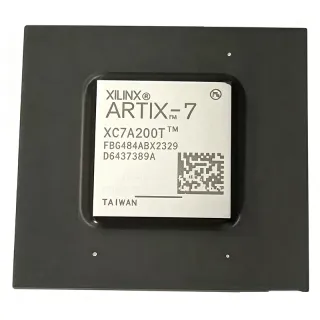
EPM9560RC304-20C - MAX 9000 CPLD, 560 Macrocells, 5V | Intel / Altera
MPN: EPM9560RC304-20C ✗ End of Life| Qty | Unit Price | Extended |
|---|---|---|
| 1 | $285 | $285.00 |
| 10 | $255 | $2,550.00 |
| 100 | $218 | $21,800.00 |
| 500 | $189 | $94,500.00 |
| 1,000 | $162 | $162,000.00 |
Drop-in alternatives for EPM9560RC304-20C — same package, pin-to-pin compatible. Different-package parts requiring PCB rework are excluded.
Quick Comparison Tool — Select alternative parts for side-by-side comparison:
EPM9560RC304-20
✅ Drop-In✓ In Stock
Contact for price
View Datasheet →EPM9560RC304-15C
✅ Drop-In✓ In Stock
$24.5 / Unit
View Datasheet →EPM9560RC304-15N
✅ Drop-In✓ In Stock
$19.8 / Unit
View Datasheet →EPM9560RC304-10
✅ Drop-In✓ In Stock
$17.6 / Unit
View Datasheet →EPM9560RC304-15
✅ Drop-In✓ In Stock
$9.4 / Unit
View Datasheet →EPM9560RC304-20C Maximum Ratings & Electrical Characteristics
| Family | MAX 9000 |
| Device Series | EPM9560 |
| Product Type | CPLD (Complex Programmable Logic Device) |
| Usable Gates | 12,000 |
| Macrocells | 560 |
| Logic Array Blocks (LABs) | 16 |
| Maximum User I/O Pins | 212 |
| fMAX (Internal) | 100 MHz |
| Pin-to-Pin Delay (tPD) | 20 ns (speed grade -20) |
| Core Supply Voltage | 5.0 V |
| I/O Logic Level | 3.3 V or 5 V (configurable) |
| Programming Technology | EEPROM (in-system programmable) |
| Programming Interface | IEEE Std. 1149.1 JTAG |
| Operating Temperature | 0 C to +70 C (commercial) |
| Package | 304-pin RQFP |
| Mounting Type | Surface Mount |
EPM9560RC304-20C 304-pin rqfp Pin Configuration Guide
Complete pinout information for EPM9560RC304-20C (304-pin rqfp package) with 212 pins. This digital IC includes GPIO, communication interfaces (UART, SPI, I2C), and power pins. Refer to the manufacturer datasheet for alternate pin functions and configuration options. Essential for embedded system design and PCB layout.

No detailed pinout data available for EPM9560RC304-20C.
Refer to the datasheet for full pin configuration.
Estimated pin count: 212 pins (digital package)
Safe Operating Area (SOA) & Thermal Characteristics
No official SOA curve available for this digital IC. Always operate within absolute maximum ratings specified in the datasheet. Ensure adequate cooling and derate as needed.
Typical Applications
EPM9560RC304-20C is suitable for 6 applications: Industrial Bus-Bridging and Protocol Conversion, High-Speed Address Decoding and Chip-Select Logic, Motor Drive and Industrial Control State Machines, Telecom Backplane Glue Logic, Test and Measurement Instrument Front-End, Legacy 5 V Embedded System Glue Logic.
Industrial Bus-Bridging and Protocol Conversion
The EPM9560RC304-20C's 560 macrocells and 212 user I/O pins make it ideal for legacy industrial bus bridging between PCI, VME, ISA and VXI backplanes. With 100 MHz fMAX and 20 ns tPD the device can decode 32-bit addresses in a single clock cycle, while 5 V tolerant I/O directly interfaces with classic 5 V peripheral ASICs without level-shifters. According to MAX 9000 application notes, the on-chip 16 LABs and uniform interconnect deliver software-independent timing closure that simplifies multi-clock domain designs.
Recommended
High-Speed Address Decoding and Chip-Select Logic
With 20 ns pin-to-pin delay the EPM9560RC304-20C serves as a wide address decoder for memory and peripheral chip-select generation in microprocess or DSP-based systems. Its 560 macrocells can implement multiple parallel decode trees for >1 GB address spaces while the 5 V core supply avoids compatibility issues with older microprocessors. According to the MAX 9000 datasheet, the predictable MAX interconnect timing enables deterministic chip-select assertion regardless of logic placement, eliminating timing-skew concerns seen in FPGA-based decoders.
Recommended
Motor Drive and Industrial Control State Machines
The EPM9560RC304-20C's 560 macrocells can host multi-state control algorithms for industrial motor drives, including PWM generation, fault handling, encoder quadrature decoding, and CAN/RS-485 protocol handshaking. Its 212 I/O pins accept 24 V tolerant signals via external resistors and drive 5 V optocoupler inputs directly, making it a robust state-machine engine in factory automation. According to the MAX 9000 datasheet, the EEPROM-based configuration provides instant-on behaviour - critical for safety circuits that must execute within microseconds of power-up.
Recommended
Telecom Backplane Glue Logic
The EPM9560RC304-20C's 304-pin RQFP package with 212 user I/O pins fits legacy telecom backplanes that require large numbers of TTL-compatible signals per board. Its 5 V core and 3.3 V / 5 V mixed I/O bank allows direct interfacing with both legacy 5 V line-card ASICs and newer 3.3 V framers. According to the MAX 9000 datasheet, JTAG-based in-system programmability enables remote board-level upgrades across telecom infrastructure, reducing field-service cost for deployed equipment.
Recommended
Test and Measurement Instrument Front-End
The EPM9560RC304-20C's 212 I/O pins and 560 macrocells can implement instrument front-end multiplexing, range selection, calibration switching, and trigger sequencing in bench-top oscilloscopes, logic analyzers, and signal generators. Its 100 MHz internal fMAX can drive fast trigger event counters and handshake with high-speed ADCs. According to the MAX 9000 datasheet, the deterministic 20 ns tPD simplifies timing analysis of trigger paths and ensures repeatable measurement timing across production units.
Recommended
Legacy 5 V Embedded System Glue Logic
The EPM9560RC304-20C is purpose-built for legacy 5 V embedded systems where modern low-voltage CPLDs cannot operate. Its 5 V tolerant I/O directly interfaces with classic 68k, x86, MIPS and PowerPC processor buses without level-shifters, while 560 macrocells provide ample capacity for peripheral glue, interrupt controllers, and DMA state machines. According to the MAX 9000 datasheet, the 304-pin RQFP package supports up to 212 user I/O pins, enough for full 32-bit data and 24-bit address bus integration in single-chip glue logic.
Recommended
Recommended Products Summary
Engineering reference data for EPM9560RC304-20C — comparison, design guidance, and compliance information.
Selection Guide
Comparison with Alternatives
| Parameter | This Product | EPM9560RC304-20 | EPM9560RC304-15C | EPM9560RC304-15N | EPM9560RC304-10 | EPM9560RC304-15 |
|---|---|---|---|---|---|---|
| Brand | Altera (Intel) | Altera (Intel) | Altera (Intel) | Altera (Intel) | Altera (Intel) | Altera (Intel) |
| Package | 304-pin RQFP | 304-pin RQFP - same | 304-pin RQFP - same | 304-pin RQFP - same | 304-pin RQFP - same | 304-pin RQFP - same |
| tPD (Pin-to-Pin Delay) | 20 ns | 20 ns | 15 ns | 15 ns | 10 ns | 15 ns |
| Macrocells | 560 | 560 | 560 | 560 | 560 | 560 |
| Usable Gates | 12,000 | 12,000 | 12,000 | 12,000 | 12,000 | 12,000 |
| User I/O Pins | 212 | 212 | 212 | 212 | 212 | 212 |
| Operating Temperature | 0 C to +70 C (commercial) | 0 C to +85 C (industrial) | 0 C to +70 C (commercial) | -40 C to +85 C (industrial) | 0 C to +70 C (commercial) | 0 C to +85 C (industrial) |
| Core Supply Voltage | 5.0 V | 5.0 V | 5.0 V | 5.0 V | 5.0 V | 5.0 V |
| Programming Interface | IEEE 1149.1 JTAG ISP | IEEE 1149.1 JTAG ISP | IEEE 1149.1 JTAG ISP | IEEE 1149.1 JTAG ISP | IEEE 1149.1 JTAG ISP | IEEE 1149.1 JTAG ISP |
| Lifecycle Status | Obsolete | Obsolete | Obsolete | Obsolete | Obsolete | Obsolete |
Key Differentiators
- Highest-density 5 V CPLD in the Altera MAX 9000 family (vs EPM9480RC240-20)
- Pin-compatible speed-grade flexibility across the EPM9560 family (vs EPM9560RC304-15C)
- Larger I/O count than most MAX 9000 siblings (vs EPM9560RC240-20)
- Industrial-temp drop-in upgrade path (vs EPM9560RC304-15N)
Design Notes
Estimated: at fMAX = 100 MHz with 50% toggle rate on 212 I/O pins, the EPM9560RC304-20C core draws approximately 200-300 mA from the 5 V supply. Place four 0.2 uF decoupling capacitors near each VCC / GND pair along the RQFP-304 perimeter, with one bulk 22 uF tantalum and one 1 uF ceramic near the package. Inadequate decoupling produces VCC bounce that can corrupt JTAG programming and cause intermittent logic errors.
Estimated: the 304-pin RQFP package has a junction-to-ambient thermal resistance around 25-30 C/W. At 1.5 W worst-case dissipation the junction rises 40-45 C above ambient - acceptable for the commercial 0 C to +70 C range but marginal in enclosed industrial cabinets. Mount the RQFP on a minimum 4 square inch copper pour with thermal vias to an internal ground plane, and provide airflow of 100 LFM or more for reliable operation above 70 C ambient.
JTAG chain integrity is critical: TCK requires a 1 kohm pull-down, TMS and TDI require 1 kohm pull-ups to VCC, and TDO should be left floating if unused. According to IEEE 1149.1, keep JTAG traces shorter than 150 mm and route them away from high-speed I/O to avoid signal-integrity corruption during in-system programming. Place the JTAG header near a board edge for convenient ISP access during manufacturing.
The -20C suffix marks a commercial-temperature speed grade - do not confuse with industrial (-N suffix) or military / MIL-grade variants. Programming voltage VPP is generated internally - do not apply external 12 V to any pin. The MAX 9000 family uses 100 erase/program cycles endurance per cell, so avoid re-programming in production test unless absolutely necessary. Last-time-buy and obsolete parts should be procured with sufficient safety stock because lead times can exceed 16 weeks.
Compliance Information
MAX 9000 family datasheet pre-dates RoHS documentation standardization. AEC-Q100 is not applicable - the part targets industrial glue logic rather than automotive safety-critical applications. Verify lead-free / halogen-free status with the manufacturer for current orders.