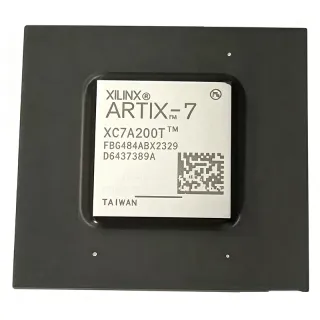
M1AFS600-FG484I - 600K Gates Fusion FPGA, ARM Cortex-M1 | Microchip
MPN: M1AFS600-FG484I ✓ Active| Qty | Unit Price | Extended |
|---|---|---|
| 1 | $0 | $0.00 |
| 10 | $0 | $0.00 |
| 100 | $0 | $0.00 |
| 500 | $0 | $0.00 |
| 1,000 | $0 | $0.00 |
M1AFS600-FG484I Overview
A field-programmable gate array (FPGA) is a semiconductor device containing a fabric of configurable logic blocks, routing resources, and programmable I/O that designers configure after manufacturing. The Fusion family extends this concept into mixed-signal system-on-chip territory by monolithically integrating configurable analog blocks, large flash memory, clock management circuitry (CCM), and flash-based programmable logic, positioning the M1AFS600 at the top of the hierarchy: FPGA -> mixed-signal FPGA -> programmable SoC -> power management and sensing subsystem.
Key features include flash-based configuration that is live at power-up (no external configuration PROM required), 128-bit flash lock and industry-leading AES decryption for IP security, and an embedded ARM Cortex-M1 soft-processing option that allows single-chip control-plane plus logic integration. The 1.5V core supply and 130nm flash process technology keep static and dynamic power manageable for industrial systems.
The Fusion fabric pairs digital look-up tables with analog conditioning blocks (voltage, current, temperature monitoring), enabling true single-chip system monitoring and control. The FG484 package provides a 1.0 mm ball pitch for routable, reworkable layouts, and the industrial-grade 'I' suffix guarantees operation from -40C to +85C.
Typical applications include industrial system monitoring and power management, embedded control with the ARM Cortex-M1 core, medical instrumentation analog supervision, and automotive-adjacent test equipment requiring flash retention and instant-on configuration.
Design consideration: standard FG (lead-containing, non-RoHS) ball metallurgy must be checked against your product environmental requirements; the FGG (lead-free) variant exists in the same footprint for RoHS-driven designs.
This page synthesizes distributor inventory, drop-in same-footprint variants, and practical design notes not found in the manufacturer datasheet.
Drop-in alternatives for M1AFS600-FG484I — same package, pin-to-pin compatible. Different-package parts requiring PCB rework are excluded.
Variants in this series
Same-series models that are drop-in compatible with M1AFS600-FG484I (same form factor and footprint) — differing in System Gates, Package, Family, RoHS Status, Speed Grade.
Quick Comparison Tool — Select alternative parts for side-by-side comparison:
M1AFS600-FGG484I
✅ Drop-In✓ In Stock
$128.4 / Unit
View Datasheet →M1AFS600-1FG484I
✅ Drop-In✓ In Stock
$425 / Unit
View Datasheet →M1AFS600-2FG484I
✅ Drop-In✓ In Stock
$97.6 / Unit
View Datasheet →M1AFS600-FG484YI
✅ Drop-In📋 Reference alternative (not in catalog)
M7AFS600-FG484I
✅ Drop-In✓ In Stock
$273.98 / Unit
View Datasheet →M1AFS600-FG484I Maximum Ratings & Electrical Characteristics
| Series | Fusion (M1AFS600) |
| Number of System Gates | 600000 gates |
| Logic Cells | 13824 |
| Number of I/Os | 172 |
| Memory Bits (DigiKey listing) | 110592 bits |
| Embedded Processor | ARM Cortex-M1 |
| Core Supply Voltage | 1.5 V |
| Process Technology | 130 nm (CMOS flash-based) |
| Frequency (per FindIC listing) | 1098.9 MHz |
| Package / Case | FBGA-484 (484-BGA), 1.0 mm pitch |
| Mounting Style | SMD/SMT |
| Minimum Operating Temperature | -40 C |
| Maximum Operating Temperature | +85 C |
| Security | 128-bit flash lock, AES decryption |
| Configuration | Flash-based, live at power-up |
| Packaging | Tray |
| RoHS Status | Non-Compliant (contains lead, FG variant) |
| Lead Free Status | Contains Lead |
M1AFS600-FG484I fbga-484 (484-bga), 1.0 mm pitch Pin Configuration Guide
Pin configuration for M1AFS600-FG484I (fbga-484 (484-bga), 1.0 mm pitch package). This digital IC includes GPIO, communication interfaces (UART, SPI, I2C), and power pins. Refer to the manufacturer datasheet for alternate pin functions and configuration options. Essential for embedded system design and PCB layout.

No detailed pinout data available for M1AFS600-FG484I.
Refer to the datasheet for full pin configuration.
Typical Applications
M1AFS600-FG484I is suitable for 6 applications: Industrial System Monitoring and Power Management, Embedded Control with ARM Cortex-M1, Medical Instrumentation Analog Supervision, Secure Industrial Networking and Gateways, Test and Measurement Equipment, Aerospace-Adjacent and Rugged Embedded Systems.
Industrial System Monitoring and Power Management
The M1AFS600-FG484I fits industrial monitoring because its Fusion analog conditioning blocks measure voltage, current, and temperature directly on-chip, while the 600K-gate flash fabric implements deterministic control logic in the same silicon. With a -40C to +85C industrial grade and live-at-power-up flash configuration, boards begin monitoring within milliseconds of power application without a boot sequence. A typical topology uses the analog blocks to supervise multiple power rails through external dividers and shunts, with threshold alarms routed to the fabric and status reported over SPI or I2C. The trade-off versus a discrete supervisor chain is one-chip integration, reducing board area and BOM count at the cost of a single-point device requiring careful 1.5V and I/O rail sequencing.
Recommended
Embedded Control with ARM Cortex-M1
Because the M1AFS600-FG484I embeds an ARM Cortex-M1 processor alongside 13,824 logic cells, it can host both software control-plane code and custom hardware accelerators in one chip, eliminating a separate microcontroller. Typical usage implements the Cortex-M1 running bare-metal firmware or a small RTOS for protocol handling, while the fabric handles high-speed interfaces, and the two communicate through fabric-defined registers at internal bandwidth far exceeding external buses. The flash-based fabric means the processor and logic are both active as soon as power is applied, important for control applications requiring instant-on behavior. The design consideration is that the Cortex-M1 is optimized for FPGA implementation rather than raw MHz performance, so compute-heavy loops should be moved to fabric accelerators.
Recommended
Medical Instrumentation Analog Supervision
Medical diagnostic equipment benefits from the M1AFS600-FG484I's monolithic combination of configurable analog monitoring and digital logic: patient-interface subsystems require rail supervision, thermal monitoring, and fault interlocks that the Fusion analog blocks implement in hardware with microsecond response, while the flash fabric runs interlock logic that cannot hang under software faults. The AES-encrypted, flash-locked configuration helps protect proprietary measurement algorithms on serviceable instruments. In a typical design the FPGA supervises analog front-end power rails and gates sensor interfaces, logging faults for compliance records. The -40C to +85C industrial grade exceeds typical medical ambient requirements, providing margin; the trade-off is that the FG variant's lead content must be exempted or the FGG variant substituted for RoHS-regulated medical devices.
Recommended
Secure Industrial Networking and Gateways
The M1AFS600-FG484I suits secure industrial gateway hardware because its 128-bit flash lock and AES bitstream decryption protect firmware IP, while the ARM Cortex-M1 and 600K-gate fabric implement protocol bridging and custom MAC-layer functions on one chip. A common topology uses the fabric for high-throughput data-path framing and CRC, with the Cortex-M1 managing network stacks and configuration, communicating through internal fabric interfaces. Flash configuration is live at power-up, so the gateway is on the network within milliseconds, and configuration stored in on-chip flash resists boot-time interception. The 172 user I/Os provide enough pins for multiple communication PHYs; the design trade-off is managing the 1.5V core plus multiple I/O bank voltages in the 484-ball layout.
Recommended
Test and Measurement Equipment
Bench and rack instrumentation uses the M1AFS600-FG484I where instant-on, deterministic logic plus on-chip analog supervision simplify instrument design: the flash fabric is ready before a host PC completes enumeration, and Fusion analog blocks monitor internal supply health reported to the instrument's self-test routine. Typical usage places the FPGA between front-end acquisition circuitry and a backplane interface, with the Cortex-M1 handling command parsing over UART/SPI and the fabric implementing trigger engines, counters, and custom interfaces at internal clock rates far above software paths. The 484-ball FBGA with 1.0 mm pitch supports the dense, layered PCB stackups typical of instruments. The trade-off versus ASIC-based designs is per-unit cost, offset by field reconfigurability for new measurement features.
Recommended
Aerospace-Adjacent and Rugged Embedded Systems
The M1AFS600-FG484I is used in rugged industrial and aerospace-adjacent ground equipment where flash-based, single-chip configuration improves reliability versus SRAM FPGAs that need external configuration devices vulnerable to SEU-induced corruption of the bitstream store. The Fusion family's flash cells retain configuration through power cycles and radiation-tolerant workflows begin from this commercial platform before moving to Microchip RTAX parts for true flight programs. In a typical design the fabric implements interface glue logic and health monitoring, with the analog blocks supervising redundant power rails and voting on failover. The -40C to +85C grade covers most ground-based environments; for launch or orbit, migrate to the RTAX2000S/RTAX4000S antif fuse family, which is not pin-compatible with this device.
Recommended
Recommended Products Summary
Engineering reference data for M1AFS600-FG484I — comparison, design guidance, and compliance information.
Selection Guide
Comparison with Alternatives
| Parameter | This Product | M1AFS600-FGG484I | M1AFS600-1FG484I | M1AFS600-2FG484I | M1AFS600-FG484YI | M7AFS600-FG484I |
|---|---|---|---|---|---|---|
| Package | FBGA-484 (1.0 mm pitch) | FBGA-484 - same footprint | FBGA-484 - same footprint | FBGA-484 - same footprint | 484-ball PBGA - same footprint | FBGA-484 - same footprint |
| Brand | Microchip Technology (Microsemi) | Microchip Technology | Microchip Technology | Microchip Technology | Microchip Technology | Microchip Technology |
| System Gates | 600K | 600K | 600K | 600K | 600K | 600K |
| User I/O | 172 | 172 | 172 | 172 | 172 | 172 |
| Embedded Processor | ARM Cortex-M1 | ARM Cortex-M1 | ARM Cortex-M1 | ARM Cortex-M1 | ARM Cortex-M1 | ARM Cortex-M7-class (verify) |
Key Differentiators
- Lead-free RoHS-compliant drop-in available (vs M1AFS600-FGG484I)
- Speed-grade flexibility on the same footprint (vs M1AFS600-2FG484I)
- ARM Cortex-M1 integration (vs AFS600-FG484I)
- Trade-off: lead-containing package (vs M1AFS600-FGG484I)
Design Notes
The M1AFS600-FG484I requires a 1.5V core supply plus I/O bank rails (up to 3.3V depending on standard). Estimate power using the Microchip Libero SmartPower tool with your actual utilization - a 600K-gate device at moderate utilization typically dissipates well under 1-2W, but I/O-heavy designs with many SSO banks can rise significantly. Sequence I/O rails before or with VCC per the Fusion power-up specification; flash configuration is live within milliseconds of valid power, so rail monitors should gate external interfaces until configuration completes to prevent partial-configuration bus contention.
The FBGA-484 with 1.0 mm pitch requires via-in-pad or dog-bone escape routing; use a 6+ layer stack with dedicated power and ground planes for the 1.5V core. Provide microvias or careful fan-out on the 24-column ball field. Distributor listings confirm the package is reworkable at 1.0 mm pitch with standard BGA rework stations. Place 100nF ceramic decoupling capacitors on the underside of the board beneath the die area, one per power pin group, plus bulk 10uF per rail. Follow the Fusion PCB layout guidelines in the manufacturer user guide for analog block reference layout.
Two common mistakes: (1) Ordering FG when RoHS is required - the FG variant contains lead and is RoHS non-compliant per distributor listings; specify M1AFS600-FGG484I instead (same footprint, lead-free). (2) Assuming drop-in compatibility with SmartFusion2 (M2S060-FG484I): although functionally similar, it is a different die and ball map, so it is a redesign, not a drop-in. Also verify speed grade against timing closure - migrating a bitstream between -1 and -2 grades requires re-running timing in Libero.
With 172 user I/Os in a 484-ball package, ground-ball assignment matters: avoid clustering many simultaneously switching outputs on one bank without adjacent ground return balls. Use the Fusion I/O bank structure to group same-voltage, same-standard signals, and series-terminate 50-ohm lines at the driver for traces longer than rise-time/6. The CCM (comprehensive clock management) blocks support PLL-based deskew; route differential clock pairs with 100-ohm controlled impedance and length-match within 5 mils for high-speed interfaces.
Compliance Information
Per datasheet aggregator listing: Lead Free Status 'Contains Lead', RoHS Status 'RoHS Non-Compliant' (FG variant). Use M1AFS600-FGG484I for lead-free RoHS-compliant equivalent.