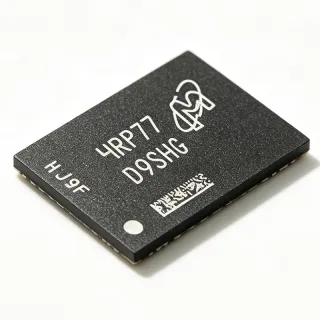
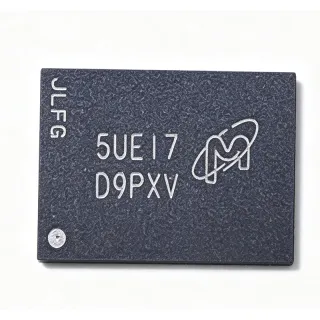
MT40A1G16TD-062E - 16Gb DDR4-3200 x16 SDRAM FBGA | Micron
MPN: MT40A1G16TD-062E ✓ Active| Qty | Unit Price | Extended |
|---|---|---|
| 1 | $27.87 | $27.87 |
| 10 | $25.2 | $252.00 |
| 100 | $22.85 | $2,285.00 |
| 500 | $20.9 | $10,450.00 |
| 1,000 | $18.41 | $18,410.00 |
MT40A1G16TD-062E Overview
DDR4 SDRAM is the fourth generation of double-data-rate synchronous dynamic random-access memory. As a memory IC within the DRAM hierarchy (DRAM -> SDRAM -> DDR SDRAM -> DDR4 SDRAM), it stores data in an array of eight internal banks for the x16 configuration, refreshing dynamically at 8192 cycles per 64 ms up to 85C and per 32 ms from 85C to 95C.
Key features include the 1.2V pseudo open-drain (POD12) I/O standard, which lowers I/O termination power compared with the DDR3 POO interface; on-die, internal, adjustable VREFDQ generation that removes external reference voltage routing; and extended temperature operation with TC maximum up to 95C. The -062E speed grade supports DDR4-3200 timing.
Architecturally, the part is internally configured as an eight-bank DRAM in x16 mode, using bank-group architecture to enable high throughput. The FBGA (fine-pitch ball grid array) package family provides short, low-inductance ball interconnects essential for signal integrity above 1.6 GHz of clock rate.
Typical applications include industrial and networking systems, embedded computing main memory, and memory modules or down-package DIMM alternatives using x16 devices.
Design considerations: POD12 termination and address/command bus fly-by routing per JEDEC DDR4 practice are required; VPP is a dedicated word-line pump supply and must not be confused with VDDQ.
This page synthesizes distributor pricing, verified drop-in alternatives (including Alliance Memory cross-references), and practical design notes not found in the manufacturer datasheet.
Drop-in alternatives for MT40A1G16TD-062E — same package, pin-to-pin compatible. Different-package parts requiring PCB rework are excluded.
Variants in this series
Same-series models that are drop-in compatible with MT40A1G16TD-062E (same form factor and footprint) — differing in Package, Memory Type, Mounting Type, Data Rate, Interface.
Quick Comparison Tool — Select alternative parts for side-by-side comparison:
MT40A1G16TB-062E:F
✅ Drop-In📋 Reference alternative (not in catalog)
MT40A1G16TD-062E AIT:F
✅ Drop-In📋 Reference alternative (not in catalog)
MT40A1G16TD-062E AUT:F
✅ Drop-In📋 Reference alternative (not in catalog)
MT40A1G16TD-062E:F
✅ Drop-In📋 Reference alternative (not in catalog)
AS4C1G16D4A-62BCN
✅ Drop-In📋 Reference alternative (not in catalog)
MT40A1G16TD-062E Specifications
| Memory Type | DDR4 SDRAM |
| Memory Size | 16 Gbit |
| Organization | 1G x 16 |
| Clock Frequency | 1.6 GHz |
| Access Time | 19 ns |
| Interface | POD12 (1.2V pseudo open-drain) |
| VDD Supply Voltage | 1.2 V +/- 60 mV |
| VDDQ Supply Voltage | 1.2 V +/- 60 mV |
| VPP Supply Voltage | 2.5 V, -125 mV, +250 mV |
| Bank Architecture | 8 banks (x16 configuration) |
| VREFDQ | On-die, internal, adjustable generation |
| Refresh | 8192-cycle, 64 ms up to 85C; 32 ms from 85C to 95C |
| Operating Temperature | TC maximum up to 95 C |
| Package | 96-ball FBGA (7.5 x 13 mm) |
| Mounting Type | Surface Mount |
| Speed Grade | -062E |
| Product Line Suffix | AAT:F (automotive AEC grade available per Micron catalog) |
MT40A1G16TD-062E 96-ball fbga (7.5 x 13 mm) Pin Configuration Guide
Pin configuration for MT40A1G16TD-062E (96-ball fbga (7.5 x 13 mm) package). Pin numbering, functions, and connection diagrams are defined in the manufacturer datasheet. Refer to it for the exact footprint and soldering guidelines.

No detailed pinout data available for MT40A1G16TD-062E.
Refer to the datasheet for full pin configuration.
Typical Applications
MT40A1G16TD-062E is suitable for 6 applications: Industrial Computing Main Memory, Automotive Infotainment and ADAS Memory, Networking and Communication Equipment, Embedded Boards and Development Platforms, Test and Measurement Instrumentation, Memory Modules and Down-Package DIMM Alternatives.
Industrial Computing Main Memory
The MT40A1G16TD-062E fits industrial PCs, edge controllers, and embedded computing boards that need high-density DRAM with wide industrial temperature coverage. Its 16Gbit density in x16 organization provides 2 GB per device, so a single chip replaces two 8Gb parts, cutting component count and simplifying fly-by routing. The device supports TC up to 95C with a 32 ms refresh regime above 85C, preserving data integrity in enclosures near heat sources. The AIT:F and AUT:F grades extend qualification for harsh environments. Placed as a point-to-point DDR4-3200 load behind an industrial SoC, the POD12 interface reduces I/O termination power versus DDR3, lowering total system dissipation by roughly 15 to 20 percent on the memory rail compared with a comparable DDR3L design.
Recommended
Automotive Infotainment and ADAS Memory
Automotive telematics, infotainment head units, and ADAS sensor-fusion ECUs require DRAM qualified to automotive quality systems with extended temperature range. Micron offers the MT40A1G16TD-062E die in AAT:F and AUT:F order codes, and Newark explicitly classifies the part as automotive DDR4 SDRAM configured as an eight-bank DRAM in x16 mode. The 2 GB-per-chip density supports map storage, camera buffering, and display frame buffers without increasing PCB area. Operation at a 1.6 GHz clock delivers the 3200 MT/s bandwidth needed by ADAS perception pipelines, while the 96-ball FBGA 7.5 x 13 mm footprint keeps the memory close to the SoC for short trace lengths and clean signal integrity. Designers should budget the 2x refresh (32 ms) above 85C in the controller configuration.
Recommended
Networking and Communication Equipment
Enterprise switches, routers, and 5G small-cell equipment use high-density DDR4 for packet buffers, routing tables, and control-plane software. The MT40A1G16TD-062E provides 16 Gbit per device at DDR4-3200, giving 2 GB in a single 96-ball FBGA. The x16 organization suits narrow, cost-optimized data paths where an x64 bus is built from four devices. On-die adjustable VREFDQ generation removes the external reference divider, simplifying layout on dense networking boards. POD12 pseudo open-drain I/O lowers termination current relative to DDR3, which matters in fanless telecom hardware. Thermal design should verify that TC stays at or below 95C at full active-refresh current in the switch airflow budget, derating for adjacent PHY and switch-ASIC dissipation.
Recommended
Embedded Boards and Development Platforms
Single-board computers, SOMs, and FPGA-based development platforms adopt the MT40A1G16TD-062E to provide 2 GB of system memory without module sockets. The x16 DDR4 interface connects directly to SoC or FPGA hard memory controllers, and the 96-ball FBGA footprint fits within a small keep-out on a 6 to 8 layer board. Using a single high-density device simplifies address/command fly-by topology versus multi-chip down-package designs and reduces BOM line items. The -062E speed grade enables DDR4-3200 operation for processor-intensive workloads such as Linux root filesystems, machine-learning inference buffers, and video pipelines. Designers using FPGA platforms should confirm controller calibration margins (read/write leveling) at 1.6 GHz with their specific trace lengths and stackup.
Recommended
Test and Measurement Instrumentation
Oscilloscopes, logic analyzers, and signal generators require deep acquisition memory with sustained write bandwidth. The MT40A1G16TD-062E supplies 2 GB per device at DDR4-3200, allowing long record lengths in compact instruments. Its deterministic 8192-cycle refresh (64 ms to 85C) lets the instrument controller schedule background operations predictably, while 1.2V POD12 I/O keeps the memory rail efficient in closed, fanless benchtop enclosures. For multi-device arrays capturing high-speed ADC streams, the FBGA ball-out supports compact daisy-chained or fly-by routed buses. When designs must guarantee supply continuity, the Alliance Memory drop-ins (MT40A1G16TD-062E:F, AS4C1G16D4A-62BCN) provide qualified second sources without PCB redesign, protecting long-production instrument programs against allocation cycles.
Recommended
Memory Modules and Down-Package DIMM Alternatives
Designers replacing SO-DIMM or UDIMM sockets with soldered-down memory (to improve reliability, reduce height, and eliminate contact failure modes) commonly use 16Gb x16 DDR4 devices such as the MT40A1G16TD-062E. Four devices create a 64-bit 8 GB bank; eight devices yield 16 GB. Compared with a socketed module, soldered FBGA packages reduce board height below 3 mm, remove connector insertion-loss degradation, and support conformal coating for harsh environments. The on-die VREFDQ and POD12 interface align with standard DDR4 controller implementations, so firmware changes versus a DIMM design are limited to timing register programming. Layout should follow JEDEC DDR4 fly-by topology with per-device ZQ and VREF decoupling to maintain 3200 MT/s signal integrity margins.
Recommended
Recommended Products Summary
Engineering reference data for MT40A1G16TD-062E — comparison, design guidance, and compliance information.
Selection Guide
Comparison with Alternatives
| Parameter | This Product | MT40A1G16TB-062E:F | MT40A1G16TD-062E AIT:F | MT40A1G16TD-062E:F (Alliance) | AS4C1G16D4A-62BCN |
|---|---|---|---|---|---|
| Package | 96-ball FBGA (7.5 x 13 mm) | 96-ball FBGA (7.5 x 13 mm) - same | 96-ball FBGA (7.5 x 13 mm) - same | 96-FBGA (7.5 x 13) - same | 96-ball FBGA - same footprint |
| Brand | Micron Technology | Micron Technology | Micron Technology | Alliance Memory | Alliance Memory |
| Memory Size | 16 Gbit | 16 Gbit | 16 Gbit | 16 Gbit | 16 Gbit |
| Organization | 1G x 16 | 1G x 16 | 1G x 16 | 1G x 16 | 1G x 16 |
| Temperature Grade | AAT:F (automotive) | Commercial/industrial (per grade) | Industrial/automotive (AIT) | Commercial/industrial | Commercial/industrial |
| VDD / VPP Supply | 1.2 V / 2.5 V | 1.2 V / 2.5 V | 1.2 V / 2.5 V | 1.2 V / 2.5 V | 1.2 V / 2.5 V (DDR4 standard) |
Key Differentiators
- Automotive-qualified ordering codes of the same die (vs AS4C1G16D4A-62BCN)
- On-die adjustable VREFDQ generation (vs MT41K256M8DA-125 (DDR3L))
- 2 GB density per device in x16 organization (vs MT40A256M16GE-083E (4 Gb x16))
Design Notes
Route the DDR4 interface using JEDEC-standard fly-by topology for address/command and point-to-point 2 GT/s-class x16 data lines. The POD12 interface requires on-die VREFDQ (generated internally by this device), so no external reference divider is needed, but still decouple VREF balls per the Micron package drawing. Keep data-group length matching within 25 mils intra-byte and impedance control at 40 ohms single-ended (ODT-adjusted) on a controlled stackup of at least 6 layers to sustain DDR4-3200 margins.
Provide three separate rails: VDD and VDDQ at 1.2 V +/- 60 mV and VPP at 2.5 V (-125/+250 mV). VPP powers the word-line charge pumps; its average current is low but it must never be left floating or shared with a 1.8 V rail. Budget active current with 2x refresh above 85C (32 ms refresh window), which raises IDD about 10 to 15 percent versus the 64 ms regime. Estimated: at typical 16Gb active currents in the several-hundred-mA class, a 1.2 V rail sized at 1.5 A per device gives comfortable headroom.
Micron specifies TC (case temperature) maximum up to 95 C for this family; above 85 C the controller must enable 2x refresh. In sealed industrial or automotive enclosures, verify case temperature with a thermocouple at the top-center of the FBGA under worst-case load, and confirm that self-refresh retention current remains within budget. If TC approaches 85 C in your application, deliberately configure the controller for 32 ms refresh from the start rather than dynamically, avoiding marginal timing transitions.
Do not mix TD and TB die revisions blindly on the same board without reading the Alliance comparison document 16Gb-DDR4-MT40A1G16TB-062EF-vs-MT40A1G16TD-062EF - although they interchange at the -062E speed code, ordering codes and grade suffixes (AAT/AIT/AUT) must match your qualification plan. Also note that DigiKey lists each grade as a separate product (AAT:F, AIT:F, AUT:F); purchasing the wrong grade for an automotive program invalidates the supply-chain documentation even though the silicon is functionally identical.
Compliance Information
The :F package suffix in Micron ordering codes denotes lead-free/RoHS-compatible finish. Automotive grades (AAT:F, AUT:F) are offered for automotive programs; AEC-Q100 certificate status should be confirmed via Micron quality documentation. REACH and halogen-free declarations should be pulled from Micron's official compliance certificates for the specific ordering code.