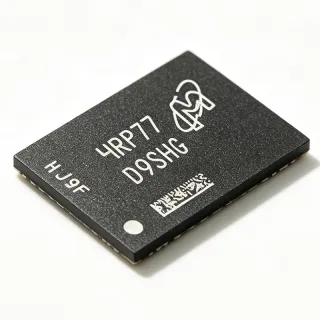
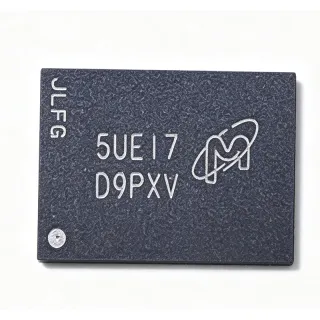
MT53D512M32D2DS-053 WT:D - 16Gb LPDDR4 SDRAM | Micron
MPN: MT53D512M32D2DS-053 WT:D ✓ Active| Qty | Unit Price | Extended |
|---|---|---|
| 1 | $7.78 | $7.78 |
| 10 | $7.25 | $72.50 |
| 100 | $6.8 | $680.00 |
| 500 | $6.4 | $3,200.00 |
| 1,000 | $6.05 | $6,050.00 |
MT53D512M32D2DS-053 WT:D Overview
LPDDR4 (Low Power Double Data Rate 4) is a JEDEC-defined generation of synchronous DRAM optimized for mobile and low-power systems. In the memory hierarchy, it sits as the main system DRAM between the application processor and long-term storage, supplying the working set for CPUs, GPUs, and accelerators. LPDDR4 achieves high bandwidth over a 32-bit data bus while operating at a low core voltage, making it the standard main memory for smartphones, tablets, and embedded SoC platforms.
Key features of this device include the 16Gb density in a single x32 organization, 1866 MT/s operation for approximately 7.4 GB/s peak bandwidth per channel, an operating temperature range of -40C to +85C, and a rich feature set: auto self-refresh with a built-in temperature sensor, auto precharge, write leveling, ZQ calibration, asynchronous reset, and data mask (DM) functions. These features reduce controller burden and idle power in battery-operated systems.
As a DDP (double-die package) part, the MT53D512M32D2DS-053 stacks two die that share the command/address bus, doubling density without increasing package size. The -053 speed grade specifies the timing bin for 1866 MT/s operation at standard 1.1V VDD / 1.1V VDDQ LPDDR4 settings. Row/bank architecture, burst length 8 or 16 on-the-fly, and low-power entry/exit per JEDEC LPDDR4 protocol are supported.
Typical applications include smartphone and tablet main memory, automotive infotainment and ADAS domain controllers, industrial HMI and edge-AI modules, networking appliances, and embedded Single Board Computers where 2 GB-class DRAM in a compact 200-ball footprint is required.
A key design consideration is signal integrity: at 1866 MT/s, LPDDR4 fly-by command/address routing requires careful length matching, termination per the controller reference design, and VTT grounding discipline on the PCB.
This page synthesizes distributor pricing, drop-in package-compatible variants, and practical design notes not found in the manufacturer datasheet, with pricing as of 2026-09-02.
Drop-in alternatives for MT53D512M32D2DS-053 WT:D — same package, pin-to-pin compatible. Different-package parts requiring PCB rework are excluded.
Variants in this series
Same-series models that are drop-in compatible with MT53D512M32D2DS-053 WT:D (same form factor and footprint) — differing in Package, Memory Type, Organization, RoHS Status, Data Rate.
Quick Comparison Tool — Select alternative parts for side-by-side comparison:
MT53D512M32D2DS-053 AIT:D
✅ Drop-In📋 Reference alternative (not in catalog)
MT53D512M32D2DS-053 AAT:D
✅ Drop-In📋 Reference alternative (not in catalog)
MT53D512M32D2DS-053 WT:ES:D
✅ Drop-In📋 Reference alternative (not in catalog)
MT53D512M32D2DS-053 WT:D
✅ Drop-In✓ In Stock
$6.05 / Unit
View Datasheet →MT53D512M32D2DS-053 AIT:E
✅ Drop-In ⚠️ Specs Unverified📋 Reference alternative (not in catalog)
MT53D512M32D2DS-053 WT:D Maximum Ratings & Electrical Characteristics
| Memory Type | SDRAM - Mobile LPDDR4 |
| Memory Size | 16 Gbit (2 GB) |
| Organization | 512M x 32 |
| Clock Frequency / Data Rate | 1.866 GHz (1866 MT/s) |
| Package | 200-WFBGA (10 mm x 14.5 mm) |
| Die Configuration | DDP (Double Die Package) |
| Operating Temperature | -40C to +85C |
| Speed Grade | -053 |
| Features | Auto self-refresh, built-in temperature sensor, auto precharge, write leveling, ZQ calibration, asynchronous reset, data mask |
| Mounting Type | Surface Mount |
| Data Bus Width | 32 bit |
| Memory Interface | Parallel, LPDDR4 |
| Self-Refresh | Auto self-refresh with temperature-compensated refresh |
| Refresh | Auto refresh and self refresh |
| RoHS Status | RoHS Compliant (per DigiKey listing) |
MT53D512M32D2DS-053 WT:D 200-wfbga (10 mm x 14.5 mm) Pin Configuration Guide
Pin configuration for MT53D512M32D2DS-053 WT:D (200-wfbga (10 mm x 14.5 mm) package). This digital IC includes GPIO, communication interfaces (UART, SPI, I2C), and power pins. Refer to the manufacturer datasheet for alternate pin functions and configuration options. Essential for embedded system design and PCB layout.

No detailed pinout data available for MT53D512M32D2DS-053 WT:D.
Refer to the datasheet for full pin configuration.
Typical Applications
MT53D512M32D2DS-053 WT:D is suitable for 6 applications: Smartphone and Tablet Main Memory, Automotive Infotainment and Cockpit Domain Controllers, Industrial HMI and Edge-AI Modules, Networking and Edge Router Appliances, Embedded Single Board Computers (SBCs), Security Cameras and Video Surveillance NVR Front Ends.
Smartphone and Tablet Main Memory
The MT53D512M32D2DS-053 WT:D is a classic mobile main-memory building block: its 16Gb (2 GB) density on a single x32 channel matches mainstream Android-class application processors, and the 1866 MT/s data rate delivers approximately 7.4 GB/s of peak read bandwidth per channel. The built-in temperature sensor enables temperature-compensated self-refresh, cutting standby power during screen-off periods - a decisive factor in battery life. In a typical smartphone PCB, the 200-ball WFBGA (10 x 14.5 mm) footprint sits directly beneath or beside the SoC with fly-by CA routing; write leveling and ZQ calibration features let the controller train the link automatically at boot, so no manual delay tuning is required across process and temperature corners.
Recommended
Automotive Infotainment and Cockpit Domain Controllers
Automotive IVI and cockpit SoCs need 2 GB-class DRAM with guaranteed temperature behavior; Micron serves this market with the AIT:D and AAT:D automotive-flow variants of the identical MT53D512M32D2DS-053 die, all sharing the same 200-ball WFBGA footprint. Designers can prototype on the commercial WT:D (rated -40C to +85C) and move to the automotive variant for production without PCB rework, protecting the layout investment. The DDP construction doubles density in the same land pattern, and auto self-refresh with the integrated temperature sensor maintains data integrity through hot cabin soak. At 1866 MT/s, the memory comfortably supports multi-display rendering and navigation workloads typical of cockpit controllers.
Recommended
Industrial HMI and Edge-AI Modules
Industrial human-machine interfaces and edge-AI compute modules (SoM form factors) select the MT53D512M32D2DS-053 WT:D when 2 GB of LPDDR4 is the sweet spot between cost and workload. The -40C to +85C rating covers most industrial enclosures, while the 32-bit interface keeps trace count and layer count manageable on dense carrier boards. Running inference models requires holding quantized network weights and frame buffers in DRAM; a 16Gb device provides that headroom at 1866 MT/s bandwidth. The asynchronous reset ball simplifies warm-restart design in systems with watchdog supervision, and data mask (DM) support lets the host write partial bursts during sensor-frame assembly without read-modify-write cycles.
Recommended
Networking and Edge Router Appliances
Edge routers, SD-WAN appliances, and industrial gateways use LPDDR4 as main memory for packet buffers, session tables, and management-plane software. The MT53D512M32D2DS-053 WT:D provides 2 GB per x32 channel at 1866 MT/s, which sustains multi-gigabit forwarding software stacks when paired with hardware packet engines. Auto precharge reduces effective read latency for scattered packet-buffer access patterns, and ZQ calibration keeps output driver impedance accurate across wide ambient swings common in unconditioned telecom cabinets. The compact 200-ball WFBGA fits the dense memory islands typical of network appliance PCBs, and the DDP organization halves the package count versus eight discrete 2Gb parts.
Recommended
Embedded Single Board Computers (SBCs)
Embedded SBC and COM manufacturers adopt the MT53D512M32D2DS-053 WT:D as the standard 2 GB main-memory population option. Because LPDDR4 boot and training are handled by the SoC's memory controller, the same carrier-board design supports multiple memory densities simply by swapping the DRAM device, and this 16Gb DDP part maximizes density per channel without a 64-bit bus. Temperature-compensated self-refresh preserves state through safe-shutdown flows, important for systems with supercapacitor ride-through. At 1866 MT/s the interface sustains Linux distributions, GUI frameworks, and data logging concurrently, making it the default choice for ARM Cortex-A class modules targeting -40C to +85C industrial environments.
Recommended
Security Cameras and Video Surveillance NVR Front Ends
IP camera SoCs and NVR video-analytics front ends buffer multiple high-resolution video streams in DRAM before encoding or AI analysis. The MT53D512M32D2DS-053 WT:D supplies 2 GB of working memory at approximately 7.4 GB/s peak bandwidth, enough to sustain several 4K sensor pipelines with frame buffers, motion-search windows, and on-device object detection. The wide -40C to +85C range suits outdoor camera enclosures, and the built-in temperature sensor-driven self-refresh reduces standby draw in battery/solar-powered units. ZQ calibration maintains signal integrity through thermal cycling, and the compact WFBGA package fits the tight memory islands beneath camera SoCs.
Recommended
Recommended Products Summary
Engineering reference data for MT53D512M32D2DS-053 WT:D — comparison, design guidance, and compliance information.
Selection Guide
Comparison with Alternatives
| Parameter | This Product | MT53D512M32D2DS-053 AIT:D | MT53D512M32D2DS-053 AAT:D | MT53D512M32D2DS-053 WT:ES:D |
|---|---|---|---|---|
| Package | 200-WFBGA (10x14.5 mm) | 200-WFBGA (10x14.5) - same | 200-WFBGA (10x14.5) - same | 200-WFBGA (10x14.5) - same |
| Brand | Micron Technology | Micron Technology | Micron Technology | Micron Technology |
| Memory Size | 16 Gbit (2 GB) | 16 Gbit | 16 Gbit | 16 Gbit |
| Organization | 512M x 32 | 512M x 32 | 512M x 32 | 512M x 32 |
| Max Data Rate | 1866 MT/s | 1866 MT/s | 1866 MT/s | 1866 MT/s |
| Die Configuration | DDP | DDP | DDP | DDP |
| Temperature Grade | -40C to +85C (WT) | Automotive IT flow | Automotive AT flow | WT, engineering sample |
| Production Status | Active, production | Active, automotive flow | Active, automotive flow | Engineering sample only |
Key Differentiators
- Production qualification vs engineering sample (vs MT53D512M32D2DS-053 WT:ES:D)
- Commercial cost vs automotive flow (vs MT53D512M32D2DS-053 AIT:D)
- Standard industrial rating for outdoor/industrial enclosures (vs MT53D512M32D2DS-053 AAT:D)
Design Notes
At 1866 MT/s, route the LPDDR4 command/address bus in fly-by topology with length matching within the tolerance stated in the Micron datasheet, and rely on write leveling (supported by this device) to close the DQS/DQ timing budget. Keep DQS_t/DQS_c differential pairs tightly coupled and matched to their DQ byte group. Avoid routing memory traces across plane splits; at 1.1V signaling, return-path discontinuities cause eye collapse that firmware training cannot fully recover.
Use a dedicated PMIC LPDDR4 rail (e.g., 1.1V VDD/VDDQ domain) with bulk and per-ball-cluster decoupling. Estimated: a 16Gb DDP device at full active load can draw on the order of 1 A combined, so size the regulator with headroom and place bulk capacitance near the package VDD balls. Sequence power per the LPDDR4 spec: RESET# must be held low until supplies stabilize, then released asynchronously - this device provides a dedicated asynchronous reset ball for exactly this purpose.
Do not mix WT:D production parts with WT:ES:D engineering samples on production builds - ES date codes carry no supply commitment. When second-sourcing with the AIT:D or AAT:D automotive variants, confirm that the SoC memory-training firmware accepts the automotive ID settings and covers the full temperature window. Finally, verify the LPDDR4 (1.1V VDDQ) mode is intended: for 0.6V VDDQ LPDDR4X power savings, choose an LPDDR4X part number instead, per Micron's unified family datasheet guidance.
Compliance Information
RoHS compliance and lead-free construction indicated by DigiKey listing for the WT:D. Automotive flow options exist as AIT:D/AAT:D variants. REACH/halogen-free/conflict-minerals declarations must be confirmed from Micron compliance documents for the ordered date code.