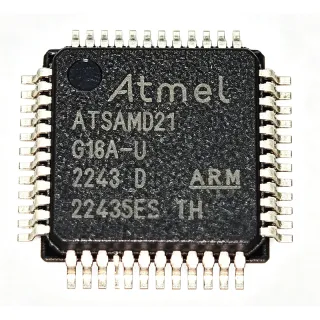
RTAX2000DL-1CQ352V - 2M-Gate Rad-Tolerant FPGA | Microchip
MPN: RTAX2000DL-1CQ352V ✓ Active| Qty | Unit Price | Extended |
|---|---|---|
| 1 | $3850 | $3,850.00 |
| 10 | $3620 | $36,200.00 |
| 100 | $3390 | $339,000.00 |
| 500 | $3150 | $1,575,000.00 |
| 1,000 | $2950 | $2,950,000.00 |
RTAX2000DL-1CQ352V Overview
A radiation-tolerant FPGA is a field-programmable gate array engineered to survive the ionizing radiation environment of space, where total ionizing dose (TID), single-event latchup (SEL), and single-event upsets (SEU) would degrade or destroy commercial devices. Within the power-management hierarchy of a spacecraft avionics system, the FPGA sits at the top of the digital logic hierarchy: semiconductor -> programmable logic device -> FPGA -> radiation-tolerant FPGA, providing one-time-programmable configuration that is live-at-power-up with no external boot memory required.
Key features of the RTAX2000DL include antifuse one-time programmability that eliminates configuration-volatile storage, true single-chip form factor reducing board area and mass, low static and dynamic power consumption, and the DSP-oriented DL variant with dedicated multiply-accumulate capability for onboard signal processing. The ceramic column-grid/package construction supports vacuum-outgassing and reliability requirements of space-flight programs.
Architecturally, the device is fabricated in advanced CMOS and organized as an array of combinational logic blocks with embedded SRAM and DSP blocks, connected by a segmented routing fabric permanently programmed by antifuse elements. Speed grade -1 devices meet timing across the military-relevant temperature range with a supply window of 1.425V to 1.575V.
Typical applications include satellite payload data processing, spacecraft bus control and telemetry, onboard radar and image signal processing, and remote-sensing downlink framing - anywhere SEU-immune, live-at-power-up logic is mandatory.
Design consideration: because the device is one-time-programmable, complete verification via the Aldec ACT-H3Ki-CQ352 footprint-compatible prototyping adaptor before programming is essential.
This page synthesizes verified distributor data, same-family drop-in variants, and design guidance not found in the manufacturer datasheet. Pricing as of 2026-09-02.
Drop-in alternatives for RTAX2000DL-1CQ352V — same package, pin-to-pin compatible. Different-package parts requiring PCB rework are excluded.
Variants in this series
Same-series models that are drop-in compatible with RTAX2000DL-1CQ352V (same form factor and footprint) — differing in Package, Configuration, Family, Technology, Equivalent System Gates.
Quick Comparison Tool — Select alternative parts for side-by-side comparison:
RTAX2000SL-1CQ352V
✅ Drop-In ⚠️ Specs Unverified✓ In Stock
$2050 / Unit
View Datasheet →RTAX2000DL-1CQ352B
✅ Drop-In ⚠️ Specs Unverified✓ In Stock
$3420 / Unit
View Datasheet →RTAX2000S-1CQ352V
✅ Drop-In ⚠️ Specs Unverified✓ In Stock
Contact for price
View Datasheet →RTAX2000D-1CQ352V
✅ Drop-In✓ In Stock
$3950 / Unit
View Datasheet →RTAX250SL-CQ352V
✅ Drop-In ⚠️ Specs Unverified✓ In Stock
Contact for price
View Datasheet →RTAX4000SL-CQ352EV
✅ Drop-In ⚠️ Specs Unverified✓ In Stock
$10250 / Unit
View Datasheet →RTAX1000SL-CQ352V
✅ Drop-In ⚠️ Specs Unverified✓ In Stock
Contact for price
View Datasheet →RTAX2000DL-1CQ352V Maximum Ratings & Electrical Characteristics
| Family | RTAX-DSP (RTAX2000DL) |
| Equivalent System Gates | 2,000,000 (approx.) |
| Logic Cells | 29,568 |
| CLBs | 19,712 |
| Core Supply Voltage | 1.425 V to 1.575 V (nominal 1.5 V) |
| Technology | Digital CMOS |
| Programming Technology | Antifuse (one-time programmable) |
| Radiation Tolerance | Radiation-tolerant (RTAX-DSP) |
| Configuration | Live at power-up, no external boot memory |
| Speed Grade | -1 |
| Package | CQ352 (352-pin ceramic QFP) |
| Mounting Type | Surface Mount |
| Application Domain | Space-flight systems |
| Special Features | DSP multiply-accumulate blocks (DL variant) |
RTAX2000DL-1CQ352V cq352 (352-pin ceramic qfp) Pin Configuration Guide
Pin configuration for RTAX2000DL-1CQ352V (cq352 (352-pin ceramic qfp) package). This digital IC includes GPIO, communication interfaces (UART, SPI, I2C), and power pins. Refer to the manufacturer datasheet for alternate pin functions and configuration options. Essential for embedded system design and PCB layout.

No detailed pinout data available for RTAX2000DL-1CQ352V.
Refer to the datasheet for full pin configuration.
Typical Applications
RTAX2000DL-1CQ352V is suitable for 6 applications: Satellite Payload Data Processing, Spacecraft Bus Control and Telemetry, Onboard Radar and Image Signal Processing, Remote-Sensing Downlink Framing, Launch Vehicle and Avionics Interface Logic, Deep-Space Instrumentation and Scientific Sensors.
Satellite Payload Data Processing
The RTAX2000DL-1CQ352V fits satellite payload processing because its 2-million-gate fabric, 29,568 logic cells, and DSP multiply-accumulate blocks handle compression, filtering, and formatting of sensor data at flight-qualified reliability. According to Microchip, RTAX-DSP devices combine low power with a true single-chip form factor and live-at-power-up operation, eliminating external boot memory that could fail under radiation. Deployed between the payload sensor interface and the downlink modulator, the FPGA provides deterministic, SEU-immune processing: the antifuse configuration cannot flip, so only registers need mitigation. The 1.425V-1.575V core rail keeps static power low for power-limited smallsat buses, while the CQ352 ceramic package meets outgassing and mechanical requirements for launch.
Recommended
Spacecraft Bus Control and Telemetry
For spacecraft command, telemetry, and housekeeping logic, the RTAX2000DL-1CQ352V supplies 19,712 CLBs of SEU-immune control logic that is live at power-up - a critical property for attitude-control and power-distribution circuits that must function immediately after launch-vehicle separation without configuration loading time. The antifuse fabric eliminates configuration-SEU concerns entirely, so designers need only register-level mitigation (triple modular redundancy) rather than full reconfiguration schemes. The narrow 1.425V-1.575V core window pairs cleanly with spacecraft point-of-load converters, and speed grade -1 timing margins across temperature support the deterministic interfaces of a spacecraft bus. The ceramic CQ352 package suits vacuum environments and standard hi-rel assembly flows.
Recommended
Onboard Radar and Image Signal Processing
The DL variant's dedicated DSP multiply-accumulate blocks make the RTAX2000DL-1CQ352V well suited to onboard synthetic-aperture radar, imaging, and hyperspectral preprocessing where hardware multipliers outperform CLB-based arithmetic in throughput and power efficiency. With roughly 2 million equivalent gates, a single device can implement FIR filter banks, FFT stages, and corner-turn buffers that would otherwise require multiple rad-tolerant chips, reducing board area, mass, and interconnect - key advantages cited by Microchip for RTAX-DSP space designs. Routing data between the ADC front end and the DSP pipeline inside one antifuse device also shortens critical paths and removes configuration-vulnerability from the processing chain, since the fabric is permanently programmed and immune to configuration upsets.
Recommended
Remote-Sensing Downlink Framing
Downlink framing, CCSDS-style formatting, and encryption-in-flight logic demand predictable latency and absolute configuration integrity - exactly what the antifuse RTAX2000DL-1CQ352V delivers. The device's 29,568 logic cells accommodate frame synchronizers, scramblers, Reed-Solomon outer coding, and pseudo-randomizer functions, while the 2-million-gate budget leaves headroom for channel adaptation. Because the configuration is programmed at the factory and live at power-up, the downlink chain is operational during the critical early-orbit phase with zero boot delay, and configuration SEU - a primary failure mode of SRAM FPGAs in orbit - is eliminated by construction. The 1.5V nominal core keeps the always-on transmitter-adjacent logic within typical spacecraft power allocations.
Recommended
Launch Vehicle and Avionics Interface Logic
Launch-vehicle avionics and flight-termination interface logic requires deterministic behavior under vibration, radiation, and wide temperature excursions. The RTAX2000DL-1CQ352V's ceramic CQ352 package and antifuse CMOS fabric address these constraints: no solder-ball BGA fatigue issues, no configuration memory to corrupt, and live-at-power-up operation from vehicle power application. The 1.425V-1.575V core specification tolerates rail droop during pyrotechnic events better than wider-tolerance 1.2V-class devices, provided upstream converters hold regulation. The 19,712-CLB organization comfortably implements bus bridges (MIL-STD-class interfaces), safing interlocks, and telemetry encoders in a single chip, supporting the true single-chip form factor Microchip promotes for space-flight systems.
Recommended
Deep-Space Instrumentation and Scientific Sensors
Deep-space instruments - spectrometers, magnetometers, particle detectors - need programmable glue logic and preprocessing that survives multi-year missions with accumulated total ionizing dose and galactic-cosmic-ray exposure. The RTAX2000DL-1CQ352V, from Microchip's RTAX radiation-tolerant family, is specified for space-flight systems and offers low power consumption, which is frequently the binding constraint when instruments share a Radioisotope Thermoelectric Generator power budget. Its antifuse configuration is intrinsically immune to configuration memory upsets, simplifying SEU mitigation to registered datapaths, and the 2-million-gate fabric implements instrument sequencers, histogram builders, and science-data packetizers on-chip. The 1.5V nominal core and speed grade -1 provide conservative timing margins essential for designs that must never be re-flown or serviced.
Recommended
Recommended Products Summary
Engineering reference data for RTAX2000DL-1CQ352V — comparison, design guidance, and compliance information.
Selection Guide
Comparison with Alternatives
| Parameter | This Product | RTAX2000SL-1CQ352V | RTAX2000DL-1CQ352B | RTAX2000S-1CQ352V | RTAX250SL-CQ352V | RTAX4000SL-CQ352EV |
|---|---|---|---|---|---|---|
| Package | CQ352 (352-pin ceramic QFP) | CQ352 - same | CQ352 - same | CQ352 - same | CQ352 - same | CQ352 - same |
| Brand | Microchip Technology | Microchip Technology | Microchip Technology | Microchip Technology | Microchip Technology | Microchip Technology |
| Core Supply Voltage | 1.425 V to 1.575 V (1.5 V nominal) | 1.425 V to 1.575 V | 1.425 V to 1.575 V | 1.425 V to 1.575 V | 1.425 V to 1.575 V | 1.425 V to 1.575 V |
| DSP Blocks | Yes (DL variant) | No | Yes | No | No | No |
| Programming Technology | Antifuse (OTP), live at power-up | Antifuse (OTP) | Antifuse (OTP) | Antifuse (OTP) | Antifuse (OTP) | Antifuse (OTP) |
Key Differentiators
- Dedicated DSP multiply-accumulate blocks (vs RTAX2000SL-1CQ352V)
- Highest-density option in the shared CQ352 footprint among 2000-class parts (vs RTAX250SL-CQ352V)
- Configuration-SEU immunity by construction (vs SRAM-based space FPGAs)
Design Notes
Design the core rail for 1.5V nominal with a tight 1.425V-1.575V window (about plus or minus 5 percent). Estimated: even small droop during high-current switching activity or pyrotechnic-induced bus transients can breach the lower limit, so size point-of-load converters with margin and verify worst-case IR drop across the CQ352 power/ground pin pairs. Decouple with low-ESR ceramics at each power pin group per the manufacturer datasheet power-supply recommendations; antifuse devices have no configuration inrush, but routing-buffer switching current still requires low-impedance distribution.
The RTAX2000DL is one-time programmable - a mis-programmed flight unit is unrecoverable. Use the footprint-compatible prototyping methodology described in the Microchip RTAX-S/SL and RTAX-DSP datasheet: validate the EDIF netlist on an SRAM FPGA adaptor board (for example the Aldec ACT-H3Ki-CQ352, which powers via the CQ352 leads and programs via onboard JTAG), run full timing simulation, then convert the netlist and pinout for the RTAX device. Never program flight hardware directly from an unverified RTL revision.
On a 352-pin ceramic QFP, distributed I/O banks and perimeter lead lengths create asymmetric flight times; for high-speed interfaces, perform IBIS-based reflection and crosstalk analysis and keep single-ended nets length-matched within the tolerance required by the receiving standard. Solid ground returns under each I/O bank reduce simultaneous-switching noise on the ceramic package. Because the device is often placed near sensitive RF receivers in payload designs, follow Microchip layout guidance for separating switching I/O from clock and analog reference pins.
Compliance Information
Space-flight ceramic-package device; RoHS/REACH exemption status for hi-rel ceramic packaging must be confirmed with Microchip for the specific lot. Qualification data (screening, TID, SEL/SEU) is program-specific and not published in the retrieved web data.