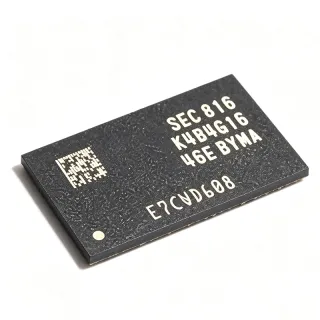
K4A4G085WF-BITD - DDR4 4Gb 2666Mbps DRAM | Samsung
Référence : K4A4G085WF-BITD ✓ Actif| Qté | Prix unitaire | Total |
|---|---|---|
| 1 | $3.45 | $3,45 |
| 10 | $3.2 | $32,00 |
| 100 | $2.95 | $295,00 |
| 500 | $2.8 | $1 400,00 |
| 1 000 | $2.65 | $2 650,00 |
K4A4G085WF-BITD Présentation
DDR4 SDRAM is a synchronous dynamic random-access memory, the successor to DDR3 in the DRAM voltage-regulator-to-memory hierarchy of a computing system. Compared with DDR3, DDR4 lowers operating voltage from 1.5 V to 1.2 V, doubles bank groups for higher bandwidth, and adds features such as DBI (data bus inversion), CA parity, and VPP (2.5 V wordline bootstrap supply), making it the mainstream memory standard for embedded, industrial, and networking processors with DDR4 memory controllers.
Key features of the K4A4G085WF family include 8 internal banks in 4 bank groups, burst lengths of 8 (BL8), on-die termination (ODT), dynamic ODT, write CRC, and optional address parity. The -BITD speed grade codes 2666 Mbps (CL19 typical at 1.2 V), and Samsung's FBGA packaging with fine-pitch ball interconnect supports high-speed signal integrity on 4-layer and higher PCB stacks.
Architecturally, the die uses Samsung's advanced DRAM process with bank-group pipelining, allowing back-to-back data bursts from different bank groups to reach the full 2666 MT/s pin speed. The x8 organization with a single DQ byte lane simplifies controller routing versus x16 parts and enables ECC via read-modify-write on boards that populate multiple x8 devices.
Typical applications include industrial embedded controllers, networking switches and routers, security/surveillance systems, test and measurement instruments, and edge computing gateways where the -40C to +95C industrial temperature rating is required.
Design consideration: DDR4 requires precise 2400-ohm-class ODT tuning and length-matched fly-by routing of clock/address/command lines; ensure your processor's memory controller reference design supports the -BITD CL19 timing set at 2666 MT/s.
This page synthesizes distributor pricing, drop-in alternatives, and practical DDR4 design notes not found in the manufacturer datasheet.
Alternatives de remplacement direct pour K4A4G085WF-BITD — même boîtier, compatible broche à broche. Les références à boîtier différent nécessitant une retouche du PCB sont exclues.
Variantes de cette série
Modèles de la même série directement compatibles avec K4A4G085WF-BITD (même facteur de forme et même empreinte) — différant par Package, Interface, Memory Type, Data Rate, Mounting Type.
Outil de comparaison rapide — sélectionnez des références alternatives pour une comparaison côte à côte :
K4A4G085WF-BCWE
✅ Remplacement direct📋 Alternative de référence (hors catalogue)
K4A4G085WD-BCRC
✅ Remplacement direct ⚠️ Spécifications non vérifiées✓ En stock
$3.58 / unité
Voir la fiche technique →K4A4G085WG-BCWE
✅ Remplacement direct ⚠️ Spécifications non vérifiées✓ En stock
$2.68 / unité
Voir la fiche technique →MT40A512M8RH-075E:B
✅ Remplacement direct✓ En stock
$2.15 / unité
Voir la fiche technique →K4A4G085WF-BITD Spécifications
| Type de mémoire | DDR4 SDRAM |
| Density | 4 Gbit |
| Organisation de la mémoire | 512M x 8 |
| Speed | 2666 Mbps (MT/s) |
| Supply Voltage (VDD) | 1.2 V |
| VPP Voltage | 2.5 V |
| Température de fonctionnement | -40C to +95C |
| Boîtier | 78-ball FBGA (78FBGA) |
| Bank Architecture | 8 banks x 4 bank groups |
| Burst Length | BL8 |
| Latence CAS | CL19 (typical at 2666 Mbps) |
| Type de montage | Surface Mount (BGA) |
| Interface | Parallel, DDR4 SSTL12 |
| Refresh | Self-refresh and auto-refresh (8K/64ms per JEDEC DDR4) |
| Termination | ODT / dynamic ODT |
| Data Mask | DM supported (x8) |
| Application Grade | Industrial |
Guide de configuration des broches du K4A4G085WF-BITD 78-ball fbga (78fbga)
Configuration des broches du K4A4G085WF-BITD (boîtier 78-ball fbga (78fbga)). La numérotation des broches, les fonctions et les schémas de connexion sont définis dans la fiche technique du fabricant. Consultez-la pour l'empreinte exacte et les directives de soudage.

Aucune donnée de brochage détaillée disponible pour K4A4G085WF-BITD.
Consultez la fiche technique pour la configuration complète des broches.
Applications typiques
K4A4G085WF-BITD convient pour 6 applications: Industrial Embedded Controllers, Networking Switches and Routers, Security and Surveillance Systems, Test and Measurement Instruments, Edge Computing Gateways, Automotive-Adjacent Telematics and Display Units.
Industrial Embedded Controllers
Industrial PLCs and embedded controllers benefit directly from the K4A4G085WF-BITD's -40C to +95C operating range, which covers cold-start in unheated cabinets and sustained 85C+ ambient near power electronics. Its 4 Gb density and 512M x 8 organization provide ample buffer space for protocol stacks and motion-control data, while the 2666 Mbps rate at 1.2 V keeps memory power low enough for passively cooled enclosures. Implemented as one or more x8 DDR4 components on the controller's JEDEC-standard 78-ball FBGA footprint, the device supports ODT and write CRC for signal integrity in electrically noisy factory environments, and the x8 lane simplifies length-matched routing on cost-sensitive 4-6 layer boards.
Recommandé
Networking Switches and Routers
Enterprise and industrial networking equipment requires high packet-buffer bandwidth, and the K4A4G085WF-BITD's 2666 Mbps pin speed with 4 bank groups enables interleaved accesses that sustain the throughput demanded by lookup tables, queue buffers, and statistics counters. The 512M x 8 organization with BL8 bursts aligns efficiently with typical 64-256 byte cacheline traffic, and write CRC improves data reliability on the write path at full speed. Multiple x8 devices can be combined with one additional x8 for side-band ECC, satisfying the error-rate budgets of carrier-grade platforms while keeping the 1.2 V rail efficient in always-on 24/7 operation.
Recommandé
Security and Surveillance Systems
IP cameras and NVR front ends need buffering for multi-stream video capture, and the K4A4G085WF-BITD's 4 Gb capacity stores multiple 1080p frame pipelines while its 2666 Mbps bandwidth sustains simultaneous capture and encode read-back. The -40C to +95C rating is essential for pole-mounted and outdoor housings that experience full solar load and sub-zero winters. At 1.2 V, the DRAM contributes a small share of the tight thermal budget of fanless camera enclosures, and Samsung's dynamic ODT helps maintain signal integrity on the short, low-cost PCB traces typical of camera modules.
Recommandé
Test and Measurement Instruments
Oscilloscopes, logic analyzers, and data acquisition systems use DRAM as deep capture memory, where the K4A4G085WF-BITD's 4 Gb density extends record length and its 2666 Mbps rate keeps up with high-speed ADC data streams after FIFO decimation. The x8 data path simplifies interleaving multiple devices into wide capture buses, and 4 bank groups allow the controller to hide tRCD latency across interleaved sample blocks. Industrial temperature rating supports benchtop and portable instruments used in non-conditioned environments, while the 1.2 V rail reduces internal heating that would otherwise degrade precision analog references.
Recommandé
Edge Computing Gateways
IoT and edge AI gateways running Linux require hundreds of megabytes of working memory; the K4A4G085WF-BITD provides 512 MB per device, and two devices reach 1 GB of 64-bit-plus-ECC memory. Its 2666 Mbps rate feeds both general-purpose workloads and small neural inference models, while DDR4's 1.2 V operation reduces total system power versus DDR3 solutions, extending thermal headroom in sealed gateway enclosures. The industrial -40C to +95C range and ODT-based signal integrity make it reliable on gateway boards with mixed digital/RF routing, and write CRC adds data-path protection for fleet-deployed units.
Recommandé
Automotive-Adjacent Telematics and Display Units
Non-safety telematics, digital clusters, and infotainment-adjacent modules use DDR4 for graphics buffering and application memory. While the K4A4G085WF-BITD is an industrial-grade part rather than AEC-Q100 automotive memory, its -40C to +95C rating matches many under-dash ambient profiles, and its 4 Gb density supports map rendering and 2D/3D graphics layers. Designers should evaluate the Samsung automotive-qualified DDR4 lines for safety-relevant applications, but for cost-driven commercial-vehicle accessories and aftermarket units, this component delivers 2666 Mbps bandwidth at low 1.2 V power with a JEDEC-standard footprint that eases second-sourcing.
Recommandé
Récapitulatif des produits recommandés
Données de référence d'ingénierie pour K4A4G085WF-BITD — comparaison, recommandations de conception et informations de conformité.
Guide de sélection
Comparaison avec les alternatives
| Paramètre | Ce produit | K4A4G085WF-BCWE | K4A4G085WD-BCRC | K4A4G085WG-BCWE | MT40A512M8RH-075E:B |
|---|---|---|---|---|---|
| Package | 78-ball FBGA | 78-ball FBGA - same | 78-ball FBGA - same | 78-ball FBGA - same | 78-ball FBGA - same (JEDEC ballout) |
| Brand | Samsung Electronics | Samsung Electronics | Samsung Electronics | Samsung Electronics | Micron Technology |
| Density | 4 Gbit | 4 Gbit | 4 Gbit | 4 Gbit | 4 Gbit |
| Organization | 512M x 8 | 512M x 8 | 512M x 8 | 512M x 8 | 512M x 8 |
| Speed Grade | 2666 Mbps | 3200 Mbps | 2666 Mbps class | 3200 Mbps | DDR4-2666 class (-075) |
| Supply Voltage | 1.2 V | 1.2 V | 1.2 V | 1.2 V | 1.2 V |
Principaux différenciateurs
- Industrial temperature rating at commodity DDR4 cost (vs MT40A512M8RH-075E:B)
- Speed-grade flexibility within the same footprint (vs K4A4G085WF-BCWE)
- JEDEC-standard x8 ballout enables true multi-vendor drop-in (vs K4A4G085WD-BCRC)
Notes de conception
Route the DDR4 fly-by topology for clock, address, and command lines with controlled impedance (40-50 ohm single-ended) and place the series termination resistor at the far end of the chain per the processor's memory design guide. Length-match DQ/DQS/DM groups within +/-25 mils intra-byte-lane; the x8 organization means one DQS pair serves DQ0-DQ7, which is more forgiving than x16 layouts. Reference VDDQ planes for all DDR4 signals and return CA/CK signals on a continuous VDD plane to avoid reference splits under the 78FBGA.
Provide two regulated rails: VDD/VDDQ at 1.2 V and VPP at 2.5 V. A point-of-load buck converter such as the TI TPS54218 family can supply the 1.2 V rail; size it for the sum of IDD0/IDD4R/IDD4W currents at 2666 MT/s from the Samsung datasheet IDD tables. Add bulk (22-47 uF) plus per-device 100 nF/10 nF decoupling capacitors immediately under the FBGA ball field via micro-vias. Do not omit VPP - it powers wordline charge pumps, and floating it can prevent initialization.
Three frequent DDR4 bring-up failures: (1) RESET# must be actively driven low during power-up - leaving it floating causes undefined state; sequence per JEDEC: VDD/VDDQ before RESET# release, CKE low until after RESET# deassert. (2) ODT settings must match the board topology; incorrect Rtt_NOM/Rtt_WR values cause read eye closure that mimics timing errors. (3) Industrial temperature operation above 85C requires a 2x refresh multiplier in the controller configuration - omitting it causes intermittent bit errors at high ambient.
Enable write CRC for data reliability at 2666 Mbps on longer traces, and use the controller's read/write leveling (DQS gating and write leveling) during bring-up to compensate for PCB skew. On 4-layer boards, keep DDR4 trace lengths under approximately 75 mm where possible; estimate flight-time skew budget as: propagation ~150 ps/inch FR-4, so a 3-inch trace adds ~450 ps against a ~750 ps UI at 2666 Mbps, leaving margin only with correct on-die termination.
Informations de conformité
RoHS/lead-free status inferred from current Samsung production DDR4 policy; REACH, halogen-free, and conflict-minerals declarations were not present in the provided web data and should be confirmed via Samsung's official product compliance documentation.