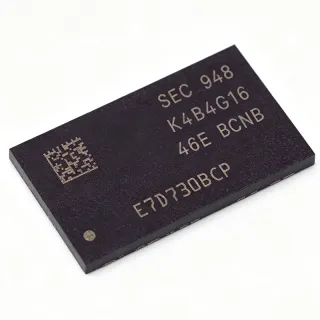
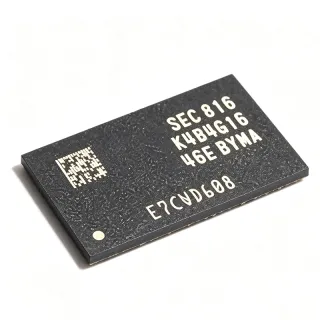
K4A4G085WF-BITD - DDR4 4Gb 2666Mbps DRAM | Samsung
MPN: K4A4G085WF-BITD ✓ Active| Qty | Unit Price | Extended |
|---|---|---|
| 1 | $3.45 | $3.45 |
| 10 | $3.2 | $32.00 |
| 100 | $2.95 | $295.00 |
| 500 | $2.8 | $1,400.00 |
| 1,000 | $2.65 | $2,650.00 |
K4A4G085WF-BITD Overview
DDR4 SDRAM is a synchronous dynamic random-access memory, the successor to DDR3 in the DRAM voltage-regulator-to-memory hierarchy of a computing system. Compared with DDR3, DDR4 lowers operating voltage from 1.5 V to 1.2 V, doubles bank groups for higher bandwidth, and adds features such as DBI (data bus inversion), CA parity, and VPP (2.5 V wordline bootstrap supply), making it the mainstream memory standard for embedded, industrial, and networking processors with DDR4 memory controllers.
Key features of the K4A4G085WF family include 8 internal banks in 4 bank groups, burst lengths of 8 (BL8), on-die termination (ODT), dynamic ODT, write CRC, and optional address parity. The -BITD speed grade codes 2666 Mbps (CL19 typical at 1.2 V), and Samsung's FBGA packaging with fine-pitch ball interconnect supports high-speed signal integrity on 4-layer and higher PCB stacks.
Architecturally, the die uses Samsung's advanced DRAM process with bank-group pipelining, allowing back-to-back data bursts from different bank groups to reach the full 2666 MT/s pin speed. The x8 organization with a single DQ byte lane simplifies controller routing versus x16 parts and enables ECC via read-modify-write on boards that populate multiple x8 devices.
Typical applications include industrial embedded controllers, networking switches and routers, security/surveillance systems, test and measurement instruments, and edge computing gateways where the -40C to +95C industrial temperature rating is required.
Design consideration: DDR4 requires precise 2400-ohm-class ODT tuning and length-matched fly-by routing of clock/address/command lines; ensure your processor's memory controller reference design supports the -BITD CL19 timing set at 2666 MT/s.
This page synthesizes distributor pricing, drop-in alternatives, and practical DDR4 design notes not found in the manufacturer datasheet.
Drop-in alternatives for K4A4G085WF-BITD — same package, pin-to-pin compatible. Different-package parts requiring PCB rework are excluded.
Variants in this series
Same-series models that are drop-in compatible with K4A4G085WF-BITD (same form factor and footprint) — differing in Package, Interface, Memory Type, Data Rate, Mounting Type.
Quick Comparison Tool — Select alternative parts for side-by-side comparison:
K4A4G085WF-BCWE
✅ Drop-In📋 Reference alternative (not in catalog)
K4A4G085WD-BCRC
✅ Drop-In ⚠️ Specs Unverified✓ In Stock
$3.58 / Unit
View Datasheet →K4A4G085WG-BCWE
✅ Drop-In ⚠️ Specs Unverified✓ In Stock
$2.68 / Unit
View Datasheet →MT40A512M8RH-075E:B
✅ Drop-In✓ In Stock
$2.15 / Unit
View Datasheet →K4A4G085WF-BITD Specifications
| Memory Type | DDR4 SDRAM |
| Density | 4 Gbit |
| Organization | 512M x 8 |
| Speed | 2666 Mbps (MT/s) |
| Supply Voltage (VDD) | 1.2 V |
| VPP Voltage | 2.5 V |
| Operating Temperature | -40C to +95C |
| Package | 78-ball FBGA (78FBGA) |
| Bank Architecture | 8 banks x 4 bank groups |
| Burst Length | BL8 |
| CAS Latency | CL19 (typical at 2666 Mbps) |
| Mounting Type | Surface Mount (BGA) |
| Interface | Parallel, DDR4 SSTL12 |
| Refresh | Self-refresh and auto-refresh (8K/64ms per JEDEC DDR4) |
| Termination | ODT / dynamic ODT |
| Data Mask | DM supported (x8) |
| Application Grade | Industrial |
K4A4G085WF-BITD 78-ball fbga (78fbga) Pin Configuration Guide
Pin configuration for K4A4G085WF-BITD (78-ball fbga (78fbga) package). Pin numbering, functions, and connection diagrams are defined in the manufacturer datasheet. Refer to it for the exact footprint and soldering guidelines.

No detailed pinout data available for K4A4G085WF-BITD.
Refer to the datasheet for full pin configuration.
Typical Applications
K4A4G085WF-BITD is suitable for 6 applications: Industrial Embedded Controllers, Networking Switches and Routers, Security and Surveillance Systems, Test and Measurement Instruments, Edge Computing Gateways, Automotive-Adjacent Telematics and Display Units.
Industrial Embedded Controllers
Industrial PLCs and embedded controllers benefit directly from the K4A4G085WF-BITD's -40C to +95C operating range, which covers cold-start in unheated cabinets and sustained 85C+ ambient near power electronics. Its 4 Gb density and 512M x 8 organization provide ample buffer space for protocol stacks and motion-control data, while the 2666 Mbps rate at 1.2 V keeps memory power low enough for passively cooled enclosures. Implemented as one or more x8 DDR4 components on the controller's JEDEC-standard 78-ball FBGA footprint, the device supports ODT and write CRC for signal integrity in electrically noisy factory environments, and the x8 lane simplifies length-matched routing on cost-sensitive 4-6 layer boards.
Recommended
Networking Switches and Routers
Enterprise and industrial networking equipment requires high packet-buffer bandwidth, and the K4A4G085WF-BITD's 2666 Mbps pin speed with 4 bank groups enables interleaved accesses that sustain the throughput demanded by lookup tables, queue buffers, and statistics counters. The 512M x 8 organization with BL8 bursts aligns efficiently with typical 64-256 byte cacheline traffic, and write CRC improves data reliability on the write path at full speed. Multiple x8 devices can be combined with one additional x8 for side-band ECC, satisfying the error-rate budgets of carrier-grade platforms while keeping the 1.2 V rail efficient in always-on 24/7 operation.
Recommended
Security and Surveillance Systems
IP cameras and NVR front ends need buffering for multi-stream video capture, and the K4A4G085WF-BITD's 4 Gb capacity stores multiple 1080p frame pipelines while its 2666 Mbps bandwidth sustains simultaneous capture and encode read-back. The -40C to +95C rating is essential for pole-mounted and outdoor housings that experience full solar load and sub-zero winters. At 1.2 V, the DRAM contributes a small share of the tight thermal budget of fanless camera enclosures, and Samsung's dynamic ODT helps maintain signal integrity on the short, low-cost PCB traces typical of camera modules.
Recommended
Test and Measurement Instruments
Oscilloscopes, logic analyzers, and data acquisition systems use DRAM as deep capture memory, where the K4A4G085WF-BITD's 4 Gb density extends record length and its 2666 Mbps rate keeps up with high-speed ADC data streams after FIFO decimation. The x8 data path simplifies interleaving multiple devices into wide capture buses, and 4 bank groups allow the controller to hide tRCD latency across interleaved sample blocks. Industrial temperature rating supports benchtop and portable instruments used in non-conditioned environments, while the 1.2 V rail reduces internal heating that would otherwise degrade precision analog references.
Recommended
Edge Computing Gateways
IoT and edge AI gateways running Linux require hundreds of megabytes of working memory; the K4A4G085WF-BITD provides 512 MB per device, and two devices reach 1 GB of 64-bit-plus-ECC memory. Its 2666 Mbps rate feeds both general-purpose workloads and small neural inference models, while DDR4's 1.2 V operation reduces total system power versus DDR3 solutions, extending thermal headroom in sealed gateway enclosures. The industrial -40C to +95C range and ODT-based signal integrity make it reliable on gateway boards with mixed digital/RF routing, and write CRC adds data-path protection for fleet-deployed units.
Recommended
Automotive-Adjacent Telematics and Display Units
Non-safety telematics, digital clusters, and infotainment-adjacent modules use DDR4 for graphics buffering and application memory. While the K4A4G085WF-BITD is an industrial-grade part rather than AEC-Q100 automotive memory, its -40C to +95C rating matches many under-dash ambient profiles, and its 4 Gb density supports map rendering and 2D/3D graphics layers. Designers should evaluate the Samsung automotive-qualified DDR4 lines for safety-relevant applications, but for cost-driven commercial-vehicle accessories and aftermarket units, this component delivers 2666 Mbps bandwidth at low 1.2 V power with a JEDEC-standard footprint that eases second-sourcing.
Recommended
Recommended Products Summary
Engineering reference data for K4A4G085WF-BITD — comparison, design guidance, and compliance information.
Selection Guide
Comparison with Alternatives
| Parameter | This Product | K4A4G085WF-BCWE | K4A4G085WD-BCRC | K4A4G085WG-BCWE | MT40A512M8RH-075E:B |
|---|---|---|---|---|---|
| Package | 78-ball FBGA | 78-ball FBGA - same | 78-ball FBGA - same | 78-ball FBGA - same | 78-ball FBGA - same (JEDEC ballout) |
| Brand | Samsung Electronics | Samsung Electronics | Samsung Electronics | Samsung Electronics | Micron Technology |
| Density | 4 Gbit | 4 Gbit | 4 Gbit | 4 Gbit | 4 Gbit |
| Organization | 512M x 8 | 512M x 8 | 512M x 8 | 512M x 8 | 512M x 8 |
| Speed Grade | 2666 Mbps | 3200 Mbps | 2666 Mbps class | 3200 Mbps | DDR4-2666 class (-075) |
| Supply Voltage | 1.2 V | 1.2 V | 1.2 V | 1.2 V | 1.2 V |
Key Differentiators
- Industrial temperature rating at commodity DDR4 cost (vs MT40A512M8RH-075E:B)
- Speed-grade flexibility within the same footprint (vs K4A4G085WF-BCWE)
- JEDEC-standard x8 ballout enables true multi-vendor drop-in (vs K4A4G085WD-BCRC)
Design Notes
Route the DDR4 fly-by topology for clock, address, and command lines with controlled impedance (40-50 ohm single-ended) and place the series termination resistor at the far end of the chain per the processor's memory design guide. Length-match DQ/DQS/DM groups within +/-25 mils intra-byte-lane; the x8 organization means one DQS pair serves DQ0-DQ7, which is more forgiving than x16 layouts. Reference VDDQ planes for all DDR4 signals and return CA/CK signals on a continuous VDD plane to avoid reference splits under the 78FBGA.
Provide two regulated rails: VDD/VDDQ at 1.2 V and VPP at 2.5 V. A point-of-load buck converter such as the TI TPS54218 family can supply the 1.2 V rail; size it for the sum of IDD0/IDD4R/IDD4W currents at 2666 MT/s from the Samsung datasheet IDD tables. Add bulk (22-47 uF) plus per-device 100 nF/10 nF decoupling capacitors immediately under the FBGA ball field via micro-vias. Do not omit VPP - it powers wordline charge pumps, and floating it can prevent initialization.
Three frequent DDR4 bring-up failures: (1) RESET# must be actively driven low during power-up - leaving it floating causes undefined state; sequence per JEDEC: VDD/VDDQ before RESET# release, CKE low until after RESET# deassert. (2) ODT settings must match the board topology; incorrect Rtt_NOM/Rtt_WR values cause read eye closure that mimics timing errors. (3) Industrial temperature operation above 85C requires a 2x refresh multiplier in the controller configuration - omitting it causes intermittent bit errors at high ambient.
Enable write CRC for data reliability at 2666 Mbps on longer traces, and use the controller's read/write leveling (DQS gating and write leveling) during bring-up to compensate for PCB skew. On 4-layer boards, keep DDR4 trace lengths under approximately 75 mm where possible; estimate flight-time skew budget as: propagation ~150 ps/inch FR-4, so a 3-inch trace adds ~450 ps against a ~750 ps UI at 2666 Mbps, leaving margin only with correct on-die termination.
Compliance Information
RoHS/lead-free status inferred from current Samsung production DDR4 policy; REACH, halogen-free, and conflict-minerals declarations were not present in the provided web data and should be confirmed via Samsung's official product compliance documentation.