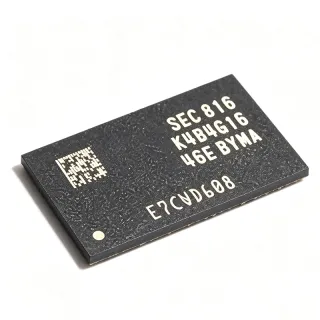
K9QDGB8U7M - Samsung NAND Flash Memory | Samsung Electronics
Référence : K9QDGB8U7M ✗ Fin de vie| Qté | Prix unitaire | Total |
|---|---|---|
| 1 | $0 | $0,00 |
| 10 | $0 | $0,00 |
| 100 | $0 | $0,00 |
| 500 | $0 | $0,00 |
| 1 000 | $0 | $0,00 |
K9QDGB8U7M Présentation
NAND flash is a type of non-volatile storage memory that retains data without power and is organized into blocks and pages to enable high-density, block-erasable storage. Within the memory hierarchy, NAND flash sits below DRAM in speed but above rotating media in ruggedness and density, making it the dominant technology for solid-state storage, eMMC modules, SSDs, and embedded firmware storage in consumer, industrial, and automotive systems.
Key characteristics of the K9 family include high storage density per package, a serial or toggle-style data interface for reduced pin count, block-protected operation, and compatibility with standard NAND controllers. Exact parameters such as page size, block size, program/erase cycle endurance, and read latency must be taken from the manufacturer datasheet for the specific device grade.
Technically, devices of this class rely on Samsung's charge-trap or floating-gate cell technology, with on-die charge pumps generating the high voltages needed for program and erase operations. Error-correcting code (ECC) is typically managed by the host controller rather than on-die, so system designers must budget ECC overhead in the storage subsystem.
Typical applications include embedded system firmware storage, set-top boxes, industrial control modules, networking equipment boot storage, and consumer electronics mass storage.
A key design consideration is wear-leveling: NAND blocks have finite erase cycles, so the host file system or controller must distribute writes evenly and reserve spare blocks, and power-loss protection must be designed into the supply rail.
This page synthesizes cross-reference resources, same-family alternates, and practical design guidance to supplement the manufacturer datasheet.
Alternatives de remplacement direct pour K9QDGB8U7M — même boîtier, compatible broche à broche. Les références à boîtier différent nécessitant une retouche du PCB sont exclues.
Variantes de cette série
Modèles de la même série directement compatibles avec K9QDGB8U7M (même facteur de forme et même empreinte) — différant par Memory Type, Package, Mounting Type, Package Type, Density.
Outil de comparaison rapide — sélectionnez des références alternatives pour une comparaison côte à côte :
K9HQGY8S5M
✅ Remplacement direct ⚠️ Spécifications non vérifiées✓ En stock
Contactez-nous pour le prix
Voir la fiche technique →K9PRGY8S7M
✅ Remplacement direct ⚠️ Spécifications non vérifiées✓ En stock
Contactez-nous pour le prix
Voir la fiche technique →K9PDG08U5M
✅ Remplacement direct ⚠️ Spécifications non vérifiées✓ En stock
$4.2 / unité
Voir la fiche technique →K9MDG08U5M
✅ Remplacement direct ⚠️ Spécifications non vérifiées✓ En stock
$35.5 / unité
Voir la fiche technique →K9PKGY8S7M-CCK0
✅ Remplacement direct ⚠️ Spécifications non vérifiées✓ En stock
$9.4 / unité
Voir la fiche technique →K9QDGB8U7M Valeurs maximales et caractéristiques électriques
| Manufacturer | Samsung Electronics |
| Product Family | K9 NAND Flash |
| Type de mémoire | NAND Flash |
| Package Type | BGA (surface mount) |
| Type de montage | Surface Mount |
Guide de configuration des broches du K9QDGB8U7M bga (surface mount)
Configuration des broches du K9QDGB8U7M (boîtier bga (surface mount)). Ce circuit intégré numérique comprend des GPIO, des interfaces de communication (UART, SPI, I2C) et des broches d'alimentation. Consultez la fiche technique du fabricant pour les fonctions alternatives des broches et les options de configuration. Indispensable pour la conception de systèmes embarqués et la conception de circuits imprimés.

Aucune donnée de brochage détaillée disponible pour K9QDGB8U7M.
Consultez la fiche technique pour la configuration complète des broches.
Applications typiques
K9QDGB8U7M convient pour 6 applications: Embedded Firmware Storage, Consumer Electronics Mass Storage, Industrial Control and HMI Storage, Networking Equipment Boot Storage, Automotive Infotainment and Telematics, IoT Gateways and Smart Home Hubs.
Embedded Firmware Storage
Samsung K9-family NAND such as the K9QDGB8U7M is widely used to store bootloaders, kernels, and root filesystems in embedded systems. The BGA package suits compact, soldered-down designs where field replacement is impossible, so data integrity mechanisms are essential. The host controller must supply ECC (BCH or LDPC per the generation) and a flash translation layer with wear-leveling, because raw NAND blocks have finite program/erase cycles. Placed on a dedicated NAND chip-select with ready/busy monitoring, the device provides non-volatile storage that survives power loss without battery backup. Designers should reserve spare blocks and implement bad-block skip to sustain reliability over the product lifetime.
Recommandé
Consumer Electronics Mass Storage
In set-top boxes, smart TVs, and digital media devices, K9-family NAND flash provides affordable high-density storage for application code, channel databases, and recorded content metadata. The Samsung K9QDGB8U7M's BGA footprint integrates directly onto the main board, reducing connector cost versus removable cards. A NAND controller manages page programming with correct command sequencing and enforces the datasheet-specified program/erase timing. Because consumer workloads are write-light, endurance is rarely the limiting factor; instead, retention and ECC strength dominate. Designers benefit from Samsung's long-life K9 supply chain and documented controller reference designs when qualifying this device class.
Recommandé
Industrial Control and HMI Storage
Industrial controllers and human-machine interfaces use NAND flash like the K9QDGB8U7M for configuration data, logging, and firmware images that must survive power interruptions and wide temperature swings. The soldered BGA package withstands vibration better than socketed solutions. Designers must implement power-fail recovery: complete atomic page writes, journal the file system, and validate block integrity at boot. Conformal-coated boards are compatible with the package surface. Selecting the correct operating-temperature grade from the Samsung datasheet is critical, as commercial grades may not cover the -40C to +85C industrial envelope required on factory floors.
Recommandé
Networking Equipment Boot Storage
Routers, switches, and access points rely on NAND flash such as the K9QDGB8U7M to hold bootloader, OS image, and configuration files. The device's non-volatile storage enables dual-image (A/B) firmware schemes: the network device validates a new image in NAND before switching the active boot slot, enabling safe over-the-network upgrades. Read latency and interface bandwidth influence boot time; verifying the device's toggle/ONFI timing parameters against the controller is essential. Redundant ECC and bad-block tables stored in reserved blocks protect configuration integrity across years of continuous 24/7 operation in telecommunications cabinets.
Recommandé
Automotive Infotainment and Telematics
Automotive head units and telematics control units use NAND flash families like the Samsung K9 line for navigation maps, media caching, and firmware. When an automotive-qualified variant is required, designers should verify the exact grade suffix, since standard K9 parts may not be AEC-Q100 qualified. The BGA package supports the compact, thermally demanding layouts typical of dashboard electronics, where sustained temperatures reach 85C ambient. Controllers must manage aggressive write workloads (map updates, logs) with robust wear-leveling, and power-fail protection circuits must guard against ignition transients corrupting in-flight page programs.
Recommandé
IoT Gateways and Smart Home Hubs
IoT gateways use NAND flash like the K9QDGB8U7M to store device certificates, firmware, and locally cached sensor data between cloud synchronizations. The soldered-down BGA package prevents tampering compared with removable SD cards, supporting secure-boot chains that hash the stored image at every startup. Storage sizing must account for log rotation and firmware staging: over-provisioning spare area extends endurance under small, frequent writes typical of telemetry. Pairing the NAND with a low-power controller that supports partial-page programming and deep power-down modes helps keep gateway standby current within battery or energy-harvesting budgets.
Recommandé
Récapitulatif des produits recommandés
Données de référence d'ingénierie pour K9QDGB8U7M — comparaison, recommandations de conception et informations de conformité.
Guide de sélection
Comparaison avec les alternatives
| Paramètre | Ce produit | K9HQGY8S5M | K9PRGY8S7M | K9PDG08U5M |
|---|---|---|---|---|
| Package | BGA (surface mount) | BGA | BGA | BGA |
| Brand | Samsung Electronics | Samsung Electronics | Samsung Electronics | Samsung Electronics |
| Memory Type | NAND Flash (K9 family) | NAND Flash (K9 family) | NAND Flash (K9 family) | NAND Flash (K9 family) |
Principaux différenciateurs
- Long-established K9 family supply chain (vs K9PDG08U5M)
- Speed-grade suffix option (vs K9PRGY8S7M-CCK0)
- Soldered BGA form factor (vs K9XXG08U0M (TSOP))
Notes de conception
Verify VCC and VCCQ rails and their power-ramp/sequencing requirements from the official Samsung K9QDGB8U7M datasheet before power design. NAND flash requires the supply to reach operating voltage within the datasheet-specified ramp rate; slow or unstable power-up can leave internal bad-block tables uninitialized. Add bulk capacitance near the device because program operations draw short current pulses, and ensure power-fail protection so an interrupted page program does not corrupt adjacent pages.
For BGA NAND flash, fan out data, command/address, and control lines with matched lengths where the controller runs toggle-DDR or ONFI timing; follow Samsung's layout guidelines for via-in-pad or dog-bone fanout of the ball array. Keep the ready/busy line short and pull it up with the specified resistor value. Provide solid ground return under the package to reduce simultaneous-switching noise on the data bus during high-speed reads.
The most common K9-family NAND integration errors are: operating without datasheet-specified ECC strength, ignoring bad-block management (initial bad blocks shipped from the factory are marked in the first pages of each block and must be scanned and skipped), and assuming cross-generation command-set compatibility. Samsung NAND generations change page size, timing, and ECC requirements - always re-qualify controller firmware when substituting any K9-family part number.
Informations de conformité
Compliance status not found in verified data as of 2026-09-04. Request Samsung's official material declaration and environmental reports for the exact part number and date code.