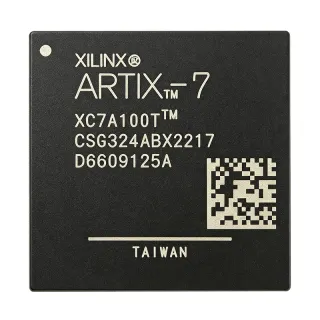
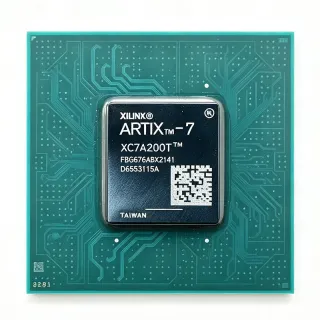
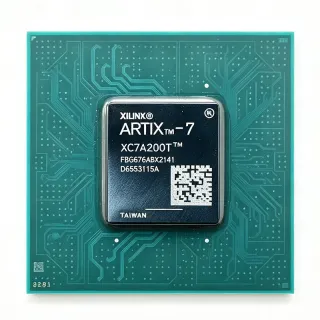
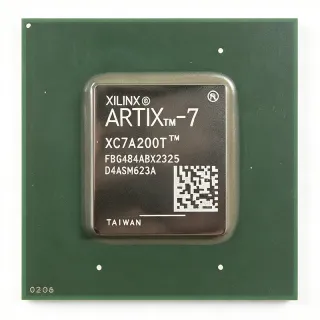
A54SX32A-1PQG208I - SX-A FPGA 48K Gates 208-PQFP | Microchip
MPN: A54SX32A-1PQG208I ✓ Active| Qty | Unit Price | Extended |
|---|---|---|
| 1 | $68.5 | $68.50 |
| 10 | $62.3 | $623.00 |
| 100 | $55.9 | $5,590.00 |
| 500 | $50.1 | $25,050.00 |
| 1,000 | $44.75 | $44,750.00 |
A54SX32A-1PQG208I Overview
An FPGA (Field-Programmable Gate Array) is a semiconductor device that implements digital logic through programmable interconnect and configurable logic blocks (CLBs), sitting above standard logic ICs and below ASICs in the programmable-logic hierarchy. The SX-A family uses a one-time-programmable antifuse architecture, which means the configuration is hard-wired at programming time rather than loaded from an external configuration memory at every power-up, giving inherent immunity to configuration readback and radiation-induced configuration upset.
Key features include 2880 CLBs, 174 user I/O pins, 2.5V core operation, and a -1 speed grade supporting toggle rates up to 278 MHz. The antifuse fabric provides low on-resistance interconnect and deterministic routing delays, while total static power is far lower than SRAM FPGAs of similar density, making the family attractive for power-sensitive, high-reliability designs.
Technically, the SX-A architecture combines sea-of-modules logic with a three-level metal routing fabric on a 0.25 um CMOS process. The D-module (combinational) and R-module (register-capable) cells give an efficient mix for both datapath and control logic. Because the antifuse is programmed once, design changes require a new device - a deliberate trade of flexibility for security, cost, and reliability.
Typical applications include industrial control and automation glue logic, communications interface bridging, aerospace and defense systems that benefit from configuration immunity, and medical equipment requiring stable single-chip logic integration.
Design consideration: the 2.5V core requires a dedicated supply rail and correct power sequencing relative to I/O banks; plan the 208-pin PQFP land pattern and thermal relief early since the package is not drop-in compatible with other footprints.
This page synthesizes distributor pricing, same-footprint alternatives, and practical design notes beyond what the manufacturer datasheet alone provides.
Drop-in alternatives for A54SX32A-1PQG208I — same package, pin-to-pin compatible. Different-package parts requiring PCB rework are excluded.
Variants in this series
Same-series models that are drop-in compatible with A54SX32A-1PQG208I (same form factor and footprint) — differing in Package, Family, System Gates, RoHS Status, Process Technology.
Quick Comparison Tool — Select alternative parts for side-by-side comparison:
A54SX32A-PQG208I
✅ Drop-In📋 Reference alternative (not in catalog)
A54SX32A-2PQG208I
✅ Drop-In✓ In Stock
$47.95 / Unit
View Datasheet →A54SX32A-1PQG208
✅ Drop-In📋 Reference alternative (not in catalog)
A54SX32A-PQG208
✅ Drop-In📋 Reference alternative (not in catalog)
A54SX32-1PQG208I
✅ Drop-In✓ In Stock
$44.9 / Unit
View Datasheet →A54SX32-PQ208I
✅ Drop-In✓ In Stock
$272.19 / Unit
View Datasheet →A54SX32A-1PQG208I Maximum Ratings & Electrical Characteristics
| Family | SX-A (antifuse FPGA) |
| System Gates | 48K |
| Logic Gates | 32K |
| Logic Cells / Modules | 1800 |
| CLBs | 2880 |
| User I/O | 174 |
| Maximum Toggle Frequency | 278 MHz |
| Speed Grade | -1 |
| Supply Voltage (Core) | 2.5 V |
| Process Technology | 0.25 um CMOS |
| Programming Technology | Antifuse (one-time programmable) |
| Package | 208-Pin PQFP (PQG208 / 208-BFQFP), 0.5 mm pitch |
| Operating Temperature | Industrial (-40C to +85C) |
| Mounting Type | Surface Mount |
| RoHS Status | Lead Free (per distributor data) |
| Packaging | Tray |
A54SX32A-1PQG208I 208-pin pqfp (pqg208 / 208-bfqfp), 0.5 mm pitch Pin Configuration Guide
Pin configuration for A54SX32A-1PQG208I (208-pin pqfp (pqg208 / 208-bfqfp), 0.5 mm pitch package). This digital IC includes GPIO, communication interfaces (UART, SPI, I2C), and power pins. Refer to the manufacturer datasheet for alternate pin functions and configuration options. Essential for embedded system design and PCB layout.

No detailed pinout data available for A54SX32A-1PQG208I.
Refer to the datasheet for full pin configuration.
Typical Applications
A54SX32A-1PQG208I is suitable for 6 applications: Industrial Control and Automation, Aerospace and Defense Systems, Communications Interface Bridging, Medical Equipment Logic Integration, Test and Measurement Instrumentation, Legacy System Sustainment and Reverse Logistics.
Industrial Control and Automation
The A54SX32A-1PQG208I fits factory automation, motor-control sequencers, and PLC I/O subsystems where deterministic logic and long product lifecycles matter more than reprogrammability. Its 48K system gates and 2880 CLBs absorb glue logic, address decoders, counters, and state machines that would otherwise occupy many 74-series devices, cutting board area and BOM count in a single 208-pin PQFP. The industrial -40C to +85C rating matches typical factory-floor ambient extremes, and the antifuse fabric tolerates electrically noisy environments because configuration cannot be corrupted by power glitches or SEUs. Deployed between a microcontroller and high-current drivers, it adds no configuration boot delay at power-up - logic is active immediately, which simplifies bring-up sequencing in machinery with hard real-time startup requirements.
Recommended
Aerospace and Defense Systems
The antifuse configuration of the A54SX32A-1PQG208I is a decisive advantage in defense and avionics payloads: configuration data is physically programmed into the fabric, so there is no bitstream to read back, intercept, or corrupt through radiation-induced configuration upset - the failure mode that plagues SRAM FPGAs in orbit and at altitude. With 32K gates, 1800 cells, and up to 278 MHz toggle rates on the -1 grade, the device implements telemetry encoders, bus bridges, and payload sequencing logic at a fraction of an ASIC NRE cost. The 2.5V core keeps static power low for battery- and solar-constrained platforms. Industrial temperature coverage plus tray packaging supports both qualification builds and low-volume production runs typical of defense programs.
Recommended
Communications Interface Bridging
In networking and telecom line cards, the A54SX32A-1PQG208I bridges protocol controllers, backplane interfaces, and physical-layer devices. The 174 user I/Os in the 208-pin PQFP provide enough parallel pins to interface multiple 8/16-bit buses simultaneously, while the -1 speed grade's 278 MHz toggle capability comfortably covers 100 MHz-class synchronous interfaces. Antifuse routing delays are deterministic and set at programming time, simplifying timing closure on fixed-frequency bus bridges - unlike SRAM FPGAs whose timing can shift with each recompile. Low standby current benefits always-on infrastructure equipment. Designers should verify I/O bank voltage compatibility with 3.3V signaling peers and budget the 2.5V core rail separately in the card's power tree.
Recommended
Medical Equipment Logic Integration
Diagnostic and monitoring instruments - patient monitors, analyzers, imaging front ends - use the A54SX32A-1PQG208I to consolidate sensor-interface glue logic, timing generators, and acquisition-sequencing state machines. Configuration immunity matters in medical devices: once programmed and verified, the antifuse fabric cannot silently alter behavior across power cycles, supporting design history files and regulatory validation documentation. The 48K gate density absorbs counters, UARTs, and handshake logic between the analog front end and the host processor, while the 2.5V core minimizes internal heat dissipation inside sealed enclosures with limited airflow. The 208-pin PQFP's 0.5 mm pitch is hand-reviewable for design verification, and industrial-grade temperature coverage provides margin over clinical operating specifications.
Recommended
Test and Measurement Instrumentation
Bench instruments and automated test equipment exploit the A54SX32A-1PQG208I's deterministic antifuse timing for trigger generators, timing-pattern generators, and measurement-sequencing logic. The -1 grade's 278 MHz toggle rating supports sub-10 ns timing resolution in counter/timer chains, and the 2880 CLBs provide enough registers for deep event pipelines without external FIFO logic. Because routing delays never change after programming, calibration constants derived at production test remain valid for the life of the instrument - a real advantage over reprogrammable fabrics that invite accidental firmware drift. The 174 I/Os connect boundary-scan chains and parallel measurement buses; designers should reserve JTAG access for programming and verify the 2.5V core supply sequencing against the instrument's main rail.
Recommended
Legacy System Sustainment and Reverse Logistics
Programs maintaining fielded electronics - railway signaling, energy metering, military spares pools - rely on the A54SX32A-1PQG208I to keep proven designs alive without PCB respins. The part remains in Microchip's active catalog with continued distributor stock (DigiKey ships today as of 2026-09-03), and its pin-compatible siblings (A54SX32A-PQG208I, A54SX32A-2PQG208I) create second-source options within the same footprint. Because the antifuse design is compiled once and frozen, sustainment teams can reprogram replacement devices from archived design files with no board modification. Procurement teams should secure lot-consistent stock for end-of-life insurance given the 0.25 um process generation, and maintain Libero/Designer project archives for future reprogramming needs.
Recommended
Recommended Products Summary
Engineering reference data for A54SX32A-1PQG208I — comparison, design guidance, and compliance information.
Selection Guide
Comparison with Alternatives
| Parameter | This Product | A54SX32A-PQG208I | A54SX32A-2PQG208I | A54SX32A-1PQG208 | A54SX32-1PQG208I | A54SX32-PQ208I |
|---|---|---|---|---|---|---|
| Package | 208-Pin PQFP (PQG208) | 208-Pin PQFP (PQG208) - same | 208-Pin PQFP (PQG208) - same | 208-Pin PQFP (PQG208) - same | 208-Pin PQFP (PQG208) - same | 208-Pin PQFP (PQ208) - verify mechanicals |
| Brand | Microchip Technology (Actel/Microsemi) | Microchip Technology | Microchip Technology | Microchip Technology | Microchip Technology | Microchip Technology |
| System Gates | 48K | 48K | 48K | 48K | 36K (SX, non-A family) | 36K (SX, non-A family) |
| Speed Grade | -1 | Standard | -2 (faster) | -1 | -1 | Standard |
| Temperature Range | Industrial (-40C to +85C) | Industrial | Industrial | Commercial (0C to +70C) | Industrial | Industrial |
Key Differentiators
- Faster -2 speed grade available pin-to-pin (vs A54SX32A-2PQG208I)
- Industrial temperature coverage (vs A54SX32A-1PQG208)
- Higher-density SX-A die versus legacy SX family (vs A54SX32-1PQG208I)
- Zero configuration-boot overhead (vs SRAM FPGAs of similar density)
Design Notes
Provide a dedicated, well-decoupled 2.5V core rail separate from I/O bank supplies. Decouple each VCC/GND pin pair with at least 0.1 uF ceramic capacitors placed within 2 mm of the pin, plus bulk 10 uF per rail. Antifuse FPGAs draw low static current, so rail sizing is dominated by dynamic toggling current - estimate it with Microchip Designer's power tool for your compiled netlist rather than using family-typical numbers. Confirm rail sequencing order against the SX-A datasheet power-up specifications to avoid latch-up during hot insertion.
The 208-pin PQFP uses 0.5 mm lead pitch; specify the land pattern from the SX-A datasheet mechanical drawing (QG208 package) and allow 1-2 mm solder-fillet inspection margin for AOI. Fan out with 0.2 mm traces/via-in-pad avoided; use dog-bone fanout on outer layers. Keep the exposed die area under the package free of buried high-speed traces to minimize crosstalk into I/O ring returns. Program devices before board-level reflow where the flow allows, since antifuse programming is irreversible - a mis-programmed part cannot be recovered.
The most common SX-A pitfall is assuming SRAM-FPGA workflow: there is no configuration PROM, no bitstream update in the field, and no partial reconfiguration. Every logic change requires a fresh device and reprogramming. Second, do not substitute the -1 grade with a slower or SX (non-A) part without re-running static timing in Microchip Designer - the A54SX32A and A54SX32 differ in die and timing. Third, archive Libero/Designer project files and programmer settings; losing them strands future builds even with physical stock on hand.
Estimated: at moderate dynamic utilization the device dissipates well under 1 W, and the 208-pin PQFP theta_JA of roughly 30-40 C/W (verify the exact figure in the SX-A thermal table for your airflow condition) yields a junction rise below 40 C over 85 C ambient - within the industrial rating. For heavy-duty clocking near the 278 MHz limit, compute P = f * C * V^2 * activity in the Designer power tool and add copper pour under the package if junction margin falls below 15 C.
Compliance Information
Kynix listing identifies A54SX32A-1PQG208I as LEAD FREE; Microchip ships mature Actel parts RoHS-compliant. REACH, halogen-free, and conflict-minerals declarations not found in retrieved data - request official Microchip environmental certificates.