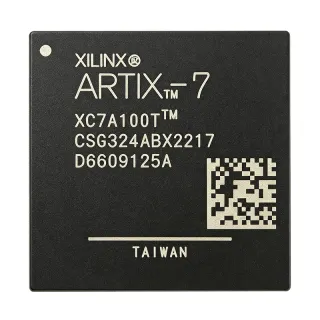
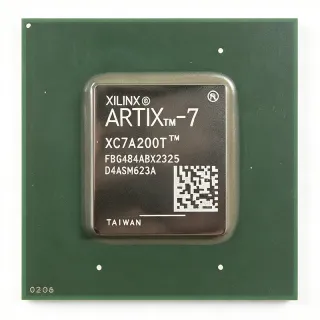
EP1M350F780-C7 - Mercury 1440-LAB FPGA, 486 I/O, 1.25Gbps CDR BGA-780
MPN: EP1M350F780-C7 ✗ End of Life| Qty | Unit Price | Extended |
|---|---|---|
| 1 | $145 | $145.00 |
| 10 | $132 | $1,320.00 |
| 100 | $119 | $11,900.00 |
| 500 | $105 | $52,500.00 |
| 1,000 | $92 | $92,000.00 |
EP1M350F780-C7 Overview
A Field-Programmable Gate Array (FPGA) is a reconfigurable semiconductor that allows hardware designers to implement custom digital logic after manufacturing. FPGAs sit within the programmable logic hierarchy: PLD -> CPLD -> FPGA -> structured ASIC. Unlike fixed-function ASICs, FPGAs are programmed via configuration bitstreams stored in SRAM cells, enabling rapid prototyping, in-field upgrades, and hardware emulation of complex digital systems such as bus interfaces, DSP pipelines, and high-speed serial links.
Key specifications include: 1440 logic array blocks (LABs), 486 user I/Os, integrated high-speed transceivers (CDR) supporting 8 channels at 1.25 Gbps with the remaining 10 channels limited to 1.0 Gbps or less, -7 commercial speed grade, 1.8V core supply, and 0 to 85 degrees C commercial operating temperature range. The device is fabricated on a CMOS process with SRAM-based configuration memory.
Architecturally, the Mercury family combines a 4-input look-up table (LUT) fabric with embedded multiplier/accumulator blocks, dedicated LVDS serializer/deserializer (SERDES) channels, and clock management tiles that together provide the throughput needed for telecom backplanes, video bridges, and embedded computing applications. The BGA-780 FineLine package supports 486 usable I/Os while preserving signal integrity at multi-gigabit data rates.
Typical applications include high-speed serial interface bridges, telecom line card prototyping, industrial imaging pipelines, and embedded processing subsystems that require parallel logic with selective high-speed serial links.
When designing with this device, ensure PCB designers follow the FineLine BGA breakout pattern with matched-length differential routing on all CDR channels, and reserve sufficient decoupling capacitance near every power pin to meet the 1.8V core supply tolerance under dynamic load.
This page synthesizes distributor pricing, drop-in same-package alternatives from the Mercury and ACEX families, and practical design considerations not found in the manufacturer datasheet.
Drop-in alternatives for EP1M350F780-C7 — same package, pin-to-pin compatible. Different-package parts requiring PCB rework are excluded.
Variants in this series
Same-series models that are drop-in compatible with EP1M350F780-C7 (same form factor and footprint) — differing in Operating Temperature, Package, Speed Grade, Family, RoHS Status.
Quick Comparison Tool — Select alternative parts for side-by-side comparison:
EP1M350F780C7N
✅ Drop-In ⚠️ Specs Unverified✓ In Stock
$168 / Unit
View Datasheet →EP1M350F780C6
✅ Drop-In ⚠️ Specs Unverified✓ In Stock
$905 / Unit
View Datasheet →EP1M350F780C5
✅ Drop-In ⚠️ Specs Unverified✓ In Stock
$1303 / Unit
View Datasheet →EP1M350B780C7
✅ Drop-In ⚠️ Specs Unverified✓ In Stock
$92 / Unit
View Datasheet →EP1M350B780C6
✅ Drop-In ⚠️ Specs Unverified✓ In Stock
$125 / Unit
View Datasheet →EP1M350F780-C7 Maximum Ratings & Electrical Characteristics
| Family | Mercury |
| Logic Family | CMOS (SRAM-based) |
| Logic Array Blocks (LABs) | 1440 |
| User I/Os | 486 |
| Supply Voltage (Core) | 1.8 V |
| High-Speed Transceiver Channels | 18 (8 up to 1.25 Gbps, 10 up to 1.0 Gbps) |
| Max CDR Data Rate | 1.25 Gbps |
| Speed Grade | -7 (commercial) |
| Operating Temperature | 0C to +85C (commercial) |
| Package | BGA-780 (FineLine) |
| Pin Count | 780 |
| Package Form | Surface Mount, Ball Grid Array |
| Configuration Memory | SRAM (volatile, requires external config device) |
| RoHS Status | unknown |
| Lifecycle Status | Obsolete (Mercury family EOL) |
EP1M350F780-C7 surface mount, ball grid array Pin Configuration Guide
Pin configuration for EP1M350F780-C7 (surface mount, ball grid array package). This digital IC includes GPIO, communication interfaces (UART, SPI, I2C), and power pins. Refer to the manufacturer datasheet for alternate pin functions and configuration options. Essential for embedded system design and PCB layout.

No detailed pinout data available for EP1M350F780-C7.
Refer to the datasheet for full pin configuration.
Typical Applications
EP1M350F780-C7 is suitable for 6 applications: Telecom Backplane Serial Interface, Video Bridge and Image Pipeline, Industrial Imaging and Machine Vision, Embedded Computing Subsystem, High-Speed Serial Protocol Converter, Prototyping and Hardware Emulation.
Telecom Backplane Serial Interface
The EP1M350F780-C7's 18 integrated high-speed transceivers with clock data recovery up to 1.25 Gbps make it well suited for telecom backplane serial interface bridges where multi-channel SERDES links replace parallel bus cabling. Its 1440 LAB fabric absorbs the sideband logic, link-layer framing, and clock-domain crossing required between backplane lanes. Placed on the line card as the central protocol converter, it reduces component count versus an ASSP plus external PHY architecture. The BGA-780 FineLine package preserves signal integrity on the differential CDR pairs and supports the 486 general-purpose I/Os needed for status LEDs, alarms, and board management. Engineers should follow the Mercury datasheet reference design for AC-coupling capacitor placement on every CDR channel.
Recommended
Video Bridge and Image Pipeline
In video bridge and image pipeline designs, the EP1M350F780-C7 acts as the format converter between Camera Link, LVDS, or DVI input ports and a parallel processing ASIC or memory buffer. The 1440 LABs deliver the parallel multiply-accumulate throughput needed for color-space conversion and basic filtering at HD video rates, while the integrated 1.25 Gbps CDR channels accept uncompressed serial video streams. The 486 user I/Os support wide parallel data buses without external bus drivers. Compared to a discrete SERDES plus FPGA, the integrated CDR reduces BOM cost and PCB area. Designers should allocate LAB resources so that image buffers fit in distributed RAM and route LVDS pairs with controlled impedance.
Recommended
Industrial Imaging and Machine Vision
For industrial imaging and machine vision, the EP1M350F780-C7 delivers the deterministic low-latency logic required for real-time frame capture from multiple CMOS sensors and the high-speed serial links to send processed images upstream. The 1440 LABs implement Bayer demosaicing, lens distortion correction, and region-of-interest extraction at line-rate, while the CDR channels carry gigabit Ethernet or proprietary image links. The BGA-780 FineLine package withstands typical factory floor vibration when properly socketed or PCB-secured. Designers should leverage the embedded multiplier blocks for pixel-rate DSP and reserve dedicated clock-management tiles for sensor pixel-clock synthesis.
Recommended
Embedded Computing Subsystem
In embedded computing subsystems, the EP1M350F780-C7 functions as a co-processor that offloads DSP, packet processing, or protocol bridging from the host CPU. The 1440 LABs provide ample logic for custom accelerators, while the integrated CDR channels connect to RapidIO, PCI Express, or proprietary high-speed links to upstream compute nodes. The 486 user I/Os interface to DDR memory, flash storage, and local peripheral buses. Designers gain a reconfigurable platform that can be repurposed for different SKUs by reloading the configuration bitstream, reducing hardware variants. The Mercury datasheet application notes provide reference memory controller and PCIe soft-core implementations.
Recommended
High-Speed Serial Protocol Converter
The EP1M350F780-C7 excels as a high-speed serial protocol converter between incompatible interfaces such as Serial RapidIO, Aurora, or custom LVDS links. Its 18 CDR channels support up to 8 lanes at 1.25 Gbps simultaneously, enabling multi-link aggregation or redundancy for fault-tolerant designs. The 1440 LABs implement framing, scrambling, and CRC logic in firmware while leaving LAB margin for protocol-specific extensions. The BGA-780 FineLine package allows dense PCB layout with controlled-impedance differential routing on every CDR pair. Engineers should validate link training sequences against the Mercury datasheet reference design before committing to volume PCB builds.
Recommended
Prototyping and Hardware Emulation
For ASIC prototyping and hardware emulation, the EP1M350F780-C7 offers a 1440-LAB reconfigurable fabric with sufficient capacity to map small to mid-sized ASIC RTL blocks plus verification infrastructure. The integrated CDR channels emulate multi-gigabit ASIC SERDES interfaces, allowing pre-silicon validation of mixed parallel/serial designs. Engineers can iterate RTL by simply recompiling the configuration bitstream without respinning the PCB. Compared to simulation, real-time in-hardware execution catches timing bugs and bus contention issues that pure simulation misses. The Mercury datasheet provides the configuration bitstream format and JTAG programming guidelines required for emulation flows.
Recommended
Recommended Products Summary
Engineering reference data for EP1M350F780-C7 — comparison, design guidance, and compliance information.
Selection Guide
Comparison with Alternatives
| Parameter | This Product | EP1M350F780C7N | EP1M350F780C6 | EP1M350F780C5 | EP1M350B780C7 | EP1M350B780C6 |
|---|---|---|---|---|---|---|
| Brand | Altera | Altera | Altera | Altera | Altera | Altera |
| Package | BGA-780 (FineLine) | BGA-780 (FineLine) - same | BGA-780 (FineLine) - same | BGA-780 (FineLine) - same | BGA-780 (FineLine) - same | BGA-780 (FineLine) - same |
| Logic Array Blocks (LABs) | 1440 | 1440 | 1440 | 1440 | 1440 | 1440 |
| User I/Os | 486 | 486 | 486 | 486 | 486 | 486 |
| Speed Grade | -7 commercial | -7 commercial | -6 commercial (faster) | -5 commercial (fastest) | -7 baseline (slower F-mkt) | -6 baseline (slower F-mkt) |
| CDR Transceiver Channels | 18 (8 up to 1.25 Gbps) | 18 (8 up to 1.25 Gbps) | 18 (8 up to 1.25 Gbps) | 18 (8 up to 1.25 Gbps) | 18 (8 up to 1.25 Gbps) | 18 (8 up to 1.25 Gbps) |
| Operating Temperature | 0C to +85C | 0C to +85C | 0C to +85C | 0C to +85C | 0C to +85C | 0C to +85C |
| Core Supply Voltage | 1.8 V | 1.8 V | 1.8 V | 1.8 V | 1.8 V | 1.8 V |
| Lifecycle Status | Obsolete | Obsolete | Obsolete | Obsolete | Obsolete | Obsolete |
Key Differentiators
- Integrated multi-gigabit CDR transceivers (1.25 Gbps) on the same die as 1440 LABs (vs EP1K100FC484-2 (ACEX 1K family))
- Largest Mercury-family BGA package with 486 user I/Os (vs EP1M350F672C7 (Mercury, F672 BGA))
- Drop-in BGA-780 FineLine footprint across Mercury variants (vs EP1M120F484-C7 (ACEX 1K family))
Design Notes
The BGA-780 FineLine package requires matched-length differential routing on every CDR channel pair, with characteristic impedance of 100 ohms differential and 55 ohms single-ended per the Mercury datasheet. Place AC-coupling capacitors (0.01uF to 0.1uF) as close as possible to the receive-side BGA balls. Use a 4-6 layer stackup with continuous ground planes beneath the BGA field to control impedance and reduce crosstalk. BGA escape vias should be 0.2mm drill with 0.4mm pad for the FineLine 1.0mm pitch.
The EP1M350F780-C7 requires a regulated 1.8V core supply with tight tolerance (plus or minus 5 percent) and separate analog supply rails for the CDR PLL blocks per the Mercury datasheet. Place 0.1uF decoupling capacitors within 5mm of every power pin and bulk 10-47uF tantalum or ceramic capacitors near the package perimeter. Inrush current during configuration bitstream load can exceed 1A - ensure the regulator can sustain the dynamic load step without collapsing the rail.
Do not assume the -C7 speed grade provides the same timing margin as -C5 or -C6 - designs that meet timing at -C5 may fail at -C7. Verify static timing analysis across the speed grade range you intend to qualify. Configuration bitstreams generated for a different speed grade are not interchangeable; recompile Quartus II projects when changing grades. Always program the configuration EEPROM with checksum verification enabled to detect bitstream corruption.
Compliance Information
Compliance data not present in the verified web data. The EP1M350F780C7N suffix (N) typically denotes a lead-free terminal finish variant; the EP1M350F780-C7 base part has unspecified lead-free status per the verified sources. RoHS and REACH status should be confirmed via the manufacturer compliance letter before volume deployment.