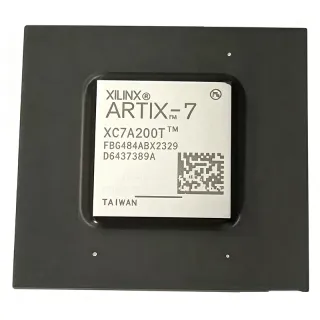
EPF8820ARC240-4 - FLEX 8000 FPGA 672 LUTs RQFP-240 | Altera
MPN: EPF8820ARC240-4 ✗ End of Life| Qty | Unit Price | Extended |
|---|---|---|
| 1 | $32.5 | $32.50 |
| 10 | $28.75 | $287.50 |
| 100 | $22.4 | $2,240.00 |
| 250 | $19.85 | $4,962.50 |
| 500 | $17.2 | $8,600.00 |
EPF8820ARC240-4 Overview
A Field-Programmable Gate Array (FPGA) is a semiconductor integrated circuit that can be reconfigured by the customer after manufacture to implement arbitrary digital logic. The FLEX 8000 family sits in Altera's classic hierarchical PLD hierarchy - FPGAs that bridge the gap between traditional PLDs (PAL/GAL) and gate arrays, providing thousands of usable gates in a single programmable chip. Each Logic Element (LE) contains a 4-input look-up table, a programmable flip-flop, and dedicated carry and cascade chains, while Embedded Array Blocks (EABs) provide on-chip RAM/ROM for wide memory functions.
Key features of the EPF8820ARC240-4 include 672 Logic Elements, 16 EABs providing up to 4096 bits of dual-port RAM or ROM, programmable I/O standards, in-system programmability via the IEEE 1149.1 (JTAG) interface, and a -4 speed grade targeting mid-tier performance. The device operates from a single 5.0V supply with 3.3V or 5V tolerant I/O options and is supported by the Altera MAX+PLUS II and Quartus design toolchains. Typical logic density is 8000 usable gates, making this part suitable for bus interfaces, peripheral glue logic, and small protocol bridges.
The FLEX 8000 architecture uses a four-level hierarchical interconnect with FastTrack continuous routing lines and segmented connections, balancing predictable timing with high logic utilization. Each EAB can be configured as a 256x16, 512x8, 1024x4, or 2048x2 memory block and supports parity generation. The -4 speed grade indicates a typical LE-to-LE propagation delay of around 4 ns, suitable for state-machine and bus-interface designs up to approximately 80 MHz internal logic rates.
Typical applications include bus-interface bridges (e.g., ISA-to-PCI glue), peripheral controllers for legacy MCUs, telecommunications channel adaptation logic, industrial control state machines, and prototype ASIC replacement. The 240-pin RQFP package provides ample user I/O for memory-rich designs. Engineers often select this part for low-cost, moderate-complexity logic consolidation where mask-programmed gate arrays would be uneconomical.
When designing with the EPF8820ARC240-4, note that the FLEX 8000 family has been classified by Altera/Intel as legacy and is supported only for existing designs - new projects should target Cyclone, MAX II, or MAX 10 families. Decoupling must follow the datasheet's VCCINT/VCCIO guidelines, and unused I/O pins should be left floating or driven per the JTAG configuration scheme.
This page synthesizes pricing, drop-in package-compatible alternatives, and practical design notes not consolidated in the manufacturer datasheet - useful for engineers maintaining or replacing legacy FLEX 8000 designs.
Drop-in alternatives for EPF8820ARC240-4 — same package, pin-to-pin compatible. Different-package parts requiring PCB rework are excluded.
Variants in this series
Same-series models that are drop-in compatible with EPF8820ARC240-4 (same form factor and footprint) — differing in Package, Process Technology, Speed Grade, Mounting Type, Configuration Memory.
Quick Comparison Tool — Select alternative parts for side-by-side comparison:
EPF8820ARC240-3
✅ Drop-In✓ In Stock
$24 / Unit
View Datasheet →EPF8820ARC240-3N
✅ Drop-In✓ In Stock
$16.4 / Unit
View Datasheet →EPF8820ARC-4
✅ Drop-In✓ In Stock
$19.95 / Unit
View Datasheet →EPF8820ARC-4N
✅ Drop-In✓ In Stock
$19.4 / Unit
View Datasheet →EPF8820ARC240-4 Maximum Ratings & Electrical Characteristics
| Family | FLEX 8000 |
| Logic Elements | 672 |
| Typical Gates | 8000 usable gates |
| Embedded Array Blocks (EABs) | 16 |
| Maximum RAM Bits | 4096 bits |
| Package | RQFP-240 (240-pin Reduced Quad Flat Pack) |
| Speed Grade | -4 |
| Supply Voltage (VCCINT) | 5.0 V |
| I/O Voltage (VCCIO) | 3.3 V or 5.0 V |
| Process Technology | CMOS SRAM |
| Programmability | SRAM, in-system via JTAG (IEEE 1149.1) |
| Configuration Schemes | Passive serial, passive parallel, JTAG |
| Mounting Type | Surface Mount (RQFP) |
| RoHS Status | unknown |
EPF8820ARC240-4 rqfp-240 (240-pin reduced quad flat pack) Pin Configuration Guide
Pin configuration for EPF8820ARC240-4 (rqfp-240 (240-pin reduced quad flat pack) package). This digital IC includes GPIO, communication interfaces (UART, SPI, I2C), and power pins. Refer to the manufacturer datasheet for alternate pin functions and configuration options. Essential for embedded system design and PCB layout.

No detailed pinout data available for EPF8820ARC240-4.
Refer to the datasheet for full pin configuration.
Typical Applications
EPF8820ARC240-4 is suitable for 6 applications: Legacy Bus-Interface Glue Logic, Peripheral Controllers for Legacy MCUs, Telecommunications Channel Adaptation Logic, Industrial Control State Machines, Prototype ASIC Replacement, Legacy Avionics and Defense Interface Boards.
Legacy Bus-Interface Glue Logic
The EPF8820ARC240-4's 672 Logic Elements and 16 Embedded Array Blocks (EABs) provide ample capacity for bus-interface glue logic, particularly ISA-to-local-bus or microcontroller-to-peripheral bridges. The -4 speed grade delivers roughly 4 ns LE propagation delay, supporting synchronous bus protocols up to about 50 MHz on the RQFP-240's generous I/O count. Compared to discrete 74-series logic, the FLEX 8000 consolidates address decoding, wait-state generation, and bus-multiplexing into a single reprogrammable device - a key reason this FPGA family was adopted in late-1990s industrial PCs and telecommunications backplane designs. The on-chip EABs also allow 4096 bits of dual-port RAM for FIFO buffers on each bus channel.
Recommended
Peripheral Controllers for Legacy MCUs
Designers often pair the EPF8820ARC240-4 with 8051, 68HC11, or early ARM7 microcontrollers to offload peripheral glue: UART baud-rate generators, PWM timers, or keypad/display scanning matrices. The 4096 bits of EAB-based RAM store lookup tables for character generation or waveform synthesis without external memory, and the JTAG interface simplifies in-system firmware updates during prototyping. The 5.0V core supply matches legacy MCU rails, eliminating level-translation overhead. With 672 LEs the device handles dozens of peripheral functions in parallel, allowing the host MCU to focus on application code. The RQFP-240 package also supports enough I/O for multi-port designs.
Recommended
Telecommunications Channel Adaptation Logic
In legacy telecom equipment, the EPF8820ARC240-4 implements channelized adaptation logic for T1/E1 framing, HDLC controllers, and protocol interworking between PDH and SDH hierarchies. The 16 EABs provide small FIFO buffers per channel, and the 672 LEs handle framing-bit insertion, line-code conversion (AMI/HDB3/B8ZS), and alarm-state machines. The 5V tolerant I/Os interface directly to legacy line-interface units, and the JTAG interface supports field reprogramming as standards evolve. Compared to ASIC implementations, the FLEX 8000 allows rapid channel-count changes without respin, which was critical during the late-1990s telecom-equipment ramp. The NRND status now limits this use to maintenance of installed bases.
Recommended
Industrial Control State Machines
Industrial PLCs and motion controllers in the late 1990s used the EPF8820ARC240-4 to implement deterministic state machines for sequencing, servo-loop glue, and safety-interlock logic. The 672 LEs provide enough capacity for multi-axis stepper/servo state machines with encoder decoding, while the 16 EABs hold motion-profile tables or PID coefficient sets. The -4 speed grade supports encoder sampling rates up to several MHz, sufficient for typical 5 kHz servo loops. The 5V core supply tolerates the noisy 24V industrial environment after external regulation, and the JTAG interface allows in-field firmware updates via the PLC's service port. The RQFP-240 package's large pin count accommodates many parallel sensor inputs.
Recommended
Prototype ASIC Replacement
Before committing to a mask-programmed gate array, design teams often used the EPF8820ARC240-4 as a fast-turn prototype for ASIC verification, particularly for designs in the 5K-10K gate complexity range. The 672 LEs and 16 EABs cover most pre-tapeout validation scenarios, and design migration from MAX+PLUS II to ASIC vendor libraries is straightforward because FLEX 8000 uses standard Verilog/VHDL with predictable synthesis. The -4 speed grade provides realistic timing models that correlate well with the eventual ASIC implementation. Engineering teams saved weeks of mask-set cost by validating prototypes on the FLEX 8000, and the JTAG interface allowed rapid design-iteration cycles during pre-silicon verification.
Recommended
Legacy Avionics and Defense Interface Boards
Military and aerospace systems designed in the 1990s-2000s relied on the EPF8820ARC240-4 for MIL-STD-1553, ARINC 429, and discrete-signal interfaces where radiation tolerance was not a primary requirement. The 672 LEs handle bus-controller and remote-terminal state machines for MIL-STD-1553, while the EABs store lookup tables for ARINC 429 label decoding. The RQFP-240 package's high pin count supports redundant bus channels, and the JTAG interface meets BIT (built-in test) requirements for field maintenance. Although now NRND, the EPF8820ARC240-4 remains in service-life extension programs for legacy defense platforms where redesign certification costs would be prohibitive.
Recommended
Recommended Products Summary
Engineering reference data for EPF8820ARC240-4 — comparison, design guidance, and compliance information.
Selection Guide
Comparison with Alternatives
| Parameter | This Product | EPF8820ARC240-3 | EPF8820ARC240-3N | EPF8820ARC-4 | EPF8820ARC-4N | EPF8636ARC208-4 | EPF8282ATC100-4 |
|---|---|---|---|---|---|---|---|
| Package | RQFP-240 | RQFP-240 (same) | RQFP-240 (same) | RQFP-240 (same) | RQFP-240 (same) | RQFP-208 (different) | TQFP-100 (different) |
| Brand | Altera | Altera | Altera | Altera | Altera | Altera | Altera |
| Family | FLEX 8000 | FLEX 8000 | FLEX 8000 | FLEX 8000 | FLEX 8000 | FLEX 8000 | FLEX 8000 |
| Logic Elements | 672 | 672 (same) | 672 (same) | 672 (same) | 672 (same) | 636 | 288 |
| Speed Grade | -4 | -3 (faster) | -3 (faster) | -4 (same) | -4 (same) | -4 | -4 |
| Supply Voltage (VCCINT) | 5.0 V | 5.0 V | 5.0 V | 5.0 V | 5.0 V | 5.0 V | 5.0 V |
| Process / Configuration | CMOS SRAM / JTAG | CMOS SRAM / JTAG | CMOS SRAM / JTAG | CMOS SRAM / JTAG | CMOS SRAM / JTAG | CMOS SRAM / JTAG | CMOS SRAM / JTAG |
| Lifecycle Status | NRND | NRND | NRND | NRND | NRND | NRND | NRND |
Key Differentiators
- Same die and pinout as -3 speed grade, allowing upward timing closure without PCB changes (vs EPF8820ARC240-3)
- Larger 240-pin package with maximum user I/O compared to -208 variant (vs EPF8820ARC208-4)
- Significantly higher logic capacity vs lower-density FLEX 8000 siblings (vs EPF8282ATC100-4)
Design Notes
Estimated: at VCCINT=5.0V with all 672 LEs switching at 50% toggle rate and a 25 MHz internal clock, ICCINT is approximately 200-300 mA. The RQFP-240's thermal pad (if present) and surrounding copper pour should provide at least 4 sq-in of 1-oz copper to keep junction temperature below 85C. Decoupling per the FLEX 8000 datasheet: place 0.1 uF ceramic caps at every VCCINT/VCCIO pin pair, plus a single 10 uF tantalum bulk cap near the device. Unlike modern low-core-voltage FPGAs, FLEX 8000 requires 5V core regulation; do NOT attempt to power from 3.3V rails.
The RQFP-240 package has 0.5 mm pitch leads and requires careful PCB layout: keep all signal traces at least 0.2 mm from pad edges, use a soldermask-defined (SMD) pad with 0.1 mm mask expansion, and plan for lead coplanarity within 0.1 mm to prevent tombstoning during reflow. Recommended land pattern: 0.30 mm pad width, 1.50 mm pad length, with 0.5 mm pitch. The device's JTAG chain (TDI/TDO/TMS/TCK) should be routed with 4-8 mil traces, kept short, and protected from cross-talk by a ground guard trace on each side. Avoid routing high-speed clocks parallel to JTAG signals.
Three pitfalls to avoid: (1) the FLEX 8000 SRAM configuration is volatile - the bitstream must be reloaded from external EPROM/flash on every power-up, so always include a configuration memory in your BOM; (2) the 5.0V VCCINT cannot be substituted with 3.3V even though the I/O banks support 3.3V - attempting this will damage the device; (3) the part is NRND and Altera/Intel no longer recommends it for new designs - if you are starting a new project, target Cyclone, MAX II, or MAX 10 instead. For maintenance of legacy designs, source only from franchised distributors and verify lot/date code before assembly.
Estimated: at the -4 speed grade's typical 4 ns LE delay, the EPF8820ARC240-4 supports internal clock rates up to approximately 60-80 MHz before timing-closure becomes difficult. For external clock distribution, keep clock traces to within 50 mm, use series-damping resistors (22-33 ohm) on clock outputs driving multiple loads, and ensure all clock inputs (CLK0/CLK1/CLK2/CLK3) have proper 50-ohm terminations when driven from external oscillators. The FLEX 8000 architecture uses FastTrack continuous routing lines for predictable clock distribution - consult the MAX+PLUS II timing analyzer output to confirm setup/hold margins on all registered paths before sign-off.
Compliance Information
RoHS and lead-free status marked unknown because the verified web data does not include the specific compliance declarations. The FLEX 8000 family pre-dates RoHS directives; many factory-stock parts are non-RoHS, but RoHS-converted variants may be available from distributors. AEC-Q100 not applicable for this industrial/commercial-grade FPGA.