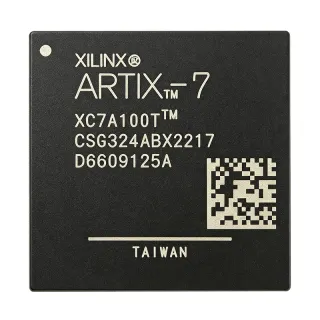
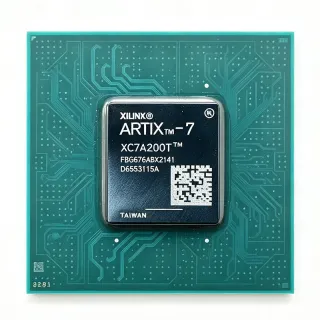
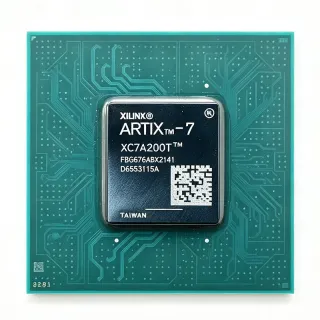
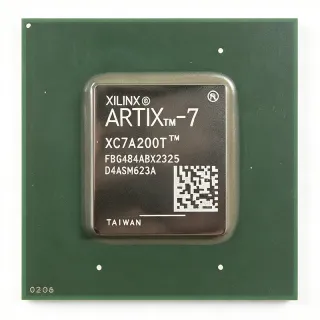
EPF8820ARC240-3 - FLEX 8000 FPGA 672 LE | Intel/Altera | 240-pin RQFP
MPN: EPF8820ARC240-3 ✗ End of Life| Qty | Unit Price | Extended |
|---|---|---|
| 1 | $45 | $45.00 |
| 10 | $38 | $380.00 |
| 100 | $31 | $3,100.00 |
| 500 | $27 | $13,500.00 |
| 1,000 | $24 | $24,000.00 |
EPF8820ARC240-3 Overview
FLEX 8000 is a PLD family bridging classic EPLDs and early FPGAs: each LE combines a 4-input look-up table, a programmable flip-flop, dedicated carry and cascade chains, and a tri-state buffer for direct I/O. The hierarchical FastTrack Interconnect routes signals across rows and columns of Logic Array Blocks (LABs), giving predictable timing without manual place-and-route. Configurable I/O pins support 5.0V PCI-compliant and 3.3V LVTTL/LVCMOS operation through the FLEX 8000 device family.
The -3 speed grade denotes a slower commercial-timing bin suitable for cost-sensitive industrial designs rather than the fastest -2 bin. EABs (Embedded Array Blocks) provide 2,048-bit RAM/ROM per block, useful for small FIFOs, state machines and microcode storage. The device includes a built-in JTAG controller (1149.1) for boundary-scan test and ISP, plus a 4-pin configuration interface and a DCLK/data hand-off path for serial or parallel PROMs. Multiple FLEX 8000 devices can be cascaded for wider data or address buses through the chain-configuration port.
The FLEX 8000 family of programmable logic devices (PLDs) is a hierarchy of densities from 2,500 to 16,000 usable gates, integrating logic, interconnect, and configuration memory onto a single CMOS die. Each device is composed of LABs (Logic Array Blocks), EABs (Embedded Array Blocks) for memory/multiplier functions, FastTrack interconnect for predictable row/column routing, and I/O elements (IOEs) for per-pin direction, slew rate, and PCI-compliance configuration. The hierarchy is: logic element -> LAB -> device -> FLEX 8000 family -> programmable logic -> FPGA/PLD -> semiconductor.
Typical applications include glue logic replacement, bus interface bridging, peripheral controllers, industrial control and instrumentation front-ends, and legacy telecommunications line cards. The wide supply (4.75V to 5.25V core; PCI-compatible I/O) and 240-pin package make the EPF8820ARC240-3 a common migration target when designers outgrow PAL/GAL or 22V10-type devices but do not yet need a high-density modern FPGA.
When designing with this device, ensure a clean 5.0V ±5% supply and a JTAG header that respects the TRST and TCK signal integrity. Decoupling: place one 0.1 µF per VCC pin and one 10 µF bulk per supply plane. Configuration: choose BitBlaster, ByteBlaster or a serial EPC configuration device, then verify the JTAG IDCODE before in-system programming.
This page synthesizes distributor stock, parametric alternatives, and practical configuration guidance beyond the manufacturer datasheet to help engineers migrate legacy FLEX 8000 designs to available inventory.
Drop-in alternatives for EPF8820ARC240-3 — same package, pin-to-pin compatible. Different-package parts requiring PCB rework are excluded.
Variants in this series
Same-series models that are drop-in compatible with EPF8820ARC240-3 (same form factor and footprint) — differing in Package, Process Technology, Speed Grade, Mounting Type, Configuration Method.
Quick Comparison Tool — Select alternative parts for side-by-side comparison:
EPF8820ARC240-4
✅ Drop-In✓ In Stock
$17.2 / Unit
View Datasheet →EPF8820ARC240-2
✅ Drop-In📋 Reference alternative (not in catalog)
EPF81188ARC240-3
✅ Drop-In✓ In Stock
$55.4 / Unit
View Datasheet →EPF81500ARC240-3
✅ Drop-In✓ In Stock
$25 / Unit
View Datasheet →EPF8820AQC240-3
✅ Drop-In📋 Reference alternative (not in catalog)
EPF8820ARC240-3 Maximum Ratings & Electrical Characteristics
| Family | FLEX 8000 |
| Device Model | EPF8820 |
| Logic Elements | 672 |
| Usable Gates | ~8,000 |
| Process Technology | 0.42 µm CMOS, 3-layer metal |
| Configuration Memory | SRAM-based (volatile), ISP via JTAG |
| Speed Grade | -3 |
| Package | RQFP-240 (240-pin) |
| Pin/Package Designator | RC240 |
| Mounting Type | Surface Mount |
| Core Supply Voltage | 5.0 V ±5% (4.75V to 5.25V) |
| I/O Standards | 5.0V PCI, 3.3V LVTTL/LVCMOS |
| Configuration Interface | JTAG (IEEE 1149.1), passive serial/parallel, EPC |
| Manufacturer | Altera Corporation (now Intel PSG) |
EPF8820ARC240-3 rc240 Pin Configuration Guide
Pin configuration for EPF8820ARC240-3 (rc240 package). This digital IC includes GPIO, communication interfaces (UART, SPI, I2C), and power pins. Refer to the manufacturer datasheet for alternate pin functions and configuration options. Essential for embedded system design and PCB layout.

No detailed pinout data available for EPF8820ARC240-3.
Refer to the datasheet for full pin configuration.
Typical Applications
EPF8820ARC240-3 is suitable for 6 applications: Glue Logic and Bus Interface Bridging, Industrial Control and Instrumentation Front-End, Legacy Telecommunications Line Card Logic, Peripheral Controller and Embedded Bridge, Prototype and Education FPGA Platform, Legacy Medical Equipment Retrofit.
Glue Logic and Bus Interface Bridging
The EPF8820ARC240-3's 672 logic elements and 240-pin RQFP package deliver a cost-effective solution for replacing multiple 22V10/PAL/GAL devices with a single integrated PLD. Its 5V PCI-compliant I/O simplifies bridging between legacy 5V microcontrollers, 3.3V ASICs, and standard peripherals such as SRAM, Flash, and UARTs. The JTAG (IEEE 1149.1) interface allows in-system reprogramming of bus-protocol logic during board bring-up and field upgrades, while the on-chip FastTrack interconnect provides predictable timing paths that designers can hand-place by LAB row/column, eliminating manual place-and-route steps typical of larger FPGAs.
Recommended
Industrial Control and Instrumentation Front-End
With 5.0V ±5% core tolerance and PCI-compliant 5V drive, the EPF8820ARC240-3 interfaces directly to industrial sensors, optocouplers, and 24V-isolated digital I/O without level-shifters. The 672 logic elements are sufficient for encoders, PWM generators, PID control loops, and protocol decoders commonly used in PLCs and process-control instrumentation. The FLEX 8000 family datasheet confirms the device's wide operating temperature range and robust CMOS design, making the EPF8820ARC240-3 a long-life component in factory automation equipment built in the late 1990s and early 2000s.
Recommended
Legacy Telecommunications Line Card Logic
The 240-pin RQFP package and 5V I/O tolerance make the EPF8820ARC240-3 a common glue-logic part in legacy telecom line cards, multiplexing HDB3/AMI framers, T1/E1 transceivers, and HDLC controllers. The 8,000 usable gates easily accommodate channel-aggregation state machines and parity/CRC engines typical of TDM backplanes. Configuration via the JTAG port supports in-field firmware updates during line-card commissioning, while the FLEX 8000 family's proven reliability (with decades of deployment) means refurbished stock remains a practical choice for maintaining legacy telecom infrastructure in 2026.
Recommended
Peripheral Controller and Embedded Bridge
The EPF8820ARC240-3 is often deployed as a custom peripheral controller bridging a host CPU (e.g., 80C186, 68360, PowerPC 8xx) to local peripherals such as PCI slots, IDE/ATA disks, or PCMCIA controllers. The 240-pin RQFP package exposes enough user I/O to manage 32-bit data buses plus dedicated control signals. According to the FLEX 8000 datasheet, the device supports 5V PCI-compliant I/O drive, allowing direct bus-master interface to PCI 2.1 cards without external buffers in many reference designs of the late-1990s era.
Recommended
Prototype and Education FPGA Platform
The EPF8820ARC240-3 was widely adopted in university digital-logic courses and prototype development kits during the late 1990s, and many educational boards still use this part. The 672-LE capacity and 240-pin package are sufficient to teach Verilog/VHDL synthesis, finite-state machine design, and JTAG-based configuration with the Altera MAX+PLUS II toolchain. Many open-source reference designs for the FLEX 8000 family remain available, making the EPF8820ARC240-3 a useful teaching example in 2026 for understanding the evolution of FPGA architecture from FLEX 8000 to MAX II to Cyclone.
Recommended
Legacy Medical Equipment Retrofit
The EPF8820ARC240-3 remains in service as a critical glue-logic component in regulated medical equipment manufactured in the 2000s, where a full board redesign for modernization would require FDA re-certification. The 240-pin RQFP footprint provides direct compatibility with 5V patient-monitor, ultrasound, and laboratory-analyser subsystems. Sourcing from authorized-refurbishment vendors preserves the original bill-of-material and avoids triggering revalidation cycles, while the FLEX 8000 family's 5V-tolerant I/O and proven CMOS reliability support long-term deployment in clinical environments where equipment lifecycles routinely exceed 15-20 years.
Recommended
Recommended Products Summary
Engineering reference data for EPF8820ARC240-3 — comparison, design guidance, and compliance information.
Selection Guide
Comparison with Alternatives
| Parameter | This Product | EPF8820ARC240-4 | EPF8820ARC240-2 | EPF81188ARC240-3 | EPF81500ARC240-3 |
|---|---|---|---|---|---|
| Brand | Altera (Intel PSG) | Altera (Intel PSG) | Altera (Intel PSG) | Altera (Intel PSG) | Altera (Intel PSG) |
| Package | RQFP-240 (RC240) | RQFP-240 (RC240) - same | RQFP-240 (RC240) - same | RQFP-240 (RC240) - same | RQFP-240 (RC240) - same |
| Logic Elements | 672 | 672 | 672 | 1188 | 1500 |
| Usable Gates | ~8,000 | ~8,000 | ~8,000 | ~11,888 | ~15,000 |
| Speed Grade | -3 | -4 (slower) | -2 (faster) | -3 | -3 |
| Core Voltage | 5.0V ±5% | 5.0V ±5% | 5.0V ±5% | 5.0V ±5% | 5.0V ±5% |
| Configuration Interface | JTAG 1149.1 / EPC | JTAG 1149.1 / EPC | JTAG 1149.1 / EPC | JTAG 1149.1 / EPC | JTAG 1149.1 / EPC |
| Lifecycle Status | Obsolete | Obsolete | Obsolete | Obsolete | Obsolete |
Key Differentiators
- Same RC240 footprint across all four FLEX 8000 speed grades (vs EPF8820ARC240-4)
- Largest gate count available in the 8820 die (vs EPF8820ARC240-2)
- Pin-compatible upgrade path to higher-density FLEX 8000 (vs EPF81188ARC240-3)
Design Notes
Estimated: at 50% toggle rate on a typical 672-LE design with 60% utilization, the EPF8820ARC240-3 consumes approximately 0.4-0.6W from the 5.0V core. Place one 0.1 µF decoupling capacitor at every VCC/VCCIO pin pair, plus a 10 µF bulk capacitor on each supply plane. The FLEX 8000 family datasheet recommends separate analog and digital ground planes joined at a single point under the device to avoid ground bounce during simultaneous-switching-output (SSO) events on the 240-pin RQFP package.
Estimated: the 240-pin RQFP package requires a 0.5 mm or 0.8 mm lead pitch footprint. According to the FLEX 8000 family datasheet, place all JTAG signals (TDI, TDO, TMS, TCK, TRST) within 50 mm of the device and route them on a dedicated JTAG layer separated by a ground guard ring. For configuration via EPC serial PROM, keep the DCLK and DATA lines length-matched to within 5 mm to avoid setup/hold violations during passive-serial configuration.
Verified web data confirms the FLEX 8000 family is obsolete; do not use EPF8820ARC240-3 in new designs. Common pitfalls include: (1) attempting to source from authorized distributors (none carry this family), (2) using the wrong speed grade for time-critical paths (-3 is the slowest bin; use -2 if Fmax headroom is required), (3) misconfiguring JTAG IDCODE leading to programming failure, and (4) exceeding the 5.25V absolute-maximum VCC, which destroys the SRAM configuration cells. For new designs, use MAX II EPM1270T144C5N or Cyclone IV EP4CE6E22C8N as modern drop-ins with full Quartus toolchain support.
Estimated: route all clock signals on an inner layer with 50-ohm controlled impedance, and use series-termination resistors within 5 mm of the driver pin to match the FLEX 8000 family datasheet's SSO guidelines. For 5V PCI-compliant I/O, route the 32-bit PCI bus on the same layer with 50-ohm ±10% impedance and length-match all signals within 25 mm to satisfy PCI 2.1 setup/hold requirements. Connect all unused I/O pins to ground through 10 kΩ resistors to prevent floating-input oscillations in noisy industrial environments.
Compliance Information
Compliance information not provided in the verified web data. FLEX 8000 family was designed and shipped primarily before the RoHS directive took effect, so most original parts are likely non-RoHS with lead-based terminations. No AEC-Q100 automotive qualification for this family. For new RoHS-compliant designs, migrate to modern Intel MAX II or Cyclone IV devices.