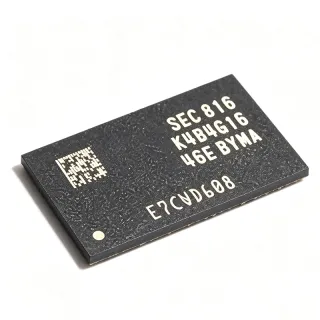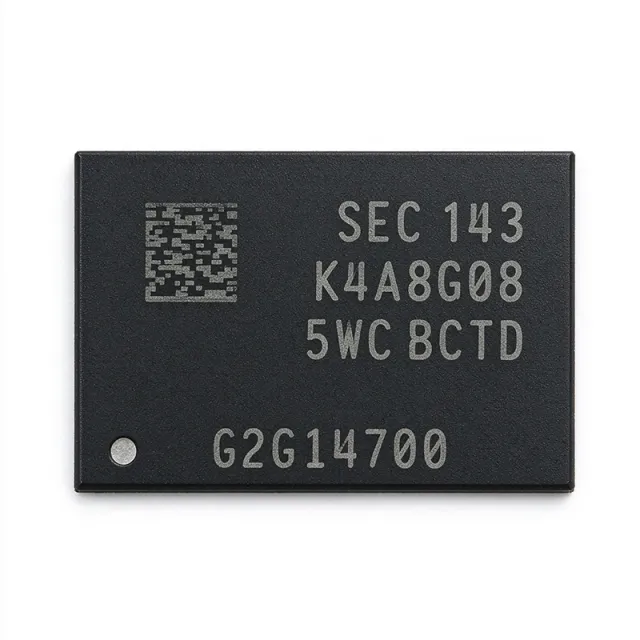
K4A8G085WC-BCTD - 8Gb DDR4 SDRAM x8 2666Mbps | Samsung
MPN: K4A8G085WC-BCTD ✗ End of Life| Qty | Unit Price | Extended |
|---|---|---|
| 1 | $22.5 | $22.50 |
| 10 | $16.25 | $162.50 |
| 100 | $14.375 | $1,437.50 |
| 500 | $13.75 | $6,875.00 |
| 1,000 | $13.125 | $13,125.00 |
K4A8G085WC-BCTD Overview
DDR4 SDRAM (Double Data Rate 4 Synchronous Dynamic Random Access Memory) is a JEDEC-defined generation of DRAM that operates from a 1.2V core supply, roughly 35% lower than DDR3's 1.5V, with VDDQ also at 1.2V. In the memory hierarchy, DDR4 SDRAM sits under the broader DRAM / SDRAM / volatile memory taxonomy and serves as the main-system-memory building block for DIMMs, soldered-down embedded memory, and server modules.
Key features of the K4A8G085WC family include a 0C to +95C operating temperature range, auto precharge function, asynchronous reset function, CRC and parity support for command/address integrity, ZQ calibration (ZQ cal) for accurate output impedance matching, dynamic on-chip termination (ODT), and a data mask function for byte-granular writes, according to the Samsung datasheet and LCSC product data.
The WC die revision represents a later process node in Samsung's DDR4 lineup, and the -BCTD speed grade corresponds to DDR4-2666 (CL19 class) operation. Internally the device uses a double-data-rate interface with differential clock inputs (CK/CK#) and a command/address bus synchronized to the same clock domain, with 8 internal banks for improved concurrency versus DDR3. Bank group architecture allows interleave between groups for higher effective bandwidth.
Typical applications include desktop and notebook DIMMs, embedded single-board computers, networking equipment, set-top boxes, industrial controllers, and point-of-sale systems where soldered-down 8Gb DDR4 in x8 organization is required.
Design consideration: DDR4 devices have strict power-up sequencing and initialization requirements (VDD before or together with VDDQ, then reset after 200 us) - follow the controller vendor's initialization sequence exactly to avoid lock-up states.
This page synthesizes distributor pricing, drop-in alternatives including the EOL migration path to the BIWE industrial-grade variant, and practical design notes not found in the manufacturer datasheet.
Drop-in alternatives for K4A8G085WC-BCTD — same package, pin-to-pin compatible. Different-package parts requiring PCB rework are excluded.
Quick Comparison Tool — Select alternative parts for side-by-side comparison:
K4A8G085WC-BIWE
✓ In Stock
$6.29 / Unit
View Datasheet →K4A8G085WC-BCRC
✓ In Stock
$4.3 / Unit
View Datasheet →K4A8G085WC-BCPB
✓ In Stock
$2.95 / Unit
View Datasheet →K4A8G085WB-BCTD
✓ In Stock
$7.5 / Unit
View Datasheet →K4A8G085WG-BCWE
📋 Reference alternative (not in catalog)
K4A8G085WC-BCTD Specifications
| Memory Type | DDR4 SDRAM |
| Density | 8 Gbit |
| Organization | 1G x 8 |
| Speed Grade | DDR4-2666 |
| Core Supply Voltage (VDD) | 1.2 V |
| I/O Supply Voltage (VDDQ) | 1.2 V |
| Interface | Double Data Rate, differential clock (CK/CK#) |
| Package | 78-ball FBGA (9 x 11 mm, 0.8 mm pitch) |
| Mounting Type | Surface Mount |
| Operating Temperature | 0C to +95C |
| Features | Auto precharge, asynchronous reset, CRC, ZQ calibration, dynamic ODT, data mask |
| JEDEC Compliance | JEDEC DDR4 standard compatible |
| Precharge | Auto precharge function |
| Reset | Asynchronous reset function |
| Termination | Dynamic on-chip termination (ODT) |
| Data Mask | Supported |
K4A8G085WC-BCTD 78-ball fbga (9 x 11 mm, 0.8 mm pitch) Pin Configuration Guide
Pin configuration for K4A8G085WC-BCTD (78-ball fbga (9 x 11 mm, 0.8 mm pitch) package). Pin numbering, functions, and connection diagrams are defined in the manufacturer datasheet. Refer to it for the exact footprint and soldering guidelines.

No detailed pinout data available for K4A8G085WC-BCTD.
Refer to the datasheet for full pin configuration.
Typical Applications
K4A8G085WC-BCTD is suitable for 6 applications: Desktop and Notebook DIMMs, Embedded Single-Board Computers, Networking and Telecom Equipment, Industrial Automation Controllers, Set-Top Boxes and Smart TVs, Point-of-Sale and Retail Terminals.
Desktop and Notebook DIMMs
The K4A8G085WC-BCTD is a core building block for UDIMM and SODIMM modules in consumer PCs. Its 8Gb density in x8 organization allows 8 GB modules from just eight chips, and its DDR4-2666 speed bin matches mainstream 12th-generation-and-earlier Intel and AMD memory controllers. The device's dynamic on-chip termination (ODT) and ZQ calibration maintain signal integrity at 2666 Mbps across the module's stub-heavy routing, where external termination would add cost and board area. Placed on a standard 288-pin DIMM at 1.2V, the chip runs from the module's shared VDD rail with 0.1 uF decoupling per ball pair. For module makers still servicing the DDR4Installed base, this EOL part is available via last-buy channels, though die-revision WC offers improved power figures versus earlier WB-based modules.
Recommended
Embedded Single-Board Computers
Soldered-down K4A8G085WC-BCTD components provide 1 GB of DDR4 system memory per chip on single-board computers, edge gateways, and embedded controllers. The 78-ball FBGA with 0.8 mm pitch supports standard six-layer stackups, and the asynchronous reset plus CRC features simplify integration with SoC memory controllers from NXP, TI, and Rockchip. At DDR4-2666, a single x8 device delivers 2.1 GB/s per pin pair, sufficient for Linux-class workloads. The 1.2V rail reduces total board power versus DDR3, roughly 35% lower core power, which matters in passively cooled enclosures. Designers should implement the JEDEC power-up sequence in firmware and enable ZQ calibration at boot. Because the part is EOL, new embedded designs should qualify the pin-compatible K4A8G085WC-BIWE industrial variant for long-term supply.
Recommended
Networking and Telecom Equipment
Enterprise switches, routers, and PON equipment use K4A8G085WC-BCTD devices as buffer memory for packet processing. The CRC feature on the command/address bus adds a hardware error check on control signals, valuable in 24/7 infrastructure where a single corrupted refresh command can crash a line card. DDR4-2666 provides the bandwidth needed for multi-gigabit packet buffering when several x8 devices are byte-laned together on a 64-bit bus. The 0C to +95C rating covers central-office ambient conditions, and dynamic ODT helps terminate shared data buses during turnarounds. Telecom vendors facing the DDR4 EOL notice should complete last-time-buy evaluation now or migrate to the BIWE industrial variant, which requires no PCB or firmware changes.
Recommended
Industrial Automation Controllers
PLC CPUs, motion controllers, and vision-system processors rely on soldered DDR4 like the K4A8G085WC-BCTD for program and image-buffer memory. The 8Gb density supports machine-vision frame buffers and Windows/Linux real-time runtimes, while the -BCTD speed bin at 2666 Mbps keeps deterministic access latency low for cyclic control tasks. Operation from 0C to +95C suits cabinet-mounted electronics; for shop-floor enclosures approaching the upper limit, the industrial-grade BIWE sibling with the same footprint is the documented migration path. Power dissipation at 1.2V remains under 1 W per device at typical bandwidth, easing conduction-cooled thermal design. Designers must honor the JEDEC initialization sequence and program mode registers for their specific controller timing before production sign-off.
Recommended
Set-Top Boxes and Smart TVs
Consumer AV platforms use the K4A8G085WC-BCTD as main memory for 4K video decoding, with its 8Gb capacity comfortably holding dual 4K frame buffers plus an Android or Linux runtime. At 1.2V and DDR4-2666, a single x8 chip provides the ~2 GB/s bandwidth required for HEVC decode pipelines, and the data mask function enables efficient partial writes during graphics compositing. The 0.8 mm-pitch FBGA reflows onto standard consumer four- or six-layer boards, and low core power helps meet energy-star standby budgets. Since the part is now EOL as Samsung shifts to DDR5, consumer OEMs should validate the WC-BCRC/BCPB grade equivalents or requalify BIWE to secure supply through remaining product lifecycles.
Recommended
Point-of-Sale and Retail Terminals
POS terminals, kiosks, and receipt printers use the K4A8G085WC-BCTD soldered down for 1 GB of system memory driving secure-payment and touch-screen software stacks. The x8 FBGA format withstands the vibration and thermal cycling of countertop retail hardware better than socketed DIMMs, and 1.2V operation limits heat inside sealed enclosures without fans. The asynchronous reset input allows the host CPU to recover the DRAM after a brown-out without full power cycling, shortening recovery time to under a second in the field. With the device's EOL status, retail-hardware makers with 5- to 10-year service commitments should place last-time buys or requalify the pin-compatible K4A8G085WC-BIWE, which adds industrial temperature margin at zero redesign cost.
Recommended
Recommended Products Summary
Engineering reference data for K4A8G085WC-BCTD — comparison, design guidance, and compliance information.
Selection Guide
Comparison with Alternatives
| Parameter | This Product | K4A8G085WC-BIWE | K4A8G085WC-BCRC | K4A8G085WB-BCTD | K4A8G085WG-BCWE |
|---|---|---|---|---|---|
| Package | 78-ball FBGA (9 x 11 mm) | 78-ball FBGA - same | 78-ball FBGA - same | 78-ball FBGA - same | 78-ball FBGA - same |
| Brand | Samsung Electronics | Samsung Electronics | Samsung Electronics | Samsung Electronics | Samsung Electronics |
| Density | 8 Gbit | 8 Gbit | 8 Gbit | 8 Gbit | 8 Gbit |
| Organization | 1G x 8 | 1G x 8 | 1G x 8 | 1G x 8 | 1G x 8 |
| Supply Voltage | 1.2 V | 1.2 V | 1.2 V | 1.2 V | 1.2 V |
Key Differentiators
- Documented EOL migration path within same footprint (vs K4A8G085WC-BIWE)
- Later WC die revision for lower power (vs K4A8G085WB-BCTD)
- DDR4-2666 cost-optimal speed bin (vs K4A8G085WG-BCWE)
Design Notes
Both VDD and VDDQ are 1.2V on the K4A8G085WC-BCTD. Budget approximately 0.1 uF of ceramic decoupling per power/ground ball pair placed within 2 mm of the package, plus bulk capacitance sized to the full bus. Estimated: at DDR4-2666 with moderate utilization, per-device current can approach several hundred mA on VDDQ; size the 1.2V rail regulator for the full x8 byte-lane count plus 30% margin. DDR4 power-up sequence requires RESET# held low until rails stabilize per JEDEC initialization.
At 2666 Mbps, use length-matched fly-by command/address routing and enable the device's dynamic on-chip termination (ODT) and ZQ calibration rather than external termination resistors. ZQ calibration should be run at initialization and periodically (ZQCS) to track temperature-driven impedance drift - the datasheet-specified calibration window is short and must not be violated. For data lines, reference to a solid ground plane and avoid stubs on DQ/DQS nets; simulate eye diagrams at your trace lengths before sign-off.
Do not substitute the Micron MT40A1G8SA-062E for this part without re-validation: IC-Components notes differences in timing parameters, VDDQ tolerance, and power-up sequencing. Also note the part's EOL status - plan BOM migration to K4A8G085WC-BIWE (100% pin/layout compatible) before broker stock depletes. Finally, gray-market BCTD parts carry counterfeit risk; verify date codes and purchase from traceable distributors such as LCSC or Sourcengine.
Compliance Information
Compliance status not stated in the provided distributor data; consult Samsung's official product page and environmental datasheet.