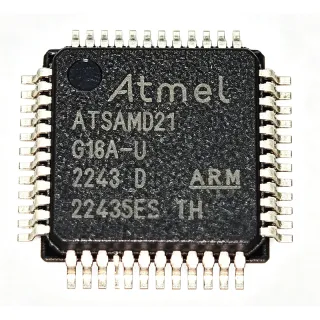
RTAX2000DL-1CQ352E - 2M-Gate Rad-Tolerant FPGA | Microchip
MPN: RTAX2000DL-1CQ352E ✓ Active| Qty | Unit Price | Extended |
|---|---|---|
| 1 | $3200 | $3,200.00 |
| 10 | $2950 | $29,500.00 |
| 100 | $2700 | $270,000.00 |
| 500 | $2500 | $1,250,000.00 |
| 1,000 | $2300 | $2,300,000.00 |
RTAX2000DL-1CQ352E Overview
A radiation-tolerant FPGA is a field-programmable gate array engineered to survive the ionizing radiation environment of space while retaining the programmability of commercial FPGAs. Within the power-management-and-logic hierarchy of a spacecraft avionics system, it sits as the central digital processing element, sitting above commercial FPGAs (like the Axcelerator family it derives from) and below fully radiation-hardened ASICs, providing a middle path of programmability, schedule, and radiation assurance.
Key features include highly reliable nonvolatile antifuse technology that is live at power-up with no configuration device required, total ionizing dose tolerance of 300 krad(Si) functional (200 krad(Si) per the parametric rating quoted by distributor data), single-event effect mitigation support, and true single-chip form factor. These characteristics eliminate configuration-memory upset concerns common to SRAM FPGAs.
Technically, the RTAX-DSP architecture is based on the Microsemi (Actel) commercial Axcelerator fabric, adding DSP mathblocks and radiation-tolerant enhancements. Embedded SRAM blocks include built-in FIFO control logic, and the chip-wide highway routing and segmentable clock structures support high-performance spaceflight designs. Design prototyping is supported via a footprint-compatible adaptor-board methodology with an EDIF netlist and pinout converter, allowing commercial equivalent parts to validate the flight design.
Typical applications include satellite payload data processing, spacecraft bus control and telemetry, and radiation-exposed instrumentation where live-at-power-up boot behavior and low power are mandatory.
A key design consideration: antifuse devices are one-time programmable, so final flight designs must be fully validated before programming; use the manufacturer's prototyping flow with commercial equivalents.
This page synthesizes distributor data, drop-in same-family alternatives, and practical design notes not found in the manufacturer datasheet.
Drop-in alternatives for RTAX2000DL-1CQ352E — same package, pin-to-pin compatible. Different-package parts requiring PCB rework are excluded.
Variants in this series
Same-series models that are drop-in compatible with RTAX2000DL-1CQ352E (same form factor and footprint) — differing in Package, Equivalent System Gates, Technology, Configuration, Embedded Memory.
Quick Comparison Tool — Select alternative parts for side-by-side comparison:
RTAX2000D-1CQ352E
✅ Drop-In✓ In Stock
$3650 / Unit
View Datasheet →RTAX2000DL-CQ352E
✅ Drop-In✓ In Stock
$3360 / Unit
View Datasheet →RTAX2000DL-1CQ352V
✅ Drop-In✓ In Stock
$2950 / Unit
View Datasheet →RTAX2000DL-CQ352B
✅ Drop-In✓ In Stock
Contact for price
View Datasheet →RTAX2000DL-1CQ352B
✅ Drop-In✓ In Stock
$3420 / Unit
View Datasheet →RTAX2000D-CQ352E
✅ Drop-In✓ In Stock
Contact for price
View Datasheet →RTAX4000DL-CQ352E
✅ Drop-In✓ In Stock
Contact for price
View Datasheet →RTAX2000DL-1CQ352E Maximum Ratings & Electrical Characteristics
| Equivalent System Gates | 2000000 gates |
| Configurable Logic Blocks (CLBs) | 19712 |
| Logic Cells | 29568 |
| DSP Mathblocks | Up to 120 |
| DSP MAC Performance | 125 MHz 18-bit x 18-bit multiply-accumulate |
| Embedded Memory | Up to 540 kbits SRAM with optional EDAC |
| Core Supply Voltage | 1.5 V nominal (1.425 V to 1.575 V) |
| Technology | Digital CMOS, antifuse (nonvolatile, one-time programmable) |
| Total Ionizing Dose (Functional) | 300 krad(Si) |
| Total Ionizing Dose (Parametric rating) | 200 krad(Si) |
| User I/O | 166 input and 166 output terminals |
| Package | 352-terminal CQFP (Ceramic Quad Flat Pack), column E lead finish |
| Mounting Type | Surface Mount |
| Family | RTAX-DSP / RTAX-SL radiation-tolerant FPGAs |
| Configuration | Live at power-up, no external configuration device |
| Speed Grade | -1 (standard) |
RTAX2000DL-1CQ352E 352-terminal cqfp (ceramic quad flat pack), column e lead finish Pin Configuration Guide
Pin configuration for RTAX2000DL-1CQ352E (352-terminal cqfp (ceramic quad flat pack), column e lead finish package). This digital IC includes GPIO, communication interfaces (UART, SPI, I2C), and power pins. Refer to the manufacturer datasheet for alternate pin functions and configuration options. Essential for embedded system design and PCB layout.

No detailed pinout data available for RTAX2000DL-1CQ352E.
Refer to the datasheet for full pin configuration.
Typical Applications
RTAX2000DL-1CQ352E is suitable for 6 applications: Satellite Payload Data Processing, Spacecraft Bus Control and Telemetry, Radiation-Exposed Instrumentation, Software-Defined Radio for Space Communications, Launch Vehicle Avionics, ASIC Prototyping and Bridge Logic.
Satellite Payload Data Processing
The RTAX2000DL-1CQ352E fits satellite payload processing because its up to 120 DSP mathblocks execute 18-bit x 18-bit multiply-accumulate at 125 MHz, providing roughly 30 GMAC-class filter throughput for FIR filtering, FFTs, and correlation in imaging and communications payloads. The 540 kbits of embedded SRAM with optional EDAC buffers sensor data and streaming pipelines, while 19712 CLBs of fabric implement formatting, compression framing, and CCSDS-adjacent protocol layers. Because the antifuse fabric is live at power-up, the payload FPGA is available as soon as the power bus rises, simplifying spacecraft boot sequencing. Designers should budget DSP mathblock placement early in Libero to keep 125 MHz timing closure in the -1 speed grade across the industrial-to-military temperature range.
Recommended
Spacecraft Bus Control and Telemetry
For spacecraft bus control, the RTAX2000DL-1CQ352E provides dependable glue logic, telemetry formatting, and watchdog functions in a single ceramic CQFP-352 device. Its nonvolatile antifuse configuration is immune to configuration-memory upsets, a decisive benefit for bus electronics that must never lose their boot image during a single-event upset in orbit. The 1.5V nominal core supply (1.425V-1.575V) keeps dynamic power low, supporting power-constrained small satellites and deep-space missions, while 166 input and 166 output terminals interface UART/MIL-STD-1553-adjacent logic, temperature sensors, and deployment switches. Segmentable clock structures let designers isolate timing domains for the attitude-control and telemetry paths. Use the manufacturer's live-at-power-up architecture to eliminate external configuration storage and its associated failure modes.
Recommended
Radiation-Exposed Instrumentation
Scientific instruments on exploration missions face cumulative total ionizing dose well beyond commercial ratings; the RTAX2000DL-1CQ352E tolerates 300 krad(Si) functional (200 krad(Si) parametric rating per distributor data), positioning it for detector readout and instrument sequencing behind radiation shielding. The DSP mathblocks preprocess detector data on-board, reducing downlink bandwidth by performing binning, filtering, and threshold detection at 125 MHz MAC rate. Optional EDAC on the 540 kbits embedded SRAM protects accumulated science data against single-event upsets. The ceramic CQFP-352 package supports reliable solder joints under thermal cycling typical of orbital instrumentation. Radiation designers should apply Microchip's SEE mitigation guidance and verify device-level cross-sections for their specific orbit and shielding model before flight lot release.
Recommended
Software-Defined Radio for Space Communications
Space communication transponders benefit from the RTAX2000DL-1CQ352E's combination of DSP mathblocks and flexible fabric: up to 120 mathblocks at 125 MHz implement digital down-conversion, matched filtering, and interleaving, while the 2-million-gate fabric frames CCSDS-compliant transfer frames and manages convolutional or shortened code interfaces. Embedded SRAM blocks with built-in FIFO control handle elastic buffering between the modem and baseband clocks, and chip-wide highway routing supports wide data paths across the die. Because the device is one-time programmable, modem waveforms must be fixed at design time, suiting missions with stable link standards rather than frequently re-targeted waveforms. Prototype timing on commercial Axcelerator equivalents with the footprint-compatible adaptor board flow before committing flight silicon.
Recommended
Launch Vehicle Avionics
Launch vehicle flight computers and sequencing units need logic that is guaranteed functional at power-up with zero configuration latency; the RTAX2000DL-1CQ352E's antifuse fabric meets this directly, removing boot-flash single-point failures during the seconds-long launch window. The 19712-CLB fabric implements redundancy management, majority voting, and discrete sequencing, while DSP mathblocks can run guidance filtering at 125 MHz 18-bit precision. The 1.425V-1.575V supply tolerance absorbs battery bus droop during high-current events, and ceramic packaging withstands the vibration and thermal profile of ascent. Designers should apply triple-modular redundancy on critical registers per Microchip's rad-tolerant design guidance and verify I/O latch-up immunity limits for the transient environment specified by the launch provider.
Recommended
ASIC Prototyping and Bridge Logic
Programs migrating from radiation-hardened ASICs frequently use the RTAX2000DL-1CQ352E as an ASIC bridge and prototyping platform, per Microchip's positioning of RTAX-S/SL as a radiation-tolerant alternative to rad-hard ASICs. The 2-million-gate capacity absorbs substantial ASIC netlists, and the manufacturer's footprint-compatible adaptor board methodology with EDIF netlist and pinout conversion lets the same design run on commercial Axcelerator devices for fast iteration, then move to antifuse flight parts with minimal porting effort. Embedded FIFO-ready SRAM emulates ASIC on-chip memories, and 166/166 I/O terminals reproduce wide ASIC bus interfaces. Treat the RTAX device as the flight baseline once timing and functional coverage goals are met, since antifuse parts cannot be revised after programming.
Recommended
Recommended Products Summary
Engineering reference data for RTAX2000DL-1CQ352E — comparison, design guidance, and compliance information.
Selection Guide
Comparison with Alternatives
| Parameter | This Product | RTAX2000D-1CQ352E | RTAX2000DL-1CQ352V | RTAX2000DL-CQ352B | RTAX4000DL-CQ352E |
|---|---|---|---|---|---|
| Package | CQFP-352 ceramic (E finish) | CQFP-352 (E finish) - same | CQFP-352 (V finish) - same footprint | CQFP-352 (B finish) - same footprint | CQFP-352 (E finish) - same |
| Brand | Microchip Technology | Microchip Technology | Microchip Technology | Microchip Technology | Microchip Technology |
| Equivalent Gates | 2,000,000 | 2,000,000 | 2,000,000 | 2,000,000 | 4,000,000 |
| DSP Mathblocks (18x18 MAC) | Up to 120 @ 125 MHz | None (D variant) | Up to 120 @ 125 MHz | Up to 120 @ 125 MHz | Up to 168 @ 125 MHz |
| Core Supply Voltage | 1.5 V nominal (1.425-1.575 V) | 1.5 V nominal (1.425-1.575 V) | 1.5 V nominal (1.425-1.575 V) | 1.5 V nominal (1.425-1.575 V) | 1.5 V nominal (1.425-1.575 V) |
| Total Dose Tolerance | 300 krad(Si) functional | 300 krad(Si) functional | 300 krad(Si) functional | 300 krad(Si) functional | 300 krad(Si) functional |
| Configuration Technology | Antifuse (nonvolatile, live at power-up) | Antifuse (nonvolatile, live at power-up) | Antifuse (nonvolatile, live at power-up) | Antifuse (nonvolatile, live at power-up) | Antifuse (nonvolatile, live at power-up) |
Key Differentiators
- On-chip DSP mathblocks for payload processing (vs RTAX2000D-1CQ352E)
- Antifuse live-at-power-up configuration (vs SRAM-based space FPGAs (e.g., Xilinx XQR Virtex families))
- Density-upgrade path in the same package (vs RTAX4000DL-CQ352E)
Design Notes
Provide a tightly regulated 1.5V core rail within 1.425V-1.575V (nominal +/-5 percent). Use low-ESR bulk capacitance plus 0.1 uF ceramic decoupling at each supply pin pair, and sequence I/O banks per the manufacturer datasheet power-up requirements. Antifuse devices draw no configuration current spikes at power-up since there is no bitstream load, which simplifies current-limited space power supplies; still verify inrush against your power system's current limit during cold startup at temperature extremes.
Antifuse FPGAs are one-time programmable: a design error after programming cannot be corrected in the field. Complete all functional, timing, and radiation-mitigation verification on commercial Axcelerator prototypes using the footprint-compatible adaptor board and EDIF netlist/pinout conversion flow described in the RTAX-S/SL datasheet before programming flight units. Additionally, apply triple-modular redundancy and scrubbing-free design techniques appropriate to antifuse fabric for single-event upset mitigation in flip-flops, since the configuration itself cannot upset but user registers can.
The 352-terminal CQFP ceramic package has fine-pitch gull-wing leads; specify a no-clean or fully qualified space-grade soldering profile and inspect leads for coplanarity before mount. Place the DSP mathblock-heavy design's high-activity clock trees on segmentable clock resources to limit simultaneous switching noise, and dedicate solid ground planes under the package. For thermal design, ceramic CQFP packages conduct heat primarily through the leads and package base, so allocate board copper under the footprint per program thermal analysis rather than assuming commercial theta_JA values.
Compliance Information
Space-grade ceramic CQFP packaging; lead finish (E column) per order code. RoHS/REACH status not stated in provided data - confirm with Microchip for the specific screening flow.