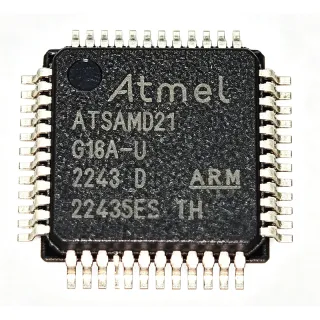
RTAX4000SL-CQ352EV - 4M Gate Rad-Tolerant FPGA | Microchip
MPN: RTAX4000SL-CQ352EV ✓ Active| Qty | Unit Price | Extended |
|---|---|---|
| 1 | $12950 | $12,950.00 |
| 10 | $12300 | $123,000.00 |
| 100 | $11600 | $1,160,000.00 |
| 500 | $10900 | $5,450,000.00 |
| 1,000 | $10250 | $10,250,000.00 |
RTAX4000SL-CQ352EV Overview
A radiation-tolerant FPGA is a programmable logic device engineered to survive the ionizing radiation environment of space, including total ionizing dose (TID), single-event latch-up (SEL), and single-event upset (SEU) effects. Within the power-management hierarchy of a spacecraft avionics system, the FPGA sits between radiation-hardened microcontrollers and application-specific ASICs, offering ASIC-like reliability with FPGA-style development cycles. The RTAX-SL family is the low-power evolution of the original RTAX-S family, succeeding Actel/Microsemi technology now maintained by Microchip Technology.
Key features include live-at-power-up operation via non-volatile antifuse programming, meaning no external configuration flash is required and the device is immune to configuration-memory upsets at turn-on. The 4-million-gate fabric implements dense combinational and sequential logic, on-chip triple modular redundancy (TMR) can be applied by design tools, and the ceramic CQFP-352 package provides hermetic sealing and excellent thermal performance for vacuum environments.
Technically, the device uses a 0.15 um CMOS antifuse process with a 1.5V core and I/O banks supplied at 2.5V, supporting common spaceflight interface standards through flexible I/O standards. Clock management and embedded block structure support high-reliability signal processing payloads. Because antifuse configuration cannot be reprogrammed in flight, design flows emphasize extensive simulation and the manufacturer's footprint-compatible prototyping methodology using equivalent Axcelerator-family commercial parts.
Typical applications include satellite on-board data handling, payload processing, telemetry and telecommand interfaces, spacecraft bus control, and radiation-tolerant glueless integration replacing dozens of discrete logic devices.
Design consideration: pin assignment must be locked early, since antifuse devices are one-time programmable and the EV screening flow requires qualified lot acceptance before assembly.
This page synthesizes distributor data, drop-in same-package alternatives, and practical design notes not found in the manufacturer datasheet.
Drop-in alternatives for RTAX4000SL-CQ352EV — same package, pin-to-pin compatible. Different-package parts requiring PCB rework are excluded.
Variants in this series
Same-series models that are drop-in compatible with RTAX4000SL-CQ352EV (same form factor and footprint) — differing in Family, Package, Logic Cells, Configuration, Radiation Tolerance.
Quick Comparison Tool — Select alternative parts for side-by-side comparison:
RTAX4000SL-1CQ352EV
✅ Drop-In✓ In Stock
Contact for price
View Datasheet →RTAX4000SL-CQ352B
✅ Drop-In✓ In Stock
$1 / Unit
View Datasheet →5962-0822408QXC
✅ Drop-In📋 Reference alternative (not in catalog)
5962-0822405VXC
✅ Drop-In📋 Reference alternative (not in catalog)
RTAX4000SL-CG1272B
✅ Drop-In ⚠️ Specs Unverified✓ In Stock
Contact for price
View Datasheet →RTAX4000SL-CQ352EV Maximum Ratings & Electrical Characteristics
| Family | RTAX-SL (Radiation-Tolerant FPGA) |
| System Gates | 4,000,000 |
| Logic Cells (ASIC Gates) | 40,320 |
| Process Technology | 0.15 um CMOS antifuse |
| Core Supply Voltage | 1.5 V |
| Package | 352-pin CQFP (Ceramic Quad Flat Pack) |
| Screening Level | EV (enhanced spaceflight screening) |
| Programming Technology | Antifuse (one-time programmable, live at power-up) |
| Radiation Tolerance | Radiation-tolerant (TID/SEL/SEU per family datasheet) |
| Configuration | Single-chip, no external boot memory |
| Package Material | Hermetic ceramic (JESD-30 S-CQFP-F352) |
| Mounting Type | Surface Mount |
| Typical Application | Space-flight systems, satellites, payload processing |
RTAX4000SL-CQ352EV hermetic ceramic (jesd-30 s-cqfp-f352) Pin Configuration Guide
Pin configuration for RTAX4000SL-CQ352EV (hermetic ceramic (jesd-30 s-cqfp-f352) package). This digital IC includes GPIO, communication interfaces (UART, SPI, I2C), and power pins. Refer to the manufacturer datasheet for alternate pin functions and configuration options. Essential for embedded system design and PCB layout.

No detailed pinout data available for RTAX4000SL-CQ352EV.
Refer to the datasheet for full pin configuration.
Typical Applications
RTAX4000SL-CQ352EV is suitable for 6 applications: Satellite On-Board Data Handling, Payload Signal Processing, Spacecraft Bus Control, Telemetry and Telecommand Interfaces, Radiation-Tolerant Glueless Logic Integration, Launch Vehicle and Avionics Electronics.
Satellite On-Board Data Handling
The RTAX4000SL-CQ352EV fits satellite on-board data handling (OBDH) because its 4M-gate / 40,320-cell fabric integrates a full spacecraft controller: CCSDS framing, memory controllers, and bus interfaces implemented in one live-at-power-up antifuse device, eliminating external configuration memory whose SEU exposure would otherwise threaten boot integrity. In typical use the FPGA bridges the spacecraft mil-1553 or SpaceWire backbone to payload-specific interfaces, with its 1.5V core keeping static power low in thermally constrained vacuum enclosures. Designers apply triple modular redundancy on state registers through Microchip Libero tool flows to counter configuration-independent SEU effects; the CQFP-352 hermetic package supports conformal-coat-free assembly and straightforward optical inspection for Class S workmanship.
Recommended
Payload Signal Processing
Payload signal processing chains - imaging front-end framing, FFT pre-processing, compression - benefit from the RTAX4000SL-CQ352EV's 4-million-gate capacity, which accommodates parallel datapaths that conventional rad-hard microprocessors cannot sustain. Because the antifuse fabric is configured at manufacture, the payload powers up instantly with no boot sequence, a hard requirement for imagers that must capture at first orbital opportunity. The 0.15 um process at 1.5V core trades raw speed for proven radiation tolerance, appropriate for moderate-clock DSP pipelines (tens of MHz) rather than GHz-class processing. Implement DSP blocks with pipeline registers and TMR-protected control FSMs; use Microchip's footprint-compatible prototyping on commercial equivalents to validate algorithms before antifuse commit.
Recommended
Spacecraft Bus Control
For spacecraft bus control - attitude determination interfaces, power switching supervision, thermal control loops - the RTAX4000SL-CQ352EV offers a single-chip replacement for dozens of discrete rad-tolerant logic devices, improving reliability prediction metrics while cutting board area. Its live-at-power-up behavior means the bus controller FPGA is functional at the instant of pyrotechnic separation events, with no configuration load window during which the vehicle would be uncommanded. The 1.5V core supports the low-dissipation budgets of small buses and rides on solar-array-derived rails. The 352-pin CQFP gives a generous, easily-bonded pin pitch for hand-augmented flight assembly and board-level rework procedures common in high-reliability AIT facilities.
Recommended
Telemetry and Telecommand Interfaces
Telemetry and telecommand (TM/TC) chains require deterministic, configuration-safe logic, and the RTAX4000SL-CQ352EV satisfies both: the antifuse configuration cannot be corrupted by SEU in flight, and 4M gates implement redundant decoders, majority-voted command validation, and frame counters with full TMR coverage. Typical implementations pair the FPGA with external SRAM protected by EDAC, with the CQFP-352 footprint providing enough I/O for 32-bit memory buses plus dual redundant command channels. Because Microchip documents footprint migration across the RTAX family using an EDIF netlist and pinout converter, TM/TC designs can be prototyped on flash-based equivalents and ported to the flight device without PCB respin, shortening qualification cycles.
Recommended
Radiation-Tolerant Glueless Logic Integration
Replacing rad-hard MSI/SSI glue logic (buffers, decoders, address comparators) with one RTAX4000SL-CQ352EV cuts parts count dramatically, directly improving mission reliability allocation and reducing screening cost per function. The 40,320-cell fabric absorbs address decode, interrupt aggregation, bus arbitration, and clock distribution that historically consumed multiple ceramic-packaged standard-logic devices, and its antifuse integrity means these functions are guaranteed at every power cycle. Timing is deterministic because the 0.15 um fabric runs well below process speed limits, giving wide margin against lot variation. Use Microchip Libero timing analysis against the flight speed grade, and reserve the -1 speed variant (RTAX4000SL-1CQ352EV) only for paths failing static timing at default grade.
Recommended
Launch Vehicle and Avionics Electronics
Launch vehicle avionics and expendable-stage electronics face extreme vibration and short mission duration but total radiation environment near Earth orbits still demands radiation-tolerant logic; the RTAX4000SL-CQ352EV's hermetic CQFP-352 package with robust ceramic construction withstands qualification vibration profiles, while live-at-power-up operation ensures guidance and sequencing logic is armed at battery activation without a configuration-load delay. Its 4M-gate capacity hosts flight-event sequencers, redundancy voting logic, and dual-string telemetry concentrators on one device, replacing multi-device heritage designs. Designers should validate shock/vibration derating against package qualification data and apply strict ESD handling per EV screening class during AIT.
Recommended
Recommended Products Summary
Engineering reference data for RTAX4000SL-CQ352EV — comparison, design guidance, and compliance information.
Selection Guide
Comparison with Alternatives
| Parameter | This Product | RTAX4000SL-1CQ352EV | RTAX4000SL-CQ352B | 5962-0822408QXC | RTAX4000SL-CG1272B |
|---|---|---|---|---|---|
| Package | 352-pin CQFP | 352-pin CQFP - same | 352-pin CQFP - same | 352-terminal CQFP - same | 1272-pin CCGA (different package, same die) |
| Brand | Microchip Technology | Microchip Technology | Microchip Technology | Microchip Technology | Microchip Technology |
| System Gates | 4,000,000 | 4,000,000 | 4,000,000 | 4,000,000 | 4,000,000 |
| Logic Cells | 40,320 | 40,320 | 40,320 | 40,320 | 40,320 |
| Core Supply Voltage | 1.5 V | 1.5 V | 1.5 V | 1.5 V | 1.5 V |
| Screening / Qualification | EV (enhanced spaceflight) | EV | B qualification flow | MIL-PRF-38535 Class Q | B qualification flow |
| Drop-in on Same Footprint | Reference | Yes - pin-to-pin | Yes - pin-to-pin | Yes - pin-to-pin | No - requires footprint migration |
Key Differentiators
- Highest logic density in the 352-pin CQFP RTAX footprint (vs RTAX1000SL-CQ352V)
- Faster timing closure margin within identical footprint (vs RTAX4000SL-CQ352EV (this part) vs RTAX4000SL-1CQ352EV)
- SMD procurement path available (vs 5962-0822408QXC)
- Package migration flexibility within the same die (vs RTAX4000SL-CG1272B)
Design Notes
The RTAX4000SL is a one-time-programmable antifuse device: there is no in-flight or post-assembly reprogramming. Freeze the pinout and netlist before committing flight lots, and use Microchip's documented footprint-compatible prototyping methodology (adaptor board with a flash-based commercial equivalent plus EDIF netlist/pinout converter, described in the RTAX-S/SL datasheet) to validate design functionality on the same PCB footprint before programming the CQFP-352 flight parts. Also verify speed-grade selection through static timing analysis before ordering; the -1 grade (RTAX4000SL-1CQ352EV) is the fallback if timing fails at default grade.
Estimate: core power scales with the 1.5V core supply and switching activity; budget core current from Libero power analysis for your gate utilization rather than assuming a fixed figure. Provide independent 1.5V core and I/O bank rails with decoupling of at least 10 uF bulk plus 0.1 uF ceramic per supply pin group, placed within a few millimeters of the CQFP-352 power pins. Single-chip antifuse operation removes configuration-device power sequencing, but apply proper rail sequencing between VCC and I/O banks per the Microchip datasheet power-up requirements to avoid I/O latch-up during turn-on.
The hermetic ceramic CQFP-352 has relatively rigid leads; design land patterns to the datasheet-recommended footprint and include stress-relief considerations for thermal cycling between assembly and launch vibration environments. Avoid routing high-speed signals directly under the package center; use the generous 352-pin perimeter to group I/O banks by voltage domain, and verify every bank voltage assignment against the pinout table in the Microchip RTAX-S/SL datasheet (rtaxs_ds2169_v18.pdf) before layout release, since incorrect bank reference voltages cannot be corrected after antifuse programming.
Because the RTAX4000SL fabric runs far below its process speed limit, edge rates are moderate, but flight-grade bus structures (32-bit memory interfaces, parallel payload links) still require controlled stub lengths and series termination where traces exceed roughly one-tenth of the signal rise-time electrical length. Apply TMR to control state machines and use register replication judiciously - excess replication increases clock loading. Cross-check timing corners for both the standard and -1 speed grades if your program may substitute RTAX4000SL-1CQ352EV parts during allocation shortages.
Compliance Information
Space-grade hermetic ceramic CQFP package; MIL-PRF-38535 Class Q screening is available on the SMD variant 5962-0822408QXC. RoHS/REACH status not stated in retrieved web data - space-grade ceramic packaging commonly carries RoHS exemptions; confirm with Microchip product compliance documentation.