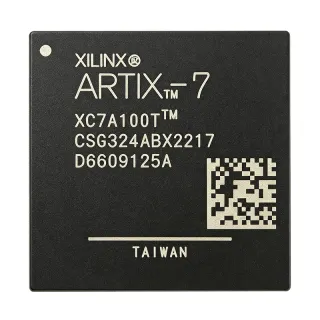
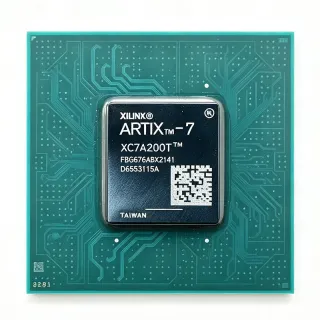
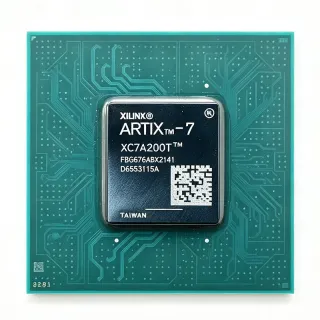
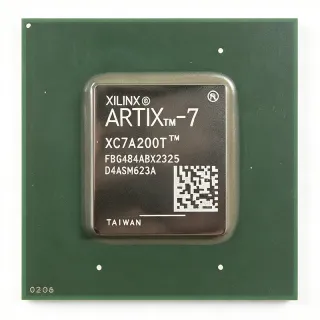
10CX220YU484E6G - Cyclone 10 GX 220K LE FPGA | Intel | 484-BGA
MPN: 10CX220YU484E6G ✓ Active| Qty | Unit Price | Extended |
|---|---|---|
| 1 | $231.82 | $231.82 |
| 10 | $218.5 | $2,185.00 |
| 100 | $195 | $19,500.00 |
| 500 | $175 | $87,500.00 |
| 1,000 | $160 | $160,000.00 |
10CX220YU484E6G Overview
An FPGA (Field Programmable Gate Array) is a semiconductor device with an array of configurable logic blocks (CLBs), programmable interconnects, and I/O cells that can be reconfigured by the designer after manufacturing. FPGAs occupy a unique tier in the programmable logic hierarchy: above fixed-function ASICs in flexibility, below microcontrollers in per-unit cost for high-volume products, but unmatched for parallel processing, low-latency I/O, and hardware-reconfigurable logic. Cyclone 10 GX sits at the intersection of low power and high serial bandwidth in Intel's portfolio.
Key features of the 10CX220YU484E6G include integrated transceivers up to 12.5 Gbps, hard memory controllers, a hard PCIe Gen2 hard IP block, and a 1.4 Gbps LVDS performance. The device supports up to 220K logic elements, 13.75 Mbits embedded RAM, and 154 18x18 multipliers for DSP workloads. The 484-BGA package provides 188 general-purpose I/O pins, with transceivers and configuration pins sharing additional balls in the same array.
The 10CX220YU484E6G is fabricated on TSMC's 20nm low-power process, delivering lower static and dynamic power versus prior-generation 28nm Cyclone V devices. Integrated PLLs, hard PCIe Gen2 x4 IP, and 12.5 Gbps transceivers enable designers to consolidate what previously required external bridge chips into a single FPGA. The architecture supports configuration via active serial (AS), passive serial (PS), JTAG, and fast passive parallel (FPP) modes.
Typical applications include industrial machine vision with GigE Vision or CoaXPress aggregation, low-cost broadcast video processing, software-defined radio front-ends, IoT edge acceleration, motor control, and PCIe-based acceleration cards. The combination of integrated transceivers and low power makes it a popular choice for cost-sensitive designs requiring high-speed serial I/O without the power budget of a Stratix 10.
When designing with the 10CX220YU484E6G, pay close attention to transceiver reference clock routing and power distribution. The integrated transceivers require clean, low-jitter reference clocks for proper link operation, and a minimum of 4 PCB layers is recommended for the transceiver power planes. Quartus Prime Lite edition provides free synthesis and place-and-route support for this device.
This page synthesizes distributor pricing, drop-in Cyclone 10 GX alternatives, and practical design notes not aggregated in a single location on the manufacturer datasheet, providing engineers a one-stop reference for sourcing and designing in this part.
Drop-in alternatives for 10CX220YU484E6G — same package, pin-to-pin compatible. Different-package parts requiring PCB rework are excluded.
Variants in this series
Same-series models that are drop-in compatible with 10CX220YU484E6G (same form factor and footprint) — differing in Package, DSP Blocks, Mounting Type, Process Technology, Operating Temperature.
Quick Comparison Tool — Select alternative parts for side-by-side comparison:
10CX220YU484E5G
✅ Drop-In✓ In Stock
$189.95 / Unit
View Datasheet →10CX220YU484I6G
✅ Drop-In✓ In Stock
$277 / Unit
View Datasheet →10CX220YU484I5G
✅ Drop-In✓ In Stock
$42.38 / Unit
View Datasheet →10CX150YU484E6G
✅ Drop-In✓ In Stock
$124.55 / Unit
View Datasheet →10CX150YU484E5G
✅ Drop-In✓ In Stock
$128.65 / Unit
View Datasheet →10CL120YU484C8G
✅ Drop-In📋 Reference alternative (not in catalog)
10CX220YU484E6G Maximum Ratings & Electrical Characteristics
| Family | Cyclone 10 GX |
| Logic Elements | 220,000 |
| Embedded Memory | 13,752,320 bits (13.75 Mbit) |
| Total RAM Bits | 13,752,320 |
| Number of I/O | 188 |
| Number of Logic Gates | 220,000 |
| Process Technology | 20 nm |
| Package | 484-BFBGA (UBGA) |
| Package Pin Count | 484 |
| Mounting Type | Surface Mount |
| Transceivers | Integrated, up to 12.5 Gbps |
| PCIe Hard IP | PCIe Gen2 hard IP block |
| DSP Blocks (Multipliers) | 154 (18x18 multipliers) |
| RoHS Status | Compliant |
10CX220YU484E6G 484 Pin Configuration Guide
Pin configuration for 10CX220YU484E6G (484 package). This digital IC includes GPIO, communication interfaces (UART, SPI, I2C), and power pins. Refer to the manufacturer datasheet for alternate pin functions and configuration options. Essential for embedded system design and PCB layout.

No detailed pinout data available for 10CX220YU484E6G.
Refer to the datasheet for full pin configuration.
Typical Applications
10CX220YU484E6G is suitable for 7 applications: Industrial Machine Vision, Software-Defined Radio Front-End, Broadcast Video Processing, PCIe Acceleration Card, Motor Control and Industrial Drives, IoT Edge Gateway, Test and Measurement Instrumentation.
Industrial Machine Vision
The Intel 10CX220YU484E6G is well-suited for industrial machine vision systems aggregating multiple GigE Vision or CoaXPress camera streams. Its 220K logic elements provide parallel pixel processing pipelines, while the 12.5 Gbps transceivers accept high-speed serial protocols like CoaXPress 2.0 with minimal external components. The 13.75 Mbit embedded RAM acts as line and frame buffers between the camera interface and the image processing pipeline. The PCIe Gen2 hard IP enables direct attachment to a host CPU for result transfer without an external bridge chip. The 188 user I/O accommodate parallel GPIO for trigger, strobe, lighting, and encoder feedback lines in factory-floor environments.
Recommended
Software-Defined Radio Front-End
The 10CX220YU484E6G serves as a digital front-end for software-defined radio platforms operating in the sub-6 GHz range. Its 12.5 Gbps transceivers digitize wideband IF signals directly from ADC chains, while the 154 embedded 18x18 multipliers implement FIR filters, channelizers, and DDC stages in parallel. The 220K LE capacity handles multi-channel FFT engines with overlapping window functions. The hard PCIe Gen2 block streams demodulated data to host processors at line rate. Compared with discrete DSP + FPGA solutions, the integrated transceiver and PCIe IP reduce BOM cost and PCB area. The 20nm process node delivers the low static power needed for portable and field-deployed SDR platforms.
Recommended
Broadcast Video Processing
In broadcast video processing equipment, the 10CX220YU484E6G performs real-time SDI bridging, format conversion, and HDR tone mapping. The 188 user I/O supports multi-stream 3G-SDI or 12G-SDI interfaces via external PHY devices, while the 12.5 Gbps transceivers drive 12G-SDI directly when paired with appropriate retimers. The 13.75 Mbit embedded RAM acts as a frame buffer for cross-format scaling, deinterlacing, and overlay composition. The 220K logic elements handle multiple independent processing channels without external memory contention. The PCIe hard IP enables low-latency insertion into broadcast workflows using IP-based transport. The 484-BGA package footprint provides ample routing density for high-speed serial and parallel video I/O.
Recommended
PCIe Acceleration Card
The 10CX220YU484E6G is a strong fit for low-cost PCIe accelerator cards targeting edge inference, compression, and storage acceleration. Its hard PCIe Gen2 x4 block provides a low-latency host interface without consuming logic fabric, freeing the 220K LE for the actual accelerator pipeline. The 154 18x18 multipliers accelerate convolutional and dense matrix operations, while the 13.75 Mbit embedded RAM holds intermediate activations. The integrated transceivers enable optional front-panel QSFP or SFP+ connectivity for network-attached accelerators. Compared with discrete GPU or ASIC accelerators, this Cyclone 10 GX solution delivers flexible reprogrammability at a lower BOM cost for low-to-mid volume deployments.
Recommended
Motor Control and Industrial Drives
The 10CX220YU484E6G drives multi-axis industrial servo and stepper motor controllers with high-resolution PWM generation and feedback loop closure. Its 188 user I/O accommodate encoder inputs (typically A/B/I), Hall sensors, and PWM outputs for multiple axes in parallel. The 220K LE capacity implements field-oriented control (FOC) algorithms with cascaded PID controllers and commutation tables. The 154 18x18 multipliers accelerate Park/Clarke transforms and observer computations in the current loop. The hard PCIe interface enables integration into Industry 4.0 servo drive networks. The industrial temperature grade variant (10CX220YU484I6G) supports harsh factory environments where ambient temperatures exceed commercial ranges.
Recommended
IoT Edge Gateway
The 10CX220YU484E6G functions as the processing hub of industrial IoT edge gateways aggregating multiple sensor protocols into a unified cloud uplink. Its transceivers accept LTE, Wi-Fi, or private LTE RF front-ends, while the 188 user I/O interface to RS-485, CAN, SPI, I2C, and GPIO sensor buses. The 220K logic elements run protocol conversion, local analytics, and security/authentication pipelines. The 13.75 Mbit embedded RAM acts as a packet buffer for store-and-forward operation during intermittent connectivity. The PCIe hard IP connects to a host CPU module running a Linux-based application stack. Compared with microcontroller-based edge nodes, this FPGA delivers deterministic low-latency response for time-critical industrial control loops.
Recommended
Test and Measurement Instrumentation
The 10CX220YU484E6G serves as the digital back-end of benchtop and PXI-based test and measurement equipment, providing stimulus generation, response capture, and protocol-aware decoding. Its 12.5 Gbps transceivers handle high-speed serial protocols under test (PCIe, SATA, USB 3.0), while the 220K logic elements implement protocol state machines and stimulus generation. The 13.75 Mbit embedded RAM acts as capture memory for pattern comparison. The hard PCIe Gen2 block connects to host PC for deep trace storage and visualization. Compared with ASIC-based instruments, this FPGA offers field-upgradeable protocol support as standards evolve. The 188 user I/O accommodate parallel logic analyzer pods and trigger bus lines.
Recommended
Recommended Products Summary
Engineering reference data for 10CX220YU484E6G — comparison, design guidance, and compliance information.
Selection Guide
Comparison with Alternatives
| Parameter | This Product | 10CX220YU484E5G | 10CX220YU484I6G | 10CX220YU484I5G | 10CX150YU484E6G | 10CX150YU484E5G | 10CL120YU484C8G |
|---|---|---|---|---|---|---|---|
| Brand | Intel | Intel | Intel | Intel | Intel | Intel | Intel |
| Package | 484-BFBGA (UBGA) | 484-BFBGA (UBGA) - same | 484-BFBGA (UBGA) - same | 484-BFBGA (UBGA) - same | 484-BFBGA (UBGA) - same | 484-BFBGA (UBGA) - same | 484-BFBGA (UBGA) - same |
| Logic Elements | 220,000 | 220,000 | 220,000 | 220,000 | 150,000 | 150,000 | 120,000 |
| Transceivers | Up to 12.5 Gbps integrated | Up to 12.5 Gbps integrated | Up to 12.5 Gbps integrated | Up to 12.5 Gbps integrated | Up to 12.5 Gbps integrated | Up to 12.5 Gbps integrated | None (Cyclone 10 LP) |
| Speed Grade | E6 (grade 6) | E5 (grade 5) | I6 (industrial grade 6) | I5 (industrial grade 5) | E6 (grade 6) | E5 (grade 5) | C8 (grade 8) |
| PCIe Hard IP | PCIe Gen2 hard IP | PCIe Gen2 hard IP | PCIe Gen2 hard IP | PCIe Gen2 hard IP | PCIe Gen2 hard IP | PCIe Gen2 hard IP | None (Cyclone 10 LP) |
Key Differentiators
- Highest-density Cyclone 10 GX in the 484-BGA footprint (vs 10CX150YU484E6G)
- Integrated 12.5 Gbps transceivers in mid-density 484-BGA (vs 10CL120YU484C8G)
- Faster speed grade (6) within the same 484-BGA family (vs 10CX220YU484E5G)
Design Notes
The Cyclone 10 GX 484-UBGA package uses a 1.0 mm ball pitch. Designers must allocate at least 4 PCB layers with dedicated power planes for the transceiver (XCVR) supply rails to meet signal-integrity targets at 12.5 Gbps. The XCVR power balls should be decoupled locally with 0.1uF and 10uF ceramic capacitors placed within 100 mils of each ball group. The exposed die-attach pad must be soldered to the central ground pad for thermal dissipation.
Cyclone 10 GX devices are designed for 20nm low-power operation, but high-utilization designs with active transceivers can still dissipate 5-10W. The 484-BGA package has a thermal resistance of approximately 12-15 C/W (theta_JB), requiring either significant PCB copper pour or a heatsink for industrial temperature applications. Designers should simulate thermal profiles with the Quartus Prime Power Analyzer before committing to mechanical packaging.
Transceiver channels on the 10CX220YU484E6G require controlled-impedance routing with reference planes intact under the entire channel length. For 12.5 Gbps operation, use stripline with 8-10 mil trace width on a 100 ohm differential pair, with skew matched to within 5 mils per channel. Reference clocks must be clean and low-jitter; a dedicated low-jitter oscillator like the Silicon Labs Si5351 is recommended for the REFCLK input.
Do not confuse the Cyclone 10 GX (10CX prefix) with the Cyclone 10 LP (10CL prefix). The Cyclone 10 LP family does not contain integrated transceivers or PCIe hard IP, making it unsuitable as a drop-in replacement for designs requiring high-speed serial I/O. Verify the silicon ID via JTAG before PCB bring-up to confirm the correct device is populated, especially when sourcing from open-market inventory.
The configuration scheme (AS, PS, JTAG, FPP) must be selected via MSEL pins before power-up; these pins have internal pull-ups but should be hard-wired on the PCB to prevent configuration mode drift. For JTAG programming, route TCK, TMS, TDI, TDO with the standard 4-wire TAP topology and provide a 4.7 kohm pull-up on TCK. Active Serial configuration requires an external QSPI flash with at least 4 MB capacity for typical Cyclone 10 GX bitstreams.
Compliance Information
RoHS and REACH compliant per Intel Cyclone 10 GX product documentation. Lead-free BGA assembly. AEC-Q100 not applicable for FPGAs targeting industrial/commercial use; automotive-grade variants may exist in other families.