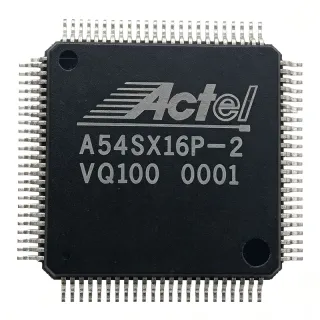
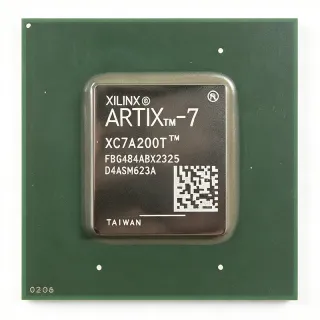
A3P250-1VQG100T - ProASIC3 FPGA 250k Gates TQFP-100 | Microchip
MPN: A3P250-1VQG100T ✓ Active| Qty | Unit Price | Extended |
|---|---|---|
| 1 | $34.5 | $34.50 |
| 10 | $31.2 | $312.00 |
| 100 | $27.8 | $2,780.00 |
| 500 | $24.9 | $12,450.00 |
| 1,000 | $22.3 | $22,300.00 |
A3P250-1VQG100T Overview
A flash-based FPGA is a field-programmable gate array whose configuration is stored in on-chip flash memory rather than an external configuration device. Within the programmable logic hierarchy, the A3P250 sits in the low-density tier of the ProASIC3 family: FPGA -> flash FPGA -> ProASIC3 -> A3P250. Because the configuration data is nonvolatile and live-at-power-up, no external boot flash or microcontroller supervisory logic is required, making it a true single-chip solution.
Key features include reprogrammable flash fabric (secure, low total cost of ownership), 1.425V to 1.575V single core supply (1.5V nominal), an automotive grade designation in this ordering option, and an industrial operating range of -40C to +125C (TA). The 68 user I/O support common single-ended standards, and the 36864-bit embedded RAM supports small FIFOs and buffers in glue-logic and control designs.
The ProASIC3 architecture uses a sea-of-vanadium-gate flash switch fabric with fine-grained VersaTiles, delivering deterministic performance suitable for control-plane logic, state machines, bus bridging, and power-up-critical functions. The device is programmed with Microchip Libero SoC design suite and supports in-system reprogramming.
Typical applications include industrial automation control, automotive subsystems (this is an automotive-grade ordering option), power-up sequencers and glue logic, and portable/instrumentation designs needing a single-chip nonvolatile FPGA.
Design consideration: keep the 1.5V core supply within the 1.425V to 1.575V window with a dedicated regulator; the TQFP-100 leads require careful solder-joint inspection (0.5 mm pitch).
This page synthesizes distributor pricing, drop-in same-footprint family alternatives, and practical design notes not found in the manufacturer datasheet.
Drop-in alternatives for A3P250-1VQG100T — same package, pin-to-pin compatible. Different-package parts requiring PCB rework are excluded.
Variants in this series
Same-series models that are drop-in compatible with A3P250-1VQG100T (same form factor and footprint) — differing in System Gates, Package, Operating Temperature, Logic Elements, Family.
Quick Comparison Tool — Select alternative parts for side-by-side comparison:
A3P250L-1VQG100I
✅ Drop-In✓ In Stock
$7.5 / Unit
View Datasheet →A3P250-1VQ100M
✅ Drop-In✓ In Stock
$7.5 / Unit
View Datasheet →A3P250-VQ100T
✅ Drop-In✓ In Stock
$7.2 / Unit
View Datasheet →A3P125-1VQG100I
✅ Drop-In✓ In Stock
$9.44 / Unit
View Datasheet →A3P125-VQ100T
✅ Drop-In✓ In Stock
$7.5 / Unit
View Datasheet →A3P250-1VQG100T Maximum Ratings & Electrical Characteristics
| Family | ProASIC3 |
| Number of System Gates | 250000 gates |
| Logic Elements (CLBs) | 6144 |
| Number of I/O | 68 |
| Total RAM Bits | 36864 |
| Supply Voltage (Core) | 1.425 V to 1.575 V |
| Operating Temperature | -40C to +125C (TA) |
| Package / Case | 100-TQFP (VQFP, 14x14 mm) |
| Supplier Device Package | 100-VQFP (14x14) |
| Mounting Type | Surface Mount |
| Programmability | Flash-based, reprogrammable, live at power-up |
| Configuration Memory | On-chip flash (single-chip, no external config device) |
| Maximum System Performance | Up to 350 MHz |
| Grade | Automotive |
| Packaging | Tray |
| Lead Pitch | 0.5 mm |
A3P250-1VQG100T 100-vqfp (14x14) Pin Configuration Guide
Pin configuration for A3P250-1VQG100T (100-vqfp (14x14) package). This digital IC includes GPIO, communication interfaces (UART, SPI, I2C), and power pins. Refer to the manufacturer datasheet for alternate pin functions and configuration options. Essential for embedded system design and PCB layout.

No detailed pinout data available for A3P250-1VQG100T.
Refer to the datasheet for full pin configuration.
Typical Applications
A3P250-1VQG100T is suitable for 6 applications: Industrial Automation Control, Automotive Body Electronics and Power-Up Sequencing, Glue Logic and Bus Bridging, Portable and Battery-Powered Instrumentation, Test and Measurement Equipment, Secure Embedded Systems and Retronics Redesign.
Industrial Automation Control
In factory automation and industrial control systems, the A3P250-1VQG100T consolidates state machines, sensor-interface glue logic, and motor-control sequencing into one flash FPGA. Its 6144 logic cells and 36864 bits of embedded RAM are sufficient for typical PLC I/O expansion, encoder decoding, and interlock logic, while the -40C to +125C industrial range survives cabinet temperature extremes. Because the fabric is live at power-up, safety interlocks and I/O disable states are enforced immediately at energization without waiting for configuration download. Place it between a host MCU and field I/O with the 68 user I/O banked for 3.3V and 2.5V standards, and rely on the single 1.5V core rail to simplify the 24V-backplane power tree.
Recommended
Automotive Body Electronics and Power-Up Sequencing
The A3P250-1VQG100T carries an automotive grade designation and operates from -40C to +125C, making it suitable for body control modules, lighting controllers, and power sequencing engines in vehicles. Its flash-based configuration is live within microseconds of ignition-on, so rails can be sequenced and load switches enabled before a separate MCU finishes booting a key functional-safety advantage. The 250k-gate fabric implements PWM engines, LIN/CAN glue logic, and diagnostic state machines, while the TQFP-100 (14x14 mm) footprint fits compact ECU boards. Design with a 1.5V core regulator rated for the automotive load-dump transient environment and use the JTAG port for in-system field updates.
Recommended
Glue Logic and Bus Bridging
For boards that mix legacy buses, memory interfaces, and modern processors, the A3P250-1VQG100T replaces dozens of 7400-series and CPLD devices with one reprogrammable 250k-gate device. Its 68 user I/O can implement parallel bus bridges, address decoders, wait-state generators, and level-shifted interfaces simultaneously, and design changes are made in firmware rather than by PCB respins. The deterministic ProASIC3 fabric provides consistent pin-to-pin delays for timing-critical handshake logic, and the 36864-bit RAM buffers burst transfers. Because the part reprograms in-system via JTAG, field upgrades of bridge logic are possible without desoldering, reducing total cost of ownership across a product's service life.
Recommended
Portable and Battery-Powered Instrumentation
Handheld instruments and battery-powered data loggers benefit from the A3P250-1VQG100T's single-chip architecture: no external configuration flash is needed, saving board area and reducing leakage paths. The ProASIC3 flash fabric has very low static power compared to SRAM FPGAs at this density, and the 14x14 mm TQFP-100 package keeps the PCB footprint compact. The 6144 logic cells implement acquisition sequencing, display drivers, and USB/UART bridging, while the embedded RAM holds sample buffers between MCU readouts. Estimated: with a low-duty-cycle control design, average core current stays in the low milliamp range, allowing multi-hour operation from a two-cell supply with an efficient 1.5V buck converter.
Recommended
Test and Measurement Equipment
Bench instruments, fixture controllers, and production test heads use the A3P250-1VQG100T for scan engines, relay matrix control, and trigger distribution. The up-to-350 MHz system capability of the ProASIC3 family supports fast state machines for time-tagging and edge detection, while the 68 I/O drive fixture relays, indicator LEDs, and peripheral handshake lines. Embedded 36864-bit RAM captures pass/fail logs between host reads. The flash fabric's deterministic routing simplifies timing closure for fixed-latency trigger paths, and in-system JTAG reprogramming lets test engineers update stimulus routines per product variant without hardware changes. Mount the TQFP-100 with adequate thermal relief given the -40C to +125C ambient specification margin.
Recommended
Secure Embedded Systems and Retronics Redesign
The A3P250-1VQG100T's flash configuration memory supports design security features valuable in tamper-sensitive embedded systems, and the part is a natural choice for replacing obsolete ASICs and EOL PLDs in long-lifecycle programs such as medical devices, avionics subassemblies, and industrial drives. Engineers port legacy ABEL/Schematic designs into Libero SoC and map them into the 6144-cell fabric, reviving boards without the original silicon. The automotive grade and 125C rating extend applicability to harsh environments, while the reprogrammable fabric supports fielded bug fixes. As a flash FPGA it also powers up instantly, preserving the timing assumptions of legacy designs that expected logic active at reset release.
Recommended
Recommended Products Summary
Engineering reference data for A3P250-1VQG100T — comparison, design guidance, and compliance information.
Selection Guide
Comparison with Alternatives
| Parameter | This Product | A3P250L-1VQG100I | A3P250-1VQ100M | A3P250-VQ100T | A3P125-1VQG100I | A3P125-VQ100T |
|---|---|---|---|---|---|---|
| Package | 100-TQFP (VQFP, 14x14 mm) | 100-TQFP (VQFP, 14x14 mm) - same | 100-TQFP (VQFP, 14x14 mm) - same | 100-TQFP (VQFP, 14x14 mm) - same | 100-TQFP (VQFP, 14x14 mm) - same | 100-TQFP (VQFP, 14x14 mm) - same |
| Brand | Microchip Technology | Microchip Technology | Microchip Technology | Microchip Technology | Microchip Technology | Microchip Technology |
| System Gates | 250000 | 250000 | 250000 | 250000 | 125000 | 125000 |
| Logic Cells | 6144 | 6144 | 6144 | 6144 | 3072 | 3072 |
| Core Supply Voltage | 1.425 V to 1.575 V | 1.425 V to 1.575 V | 1.425 V to 1.575 V | 1.425 V to 1.575 V | 1.425 V to 1.575 V | 1.425 V to 1.575 V |
| Operating Temperature | -40C to +125C | -40C to +100C (industrial, verify datasheet) | Military extended range | -40C to +125C | -40C to +100C (industrial, verify datasheet) | Commercial range |
| Configuration Type | On-chip flash, live at power-up | On-chip flash, live at power-up | On-chip flash, live at power-up | On-chip flash, live at power-up | On-chip flash, live at power-up | On-chip flash, live at power-up |
Key Differentiators
- Full 250k-gate density at lowest package tier (vs A3P125-1VQG100I)
- Automotive grade designation (vs A3P250-VQ100T)
- Standard fabric vs low-power fabric trade-off (vs A3P250L-1VQG100I)
Design Notes
The 1.5V core rail must stay within 1.425V to 1.575V under all load and line conditions. Use a dedicated low-noise LDO or buck with at least 500 mA headroom; ProASIC3 core current scales with toggle rate, so an active design at high clock frequencies draws more than an idle one. Follow Microchip's ProASIC3 power-up requirements: core and I/O supply ramp order and VPP/VPT programming voltage handling are specified in the datasheet. Add 10uF bulk plus 0.1uF ceramic decoupling at each supply pin group and verify sequencing in Libero's power estimator before tape-out.
The TQFP-100 has a 0.5 mm lead pitch, which is at the practical limit of standard reflow inspection. Use solder-mask-defined pads matching Microchip's recommended land pattern, and specify X-ray or AOI inspection for automotive programs. Keep JTAG (TDI/TDO/TMS/TCK) routed to a header for in-system programming even if production boards skip it, and place 22 to 33 ohm series resistors on fast I/O nets to control ringing given the modest edge rates of ProASIC3 I/O.
Do not substitute the automotive-grade A3P250-1VQG100T with a commercial-temperature variant in automotive programs without requalification, and conversely do not pay automotive pricing for consumer builds where A3P250-VQ100T suffices. When migrating to A3P125 devices in the same footprint, re-run utilization reports: the halved 3072-cell fabric will not absorb the same design. Finally, the flash fabric erases/programs through VPP, so never hard-wire VPP to a permanent 3.3V rail if in-field reprogramming is planned.
Compliance Information
The 'G' suffix in A3P250-1VQG100T denotes green (RoHS/halogen-free) packaging per Microchip naming convention and distributor listings. Formal REACH and conflict-minerals declarations should be obtained from Microchip's compliance documentation. The part is designated 'Grade: Automotive' in distributor data; AEC-Q100 formal qualification status should be confirmed with Microchip directly.