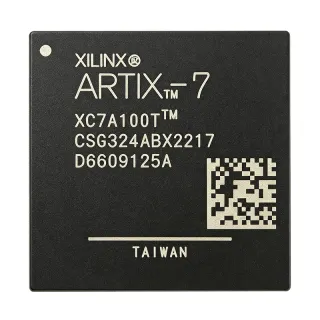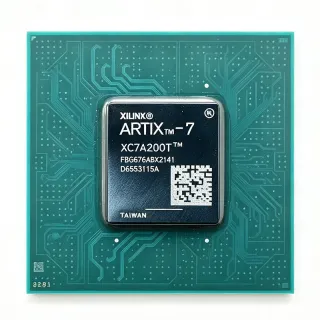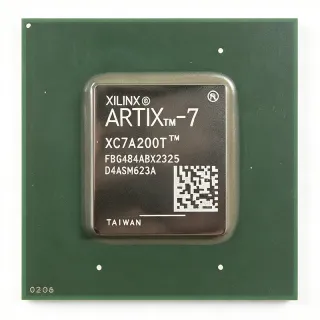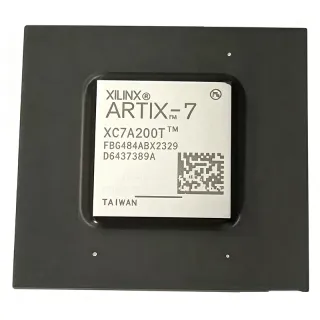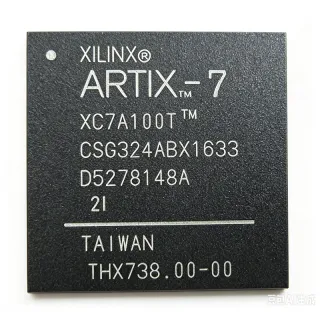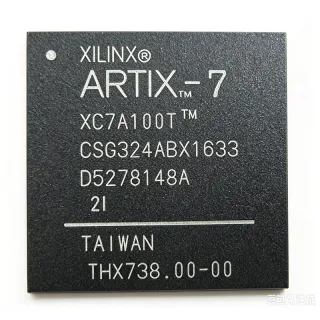
EP1M120F484C5N - Mercury FPGA 120K Logic Elements | Altera | 303 I/O
MPN: EP1M120F484C5N ✗ End of Life| Qty | Unit Price | Extended |
|---|---|---|
| 1 | $125.66 | $125.66 |
| 10 | $119.38 | $1,193.80 |
| 100 | $108.74 | $10,874.00 |
| 500 | $96.21 | $48,105.00 |
| 1,000 | $89.5 | $89,500.00 |
EP1M120F484C5N Overview
What is a Mercury FPGA? A Field Programmable Gate Array (FPGA) is a programmable logic device (PLD) whose architecture consists of an array of configurable logic blocks (LABs/LEs) surrounded by programmable interconnect and surrounded by programmable I/O cells. Mercury is Altera's high-performance, low-power family that integrates high-speed transceivers alongside the general-purpose logic fabric, allowing designers to embed serial-link functionality directly into the fabric without an external PHY. This combination makes Mercury-family FPGAs members of the broader hierarchy: FPGA -> programmable logic device -> logic IC -> semiconductor IC.
Key features include 4,800 logic cells, 303 user I/Os, an embedded transceiver block with embedded CDR up to 1.25 Gbps per channel, dedicated on-chip memory, and a 0.18 micron process that yields low static and dynamic power. The 1.8 V core and the LVTTL/LVCMOS-compatible I/O make it compatible with mainstream 1.8 V ASIC-style boards and existing Altera Quartus design flows.
The architectural depth lies in the integration of serial transceivers, the LAB-based logic fabric, and embedded RAM; this allows designers to implement high-speed serial protocol bridges (such as Gigabit Ethernet MACs or proprietary backplanes) and datapath logic in a single device, simplifying board layout and BOM.
Typical applications include high-speed serial-protocol bridging, telecommunications backplane interface cards, industrial motor-control boards with embedded serial links, prototyping of ASIC datapaths, and high-volume embedded communication subsystems. Designers choose this part when 1.25 Gbps embedded CDR with 120K-gate logic capacity is sufficient and footprint area can accommodate the 23 mm x 23 mm FC-FBGA.
A key design consideration is signal-integrity routing for the high-speed serial channels - controlled-impedance differential traces (typically 100 ohm differential) and proper decoupling are mandatory. The 484-pin FC-FBGA package also requires careful PCB stack-up planning because of its dense escape routing.
This page synthesizes distributor pricing, drop-in same-family alternatives, and practical design notes not found in the manufacturer datasheet itself.
Drop-in alternatives for EP1M120F484C5N — same package, pin-to-pin compatible. Different-package parts requiring PCB rework are excluded.
Variants in this series
Same-series models that are drop-in compatible with EP1M120F484C5N (same form factor and footprint) — differing in Package, Family, Operating Temperature, Speed Grade, Process Technology.
Quick Comparison Tool — Select alternative parts for side-by-side comparison:
EP1M120F484C5M
✅ Drop-In✓ In Stock
Contact for price
View Datasheet →EP1M120F484C5
✅ Drop-In✓ In Stock
$110 / Unit
View Datasheet →EP1M120F484-I6
✅ Drop-In✓ In Stock
$98.5 / Unit
View Datasheet →EP1M120F484-6
✅ Drop-In✓ In Stock
$53.1 / Unit
View Datasheet →EP1M120F484
✅ Drop-In✓ In Stock
$92 / Unit
View Datasheet →EP1M120F48416
✅ Drop-In✓ In Stock
$97.4 / Unit
View Datasheet →EP1M120F484C5N Maximum Ratings & Electrical Characteristics
| Family | Mercury |
| Logic Elements / Cells | 4,800 (120K equivalent gates) |
| Logic Array Blocks (LABs) | 480 |
| User I/Os | 303 |
| Process Technology | 0.18 micron CMOS |
| Core Supply Voltage | 1.8 V (1.71 V to 1.89 V) |
| Integrated Transceivers | Yes, with CDR up to 1.25 Gbps |
| Package | 484-pin FC-FBGA (FineLine BGA, 23 mm x 23 mm) |
| Mounting Type | Surface Mount |
| Operating Temperature | 0 C to 85 C (Commercial) |
| Speed Grade | C5 |
EP1M120F484C5N 484-pin fc-fbga (fineline bga, 23 mm x 23 mm) Pin Configuration Guide
Pin configuration for EP1M120F484C5N (484-pin fc-fbga (fineline bga, 23 mm x 23 mm) package). This digital IC includes GPIO, communication interfaces (UART, SPI, I2C), and power pins. Refer to the manufacturer datasheet for alternate pin functions and configuration options. Essential for embedded system design and PCB layout.

No detailed pinout data available for EP1M120F484C5N.
Refer to the datasheet for full pin configuration.
Typical Applications
EP1M120F484C5N is suitable for 6 applications: Gigabit Ethernet Serial Bridge, Telecommunications Backplane Interface, ASIC Prototyping and Datapath Emulation, Industrial Motor Control with Serial Feedback, High-Speed Data Acquisition Front-End, Legacy Board Revision Refresh.
Gigabit Ethernet Serial Bridge
The EP1M120F484C5N's integrated 1.25 Gbps CDR transceivers let it terminate 1000BASE-X serial links without an external PHY, while the 4,800 logic cells implement the MAC, bridge logic, and protocol conversion in a single device. Placed between an SFP cage and a host CPU via parallel bus, the device handles CDR, 8b/10b encoding, and rate adaptation; the 1.8 V core and LVCMOS I/O simplify power-tree design when bridging to 1.8 V processors. Unlike a discrete PHY + small CPLD combination, this part reduces BOM count and PCB area.
Recommended
Telecommunications Backplane Interface
Mercury FPGAs were designed for telecom backplanes, and the EP1M120F484C5N fits line-card interface roles where multiple 1.25 Gbps serial channels run between shelves. The 303 user I/Os expose parallel control/status buses to the framer ASIC, while the embedded CDR handles each serial link with deterministic jitter. Designers place the device adjacent to the line-card connector with controlled-impedance 100-ohm differential routing; this single-chip solution replaces separate transceivers plus glue logic that earlier backplanes required.
Recommended
ASIC Prototyping and Datapath Emulation
With 120K equivalent gates and 303 I/Os, the EP1M120F484C5N is well sized for ASIC datapath prototyping where designers need to validate RTL against real I/O before taping out. The 1.8 V core keeps dynamic power manageable during long emulation runs, while the Quartus II design flow accepts standard Verilog/VHDL and produces a working bitstream in minutes. Compared with a pure simulation flow, real-time FPGA prototyping catches timing bugs, clock-domain crossing issues, and protocol-handshake errors that simulation misses.
Recommended
Industrial Motor Control with Serial Feedback
Industrial servo drives benefit from the EP1M120F484C5N's combination of high-speed serial links (for resolver-to-digital feedback and EtherCAT-style servo loops) and 303 I/Os (for encoder, Hall-sensor, and PWM outputs). The device drives power-stage gate drivers directly from its LVCMOS I/O, while the embedded transceivers handle the feedback-link PHY. The commercial 0-85 C temperature grade covers most indoor cabinet deployments; industrial-grade variants exist for harsher environments.
Recommended
High-Speed Data Acquisition Front-End
Data-acquisition front-ends digitizing multiple analog channels need parallel LVCMOS I/O for ADC data, plus a serial link for off-board transport. The EP1M120F484C5N's 303 I/Os accept wide ADC buses (up to 144 LVCMOS pairs at 200 MHz), while the 1.25 Gbps transceivers stream aggregated samples upstream. Designers place the FPGA adjacent to the ADCs with matched-length trace groups; the 484-ball FC-BGA's large ball count supports wide datapath fan-out without routing congestion.
Recommended
Legacy Board Revision Refresh
When an existing Mercury-based design needs a refresh or re-spin, the EP1M120F484C5N keeps the schematic, PCB footprint, and Quartus bitstream unchanged while providing a current-date RoHS-compliant source. Engineers can swap in this part without respinning the board, without recompiling the RTL, and without re-qualifying the I/O timing. This is the primary use case for the part in 2026: maintaining installed base designs where Mercury's combination of logic capacity and integrated transceivers is still specified.
Recommended
Recommended Products Summary
Engineering reference data for EP1M120F484C5N — comparison, design guidance, and compliance information.
Selection Guide
Comparison with Alternatives
| Parameter | This Product | EP1M120F484C5M | EP1M120F484C5 | EP1M120F484-I6 | EP1M120F484-6 | EP1M120F484 |
|---|---|---|---|---|---|---|
| Brand | Altera (Intel) | Altera (Intel) | Altera (Intel) | Altera (Intel) | Altera (Intel) | Altera (Intel) |
| Package | 484-FBGA (23x23 mm) | 484-FBGA (23x23 mm) - same | 484-FBGA (23x23 mm) - same | 484-FBGA (23x23 mm) - same | 484-FBGA (23x23 mm) - same | 484-FBGA (23x23 mm) - same |
| Logic Elements / Cells | 4,800 (120K gates) | 4,800 (120K gates) - same | 4,800 (120K gates) - same | 4,800 (120K gates) - same | 4,800 (120K gates) - same | 4,800 (120K gates) - same |
| User I/Os | 303 | 303 - same | 303 - same | 303 - same | 303 - same | 303 - same |
| Transceiver Rate (CDR) | up to 1.25 Gbps | 1.25 Gbps - same | 1.25 Gbps - same | 1.25 Gbps - same | 1.25 Gbps - same | 1.25 Gbps - same |
| Core Voltage | 1.8 V (1.71-1.89 V) | 1.8 V - same | 1.8 V - same | 1.8 V - same | 1.8 V - same | 1.8 V - same |
| Operating Temperature | 0 C to 85 C (Commercial) | -55 C to +125 C (Mil-temp) | 0 C to 85 C - same | -40 C to +100 C (Industrial) | 0 C to 85 C - same | 0 C to 85 C - same |
| Terminal Finish | Pb-free / RoHS (N suffix) | Pb-free / RoHS | Leaded (SnPb) - not RoHS | Pb-free / RoHS | Leaded (SnPb) | Leaded (SnPb) |
| Lifecycle Status | Obsolete (Mercury family) | Obsolete | Obsolete | Obsolete | Obsolete | Obsolete |
Key Differentiators
- Integrated 1.25 Gbps CDR transceivers eliminate external PHY (vs Altera Cyclone EP1C6Q240C8)
- Pin-compatible family gives multi-grade procurement flexibility (vs EP1M120F484C5 (leaded finish))
- 120K-gate logic capacity with 303 user I/Os in a single BGA (vs Lattice ispMACH LC4256ZE-7TN144)
Design Notes
The 484-ball FC-FBGA at 23 mm x 23 mm requires a 4-layer PCB stack-up minimum, with the second layer as a continuous ground plane directly beneath the BGA. Use 0.5 mm ball pitch escape routing with 0.1 mm/0.1 mm trace/space design rules; fan-out must be planned before schematic completion. Microvia or via-in-pad technology is strongly recommended for the inner rows because through-via stubs would otherwise violate the high-speed serial-link signal integrity budget.
Route the embedded 1.25 Gbps CDR serial channels as 100-ohm differential pairs (strip-line or micro-strip with controlled impedance), keep pair-to-pair skew under 5 mil, and place AC-coupling capacitors (typically 100 nF) at the receiver ball. Maintain a solid reference plane under each serial channel and avoid crossing splits in the ground/power planes. The CDR can recover up to 1.25 Gbps, but only if the eye diagram at the receiver ball stays open; poor stack-up will collapse the eye and force the link to fall back to lower rates.
Decouple the 1.8 V core supply with at least 10 x 100 nF ceramic capacitors placed within 5 mm of the BGA balls, plus 4 x 10 uF bulk capacitors around the package perimeter. The I/O banks each require their own VCCIO decoupling; tying multiple banks to the same supply is acceptable only if they share the same I/O standard. Use a low-noise LDO (such as the TI TPS7A4701) for the analog PLL supply if the application requires deterministic jitter on the high-speed serial links.
Common pitfalls: (1) using the wrong speed/temperature suffix and discovering at prototype time that the device does not meet timing at the target corner; (2) assuming the EP1M120F484C5N is in active production - it is in the obsolete/EOL phase, so always confirm stock before committing to a BOM; (3) forgetting to configure all unused user I/Os as tri-stated inputs with weak pull-ups to avoid floating inputs that draw extra supply current; (4) using a non-Altera configuration PROM (EPC1/EPC2 family) that the Quartus programmer does not recognize for the 1.8 V core voltage range.
Compliance Information
RoHS, REACH, AEC-Q100, lead-free, halogen-free, and conflict-minerals status are not stated in the retrieved Verified Web Data. The 'N' suffix historically denotes a Pb-free/RoHS-compliant terminal finish on Altera Mercury parts, but this is not explicitly confirmed by the retrieved data and must be verified against the manufacturer declaration before placing volume orders.