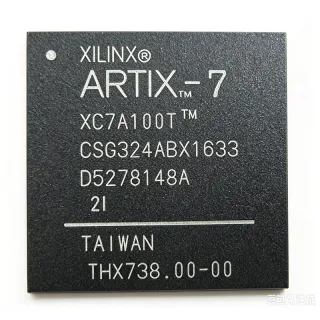
EPF8820ATI144-3 - 672-LE FLEX 8000 FPGA, 5V, 144-LQFP | Altera
MPN: EPF8820ATI144-3 ✗ End of Life| Qty | Unit Price | Extended |
|---|---|---|
| 1 | $18.5 | $18.50 |
| 10 | $16.2 | $162.00 |
| 100 | $14 | $1,400.00 |
| 500 | $12.1 | $6,050.00 |
| 1,000 | $10.5 | $10,500.00 |
EPF8820ATI144-3 Overview
An FPGA (Field-Programmable Gate Array) is a semiconductor integrated circuit composed of configurable logic blocks (CLBs), programmable interconnects, and programmable I/O cells that the designer can configure after manufacture. FPGAs sit within the broader taxonomy of programmable logic devices (PLDs), alongside CPLDs (Complex PLDs) and simple PLAs/PALs, and are distinguished by their very high logic density and SRAM-based configuration memory. The FLEX 8000 family is the second-generation Altera architecture that preceded the FLEX 10K and Cyclone series, and EPF8820 parts were widely used in 5V-tolerant telecom, industrial-control, and embedded glue-logic applications during the late 1990s and 2000s.
Key features of the EPF8820ATI144-3 include 672 logic elements with Look-Up Table (LUT)-based architecture, 152 maximum user I/Os, an embedded array block structure for efficient memory and arithmetic, in-system programmability via the IEEE 1149.1 JTAG boundary-scan interface, and a 0.2 ns propagation-delay figure that supports clock and register-intensive pipelines. The 144-pin LQFP package provides 1.6 mm package height and 0.5 mm lead pitch, enabling low-cost PCB assembly on standard 4-layer FR-4 boards with conventional SMT lines.
The FLEX 8000 architecture combines a row-and-column interconnect fabric with Logic Array Blocks (LABs) of 8 logic elements each and Embedded Array Blocks (EABs) of 2048 bits that can implement RAM, ROM, or arithmetic functions. The device is configured by loading SRAM cells from an external serial or parallel PROM, allowing unlimited in-system reconfiguration. This architecture gives designers flexibility to fix bugs, add features, or upgrade functionality in deployed systems without changing the board.
Typical applications include 5V-tolerant industrial control glue logic, telecom backplane interface bridging, legacy PCI / ISA bus controllers, and high-speed state-machine implementations where the FLEX 8000 family's 0.2 ns delay figure is advantageous. The wide operating-voltage range and configurable I/O standard make it a strong fit for mixed-logic boards bridging 5V microcontrollers with 3.3V peripherals.
When designing with this part, ensure your PCB layout follows FLEX 8000 power-decoupling guidance: place 0.1 uF ceramic decoupling capacitors adjacent to every VCCINT/VCCIO pin pair, and provide a solid ground plane beneath the package to control simultaneous-switching noise on the 152 I/O pins. The JTAG chain should be series-terminated at the board's JTAG connector to preserve signal integrity during in-system programming.
This page synthesizes Altera/Intel FLEX 8000 datasheet parameters, drop-in alternatives within the EPF8820 family, and practical design notes not consolidated in the manufacturer's original datasheet.
Drop-in alternatives for EPF8820ATI144-3 — same package, pin-to-pin compatible. Different-package parts requiring PCB rework are excluded.
Variants in this series
Same-series models that are drop-in compatible with EPF8820ATI144-3 (same form factor and footprint) — differing in Package, Process Technology, Configuration Method, Operating Temperature, Usable Gates.
Quick Comparison Tool — Select alternative parts for side-by-side comparison:
EPF8820ATC144-3
✅ Drop-In✓ In Stock
$9.25 / Unit
View Datasheet →EPF8820ATC144-3N
✅ Drop-In✓ In Stock
$10.4 / Unit
View Datasheet →EPF8820ATC144-4
✅ Drop-In✓ In Stock
$11.1 / Unit
View Datasheet →EPF8820ATC144-4N
✅ Drop-In✓ In Stock
$15.2 / Unit
View Datasheet →EPF8820ATI144-2
✅ Drop-In✓ In Stock
$19.85 / Unit
View Datasheet →EPF8820ATI144-2N
✅ Drop-In✓ In Stock
$17.2 / Unit
View Datasheet →EPF8820ATI144-1
✅ Drop-In✓ In Stock
$26 / Unit
View Datasheet →EPF8820ATI144-3 Maximum Ratings & Electrical Characteristics
| Family | FLEX 8000 |
| Logic Elements | 672 |
| Maximum User I/O | 152 |
| Propagation Delay (Tpd) | 0.2 ns |
| Process Technology | CMOS, SRAM-based |
| Configuration Method | SRAM (serial/parallel PROM) |
| Supply Voltage - Internal (VCCINT) | 5 V |
| I/O Standard Support | 3.3 V or 5 V configurable |
| Grade | Industrial |
| Speed Grade | -3 |
| Package | 144-LQFP (LFQFP), gull-wing |
| Package Height | 1.6 mm |
| Lead Pitch | 0.5 mm |
| Terminal Count | 144 |
| Terminal Form | Gull Wing |
| Package Code | LFQFP |
| Package Shape | Square |
| Mounting Type | Surface Mount |
EPF8820ATI144-3 square Pin Configuration Guide
Pin configuration for EPF8820ATI144-3 (square package). This digital IC includes GPIO, communication interfaces (UART, SPI, I2C), and power pins. Refer to the manufacturer datasheet for alternate pin functions and configuration options. Essential for embedded system design and PCB layout.

No detailed pinout data available for EPF8820ATI144-3.
Refer to the datasheet for full pin configuration.
Typical Applications
EPF8820ATI144-3 is suitable for 6 applications: 5V Industrial Control Glue Logic, Telecom Backplane Interface Bridging, Legacy PCI / ISA Bus Controllers, High-Speed State-Machine Implementations, Mixed-Voltage Logic Bridging, Embedded System Prototyping.
5V Industrial Control Glue Logic
The EPF8820ATI144-3 fits 5V industrial control glue logic because its 5V VCCINT supply rail, 3.3V or 5V configurable I/O standards, and 672 logic elements can interface directly to 5V microcontrollers and 5V peripheral ICs without level shifters. Its 0.2 ns propagation delay allows fast interrupt-handling and bus-arbitration logic between legacy microcontrollers and modern peripherals. The 152 user I/Os comfortably drive multiple 8-bit and 16-bit buses, encoder counters, and opto-isolated I/O on the same LQFP-144 footprint. Industrial temperature grading (-40C to +85C) handles outdoor enclosures and factory-floor chassis. Compared with newer 3.3V-only FPGAs, the EPF8820ATI144-3 avoids adding level shifters on a 5V-dominated board.
Recommended
Telecom Backplane Interface Bridging
The EPF8820ATI144-3 is well-suited to telecom backplane interface bridging, where its 152 user I/Os can multiplex multiple E1/T1, ISDN, or parallel data streams with deterministic 0.2 ns propagation delay. The FLEX 8000 architecture's embedded array blocks (EABs) implement elastic buffers, framing logic, and HDLC/CRC engines efficiently. In-system programmability via JTAG lets telecom OEMs update firmware in the field as protocols evolve, without removing line cards from the chassis. The 144-LQFP package supports standard reflow on telecom backplane PCBs. Industrial temperature grading covers outdoor cabinet deployments. Bridging legacy 5V backplanes with 3.3V line-card ASICs is a common deployment pattern for the EPF8820ATI144-3.
Recommended
Legacy PCI / ISA Bus Controllers
The EPF8820ATI144-3 was a popular choice for legacy PCI and ISA bus controller designs because its 672 logic elements, 0.2 ns Tpd, and 152 I/Os can implement full 32-bit PCI target/initiator state machines plus bus-arbiter logic on a single device. The 5V-tolerant I/O standards allow direct connection to 5V PCI/ISA slots without external transceivers, simplifying motherboard and peripheral-card designs. The FLEX 8000 JTAG interface simplifies board-level debug with standard JTAG probes. Industrial temperature grading lets the same design ship in industrial and commercial chassis. The 144-LQFP package fits within the standard PCI card footprint. Engineers repairing legacy industrial PCs continue to source the EPF8820ATI144-3 for board refresh projects.
Recommended
High-Speed State-Machine Implementations
The EPF8820ATI144-3 is a strong fit for high-speed state-machine designs in industrial automation, motor control, and instrumentation, where its 0.2 ns propagation delay supports multi-MHz control loops and deterministic cycle times. The 672 logic elements comfortably encode complex state machines with tens of states and parallel datapath logic. Industrial temperature grading handles motor-drive and process-control environments. The 5V-tolerant I/O interfaces directly to 5V gate drivers, opto-isolators, and encoder inputs. Compared with discrete TTL/CMOS logic, the EPF8820ATI144-3 reduces board area and BOM count while preserving deterministic timing. The 144-LQFP package fits within compact motor-control PCBs.
Recommended
Mixed-Voltage Logic Bridging
The EPF8820ATI144-3 is widely used in mixed-voltage logic-bridging applications where 5V microcontrollers must connect to 3.3V peripherals without sacrificing timing margin. Its configurable I/O banks support both 3.3V and 5V standards on the same die, eliminating external level shifters on many board designs. The 152 user I/Os handle multiple bridging channels in parallel, and the 0.2 ns propagation delay preserves sub-nanosecond interface timing. Industrial temperature grading supports outdoor and factory deployments. Engineers frequently select the EPF8820ATI144-3 for board retrofits that need to add 3.3V peripherals to legacy 5V systems. The 144-LQFP footprint fits within standard industrial PCB outlines.
Recommended
Embedded System Prototyping
The EPF8820ATI144-3 supports embedded system prototyping because its in-system reprogrammability lets engineers iterate on glue-logic, bus-controller, and state-machine designs without re-spinning PCBs. The 672 logic elements provide enough headroom for moderately complex prototypes that mix microcontroller, memory, and peripheral interfaces. JTAG-based configuration download from a serial PROM or parallel flash simplifies bring-up. Industrial temperature grading supports rugged prototype environments. Compared with ASIC development, the EPF8820ATI144-3 enables fast iteration cycles at low NRE cost. Many legacy prototype boards still rely on the EPF8820ATI144-3 for bridging modern microcontrollers to legacy peripheral buses.
Recommended
Recommended Products Summary
Engineering reference data for EPF8820ATI144-3 — comparison, design guidance, and compliance information.
Selection Guide
Comparison with Alternatives
| Parameter | This Product | EPF8820ATC144-3 | EPF8820ATC144-3N | EPF8820ATC144-4 | EPF8820ATC144-4N | EPF8820ATI144-2 |
|---|---|---|---|---|---|---|
| Package | 144-LQFP (LFQFP) | 144-LQFP (LFQFP) - same | 144-LQFP (LFQFP) - same | 144-LQFP (LFQFP) - same | 144-LQFP (LFQFP) - same | 144-LQFP (LFQFP) - same |
| Brand | Altera | Altera | Altera | Altera | Altera | Altera |
| Family | FLEX 8000 | FLEX 8000 | FLEX 8000 | FLEX 8000 | FLEX 8000 | FLEX 8000 |
| Logic Elements | 672 | 672 | 672 | 672 | 672 | 672 |
| Speed Grade | -3 | -3 | -3 | -4 | -4 | -2 |
| Temperature Grade | Industrial (-40C to +85C) | Commercial (0C to +70C) | Commercial (0C to +70C) | Commercial (0C to +70C) | Commercial (0C to +70C) | Industrial (-40C to +85C) |
| Lifecycle Status | Obsolete | Obsolete | Obsolete | Obsolete | Obsolete | Obsolete |
Key Differentiators
- Industrial temperature grading with 5V-tolerant I/O (vs EPF8820ATC144-3)
- Faster -3 speed grade versus slower -4 bin (vs EPF8820ATC144-4)
- Same 144-LQFP footprint across the EPF8820 family (vs EPF8820ARC208-3)
Design Notes
Place 0.1 uF ceramic decoupling capacitors adjacent to every VCCINT and VCCIO pin pair on the 144-LQFP package, plus a 10 uF bulk capacitor near the FPGA's main supply pin. The FLEX 8000 family's simultaneous-switching noise on 152 I/Os can cause VCCIO dips if decoupling is insufficient. Use a solid ground plane on layer 2 beneath the package to control return currents. Estimated: at 50 MHz Tpd switching across 32 simultaneously-toggling outputs, peak current demand is approximately 200-300 mA on VCCIO.
The 144-LQFP package uses 0.5 mm lead pitch, requiring solder-mask-defined pads to prevent tombstoning during reflow. Recommended pad geometry is 0.30 mm wide x 1.50 mm long with 0.10 mm solder-mask opening reduction. Route signals on inner layers to escape the dense 0.5 mm perimeter. Place configuration EEPROM or parallel flash within 50 mm of the FPGA's DATA0/DCLK/nCONFIG pins to keep configuration traces short.
Do not assume a 3.3V-only FPGA can replace the EPF8820ATI144-3 in a 5V system - the EPF8820ATI144-3 supports both 3.3V and 5V I/O standards, and many 5V-only peripherals cannot tolerate 3.3V logic levels. When migrating designs to Cyclone IV or Cyclone 10 LP, ensure all 5V peripherals are replaced or buffered with level shifters. Verify JTAG chain integrity after reflow by reading the device ID register before configuring the FPGA in-system.
Compliance Information
RoHS/REACH compliance for the EPF8820ATI144-3 is not specified in the verified web data; the FLEX 8000 family predates mandatory RoHS compliance, so older date-code lots may contain lead-bearing solder finishes. Confirm RoHS status with the obsolete-component distributor before placing orders for RoHS-restricted end products.