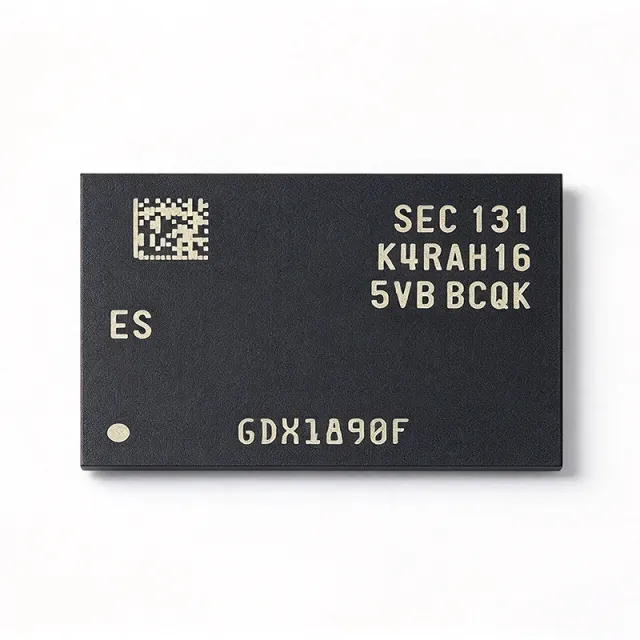
K4RAH165VB-BCQK - 16Gb DDR5 SDRAM 4800Mbps 1.1V | Samsung
MPN: K4RAH165VB-BCQK ✓ Active| Qty | Unit Price | Extended |
|---|---|---|
| 1 | $42.1875 | $42.19 |
| 10 | $30.4688 | $304.69 |
| 100 | $26.9531 | $2,695.31 |
| 500 | $25.7813 | $12,890.65 |
| 1,000 | $24.6094 | $24,609.40 |
K4RAH165VB-BCQK Overview
DDR5 SDRAM is the fifth generation of double data rate synchronous dynamic random-access memory, the dominant category of volatile main-memory ICs in the computing hierarchy. Compared with DDR4, DDR5 doubles the bank count, moves the power management from the module to the device (via PMIC on RDIMMs), lowers the operating voltage from 1.2V to 1.1V, and introduces on-die ECC (ODECC), which improves reliability without bus bandwidth overhead.
Key features of the K4RAH165VB-BCQK include auto self-refresh, an asynchronous reset function, on-chip error correction code (ECC), write leveling, CRC-based link error detection, and ZQ calibration for output driver impedance matching. These functions address signal integrity and data reliability at multi-gigabit data rates. Operating temperature is specified from 0C to +85C.
The device implements the DDR5 architecture with 16n prefetch, bank groups, and same-bank refresh improvements that raise effective bandwidth versus DDR4 at equivalent core frequencies. The 1.1V supply reduces power consumption by roughly 30% relative to DDR4 at comparable speeds, per Samsung DDR5 family documentation, making the part attractive for power-constrained platforms.
Typical applications include PC client DRAM modules (UDIMM/SODIMM), networking and communication equipment, embedded and industrial computing platforms, and notebook/mainboard memory subsystems, where a stable, qualified DDR5 component supply is required.
Design considerations: DDR5 signal integrity demands length-matched routing, on-die termination (ODT) programming, and reference voltage training routines implemented by the memory controller; the ZQ calibration pin requires a precision external resistor per the DDR5 datasheet guidelines.
This page synthesizes distributor pricing, drop-in same-family alternatives, cross-reference data, and practical design notes not found in the raw Samsung datasheet, giving sourcing and engineering teams a single citable reference.
Drop-in alternatives for K4RAH165VB-BCQK — same package, pin-to-pin compatible. Different-package parts requiring PCB rework are excluded.
Quick Comparison Tool — Select alternative parts for side-by-side comparison:
K4RAH165VB-BCWM
✓ In Stock
$9.92 / Unit
View Datasheet →K4RAH165VB-BIWM
✓ In Stock
Contact for price
View Datasheet →K4RAH165VB-BIQK
✓ In Stock
Contact for price
View Datasheet →K4RAH165VP-BCWM
✓ In Stock
$24.6094 / Unit
View Datasheet →K4RHE165VB-BCWM
✓ In Stock
Contact for price
View Datasheet →K4RAH165VB-BCQK Specifications
| Memory Type | DDR5 SDRAM (DRAM, volatile) |
| Memory Size | 16 Gb |
| Memory Organization | 1G x 16 |
| Memory Interface | Parallel |
| Data Rate | up to 4800 Mbps |
| Supply Voltage | 1.1 V |
| Operating Temperature | 0C to +85C |
| Technology Standard | DDR5 (JEDEC DDR5 SDRAM family) |
| On-Die ECC | Yes (on-chip error correction code) |
| Self Refresh | Auto self-refresh |
| Reset Function | Asynchronous reset |
| Write Leveling | Yes |
| CRC Function | Yes |
| ZQ Calibration | Yes |
| Mounting Type | Surface Mount |
| Package | FBGA (fine-pitch BGA) |
| RoHS Status | Compliant |
K4RAH165VB-BCQK fbga (fine-pitch bga) Pin Configuration Guide
Pin configuration for K4RAH165VB-BCQK (fbga (fine-pitch bga) package). Pin numbering, functions, and connection diagrams are defined in the manufacturer datasheet. Refer to it for the exact footprint and soldering guidelines.

No detailed pinout data available for K4RAH165VB-BCQK.
Refer to the datasheet for full pin configuration.
Typical Applications
K4RAH165VB-BCQK is suitable for 6 applications: PC Client Main Memory (UDIMM/SODIMM), Networking and Communication Equipment, Embedded and Industrial Computing, Notebook and Mainboard Memory Subsystems, Data Center Memory (Module Repair and Rebuild), Consumer Electronics and Set-Top Platforms.
PC Client Main Memory (UDIMM/SODIMM)
The K4RAH165VB-BCQK is a primary building block for DDR5 client memory modules such as UDIMMs and SODIMMs, where sixteen x16 devices deliver a 64-bit module with 2GB capacity or enable x16-based ECC DIMMs. Its 4800 Mbps-class data rate and 1n-bank-group architecture supply the bandwidth mainstream CPUs expect from DDR5 platforms, while on-die ECC corrects internal single-bit errors without bus overhead. On the module, the device operates from a 1.1V rail regulated by the onboard PMIC (e.g., a Renesas or Richtek DDR5 PMIC), and the controller performs write leveling, read training, and ZQ-based impedance calibration during boot. Designers benefit from the roughly 30% power efficiency gain over DDR4 cited by Samsung for the DDR5 family.
Recommended
Networking and Communication Equipment
Routers, switches, and telecom line cards use the K4RAH165VB-BCQK for packet buffering, queue management, and lookup tables. The 16Gb (1G x 16) organization provides deep buffering for bursty traffic, and 4800 Mbps-class throughput keeps pace with multi-gigabit port aggregation. On-die ECC raises memory reliability for always-on network infrastructure, while the CRC function flags link-level anomalies. In these designs the DDR5 component typically hangs from a networking SoC's DDR5 controller; layout must respect length matching and ODT programming, and the asynchronous RESET ball must be driven correctly during power sequencing. Industrial-temperature BI-grade Samsung variants are available when equipment must operate above the commercial 0C to +85C envelope.
Recommended
Embedded and Industrial Computing
Industrial PCs, edge-AI gateways, and embedded controllers adopt DDR5 for its lower 1.1V power draw and built-in reliability features. The K4RAH165VB-BCQK fits these designs where a DDR5-capable SoC or FPGA-with-hard-controller requires 16Gb devices; auto self-refresh preserves memory contents in low-power states, and the ZQ calibration function maintains driver impedance across temperature excursions. For deployments beyond the commercial 0C to +85C range, the BI-grade Samsung variants cover industrial requirements with the same footprint. Design teams should budget for controller memory-training at every boot, implement solid 1.1V planes with generous decoupling, and follow the datasheet's power-up sequence to avoid latch-up on the DQ domain.
Recommended
Notebook and Mainboard Memory Subsystems
Notebook mainboards and compact x16-based memory subsystems use the K4RAH165VB-BCQK where soldered-down DRAM replaces sockets for space and reliability. The 16Gb device allows 2GB per chip, so a four-chip down configuration reaches 8GB on a minimal board area, and the 1.1V rail directly benefits battery runtime via DDR5's improved efficiency versus DDR4. The asynchronous reset and auto self-refresh features support modern suspend/resume power flows, while on-die ECC improves data integrity on non-ECC client platforms. Board designers must route the DDR5 fly-by/per-device topology to the controller's training specification and keep the ZQ reference resistor tightly coupled to the ball.
Recommended
Data Center Memory (Module Repair and Rebuild)
Although server RDIMMs predominantly use x8 DDR5 devices, the K4RAH165VB-BCQK serves data-center secondary uses: x16-based NVDIMM-adjacent designs, memory rebuild and repair of damaged modules, and prototype or validation boards for DDR5 signal-integrity characterization. Its 1.1V operation and on-die ECC align with server-grade reliability expectations at the device level, and 4800 Mbps-class speed matches first-generation DDR5 server platforms. Repair technicians value that BCQK and BCWM suffix variants of the same die are widely stocked by brokers, simplifying like-for-like replacement on existing boards. Always re-run memory training after replacement, since DDR5 controllers recalibrate timing per device.
Recommended
Consumer Electronics and Set-Top Platforms
Set-top boxes, smart-display SoCs, and gaming peripherals with DDR5 memory controllers use the K4RAH165VB-BCQK as cost-effective main memory. The 1G x 16 organization suits SoCs with 16- or 32-bit memory interfaces, delivering 4800 Mbps-class bandwidth for 4K media decode and UI rendering, while the 1.1V rail and DDR5 efficiency gains reduce thermal load in sealed consumer enclosures. Auto self-refresh and asynchronous reset integrate cleanly with consumer suspend/resume flows. Because consumer platforms are cost-sensitive, designers can interchange the BCQK with the BCWM suffix when procurement offers better pricing, provided the controller supports the part's speed bin and training profile.
Recommended
Recommended Products Summary
Engineering reference data for K4RAH165VB-BCQK — comparison, design guidance, and compliance information.
Selection Guide
Comparison with Alternatives
| Parameter | This Product | K4RAH165VB-BCWM | K4RAH165VB-BIWM | K4RAH165VB-BIQK | K4RHE165VB-BCWM |
|---|---|---|---|---|---|
| Package | FBGA | FBGA - same | FBGA - same | FBGA - same | FBGA - same class |
| Brand | Samsung Electronics | Samsung Electronics | Samsung Electronics | Samsung Electronics | Samsung Electronics |
| Memory Size | 16 Gb | 16 Gb | 16 Gb | 16 Gb | 16 Gb |
| Organization | 1G x 16 | 1G x 16 | 1G x 16 | 1G x 16 | 1G x 16 |
| Technology | DDR5 SDRAM | DDR5 SDRAM | DDR5 SDRAM | DDR5 SDRAM | DDR5 SDRAM (E-die) |
| Supply Voltage | 1.1 V | 1.1 V | 1.1 V | 1.1 V | 1.1 V |
| On-Die ECC / Calibration Features | Yes - ODECC, CRC, write leveling, ZQ calibration | Yes - identical feature set | Yes - identical feature set | Yes - identical feature set | Yes - same DDR5 feature set, different die |
Key Differentiators
- DDR5 generation efficiency (vs K4AAG165WM-BCRC (DDR4 family))
- Industrial temperature option in same footprint (vs K4RAH165VB-BCWM)
- Built-in reliability without bus overhead (vs DDR4 devices requiring side-band ECC)
Design Notes
DDR5 at 4800 Mbps-class rates requires disciplined signal integrity: route DQ/DQS byte groups with matched intra-group lengths and controlled impedance (typically 40 ohm single-ended, 80 ohm differential per controller guidelines), keep CA/CK routed per the SoC's topology recommendation, and rely on the controller's write leveling and read training to close timing. The K4RAH165VB-BCQK's write leveling and CRC features exist precisely to support this calibration flow - do not bypass them in firmware.
Power the K4RAH165VB-BCQK from a clean 1.1V rail with solid planes and dense decoupling (a mix of 10uF bulk and 0.1uF/0.01uF ceramic near each VDD ball group). On module designs, the DDR5 PMIC regulates VDD and VDDQ; on soldered-down boards, ensure the rail sequenced per the datasheet power-up procedure and that the asynchronous RESET ball is asserted until rails are stable. Estimated: at typical DDR5 idle currents the device family draws tens of milliwatts, far below DDR4 at equal bandwidth, per Samsung's 30% efficiency claim.
Common pitfalls: (1) substituting a DDR4 cross-referenced part (e.g., MT40A2G8VB-062E) - DDR4 and DDR5 differ in pinout, voltage, and protocol and are NOT interchangeable; (2) omitting or mis-sizing the ZQ calibration reference resistor, which degrades output driver impedance accuracy; (3) ignoring suffix binning differences (BCQK vs BCWM vs BI grades) when re-running controller training; (4) exceeding the 0C to +85C commercial range in sealed enclosures - use BI-grade variants for industrial temperatures.
Compliance Information
RoHS compliance per current-production Samsung DDR5 component status on distributor listings; full REACH/halogen-free declarations should be obtained from Samsung official compliance documentation.