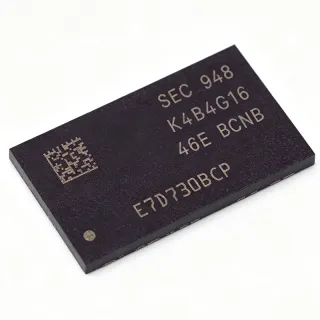
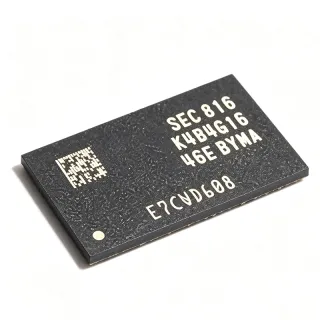
K4RHE165VB-BCWM - 24Gb DDR5 SDRAM 5600Mbps 1.1V | Samsung
MPN: K4RHE165VB-BCWM ✓ Active| Qty | Unit Price | Extended |
|---|---|---|
| 1 | $0 | $0.00 |
| 10 | $0 | $0.00 |
| 100 | $0 | $0.00 |
| 500 | $0 | $0.00 |
| 1,000 | $0 | $0.00 |
K4RHE165VB-BCWM Overview
DDR5 SDRAM is the fifth generation of double data rate synchronous dynamic random-access memory, a class of volatile semiconductor memory that stores data in capacitor-based cells refreshed at regular intervals. Within the memory hierarchy, DDR5 SDRAM sits as the main-system-memory technology, succeeding DDR4 and delivering higher densities, higher data rates, and improved power efficiency through a lower 1.1V operating voltage and on-die power management.
Key features of the K4RHE165VB-BCWM include 24 Gb (3 GB) density in a x16 organization, a 5600 Mbps/pin data rate, and a 1.1V core supply that reduces dynamic power versus DDR4. The 106-ball Fine-Pitch Ball Grid Array (FBGA) package provides a compact footprint for dense memory module and embedded designs. The device is specified for commercial operating temperatures of 0 to 85 degrees C and is in mass production, per Elite Memory Solutions and Samsung product listings.
Architecturally, this DDR5 generation doubles the bank groups and burst length compared with DDR4, improving effective bandwidth and enabling the channel architecture used in modern memory modules. The x16 organization suits designs that populate narrower memory channels or require high capacity per component.
Typical applications include next-generation DDR5 memory modules (RDIMM, UDIMM, SODIMM), high-performance computing systems, servers and workstations, and AI/ML accelerator memory where bandwidth and energy efficiency are critical.
Design consideration: verify controller training margins at 5600 Mbps and follow the DDR5 fly-by routing and on-die termination guidance in the Samsung datasheet to maintain signal integrity.
This page synthesizes distributor stock data, drop-in alternative analysis, and application guidance not found in the manufacturer datasheet alone.
Drop-in alternatives for K4RHE165VB-BCWM — same package, pin-to-pin compatible. Different-package parts requiring PCB rework are excluded.
Variants in this series
Same-series models that are drop-in compatible with K4RHE165VB-BCWM (same form factor and footprint) — differing in Package, Operating Temperature, Density, Organization, Interface.
Quick Comparison Tool — Select alternative parts for side-by-side comparison:
K4RHE086VB-BCWM
✅ Drop-In✓ In Stock
$7.65 / Unit
View Datasheet →K4RAH165VB-BCWM
✅ Drop-In ⚠️ Specs Unverified✓ In Stock
$9.92 / Unit
View Datasheet →K4RHE165VB-BCWM Maximum Ratings & Electrical Characteristics
| Memory Type | DDR5 SDRAM |
| Density | 24 Gb (3 GB) |
| Organization | 1G x 16 |
| Data Rate | 5600 Mbps |
| Supply Voltage | 1.1 V |
| Package | 106 FBGA |
| Mounting Type | Surface Mount (BGA) |
| Operating Temperature | 0 to 85 C |
| Product Status | Mass Production |
| Interface | DDR5 (parallel, DDR) |
| Access Type | Synchronous |
| Clock Rate (nominal) | 2800 MHz (5600 MT/s DDR) |
| Ball Count | 106 |
K4RHE165VB-BCWM 106 fbga Pin Configuration Guide
Pin configuration for K4RHE165VB-BCWM (106 fbga package). This digital IC includes GPIO, communication interfaces (UART, SPI, I2C), and power pins. Refer to the manufacturer datasheet for alternate pin functions and configuration options. Essential for embedded system design and PCB layout.

No detailed pinout data available for K4RHE165VB-BCWM.
Refer to the datasheet for full pin configuration.
Typical Applications
K4RHE165VB-BCWM is suitable for 6 applications: DDR5 Memory Modules (RDIMM/UDIMM/SODIMM), High-Performance Computing (HPC), AI and Machine Learning Acceleration, Servers and Datacenter Storage Controllers, Embedded and Edge Computing Boards, Workstations and Client PCs.
DDR5 Memory Modules (RDIMM/UDIMM/SODIMM)
The K4RHE165VB-BCWM is a primary building block for next-generation DDR5 memory modules. Its 24Gb density in a x16 organization allows module designers to reach high capacities with fewer components per rank, reducing BOM count and assembly cost. The 5600 Mbps data rate aligns with DDR5-5600 module speed bins for mainstream server and desktop platforms, while the 1.1V supply contributes to the roughly 30% power-efficiency gain DDR5 offers over DDR4. Components are placed on both sides of the module following the DDR5 fly-by routing topology, with on-die termination (ODT) and on-module PMIC voltage regulation (5V to 1.1V conversion) required by the DDR5 standard. Designers must validate read/write training margins across the full module population and temperature range.
Recommended
High-Performance Computing (HPC)
High-performance computing nodes demand maximum memory bandwidth per socket, and the K4RHE165VB-BCWM addresses this with its 5600 Mbps per-pin data rate, delivering over 44 GB/s per 64-bit channel at DDR5-5600 speeds. The 24Gb (3GB) per-component density enables large main-memory footprints within limited DIMM slots, critical for scientific simulation and large-dataset workloads. Its 1.1V operation reduces memory-subsystem power draw, which is often 30-40% of total node power, improving performance-per-watt metrics used in HPC procurement. The 106 FBGA package supports dense two-sided mounting on modules. System integrators typically pair such DRAM with high-core-count server CPUs where memory bandwidth is the limiting factor for bandwidth-bound kernels.
Recommended
AI and Machine Learning Acceleration
AI training and inference systems are bandwidth- and capacity-hungry, making DDR5 main memory a frequent bottleneck. The K4RHE165VB-BCWM's 24Gb per-device capacity allows large host memory pools for dataset staging and model parameter storage, while the 5600 Mbps interface sustains the streaming bandwidth AI accelerators need when offloading data from HBM. Compared with DDR4 at 3200 MT/s, DDR5-5600 roughly doubles peak bandwidth per channel, directly shortening data-loading phases. The 1.1V rail lowers energy per byte transferred, which matters at datacenter scale where memory power compounds across thousands of nodes. Designers should size channel populations to balance x16 device organization against controller channel width for maximum utilization.
Recommended
Servers and Datacenter Storage Controllers
Enterprise servers and storage controllers use DDR5 DIMM subsystems populated with components such as the K4RHE165VB-BCWM. The part's mass-production status (per Elite Memory Solutions) supports long-lifetime enterprise designs, and its 0 to 85 C commercial operating range covers standard datacenter ambient conditions. DDR5's improved channel architecture and on-die ECC-related features enhance reliability for always-on workloads, while the 1.1V core supply directly reduces cooling costs in dense rack deployments. For storage controllers managing NVMe arrays, the x16 organization offers flexible capacity population on constrained controller boards. System-level RAS features (rowhammer mitigations, refresh management) from the DDR5 standard should be enabled in controller firmware.
Recommended
Embedded and Edge Computing Boards
High-end embedded and edge-computing boards - network appliances, industrial gateways, and edge AI servers - increasingly adopt DDR5 SODIMM or soldered-down memory. The K4RHE165VB-BCWM's compact 106 FBGA package suits solder-down designs where module sockets are undesirable for vibration or height reasons, while its 24Gb density allows substantial in-memory buffering (packet buffers, video analytics frames) without increasing PCB area. The 5600 Mbps rate keeps pace with multi-gigabit networking throughput, and 1.1V operation simplifies the power tree on battery-backed or PoE-powered edge systems. Board designers must follow DDR5 length-matching and ODT tuning guidelines, and verify 0 to 85 C ratings against their enclosure thermal profile.
Recommended
Workstations and Client PCs
DDR5 client platforms use x16 components such as the K4RHE165VB-BCWM in UDIMM and SODIMM form factors for high-end workstations and performance laptops. The 24Gb per-device density enables configurations like 96GB or 192GB in a two-channel system without resorting to double-sided high-component-count layouts, supporting content-creation workloads that require large memory footprints (8K video editing, CAD assemblies). The 5600 Mbps bin matches JEDEC-standard client DDR5 speeds, ensuring compatibility with mainstream CPU memory controllers, while the 1.1V supply extends battery life in mobile workstations. Laptop designers favor 106 FBGA x16 parts on SODIMMs for the best capacity-per-rank at minimum height.
Recommended
Recommended Products Summary
Engineering reference data for K4RHE165VB-BCWM — comparison, design guidance, and compliance information.
Selection Guide
Comparison with Alternatives
| Parameter | This Product | K4RHE086VB-BCWM | K4RAH165VB-BCWM |
|---|---|---|---|
| Package | 106 FBGA | 106 FBGA - same | 106 FBGA - same |
| Brand | Samsung Electronics | Samsung Electronics | Samsung Electronics |
| Density | 24 Gb (3 GB) | 16 Gb (2 GB) | 24 Gb (3 GB) |
| Supply Voltage | 1.1 V | 1.1 V | 1.1 V |
Key Differentiators
- Highest capacity in the K4RHE DDR5 x16 family (vs K4RHE086VB-BCWM)
- DDR5 generation efficiency (vs K4RHE086VB-BCWM)
- Mass-production maturity with broad distributor stock (vs K4RAH165VB-BCWM)
Design Notes
At 5600 Mbps, DDR5 signal integrity margins are tight. Follow the Samsung datasheet's fly-by routing topology, keep DQ/DQS length matching within datasheet-specified skew windows, and use the ODT settings recommended for x16 devices. Perform read/write Vref training across all DIMM populations and temperature corners; verify eye diagrams at the receiver per DDR5 compliance testing before releasing the design to production.
The K4RHE165VB-BCWM operates from a 1.1V supply; DDR5 modules regulate this on-module from a 5V input via a PMIC, while solder-down designs must generate 1.1V locally with adequate transient response. Size the power delivery network for worst-case refresh and write bursts, and place bulk and high-frequency decoupling close to each DRAM's VDD/VDDQ ball groups per the datasheet decoupling guidance.
Beware of refurbished K4RHE165VB-BCWM units on the open market - at least one distributor (eTechBuy) explicitly lists the part as refurbished. Source only from authorized or verified distributors, request date-code and authenticity verification for production orders, and confirm the exact speed bin and die revision against your controller's memory compatibility list (QVL) before mixing suppliers or die revisions within one system.
Compliance Information
Compliance data was not present in the retrieved distributor listings. Samsung mass-production DDR5 DRAM is typically RoHS compliant, but official certification must be obtained from the Samsung compliance portal or the manufacturer before procurement.