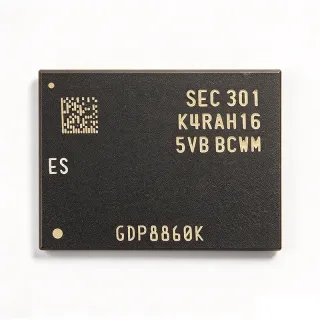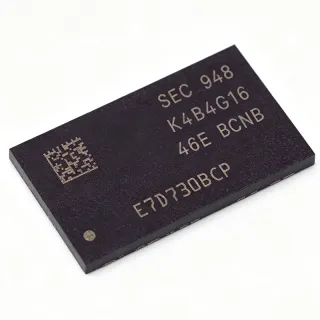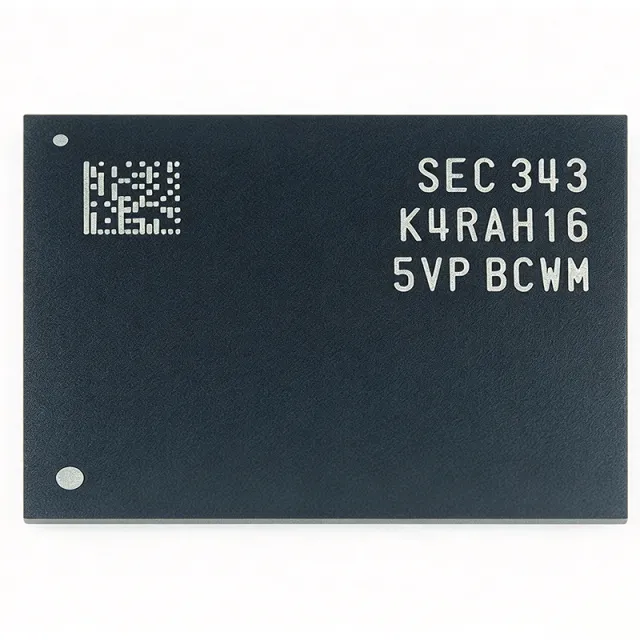
K4RAH165VP-BCWM - 16Gb DDR5 SDRAM 5600Mbps 1.1V | Samsung
MPN: K4RAH165VP-BCWM ✓ Active| Qty | Unit Price | Extended |
|---|---|---|
| 1 | $42.1875 | $42.19 |
| 10 | $30.4688 | $304.69 |
| 100 | $26.9531 | $2,695.31 |
| 500 | $25.7813 | $12,890.65 |
| 1,000 | $24.6094 | $24,609.40 |
K4RAH165VP-BCWM Overview
DDR5 SDRAM (Double Data Rate 5 synchronous dynamic random-access memory) is the fifth generation of the JEDEC DDR DRAM family and the successor to DDR4. In the memory hierarchy, DRAM sits below CPU caches but above storage (SSD/NAND) as the main system memory. DDR5 introduces two independent 32-bit sub-channels per DIMM, an on-die power management IC (PMIC), on-die ECC, and double the bank groups of DDR4, which together improve effective bandwidth and power efficiency by roughly 30% compared to DDR4 at equivalent capacities.
Key features of this device include its 16Gbit density (double the previous-generation 8Gb monolithic die), 5600 Mbps transfer rate, low 1.1 V core operation, and an x16 organization suited to bandwidth- and density-balanced client and mobile designs. The FBGA-106 package minimizes board area and shortens signal paths, supporting the tight timing margins required at DDR5 speeds.
Architecturally, the die uses Samsung advanced DRAM process technology with bank-group parallelism and a DLL-enabled mode of operation; the manufacturer specification covers timing parameters for DLL enabled mode, with common features described in the separate Samsung Device Operation datasheet. On-die power management reduces external rail complexity and improves supply noise immunity.
Typical applications include mobile devices and tablets, consumer electronics, embedded computing, set-top boxes, networking equipment, and compact PC main-memory subsystems where x16 DRAM components populate SO-DIMM or soldered-down memory configurations.
Designers should observe DDR5 routing rules: length-matched fly-by or balanced-tree command/address topologies, on-die termination (ODT) configuration, and clean 1.1 V VDD rails supplied by a PMIC-compatible regulator. Signal integrity simulation at 5600 Mbps is strongly recommended before tape-out.
This page synthesizes distributor pricing, drop-in alternatives from the Samsung K4RAH DDR5 family, and practical design notes not consolidated in the manufacturer datasheet.
Drop-in alternatives for K4RAH165VP-BCWM — same package, pin-to-pin compatible. Different-package parts requiring PCB rework are excluded.
Variants in this series
Same-series models that are drop-in compatible with K4RAH165VP-BCWM (same form factor and footprint) — differing in Package, Data Rate, Density, Interface, Organization.
Quick Comparison Tool — Select alternative parts for side-by-side comparison:
K4RAH165VB-BCWM
✓ In Stock
$9.92 / Unit
View Datasheet →K4RAH165VB-BIWM
✓ In Stock
Contact for price
View Datasheet →K4RAH165VB-BIQK
✓ In Stock
Contact for price
View Datasheet →K4RAH165VB-BCQK
✓ In Stock
Contact for price
View Datasheet →K4RAH086VP-BCWM
✓ In Stock
Contact for price
View Datasheet →K4RAH086VB-BIWM
✓ In Stock
$4.85 / Unit
View Datasheet →K4RAH086VB-BCWM
✓ In Stock
$44.5455 / Unit
View Datasheet →K4RAH165VP-BCWM Maximum Ratings & Electrical Characteristics
| Memory Type | DDR5 SDRAM |
| Density | 16 Gbit |
| Organization | 1G x 16 |
| Data Rate | 5600 Mbps |
| Supply Voltage | 1.1 V |
| Package | FBGA-106 |
| Mounting Type | Surface Mount |
| Operating Temperature | 0C to +85C |
| Interface | DDR5 (Double Data Rate 5) |
| Generation | DDR5, 16Gb B-die family |
| RoHS Status | Compliant |
| Access Type | Synchronous, DLL enabled mode |
| Application Class | Mobile, tablet, consumer electronics DRAM |
K4RAH165VP-BCWM fbga-106 Pin Configuration Guide
Pin configuration for K4RAH165VP-BCWM (fbga-106 package). This digital IC includes GPIO, communication interfaces (UART, SPI, I2C), and power pins. Refer to the manufacturer datasheet for alternate pin functions and configuration options. Essential for embedded system design and PCB layout.

No detailed pinout data available for K4RAH165VP-BCWM.
Refer to the datasheet for full pin configuration.
Typical Applications
K4RAH165VP-BCWM is suitable for 6 applications: Smartphone Main Memory, Tablet and Notebook Memory, Consumer Electronics / Set-Top Boxes, Networking and Communication Equipment, Embedded and Industrial Computing, IoT Gateways and Smart Home Hubs.
Smartphone Main Memory
The K4RAH165VP-BCWM fits smartphone main-memory subsystems because its 16Gbit density, 5600 Mbps data rate, and 1.1 V operation match the density, bandwidth, and battery-life constraints of modern mobile SoC platforms. In soldered-down or PoP-adjacent memory configurations, the x16 organization balances bus width against component count, and the compact FBGA-106 package shortens trace lengths for signal integrity at DDR5 speeds. Placed on the SoC memory bus with length-matched routing and ODT configured per the Samsung DDR5 specification, each device contributes a full 16-bit channel slice. The 1.1 V core reduces dynamic power by roughly 30% versus equivalent DDR4, extending battery runtime, while the 0C to +85C range suits consumer device environments.
Recommended
Tablet and Notebook Memory
Tablets and thin-and-light notebooks benefit from the K4RAH165VP-BCWM's 16Gbit-per-chip density, which allows 4GB to 8GB per channel with only four to eight DRAM packages. The 5600 Mbps rate supports the memory bandwidth demanded by integrated-GPU platforms, and the 1.1 V rail integrates cleanly with the DDR5 PMIC architecture defined in the JEDEC-aligned Samsung specification. Devices are placed on the x16 sub-channel with fly-by or balanced-tree routing; on-die termination simplifies the termination network at these speeds. Compared with 8Gb alternatives such as the K4RAH086VP-BCWM, the 16Gb die halves package count for a given capacity, reducing board area and BOM cost in space-constrained form factors.
Recommended
Consumer Electronics / Set-Top Boxes
Set-top boxes, smart TVs, and streaming media players require 4GB-8GB of main memory with enough bandwidth for 4K video decode and UI composition. The K4RAH165VP-BCWM supplies 16Gbit per package at 5600 Mbps from a single 1.1 V rail, letting designers reach target capacity with fewer chips and a compact FBGA-106 footprint that fits cost-driven consumer PCBs. DDR5's on-die power management reduces external rail complexity, and the commercial 0C to +85C range covers typical living-room environments. Memory training at 5600 Mbps should be validated across the speed bin; the same-family BCWM/BCQK variants provide supply-chain flexibility without PCB rework since all share the identical footprint.
Recommended
Networking and Communication Equipment
Enterprise access points, small switches, and edge gateways use x16 DDR5 components like the K4RAH165VP-BCWM for packet buffering, table storage, and control-plane memory. The 5600 Mbps interface provides the bandwidth headroom that multi-gigabit forwarding engines require, while 16Gbit density supports large flow and routing tables in a small footprint. Networking platforms often span wide ambient ranges; for such deployments select the BI industrial-grade family variants (e.g., K4RAH165VB-BIWM) on the same footprint. The DDR5 fly-by command/address topology and on-die termination reduce routing complexity on 6-8 layer boards, and the 1.1 V rail eases thermal budgeting in fanless enclosures.
Recommended
Embedded and Industrial Computing
Industrial PCs, HMI panels, and embedded controllers increasingly adopt DDR5 for its bandwidth and power efficiency. The K4RAH165VP-BCWM serves these designs where the ambient range stays within 0C to +85C; for extended-range deployments, use the pin-compatible industrial variants K4RAH165VB-BIWM or K4RAH165VB-BIQK, which share the FBGA-106 footprint so a single PCB supports both commercial and industrial builds. The 16Gbit x16 organization reaches 4GB with just two packages, valuable on compact COM modules. Designers should implement the DDR5 PMIC reference design, run signal-integrity simulation at 5600 Mbps, and confirm controller training tables cover the selected speed bin before production release.
Recommended
IoT Gateways and Smart Home Hubs
AI-enabled IoT gateways and smart-home hubs need local inference and multi-protocol buffering memory in constrained power and space budgets. The K4RAH165VP-BCWM delivers 16Gbit at 5600 Mbps from 1.1 V, roughly 30% more power-efficient than DDR4 per Samsung's DDR5 platform data, which matters for always-on hubs. One or two FBGA-106 packages provide 2-4GB, enough for edge AI models and protocol stacks while keeping the PCB small. Because these products often run 24/7, designers should budget junction temperature conservatively within the 0C to +85C range and consider the industrial-grade BI variants for outdoor or garage-located installations on the same footprint.
Recommended
Recommended Products Summary
Engineering reference data for K4RAH165VP-BCWM — comparison, design guidance, and compliance information.
Selection Guide
Comparison with Alternatives
| Parameter | This Product | K4RAH165VB-BCWM | K4RAH165VB-BIWM | K4RAH086VP-BCWM |
|---|---|---|---|---|
| Package | FBGA-106 | FBGA-106 - same | FBGA-106 - same | FBGA-106 - same |
| Brand | Samsung Electronics | Samsung Electronics | Samsung Electronics | Samsung Electronics |
| Density | 16 Gbit | 16 Gbit | 16 Gbit | 8 Gbit |
| Organization | 1G x 16 | 1G x 16 | 1G x 16 | 512M x 16 |
| Supply Voltage | 1.1 V | 1.1 V | 1.1 V | 1.1 V |
| Operating Temperature | 0C to +85C | 0C to +85C (commercial) | Industrial grade (BI suffix) | 0C to +85C (commercial) |
Key Differentiators
- Highest density in the drop-in footprint group (vs K4RAH086VP-BCWM)
- Commercial grade availability (vs K4RAH165VB-BIWM)
- DDR5 generation power efficiency (vs K4A4G165WF-BCTD (DDR4))
Design Notes
At 5600 Mbps, DDR5 signal margins are tight. Follow the Samsung DDR5 design package: length-match data groups within the die-specified skew budget, use the JEDEC-style x16 FBGA-106 land pattern exactly, and configure on-die termination (ODT) per the controller training algorithm. Route on inner layers with solid reference planes, and run full-channel SI simulation including package parasitics before tape-out. DDR5's two independent sub-channels mean each x16 device may map to one sub-channel - confirm the topology in the Samsung Device Operation datasheet.
Supply the K4RAH165VP-BCWM from a clean 1.1 V rail using a DDR5-compatible PMIC as specified in the Samsung DDR5 platform documentation. Decouple VDD/VDDQ with the reference design's capacitor network placed within a few millimeters of the balls. DDR5 moves power management closer to the die, reducing rail impedance sensitivity, but PDN droop during simultaneous switching must still be verified at full 5600 Mbps activity. Do not reuse DDR4 1.2 V rails without re-validating the power tree.
Three frequent mistakes with this part: (1) substituting speed bins (WM vs QK suffix) without updating the memory controller training table - DDR5 training will fail or run at a downtrained rate; (2) using commercial-grade BC parts in industrial enclosures exceeding 0C to +85C - select BI variants instead, which share the same footprint; (3) reading only the component datasheet - Samsung's die-specific specification is an abstract and must be read together with the separate Device Operation datasheet covering common DDR5 functionality.
The FBGA-106 land pattern should follow the footprint diagram published by Samsung (mirrored on LCSC's product-image page for C52145349). Use via-in-pad or short dog-bone escapes for the outer balls, and keep package-count-per-rank balanced for fly-through topologies. For soldered-down mobile designs, confirm reflow profile against the FBGA package's MSL rating - [DATA_NEEDED: moisture sensitivity level] - before setting the assembly process window.
Compliance Information
RoHS compliance stated on JLCPCB parts listing (FBGA-106 DDR SDRAM, RoHS). REACH, halogen-free, and conflict-minerals declarations not present in verified data - confirm via Samsung official environmental documentation.