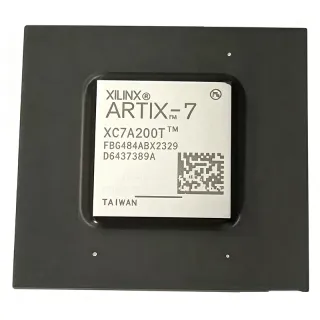
RTAX250S-CG624V - 250K-Gate Rad-Tolerant FPGA | Microchip
MPN: RTAX250S-CG624V ✓ Active| Qty | Unit Price | Extended |
|---|---|---|
| 1 | $0 | $0.00 |
| 10 | $0 | $0.00 |
| 100 | $0 | $0.00 |
| 500 | $0 | $0.00 |
| 1,000 | $0 | $0.00 |
RTAX250S-CG624V Overview
A radiation-tolerant FPGA is a field-programmable gate array engineered to survive the single-event upsets (SEU) and total ionizing dose (TID) effects of space radiation environments. Within the power-management hierarchy of spaceflight electronics, it sits above commercial FPGAs and below fully radiation-hardened ASICs, offering a single-chip, live-at-power-up fabric based on antifuse technology that does not require configuration devices.
Key features of the RTAX250S include SEU-hardened registers that eliminate the need for triple module redundancy (TMR) in many designs, embedded SRAM blocks with built-in FIFO control logic, segmentable clock resources, chip-wide highway routing, and dedicated carry logic for arithmetic. The 0.15 um CMOS process with a nominal 1.5 V core supply keeps static and dynamic power consumption low, an important consideration for solar- and battery-powered spacecraft.
Architecturally, the RTAX-S family is derived from the commercial Axcelerator architecture, combining prototyping on footprint-compatible ProASIC/AX adaptors with flight-grade antifuse fabric. The CG624 ceramic column grid array provides mechanical reliability through column rather than ball interconnect, reducing solder-joint fatigue under thermal cycling and launch vibration.
Typical applications include satellite command and data handling, telemetry encoders, payload data processing, bus controllers, and radiation-tolerant glue logic replacing multiple ASICs in low- and mid-Earth-orbit spacecraft.
Design consideration: verify the flight vs. prototype flow early - the manufacturer recommends prototyping on footprint-compatible adaptor boards and migrating the EDIF netlist with a pinout converter to the RTAX-S device.
This page synthesizes verified distributor data, drop-in package-compatible alternatives, and practical design guidance not consolidated in the manufacturer datasheet.
Drop-in alternatives for RTAX250S-CG624V — same package, pin-to-pin compatible. Different-package parts requiring PCB rework are excluded.
Variants in this series
Same-series models that are drop-in compatible with RTAX250S-CG624V (same form factor and footprint) — differing in Package, Radiation Tolerance, Family, Configuration, Core Supply Voltage.
Quick Comparison Tool — Select alternative parts for side-by-side comparison:
RTAX250S-1CG624V
✅ Drop-In✓ In Stock
Contact for price
View Datasheet →RTAX250SL-CG624V
✅ Drop-In✓ In Stock
$10000 / Unit
View Datasheet →RTAX250SL-1CG624V
✅ Drop-In✓ In Stock
Contact for price
View Datasheet →RTAX250S-LG624V
✅ Drop-In✓ In Stock
Contact for price
View Datasheet →RTAX250S-1LG624V
✅ Drop-In✓ In Stock
Contact for price
View Datasheet →RTAX250SL-1CG624V
✅ Drop-In✓ In Stock
Contact for price
View Datasheet →RTAX250S-CG624V Maximum Ratings & Electrical Characteristics
| Family | RTAX-S Radiation-Tolerant FPGA |
| Equivalent System Gates | 250000 |
| Configurable Logic Blocks (CLBs) | 2816 |
| Logic Cells | 4224 |
| Maximum System Frequency | 649 MHz |
| Process Technology | 0.15 um CMOS |
| Core Supply Voltage | 1.5 V nominal |
| User I/O | 248 |
| Package | 624-pin Ceramic Column Grid Array (CCGA) |
| Operating Temperature | -55C to +125C |
| Programming Technology | Antifuse (live at power-up) |
| SEU Immunity | SEU-hardened registers, immune to single-event upsets |
| Embedded Memory | Embedded SRAM with built-in FIFO control logic |
| Special Routing | Segmentable clocks, chip-wide highway routing, carry logic |
| Mounting Type | Surface Mount |
| Target Application | Space-flight systems |
RTAX250S-CG624V 624-pin ceramic column grid array (ccga) Pin Configuration Guide
Pin configuration for RTAX250S-CG624V (624-pin ceramic column grid array (ccga) package). This digital IC includes GPIO, communication interfaces (UART, SPI, I2C), and power pins. Refer to the manufacturer datasheet for alternate pin functions and configuration options. Essential for embedded system design and PCB layout.

No detailed pinout data available for RTAX250S-CG624V.
Refer to the datasheet for full pin configuration.
Typical Applications
RTAX250S-CG624V is suitable for 6 applications: Satellite Command and Data Handling, Payload Data Processing, Telemetry Encoder and Downlink Formatting, Radiation-Tolerant Glue Logic Consolidation, Spacecraft Bus Controller / Interface Bridge, Launch Vehicle and Avionics Support Electronics.
Satellite Command and Data Handling
The RTAX250S-CG624V fits spacecraft command and data handling (CDH) units where 250K system gates cover telemetry formatting, telecommand decoding, and bus protocol bridging. Its SEU-hardened registers provide flip-flop immunity to single-event upsets without mandatory triple module redundancy, reducing design overhead, while live-at-power-up antifuse configuration removes the external configuration memory that is itself an SEU failure point in SRAM FPGAs. In a typical CDH board the device sits between the onboard computer and the spacecraft bus interface, running at moderate clock rates where the 1.5 V core keeps power within the spacecraft power budget, and the 624-pin CCGA withstands launch vibration and on-orbit thermal cycling.
Recommended
Payload Data Processing
For instrument payload processing on Earth-observation and science satellites, the RTAX250S-CG624V implements front-end data formatting, FIFO buffering, and compression pre-processing. Embedded SRAM blocks with built-in FIFO control logic handle sensor data stream buffering without external memory, and dedicated carry logic accelerates checksum and filter arithmetic. The 649 MHz performance capability gives headroom for parallel processing channels, while 248 user I/O accommodate high-width sensor interfaces. Designers typically prototype on footprint-compatible adaptors with ProASIC3/A3PE3000 devices, then migrate the verified netlist to the RTAX-S flight unit, minimizing radiation-part risk during algorithm development and shortening overall program schedules.
Recommended
Telemetry Encoder and Downlink Formatting
The RTAX250S-CG624V serves as a telemetry encoder, implementing CCSDS-class framing, scrambling, and channel coding functions within its 2816 CLB fabric. Its segmentable clock resources let designers run the coding pipeline and the downlink interface from independent clock domains, and chip-wide highway routing keeps high-fanout control signals timing-clean across the die. Because the antifuse fabric is radiation-tolerant by construction and registers are SEU hardened, the encoder maintains data integrity in proton and heavy-ion environments where SRAM-based FPGAs would require continuous scrubbing. The 1.5 V nominal supply keeps encoder power low, preserving link budget margin for the transmitter chain on power-limited small satellites.
Recommended
Radiation-Tolerant Glue Logic Consolidation
Space programs traditionally used multiple rad-hard ASICs or SSI/MSI logic for address decoding, bus interfacing, and control; the RTAX250S-CG624V consolidates these functions into one programmable device, cutting board area, mass, and assembly cost. Its 250K gate capacity absorbs dozens of legacy MSI functions, and design changes late in the program are handled by reprogramming rather than respinning an ASIC - critical when launch dates are fixed. The ceramic CCGA package offers proven hermeticity and column interconnect reliability, and operation from -55C to +125C covers the full qualification envelope of typical spacecraft internal environments, including eclipse-induced thermal swings on unheated boards.
Recommended
Spacecraft Bus Controller / Interface Bridge
As a bus controller or interface bridge, the RTAX250S-CG624V connects spacecraft subsystems across MIL-STD-1553-adjacent, CAN-like, or custom serial buses, translating protocols and arbitrating access. The 248 user I/O support wide parallel interfaces to legacy rad-hard processors, and the antifuse fabric's live-at-power-up behavior means the bridge is operational immediately at spacecraft power application - an advantage during AIT (assembly, integration and test) when SRAM FPGAs must first be configured. Designers exploit the embedded FIFO logic to decouple bus timing from processor timing, and the SEU-hardened registers keep arbitration state machines operational through single-event upset events without system resets.
Recommended
Launch Vehicle and Avionics Support Electronics
In launch vehicle avionics support roles - sequencers, health-monitoring concentrators, and safe-and-arm interface logic - the RTAX250S-CG624V offers deterministic antifuse fabric with no configuration latency and robust single-chip integration. The -55C to +125C operating range and ceramic CCGA packaging tolerate the harsh thermal and mechanical environment of boost phase, while SEU-hardened registers address the elevated radiation exposure at higher altitudes. With 2816 CLBs and dedicated carry logic, designers implement time-critical sequencing and redundancy voting circuits in a single device, replacing multi-chip rad-hard logic families and improving mean-time-between-failure estimates for mission-critical flight control support functions.
Recommended
Recommended Products Summary
Engineering reference data for RTAX250S-CG624V — comparison, design guidance, and compliance information.
Selection Guide
Comparison with Alternatives
| Parameter | This Product | RTAX250S-1CG624V | RTAX250SL-CG624V | RTAX250S-1LG624V |
|---|---|---|---|---|
| Package | 624-pin CCGA (CG624) | 624-pin CCGA - same | 624-pin CCGA - same | 624-terminal LGA footprint - compatible |
| Brand | Microchip Technology (Actel/Microsemi) | Microchip Technology | Microchip Technology | Microchip Technology |
| System Gates | 250000 | 250000 | 250000 | 250000 |
| Logic Cells | 4224 | 4224 | 4224 | 4224 |
| Speed Grade | Standard | -1 (faster) | Standard | -1 (faster) |
| Core Supply Voltage | 1.5 V nominal | 1.5 V nominal | 1.5 V nominal | 1.5 V nominal |
| Operating Temperature | -55C to +125C | -55C to +125C | -55C to +125C | -55C to +125C |
| SEU-Hardened Registers | Yes | Yes | Yes | Yes |
Key Differentiators
- Faster -1 speed grade available in identical footprint (vs RTAX250S-1CG624V)
- SL process variant procurement flexibility (vs RTAX250SL-CG624V)
- Column interconnect reliability over LGA (vs RTAX250S-LG624V)
Design Notes
Prototype before you buy flight silicon. Microchip's documented methodology uses a footprint-compatible adaptor board (e.g., Aldec ACT-H3Ki-CG624 with an A3PE3000 device) whose BGA footprint mimics the CG624 package. Develop and verify the design on the adaptor, then convert the EDIF netlist and pinout for the RTAX-S device per the application note 'Prototyping for RTAX-S and RTAX-SL Devices.' Buying CG624 flight parts before timing closure risks scrapping expensive radiation-tolerant devices.
Power the 1.5 V core rail with low-noise supplies and adequate decoupling per the RTAX-S power guidelines in the family datasheet. While the 0.15 um antifuse fabric keeps static power low, dynamic power scales with clock frequency and toggle rate - designs approaching the 649 MHz performance point should run early power estimation in Libero SoC to size the spacecraft power budget, since changing supply architecture after PCB layout of a ceramic CCGA board is costly.
The 624-column CCGA presents controlled but non-trivial parasitics; define I/O standards and slew rates early and simulate flight-representative trace lengths for high-speed interfaces. Reserve the SEU-hardened register fabric for state-critical flops, and still apply program-approved mitigation (TMR, scrubbing, or EDAC) to RAM contents and combinational logic where the mission radiation specification requires it - hardened flip-flops do not protect every element of the design.
Compliance Information
Space-grade ceramic-packaged devices are typically covered by aerospace/defense RoHS exemptions; request material declarations and certificates of conformance from Microchip for your lot.