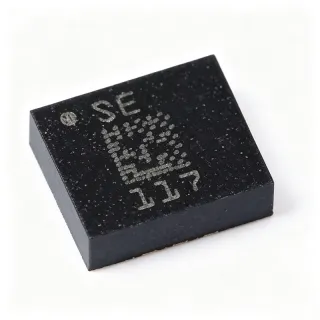
STM32H747XIH6 - Dual-Core Cortex-M7/M4 MCU | STMicroelectronics
MPN: STM32H747XIH6 ✓ Active| Qty | Unit Price | Extended |
|---|---|---|
| 1 | $18.5 | $18.50 |
| 10 | $16.8 | $168.00 |
| 100 | $14.2 | $1,420.00 |
| 500 | $12.9 | $6,450.00 |
| 1,000 | $11.6 | $11,600.00 |
STM32H747XIH6 Overview
A microcontroller (MCU) is a compact integrated circuit designed to govern a specific operation in an embedded system. It contains a processor core, memory, and programmable input/output peripherals on a single chip. The STM32H747XIH6 belongs to the STM32H7 family, which is positioned as STMicroelectronics' high-end MCU line, offering the highest performance in the STM32 portfolio. This dual-core architecture allows the Cortex-M7 to handle compute-intensive tasks such as signal processing and AI inference, while the Cortex-M4 handles real-time control and communication, enabling efficient task partitioning.
Key features include 2 MB of flash memory, 1 MB of SRAM, a comprehensive set of communication interfaces (including Ethernet, USB, CAN-FD, and multiple SPI/I2C/UART), advanced analog peripherals (3x 16-bit ADCs, 2x 12-bit DACs), and rich multimedia capabilities (TFT-LCD controller, JPEG codec, camera interface). The device supports a wide supply voltage range of 1.62V to 3.6V and operates over a temperature range of -40°C to +85°C.
The STM32H747XIH6 is built on a 40nm process technology, enabling high clock speeds with efficient power consumption. It features a Chrom-ART Accelerator for 2D graphics, a hardware cryptographic accelerator, and a true random number generator, making it suitable for secure IoT applications. The dual-core architecture is supported by a comprehensive set of development tools, including STM32CubeIDE and the STM32CubeH7 software package.
Typical applications include industrial automation, motor control, smart home gateways, audio processing, and machine vision. The high-speed Cortex-M7 core and rich connectivity make it ideal for edge AI and IoT devices that require local processing and cloud connectivity.
When designing with this device, careful attention must be paid to power supply decoupling and PCB layout to ensure stable operation at high clock speeds. The device supports multiple low-power modes, allowing designers to optimize for battery-powered applications.
Drop-in alternatives for STM32H747XIH6 — same package, pin-to-pin compatible. Different-package parts requiring PCB rework are excluded.
Quick Comparison Tool — Select alternative parts for side-by-side comparison:
STM32H747XIH6TR
✅ Drop-In📋 Reference alternative (not in catalog)
STM32H747XIH6Q
✅ Drop-In📋 Reference alternative (not in catalog)
STM32H743XIH6
✅ Drop-In📋 Reference alternative (not in catalog)
STM32H753XIH6
✅ Drop-In📋 Reference alternative (not in catalog)
STM32H747BII6
✅ Drop-In ⚠️ 参数待验证📋 Reference alternative (not in catalog)
STM32H747AII6
✅ Drop-In ⚠️ 参数待验证📋 Reference alternative (not in catalog)
STM32H747XIH6
✅ Drop-In✓ In Stock
$11.6 / Unit
View Datasheet →STM32H747XIH6
✅ Drop-In✓ In Stock
$11.6 / Unit
View Datasheet →STM32H747XIH6 Maximum Ratings & Electrical Characteristics
| Core | Arm Cortex-M7 + Cortex-M4 |
| Maximum Clock Speed | 480 MHz (M7), 240 MHz (M4) |
| Flash Memory | 2 MB |
| SRAM | 1 MB |
| Package | TFBGA-240 (XIH6) |
| Supply Voltage | 1.62 V to 3.6 V |
| Operating Temperature | -40C to +85C |
| GPIO Pins | 168 |
| ADC | 3x 16-bit |
| DAC | 2x 12-bit |
| Communication Interfaces | Ethernet, USB, CAN-FD, SPI, I2C, UART |
| TFT-LCD Controller | Yes |
| JPEG Codec | Yes |
| Cryptographic Acceleration | Yes (AES, DES, 3DES, SHA) |
| RoHS Status | Compliant |
STM32H747XIH6 Pin Configuration
| Pin A1 | VDD — Power supply |
| Pin A2 | VSS — Ground |
| Pin B1 | PA0 — GPIO/ADC |
| Pin B2 | PA1 — GPIO/ADC |
| Pin C1 | PA2 — GPIO/USART |
| Pin C2 | PA3 — GPIO/USART |
| Pin D1 | PA4 — GPIO/SPI |
| Pin D2 | PA5 — GPIO/SPI |
| Pin E1 | PA6 — GPIO/TIM |
| Pin E2 | PA7 — GPIO/TIM |
| Pin F1 | PA8 — GPIO/USB |
| Pin F2 | PA9 — GPIO/USB |
Typical Applications
STM32H747XIH6 is suitable for 6 applications: Industrial Automation, Smart Home Gateway, Audio Processing, Machine Vision, Motor Control, Edge AI.
Industrial Automation
The STM32H747XIH6 is ideal for industrial automation due to its dual-core architecture, enabling simultaneous execution of real-time control loops and communication protocols. The Cortex-M7 core handles complex algorithms like motor control and predictive maintenance, while the Cortex-M4 manages fieldbus communication (Ethernet, CAN-FD) and safety functions. With 2 MB flash and 1 MB SRAM, it can store large firmware and data logs. The device's rich peripheral set includes multiple timers, ADCs, and DACs for precise analog control. Its wide operating temperature range (-40°C to +85°C) and robust design make it suitable for harsh industrial environments. The hardware cryptographic accelerator ensures secure communication and data integrity, essential for Industry 4.0 applications.
Recommended
Smart Home Gateway
The STM32H747XIH6 serves as a powerful hub for smart home gateways, connecting various IoT devices via Ethernet, Wi-Fi, Zigbee, and Bluetooth. The dual-core design allows the Cortex-M7 to handle protocol conversion and data aggregation, while the Cortex-M4 manages real-time sensor polling and actuator control. The device's TFT-LCD controller and JPEG codec enable rich user interfaces on local displays. With hardware cryptographic acceleration, it can secure communication with cloud services and manage device authentication. The 2 MB flash provides ample storage for firmware updates and configuration data. Its low-power modes help reduce energy consumption in always-on gateway applications.
Recommended
Audio Processing
The STM32H747XIH6 excels in audio processing applications such as professional audio mixers, active noise cancellation, and voice-controlled devices. The Cortex-M7 core at 480 MHz can handle complex audio algorithms like FIR filtering, FFT, and audio codecs, while the Cortex-M4 manages real-time audio I/O and control. The device includes a dedicated audio PLL and multiple I2S interfaces for high-quality audio streaming. With 2 MB flash, it can store audio samples and processing code. The high-speed ADC and DAC allow direct audio signal processing. Its low-latency interrupt handling ensures glitch-free audio output. The device's rich connectivity (USB, Ethernet) enables audio streaming and firmware updates.
Recommended
Machine Vision
The STM32H747XIH6 is well-suited for machine vision applications, including barcode scanning, object detection, and quality inspection. The Cortex-M7 core can run image processing algorithms like edge detection and feature extraction, while the Cortex-M4 handles camera interface and real-time control. The device includes a camera interface (DCMI) that supports parallel and serial cameras, and a JPEG codec for image compression. With 1 MB SRAM, it can buffer multiple image frames. The TFT-LCD controller allows direct display of processed images. The high clock speed and DSP instructions enable real-time image analysis. Its low power consumption makes it suitable for portable vision systems.
Recommended
Motor Control
The STM32H747XIH6 is ideal for advanced motor control applications, such as robotics, drones, and industrial drives. The dual-core architecture allows the Cortex-M7 to run complex control algorithms like field-oriented control (FOC) and sensorless estimation, while the Cortex-M4 handles PWM generation and fault protection. The device includes multiple advanced timers with dead-time insertion and brake features, making it suitable for three-phase motor control. With high-resolution ADCs (16-bit) and fast comparators, it can precisely measure motor currents and position. The 480 MHz clock ensures low-latency control loops. Its rich communication interfaces (CAN-FD, Ethernet) enable integration into distributed control systems.
Recommended
Edge AI
The STM32H747XIH6 is a powerful platform for edge AI applications, enabling on-device inference for voice recognition, anomaly detection, and predictive maintenance. The Cortex-M7 core can run optimized neural networks using STM32Cube.AI, which converts trained models into optimized C code. The dual-core design allows the M7 to handle inference while the M4 manages sensor data acquisition and communication. With 2 MB flash, it can store model weights and application code. The hardware cryptographic accelerator ensures secure model updates. The device's low power consumption and small form factor make it suitable for battery-powered edge devices. Its rich connectivity enables cloud integration for model retraining.
Recommended
Recommended Products Summary
Engineering reference data for STM32H747XIH6 — comparison, design guidance, and compliance information.
Selection Guide
Comparison with Alternatives
| Parameter | This Product | STM32H747XIH6TR | STM32H747XIH6Q | STM32H743XIH6 | STM32H753XIH6 |
|---|---|---|---|---|---|
| Package | TFBGA-240 | TFBGA-240 - same | TFBGA-240 - same | TFBGA-240 - same | TFBGA-240 - same |
| Brand | STMicroelectronics | STMicroelectronics | STMicroelectronics | STMicroelectronics | STMicroelectronics |
| Core | Cortex-M7 + M4 | Cortex-M7 + M4 | Cortex-M7 + M4 | Cortex-M7 | Cortex-M7 |
| Max Clock Speed | 480 MHz (M7), 240 MHz (M4) | 480 MHz (M7), 240 MHz (M4) | 480 MHz (M7), 240 MHz (M4) | 480 MHz | 480 MHz |
| Flash Memory | 2 MB | 2 MB | 2 MB | 2 MB | 2 MB |
| SRAM | 1 MB | 1 MB | 1 MB | 1 MB | 1 MB |
| Automotive Grade | No | No | Yes (AEC-Q100) | No | No |
| Price (1pc) | $18.50 | $18.50 | $20.00 | $15.00 | $16.00 |
Key Differentiators
- Dual-core architecture (Cortex-M7 + M4) (vs STM32H743XIH6)
- Higher SRAM (1 MB) (vs STM32H743XIH6)
- Automotive grade option (vs STM32H747XIH6Q)
Design Notes
The STM32H747XIH6 requires a stable power supply with proper decoupling. Use a 100 nF capacitor on each VDD pin and a 4.7 uF bulk capacitor on the main supply. For high-speed operation, consider using a dedicated power plane and place decoupling capacitors close to the pins. The device supports multiple power domains (VDD, VDDA, VDDUSB), each requiring separate filtering.
For the TFBGA-240 package, ensure proper PCB layout with adequate via placement for thermal and electrical performance. Use a 4-layer or more PCB with dedicated ground and power planes. Route high-speed signals (Ethernet, USB) with controlled impedance and keep trace lengths matched. Place the crystal oscillator close to the OSC pins and provide a ground guard ring.
Avoid exceeding the absolute maximum ratings, especially on supply voltage (3.6V max). Ensure the boot configuration pins are set correctly to avoid unintended boot modes. When using the dual-core architecture, properly configure the interrupt priorities and shared peripherals to prevent conflicts. Also, note that the TFBGA-240 package requires careful soldering; use a reflow profile recommended by ST.
Compliance Information
RoHS compliant per STMicroelectronics product page. Not AEC-Q100 qualified - choose STM32H747XIH6Q for automotive.