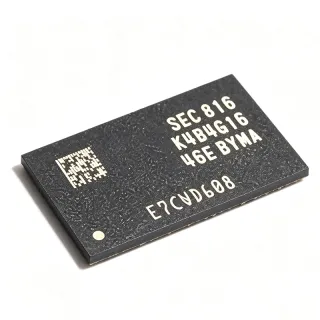
K4B4G1646 - 4Gb DDR3 SDRAM x16 96-FBGA | Samsung
MPN: K4B4G1646 ✓ Active| Qty | Unit Price | Extended |
|---|---|---|
| 1 | $14.72 | $14.72 |
| 10 | $13.98 | $139.80 |
| 100 | $13.25 | $1,325.00 |
| 500 | $12.59 | $6,295.00 |
| 1,000 | $11.96 | $11,960.00 |
K4B4G1646 Overview
DDR3 SDRAM (Double Data Rate Type Three Synchronous Dynamic Random Access Memory) is a JEDEC-standard memory technology that transfers data on both clock edges, achieving high bandwidth at low operating voltage. Within the memory hierarchy, the K4B4G1646 belongs to the DRAM family: memory IC -> DRAM -> DDR3 SDRAM -> DDR3L, serving as main memory in embedded processors, industrial controllers, and networking equipment.
Key features of the family include a dynamic on-chip termination (ODT) function, ZQ calibration for output impedance matching, an asynchronous reset function, auto precharge, and a data mask function for partial write operations. Operating temperature ranges from 0C to +95C on standard grades. The 96-FBGA surface-mount package minimizes board area and shortens signal paths for high-speed operation.
Architecturally, the 4Gb density is implemented as multiple internal banks that allow interleaved row access, sustaining high effective bandwidth during burst transfers. The x16 organization simplifies 16-bit and 32-bit memory system designs by reducing required chip count versus x8 devices. The Q-die DDR3L variants provide drop-down compatibility to 1.35V operation for lower power consumption.
Typical applications include industrial control main memory, networking and router buffering, digital video surveillance recording, and embedded processor memory subsystems for SoCs and FPGAs requiring dense, high-bandwidth DDR3.
Design consideration: verify the speed grade suffix (e.g., HCMA at 1866 Mbps, BC at 2133 Mbps) against your memory controller's timing budget, and route fly-by clock/topology per JEDEC DDR3 guidelines with proper ODT settings.
This page synthesizes distributor pricing, drop-in alternatives, cross-reference findings, and practical design notes not found in the manufacturer datasheet.
Drop-in alternatives for K4B4G1646 — same package, pin-to-pin compatible. Different-package parts requiring PCB rework are excluded.
Variants in this series
Same-series models that are drop-in compatible with K4B4G1646 (same form factor and footprint) — differing in Supply Voltage, Package, Memory Type, Memory Size, Data Rate.
Quick Comparison Tool — Select alternative parts for side-by-side comparison:
K4B4G1646E-BCNB
✅ Drop-In✓ In Stock
$13.5227 / Unit
View Datasheet →K4B4G1646B-HCMA
✅ Drop-In📋 Reference alternative (not in catalog)
K4B4G1646D-BCMA0
✅ Drop-In✓ In Stock
$5.9 / Unit
View Datasheet →K4B4G1646E-BYK000
✅ Drop-In✓ In Stock
$0.5619 / Unit
View Datasheet →K4B4G1646Q
✅ Drop-In✓ In Stock
$6.5 / Unit
View Datasheet →K4B4G1646 Maximum Ratings & Electrical Characteristics
| Memory Type | DDR3 SDRAM |
| Memory Size | 4 Gbit |
| Organization | 256M x 16 |
| Interface | Parallel |
| Max Data Rate | Up to 2133 Mbps (grade dependent) |
| Clock Frequency Range | 800 MHz to 2133 Mbps (grade dependent) |
| Supply Voltage | 1.5 V (DDR3L variants 1.35 V) |
| Package | 96-FBGA |
| Mounting Type | Surface Mount |
| Operating Temperature | 0C to +95C |
| On-Chip Termination (ODT) | Dynamic ODT |
| ZQ Calibration | Yes |
| Auto Precharge | Yes |
| Asynchronous Reset | Yes |
| Data Mask Function | Yes |
| Die Revisions | B-die, D-die, Q-die (DDR3L) |
K4B4G1646 96-fbga Pin Configuration Guide
Pin configuration for K4B4G1646 (96-fbga package). This digital IC includes GPIO, communication interfaces (UART, SPI, I2C), and power pins. Refer to the manufacturer datasheet for alternate pin functions and configuration options. Essential for embedded system design and PCB layout.

No detailed pinout data available for K4B4G1646.
Refer to the datasheet for full pin configuration.
Typical Applications
K4B4G1646 is suitable for 6 applications: Industrial Control Main Memory, Networking and Router Buffer Memory, Video Surveillance and DVR Systems, Embedded SoC / FPGA Memory Subsystems, Test and Measurement Instrumentation, Smart Home and IoT Gateway Memory.
Industrial Control Main Memory
The K4B4G1646 serves as main system memory in industrial PLCs, motion controllers, and factory-automation HMIs, where its 4Gb density and x16 organization let a single device populate a 16-bit memory bus. Its 0C to +95C operating range covers most industrial ambient conditions, and dynamic ODT with ZQ calibration maintains signal integrity across long PCB traces typical of control backplanes. Placed on a 1.5V rail (or 1.35V on the DDR3L Q-die variant) with the controller's fly-by clock topology, a 1866 Mbps grade sustains multi-GB/s burst bandwidth for real-time control loops and data logging. The 96-FBGA footprint conserves board area, and the data mask function enables efficient partial-word writes during cyclic logging operations.
Recommended
Networking and Router Buffer Memory
In routers, switches, and network appliances, the K4B4G1646E-BCNB's 2133 Mbps data rate provides up to approximately 4.2 GB/s of peak bandwidth per device, suiting packet buffering and queue management workloads. The x16 organization pairs naturally with 16-bit or 32-bit buffer-memory buses on network processors, reducing chip count versus x8 alternatives. Dynamic on-chip termination eases multi-drop signal integrity, while ZQ calibration compensates for output-driver variation over temperature, sustaining reliable eye diagrams at high data rates. With 4Gb per device, a two-chip 32-bit configuration delivers 1 GB of buffering in minimal board area, and the asynchronous reset function supports rapid recovery after watchdog resets in 24/7 network equipment.
Recommended
Video Surveillance and DVR Systems
Digital video recorders and network camera NVRs use the K4B4G1646 as working memory for frame buffering, motion analysis, and pre-processing of multiple video streams. The 4Gb per-device density supports simultaneous buffering of several high-definition channels, and the D-die K4B4G1646D-BC datasheet explicitly targets display and storage applications, confirming suitability for this domain. The 2133 Mbps E-die grade sustains the write bandwidth required by multiple concurrent H.264/H.265 encode pipelines, while the x16 organization simplifies 32-bit SoC memory interfaces. Operating from 0C to +95C, the device tolerates the elevated internal temperatures of enclosed DVR chassis, and the data mask function improves write efficiency during partial-frame updates.
Recommended
Embedded SoC / FPGA Memory Subsystems
Embedded designs built around FPGAs and SoCs with hard DDR3 memory controllers, such as Xilinx Zynq and Artix-7 devices, use the K4B4G1646 as their primary DDR3 memory. The JEDEC-standard x16 96-ball ballout matches the typical 16-bit controller interface, and speed grades up to 2133 Mbps align with the controller's maximum operating frequency. Dynamic ODT and fly-by topology support simplify the memory interface when using multiple devices in a 32-bit configuration. The DDR3L Q-die variant drops core voltage to 1.35V, reducing memory-subsystem power by roughly 10% in battery-powered or thermally constrained embedded systems, provided the controller and board rail are designed for the lower voltage class.
Recommended
Test and Measurement Instrumentation
Oscilloscopes, logic analyzers, and signal generators require deep capture memory with sustained write bandwidth, making the K4B4G1646 a practical main-memory component. Its 4Gb density enables long record lengths, while 1866-2133 Mbps grades sustain the streaming rates needed to move acquisition samples from front-end FPGAs into storage. ZQ calibration maintains driver impedance accuracy over long warm-up periods, and the asynchronous reset input allows clean recovery between acquisitions. In benchtop instruments operating in controlled 0C to +50C room environments, the standard temperature range is fully sufficient, and the compact 96-FBGA package allows dense memory arrays on 4-8 layer instrument boards without exceeding board area budgets.
Recommended
Smart Home and IoT Gateway Memory
IoT gateways and smart-home hubs running Linux-class embedded processors use the K4B4G1646 for operating-system main memory, where 4Gb (512 MB per x16 device) comfortably hosts a lightweight Linux stack plus application buffers. The Q-die DDR3L variant operating at 1.35V reduces standby power in always-on gateway products, an important consideration for 24/7 devices. The x16 organization minimizes component count on cost-sensitive gateway boards, and the 96-FBGA footprint fits compact fanless enclosures. With operating temperatures from 0C to +95C, the device withstands the elevated ambient temperatures inside sealed plastic enclosures mounted on walls or in electrical cabinets without active cooling.
Recommended
Recommended Products Summary
Engineering reference data for K4B4G1646 — comparison, design guidance, and compliance information.
Selection Guide
Comparison with Alternatives
| Parameter | This Product | K4B4G1646E-BCNB | K4B4G1646B-HCMA | K4B4G1646Q |
|---|---|---|---|---|
| Package | 96-FBGA | 96-FBGA - same | 96-FBGA - same | 96-FBGA - same |
| Brand | Samsung Electronics | Samsung Electronics | Samsung Electronics | Samsung Electronics |
| Memory Size | 4 Gbit | 4 Gbit | 4 Gbit | 4 Gbit |
| Organization | 256M x 16 | 256M x 16 | 256M x 16 | 256M x 16 |
| Supply Voltage Class | 1.5 V DDR3 | 1.5 V DDR3 | 1.5 V DDR3 | 1.35 V DDR3L |
| Die Revision | B/D/E/Q die family | E-die | B-die | Q-die |
Key Differentiators
- Highest verified speed grade in family (vs K4B4G1646B-HCMA)
- Lower power via DDR3L (vs K4B4G1646E-BCNB)
- Cost-optimized grade for lower bandwidth designs (vs K4B4G1646E-BCNB)
Design Notes
Enable dynamic ODT and ZQ calibration to preserve eye margins at 1866-2133 Mbps. Connect a precision 240-ohm (1%) RZQ resistor from the ZQ ball to ground; the internal calibration engine derives output-driver and ODT impedance from it. For multi-device configurations, use fly-by clock topology with per-device write leveling, and keep DQ/DQS length matching within the JEDEC DDR3 skew budget. Route address/command lines on a controlled-impedance layer referenced to a solid ground plane, per the Samsung datasheet layout guidance.
Standard DDR3 variants require 1.5V on both VDD and VDDQ rails; the DDR3L Q-die variant uses 1.35V. Estimated: a 4Gb device under active read/write cycling draws several hundred milliamperes, i.e. roughly 0.5-1W dissipation, so use dedicated power planes or a POL buck regulator with bulk plus per-ball decoupling (many 0402/0603 100nF ceramics plus 10uF bulk). Verify your memory controller supports 1.35V before qualifying the Q-die DDR3L part, since rail voltage is not downward-compatible on plain DDR3 controllers.
The bare MPN K4B4G1646 is a family identifier, not an orderable part: the suffix encodes die revision (B/D/E/Q), speed grade (e.g., HCMA 1866 Mbps, BC 2133 Mbps), and package/power codes. Ordering or substituting across suffixes without checking the corresponding datasheet timing tables (tCL, tRCD, tRP, tRC) can cause boot failures on memory controllers with fixed timing. Also note standard grades are rated 0C to +95C - do not use them in automotive +105C environments. Samsung reserves the right to change specifications without notice, so verify the latest datasheet revision before release.
Use the JEDEC-standard x16 96-ball FBGA land pattern. Place the DDR3 device within a few centimeters of the controller when possible; for length-matched DQ groups, keep each byte-lane's DQS with its four DQ pairs. Provide a low-inductance return path by avoiding plane splits under DDR3 routing. The asynchronous reset (RESET#) ball should be driven by a power-good qualified reset so the SDRAM never sees clocking during an unstable supply ramp.
Compliance Information
Compliance status was not explicitly stated in the verified web data for this MPN; confirm on the official Samsung product page or distributor listing for the exact ordering suffix before production release.