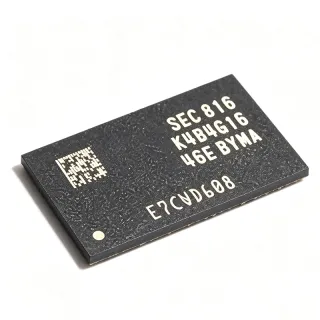
K4RHE086VP - Samsung 24Gb DDR5 DRAM | Samsung Electronics
MPN: K4RHE086VP ✓ Active| Qty | Unit Price | Extended |
|---|---|---|
| 1 | $12.5 | $12.50 |
| 10 | $11.9 | $119.00 |
| 100 | $11.2 | $1,120.00 |
| 500 | $10.6 | $5,300.00 |
| 1,000 | $9.9 | $9,900.00 |
K4RHE086VP Overview
DDR5 SDRAM is the fifth generation of double-data-rate synchronous dynamic random-access memory, the dominant main-memory technology in computing hierarchies. It sits within the DRAM family alongside DDR4, DDR3, LPDDR4/5, and HBM, and functions as the primary working memory between the CPU and storage. DDR5 doubles the bank count per bank group versus DDR4, moves power management onto the module via a PMIC, and introduces on-die ECC to improve reliability at higher densities.
Key features of the K4RHE086VP include its 24 Gb density, which enables higher memory capacity per chip and reduces component count on high-capacity DIMMs; the x8 organization, which suits server RDIMMs and embedded memory arrays; and Samsung's D1a process, which improves bit density and power efficiency versus earlier nodes. Samsung's DDR5 family supports the DDR5 interface standard with its associated speed bins for data rates in the multi-gigabit-per-second class (speed grade code ).
Architecturally, the device uses DDR5 core innovations including a 16n prefetch, dual 32-bit subchannel-capable DIMM topologies, on-die ECC (ODDE), and decision-feedback equalization (DFE) on the data path to sustain signal integrity at high data rates. Bank-group architecture shortens effective access latency and raises sustainable bandwidth for multi-core server workloads.
Typical applications include data-center RDIMM and LRDIMM modules for cloud servers, high-performance client and workstation DIMMs, AI/ML training and inference memory pools, and networking equipment requiring high bandwidth per watt. The 24 Gb density is particularly valuable in 64 GB+ module builds where minimizing IC count improves power and reliability.
Design consideration: DDR5 termination and routing demand tighter impedance control than DDR4; follow the Samsung DDR5 design guide for fly-by command/address routing and reference-voltage planning, and always confirm the exact speed bin and operating temperature range on the official datasheet before finalizing a BOM.
This page consolidates verified distributor listings, same-brand drop-in alternatives from the Samsung DDR5 portfolio, and practical sourcing guidance not found in the manufacturer datasheet.
Drop-in alternatives for K4RHE086VP — same package, pin-to-pin compatible. Different-package parts requiring PCB rework are excluded.
Variants in this series
Same-series models that are drop-in compatible with K4RHE086VP (same form factor and footprint) — differing in Interface, Package, Application Segment, Data Rate, Density.
Quick Comparison Tool — Select alternative parts for side-by-side comparison:
K4RHE086VB-BCWM
✅ Drop-In✓ In Stock
$7.65 / Unit
View Datasheet →K4RHE165VB-BCWM
✅ Drop-In✓ In Stock
Contact for price
View Datasheet →K4RAH086VP-BCWM
✅ Drop-In✓ In Stock
Contact for price
View Datasheet →K4RAH086VE-BCWM
✅ Drop-In✓ In Stock
$7.6 / Unit
View Datasheet →K4RAH086VB-BIWM
✅ Drop-In✓ In Stock
$4.85 / Unit
View Datasheet →K4RHE086VP Specifications
| Memory Type | DDR5 SDRAM |
| Density | 24 Gb |
| Organization | x8 |
| Process Node | 1a-class (D1a) |
| Package Type | FBGA |
| Mounting Type | Surface Mount |
| Interface Type | DDR5 (double data rate 5) |
| On-Die ECC | Yes (DDR5 standard feature) |
| Brand | Samsung Electronics |
| Product Family | Samsung K4RHE DDR5 series |
| Typical Application | Server / client DRAM modules |
K4RHE086VP fbga Pin Configuration Guide
Pin configuration for K4RHE086VP (fbga package). Pin numbering, functions, and connection diagrams are defined in the manufacturer datasheet. Refer to it for the exact footprint and soldering guidelines.

No detailed pinout data available for K4RHE086VP.
Refer to the datasheet for full pin configuration.
Typical Applications
K4RHE086VP is suitable for 6 applications: Data Center Server Memory (RDIMM), AI/ML Training and Inference Memory, High-Performance Client and Workstation DIMMs, Networking and Telecom Equipment, Storage Controllers and Enterprise SSDs, Test, Measurement and Emulation Systems.
Data Center Server Memory (RDIMM)
The K4RHE086VP fits data-center RDIMM designs where its 24 Gb density and x8 organization allow 64 GB-class modules to be built from fewer ICs than 16 Gb designs, cutting BOM count and register load on the fly-by CA bus. Samsung's D1a node improves bits-per-wafer and power efficiency, directly lowering server energy cost. Placed on a registered module with the DDR5 PMIC and SPD hub, the device operates in the DDR5 multi-gigabit data-rate class; designers must budget termination power and verify the exact speed bin against the platform's JEDEC SPD profile before qualification.
Recommended
AI/ML Training and Inference Memory
AI accelerators and training servers demand the highest bandwidth and capacity per socket, making 24 Gb DDR5 components like the K4RHE086VP a strong host-memory choice. Doubling die density raises capacity per rank, enabling large parameter sets to remain in host DRAM rather than spilling to storage. The x8 organization supports the subchannel topologies common in DDR5 server platforms. Trade-off consideration: HBM or GDDR remains preferable next to the accelerator die, but for capacity-heavy host memory the K4RHE086VP maximizes GB per DIMM slot and per watt on the D1a process.
Recommended
High-Performance Client and Workstation DIMMs
Workstation platforms benefit from the K4RHE086VP's 24 Gb density when building 48 GB and 96 GB non-binary module capacities, which DDR5 enables through on-die ECC and higher per-chip density. The FBGA-packaged x8 component interfaces directly to client memory controllers supporting DDR5 speed bins; designers should confirm the suffix speed grade matches the platform's supported JEDEC profile. Compared with populating two ranks of 16 Gb ICs, a single rank of 24 Gb devices reduces trace count, termination load, and module power for compact workstation and small-form-factor designs.
Recommended
Networking and Telecom Equipment
Routers, switches, and 5G infrastructure line cards use high-density DDR5 as packet-buffer and table memory, where the K4RHE086VP's 24 Gb capacity supports large flow tables with fewer components. The x8 organization suits 64-bit and 72-bit (with ECC) memory buses typical of networking designs. Samsung's D1a process delivers improved power efficiency, important for thermally constrained line-card designs. Designers must validate refresh behavior under sustained heavy traffic loads and confirm operating temperature range from the suffix datasheet, as telecom environments frequently exceed commercial grades.
Recommended
Storage Controllers and Enterprise SSDs
Enterprise SSD controllers use DDR5 DRAM as mapping-table (FTL) cache, and the K4RHE086VP's 24 Gb density allows a single DRAM to back multi-terabyte NAND arrays with a 1 GB-per-1 TB mapping ratio at reduced IC count. The DDR5 interface shortens table-lookup latency versus DDR4 at similar power, improving IOPS consistency. The x8 organization fits standard controller memory buses. Trade-off: LPDDR4/LPDDR5 may suit power-critical designs, but DDR5 offers higher capacity ceilings and ECC support that enterprise storage platforms require for data integrity.
Recommended
Test, Measurement and Emulation Systems
Memory test platforms, protocol analyzers, and DDR5 emulation systems require reference DDR5 components across all available densities; the K4RHE086VP provides a 24 Gb x8 reference device for validating controllers at the newest generation. Its D1a die represents the leading-edge Samsung node that future platforms will ship with, making it valuable for early silicon bring-up. Engineers characterizing on-die ECC behavior and DFE equalization use 24 Gb devices to stress the DDR5 channel. Confirm suffix-specific AC timing from the Samsung datasheet when building test patterns and margin-testing fixtures.
Recommended
Recommended Products Summary
Engineering reference data for K4RHE086VP — comparison, design guidance, and compliance information.
Selection Guide
Comparison with Alternatives
| Parameter | This Product | K4RHE086VB-BCWM | K4RHE165VB-BCWM | K4RAH086VP-BCWM |
|---|---|---|---|---|
| Package | FBGA | FBGA - same | FBGA - same family | FBGA - same family |
| Brand | Samsung Electronics | Samsung Electronics | Samsung Electronics | Samsung Electronics |
| Memory Type | DDR5 SDRAM | DDR5 SDRAM | DDR5 SDRAM | DDR5 SDRAM |
| Density | 24 Gb | 24 Gb | 24 Gb | 16 Gb |
| Organization | x8 | x8 | x16 | x8 (2Gx8) |
| Process Node | 1a-class (D1a) | 1a-class (D1a) | 1a-class (D1a) | Prior DDR5 node |
| On-Die ECC | Yes (DDR5 standard) | Yes (DDR5 standard) | Yes (DDR5 standard) | Yes (DDR5 standard) |
Key Differentiators
- 24 Gb density doubles module capacity per IC (vs K4RAH086VP-BCWM)
- Latest-generation D1a process efficiency (vs K4RAH086VP-BCWM)
- x8 organization for standard server buses (vs K4RHE165VB-BCWM)
Design Notes
DDR5 channel margins are substantially tighter than DDR4 because of higher data rates and lower VDD (1.1 V class). Route DQ/DM/DBI as length-matched groups with controlled single-ended impedance, implement fly-by CA routing with DFE-aware receiver budgets, and follow Samsung's DDR5 design guide for reference voltage (VDDQ) decoupling. Simulate with IBIS models from the Samsung support portal for the exact speed bin before tape-out of DIMM or board-level memory interfaces.
DDR5 moves power management onto the module: the PMIC (typically a dedicated DDR5 PMIC IC) supplies VDD1/VDD2/VDDQ rails independently of the motherboard. Budget termination power carefully - at 24 Gb density with multiple ranks, idle versus active termination current differs significantly. Verify the exact VDD and VDDQ values plus tolerance windows from the suffix-specific datasheet; do not assume 1.1 V universally, as speed-grade variants can specify different operating points.
Do not qualify alternatives on the shortened base MPN alone. Suffix codes (speed bin, temperature, packing) change AC timing tables and compliance documents even when the core die is identical - K4RHE086VP versus K4RHE086VB-BCWM may differ in the exact supported JEDEC profile. Also verify SPD contents when changing density (16 Gb to 24 Gb); module topology and register settings are not transparent to the host controller. Always obtain the official Samsung datasheet for the complete orderable part number.
Compliance Information
Compliance statements are issued per complete orderable MPN including suffix. Retrieve the official Samsung environmental declaration for the full K4RHE086VP suffix code before relying on compliance data.