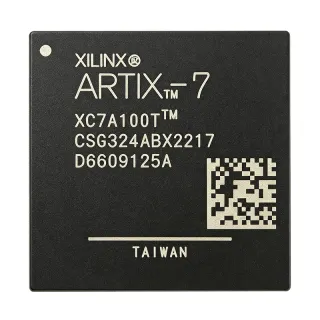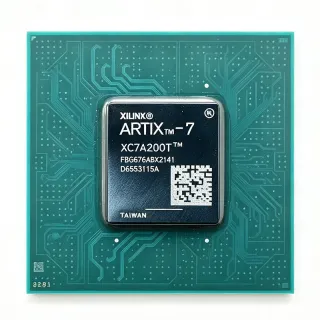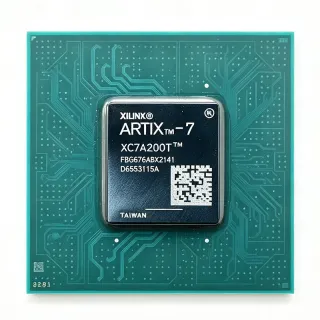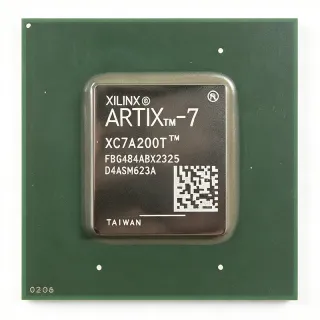
RTAX2000SL-LG624V - 2M-Gate Rad-Tolerant FPGA 624-CLGA | Microchip
MPN: RTAX2000SL-LG624V ✓ Active| Qty | Unit Price | Extended |
|---|---|---|
| 1 | $2200 | $2,200.00 |
| 10 | $2090 | $20,900.00 |
| 100 | $1980 | $198,000.00 |
| 500 | $1870 | $935,000.00 |
| 1,000 | $1760 | $1,760,000.00 |
RTAX2000SL-LG624V Overview
A radiation-tolerant FPGA is a field-programmable gate array qualified for space-flight environments, where ionizing radiation can upset conventional SRAM-based logic. Within the programmable logic hierarchy (FPGA -> programmable logic device -> digital IC -> semiconductor), the RTAX-S family occupies the high-reliability tier: unlike SRAM FPGAs that require configuration flash and triple-module redundancy, RTAX-S/SL devices use antifuse programming that is inherently immune to configuration upsets and is live at power-up, with no external boot device required.
Key features include single-event upset (SEU) immune antifuse architecture, low static power consumption critical for orbital missions, a true single-chip form factor, and embedded SRAM blocks with built-in FIFO control logic. The device is fabricated on a 0.15 um CMOS process and supports segmentable clocking and chip-wide highway routing resources.
Architecturally, the RTAX2000SL is derived from the commercial Axcelerator family, offering 32,256 logic cells organized into CLBs, with dedicated embedded memory and high-performance routing. The SL variant optimizes static power for long-duration space missions where solar or battery power budgets are strict.
Typical applications include satellite payload data processing, spacecraft bus controllers, telemetry and telecommand systems, and deep-space science instruments. The 624-pin CLGA package suits high-I/O payloads requiring dense signal integration.
Design consideration: antifuse FPGAs are one-time programmable; use the Aldec/Microchip ProASIC3E-based prototyping flow to validate designs before committing flight hardware.
This page synthesizes distributor data, drop-in alternatives within the RTAX family, and design guidance not found in the manufacturer datasheet.
Drop-in alternatives for RTAX2000SL-LG624V — same package, pin-to-pin compatible. Different-package parts requiring PCB rework are excluded.
Variants in this series
Same-series models that are drop-in compatible with RTAX2000SL-LG624V (same form factor and footprint) — differing in Package, Equivalent System Gates, Family, Embedded Memory, Logic Cells.
Quick Comparison Tool — Select alternative parts for side-by-side comparison:
RTAX2000SL-1LG624V
✅ Drop-In✓ In Stock
$9600 / Unit
View Datasheet →RTAX2000S-1LG624V
✅ Drop-In✓ In Stock
Contact for price
View Datasheet →RTAX1000SL-LG624V
✅ Drop-In✓ In Stock
$2025 / Unit
View Datasheet →RTAX1000SL-1LG624V
✅ Drop-In✓ In Stock
$975 / Unit
View Datasheet →RTAX1000S-LG624V
✅ Drop-In✓ In Stock
$2600 / Unit
View Datasheet →RTAX250SL-LG624V
✅ Drop-In✓ In Stock
$1620 / Unit
View Datasheet →RTAX2000SL-LG624V Maximum Ratings & Electrical Characteristics
| Family | RTAX-SL (RTAX-S/SL RadTolerant FPGAs) |
| Equivalent System Gates | 2,000,000 (approx.) |
| Logic Cells | 32,256 |
| Configurable Logic Blocks (CLBs) | 21,504 |
| Maximum System Frequency | 649 MHz |
| Process Technology | 0.15 um CMOS |
| Core Supply Voltage | 1.5 V (nominal) |
| Programming Technology | Antifuse (one-time programmable) |
| Radiation Tolerance | Radiation-tolerant (space-flight qualified family) |
| Package | 624-pin CLGA (LG624) |
| Mounting Type | Surface Mount |
| Operating Temperature | -55C to +125C |
| Embedded Memory | Embedded SRAM with built-in FIFO control logic |
| Special Routing Features | Segmentable clocks, chip-wide highway routing |
| Power-Up Behavior | Live at power-up (no external configuration device) |
RTAX2000SL-LG624V 624-pin clga (lg624) Pin Configuration Guide
Pin configuration for RTAX2000SL-LG624V (624-pin clga (lg624) package). This digital IC includes GPIO, communication interfaces (UART, SPI, I2C), and power pins. Refer to the manufacturer datasheet for alternate pin functions and configuration options. Essential for embedded system design and PCB layout.

No detailed pinout data available for RTAX2000SL-LG624V.
Refer to the datasheet for full pin configuration.
Typical Applications
RTAX2000SL-LG624V is suitable for 6 applications: Satellite Payload Data Processing, Spacecraft Bus Control and Avionics, Telemetry, Tracking and Command (TT&C), Deep-Space Science Instruments, Launch Vehicle and Reentry Systems, New Space LEO Constellations.
Satellite Payload Data Processing
The RTAX2000SL-LG624V fits payload data processing because its ~2,000,000 equivalent gates and 32,256 logic cells provide the fabric width needed for on-board image compression, channel coding, and encryption, while its antifuse configuration is immune to SEU-induced configuration corruption - eliminating the configuration-memory scrubbing burden of SRAM FPGAs. The 649 MHz-class fabric supports high-throughput parallel datapaths on a 1.5V nominal core, keeping power within typical payload allocations. In use, the device implements CCSDS-compliant encoders, framing, and lossless compression between sensor front ends and downlink modems. The trade-off is one-time programmability: prototypes must be validated on ProASIC3E-based adaptors (e.g., RTAX2000S-CG624PROTO) before flight units are programmed, as antifuse programming is irreversible and flight rework is impossible.
Recommended
Spacecraft Bus Control and Avionics
For spacecraft bus controllers, attitude determination, and platform avionics, the RTAX2000SL-LG624V offers live-at-power-up operation with no boot device - a single-chip solution that reduces parts count and failure modes on the most reliability-critical board. Its RTAX-SL antifuse fabric holds configuration through single-event effects, while -55C to +125C operation covers launch transients and eclipse thermal cycling. Engineers typically implement MIL-STD-1553 or SpaceWire interfaces, watchdog logic, and mode-control state machines in the 32,256 logic cells. Performance consideration: since the device is one-time programmable, interface IP must be timing-verified in Libero SoC on the standard speed grade, or the '-1' variant (RTAX2000SL-1LG624V) selected for margin; the shared LG624 footprint lets one PCB support either grade without redesign.
Recommended
Telemetry, Tracking and Command (TT&C)
The RTAX2000SL-LG624V suits TT&C subsystems where the logic must survive years of accumulated total ionizing dose and frequent single-event upsets without service. Its embedded SRAM blocks with built-in FIFO control logic buffer telemetry frames and command queues, while chip-wide highway routing and segmentable clocks help isolate the slow, safety-critical command path from faster telemetry processing domains. Typical implementations include PCM frame formatters, command decoders, and watchdog/failsafe logic running at modest clock rates but requiring zero configuration-error probability. The 1.5V core minimizes static draw during eclipse when the platform runs on battery. Design consideration: protect I/O banks with radiation-hardened line drivers or RC filtering, and verify latch-up limits per the Microchip RTAX-S datasheet characterization for your orbital environment.
Recommended
Deep-Space Science Instruments
Deep-space missions impose extreme radiation and strict power budgets, and the RTAX2000SL-LG624V addresses both: the antifuse fabric has no configuration upset mechanism, and the RTAX-SL low-static-power optimization on a 0.15 um 1.5V process conserves energy over multi-year cruises. With ~2M gates, the device implements instrument front-end sequencing, high-rate ADC interface glue, on-board histogramming, and lossy-on-demand compression for spectrometers, imagers, and particle detectors. The 624-pin CLGA provides the I/O count to aggregate multiple sensor channels on one chip, reducing harness mass. Because flight devices are programmed once, instrument teams use the Aldec/Microchip flash-based prototyping adaptor to validate FPGA code against real instrument hardware before committing flight parts, then program the full mission lot from a single verified design database.
Recommended
Launch Vehicle and Reentry Systems
Launch-vehicle avionics demand determinism at power-up and immunity to the intense radiation and vibration of ascent - both strengths of the RTAX2000SL-LG624V. Its live-at-power-up antifuse configuration removes boot latency from flight-critical timelines, and -55C to +125C operation plus a rugged 624-pin CLGA soldered interconnect suit booster flight computers, separation sequencing, and flight-termination interfaces. Designers map redundant sensor voting and dual-string control logic across the 32,256 logic cells, exploiting SEU-immune configuration so that only transient upsets in registers (handled by design-level TMR) need consideration. Performance trade-off: fabric speed is capped by the selected speed grade, so time-critical control loops should be timing-verified at worst-case temperature; the RTAX2000SL-1LG624V variant on the same footprint provides additional timing margin when needed.
Recommended
New Space LEO Constellations
LEO constellations balance rad-tolerance with cost at scale, and the RTAX2000SL-LG624V serves the payload and gateway side of that equation where SEU-immune configuration justifies antifuse cost. At ~2M gates and 649 MHz-class performance, one device replaces multiple glue ASICs in software-defined radio payload chains, implementing DDC/DUC filters, framing, and interfacing to high-speed ADC/DACs. The single-chip, no-configuration-flash architecture simplifies qualification and removes a radiation-sensitive part from the BOM. Constellation operators often standardize one LG624 PCB across payload revisions, populating RTAX1000SL-LG624V for cost-down variants and RTAX2000SL-1LG624V for high-throughput beams. Planning note: antifuse one-time programming requires disciplined design freeze and lots programming under ESD-controlled conditions; budget prototype cycles on ProASIC3E hardware before the flight production run.
Recommended
Recommended Products Summary
Engineering reference data for RTAX2000SL-LG624V — comparison, design guidance, and compliance information.
Selection Guide
Comparison with Alternatives
| Parameter | This Product | RTAX2000SL-1LG624V | RTAX2000S-1LG624V | RTAX1000SL-LG624V | RTAX250SL-LG624V |
|---|---|---|---|---|---|
| Package | 624-pin CLGA (LG624) | 624-pin CLGA (LG624) - same | 624-pin CLGA (LG624) - same | 624-pin CLGA (LG624) - same | 624-pin CLGA (LG624) - same |
| Brand | Microchip Technology | Microchip Technology | Microchip Technology | Microchip Technology | Microchip Technology |
| Equivalent Gates | ~2,000,000 | ~2,000,000 | ~2,000,000 | ~1,000,000 | RTAX250SL-class (lower density) |
| Speed Grade | Standard (L) | -1 (faster) | -1 (faster) | Standard (L) | Standard (L) |
| Core Supply Voltage | 1.5 V nominal | 1.5 V nominal | 1.5 V nominal | 1.5 V nominal | 1.5 V nominal |
| Programming Technology | Antifuse (OTP) | Antifuse (OTP) | Antifuse (OTP) | Antifuse (OTP) | Antifuse (OTP) |
| Operating Temperature | -55C to +125C | -55C to +125C | -55C to +125C | -55C to +125C | -55C to +125C |
Key Differentiators
- Highest fabric speed on the shared footprint (vs RTAX2000SL-1LG624V)
- Lower static power than RTAX-S (non-SL) (vs RTAX2000S-1LG624V)
- Double the density of same-footprint alternatives (vs RTAX1000SL-LG624V)
Design Notes
Antifuse FPGAs are one-time programmable: a programming error or unverified design permanently consumes a flight device costing thousands of dollars. Establish a strict design-freeze gate - Libero SoC timing closure at worst-case temperature/voltage, functional simulation, and hardware validation on a ProASIC3E-based prototyping adaptor (e.g., RTAX2000S-CG624PROTO) - before any RTAX2000SL-LG624V device reaches the programmer. Program flight units in an ESD-controlled area with traceable programmer calibration records, and retain one spare programmed unit per design revision for failure investigation.
The RTAX2000SL uses a 1.5V nominal core supply with very low static power - an advantage over SRAM FPGAs, but you must still budget dynamic power for the 649 MHz-class fabric when datapaths toggle at high rates. Estimate dynamic power in Libero's SmartPower using realistic switching activity from simulation, then derate for radiation-induced threshold shifts. Provide local decoupling (bulk plus 0.1 uF ceramics) at each supply pin group per the Microchip RTAX-S datasheet, and verify inrush and sequencing against the platform EPS during thermal-vacuum testing.
The 624-ball CLGA requires careful board design: use microvia-in-pad or the recommended land pattern from the RTAX-S package data, maintain controlled impedance on high-speed I/O banks, and route JTAG/programming access so flight programming is possible after assembly. Because antifuse configuration removes the need for configuration flash, keep the reclaimed board area for decoupling and guard-trace isolation of sensitive analog I/O. X-ray inspect solder joints after reflow - collapsed balls on CLGA packages are a common hidden defect in space assemblies.
While RTAX configuration is SEU-immune, user flip-flops are not: apply triple-module redundancy (TMR) to control state machines and use the device's segmentable clock domains to isolate safety-critical logic from high-activity datapaths. Mitigate SET on I/O with filtering or threshold buffering per your mission's radiation design margin (RDM) policy, and validate SEFI-free operation with beam testing on qualification lots.
Compliance Information
Space-grade product qualified for flight use; environmental compliance declarations (RoHS/REACH/lead status) were not present in the provided web data and must be requested from Microchip with the flight lot certificate of conformance.