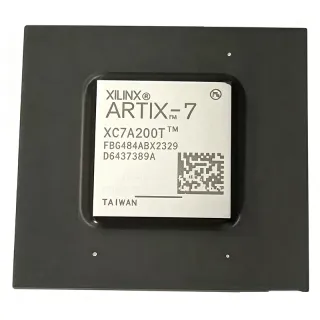
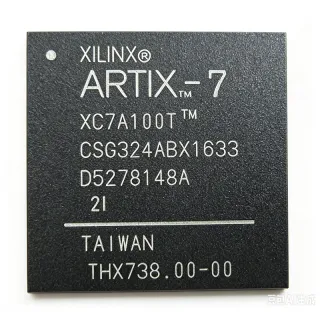
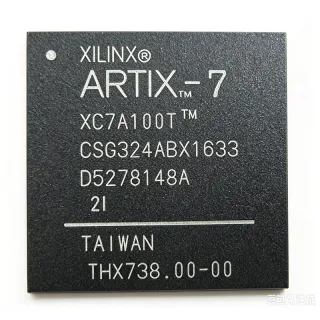
XC7A75T - Artix-7 FPGA 75K Logic Cells, 6.6Gb/s | AMD
MPN: XC7A75T ✓ Active| Qty | Unit Price | Extended |
|---|---|---|
| 1 | $215 | $215.00 |
| 10 | $198 | $1,980.00 |
| 100 | $182 | $18,200.00 |
| 500 | $168 | $84,000.00 |
| 1,000 | $155 | $155,000.00 |
XC7A75T Overview
An FPGA (Field-Programmable Gate Array) is a programmable logic device configured after manufacturing to implement arbitrary digital logic. Within the semiconductor hierarchy, FPGAs sit between ASICs and general-purpose processors, offering reconfigurability, parallel processing, and rapid prototyping. The Artix-7 family is AMD's lowest-power, lowest-cost 28nm FPGA line, optimized for highest performance per watt with integrated analog mixed-signal (AMS) capability.
Key differentiating features include DSP48E1 slices for high-speed arithmetic, an XADC dual 12-bit ADC for on-chip temperature and voltage monitoring, support for LVCMOS, LVDS, and HSTL I/O standards, and GTP transceivers supporting PCIe, Gigabit Ethernet, and Serial RapidIO protocols.
Architecturally, the device comprises configurable logic blocks (CLBs) of 6-input LUTs and flip-flops, column-based block RAM, and dedicated clocking fabric. The 28nm process reduces dynamic power versus older 40nm/65nm generations, while bitstream encryption protects IP. Configuration is supported via JTAG, SPI, or BPI flash.
Typical applications include software-defined radio (baseband processing with high-speed ADC/DAC interfacing), motor control, medical imaging, and industrial networking where moderate logic density plus 6.6 Gb/s serial connectivity is required at low cost.
Design tip: implement with the Vivado Design Suite, decouple each VCCO/VCCAUX pin with 100nF ceramics, and follow UG475/UG482 layout guidelines for transceiver routing. Pricing below reflects distributor data as of 2026-08-29.
Drop-in alternatives for XC7A75T — same package, pin-to-pin compatible. Different-package parts requiring PCB rework are excluded.
Variants in this series
Same-series models that are drop-in compatible with XC7A75T (same form factor and footprint) — differing in Block RAM, Design Software, I/O Standards, Process Technology.
Quick Comparison Tool — Select alternative parts for side-by-side comparison:
XC7A75T-2FGG484I
✅ Drop-In✓ In Stock
$59.89 / Unit
View Datasheet →XA7A75T-1FGG484Q
✅ Drop-In📋 Reference alternative (not in catalog)
XC7A100T-1FGG484C
✅ Drop-In ⚠️ Specs Unverified📋 Reference alternative (not in catalog)
XC7A50T-1FGG484C
✅ Drop-In ⚠️ Specs Unverified📋 Reference alternative (not in catalog)
XC7A100T-2FGG484C
✅ Drop-In ⚠️ Specs Unverified📋 Reference alternative (not in catalog)
XC7A75T Maximum Ratings & Electrical Characteristics
| Logic Cells | 75520 |
| Block RAM | 1800 Kb |
| Clock Management Tiles (CMT) | 5 (MMCM + PLL each) |
| GTP Transceivers | 6 |
| Transceiver Line Rate | up to 6.6 Gb/s |
| Maximum User I/O | 285 |
| Process Technology | 28 nm HKMG |
| Total CLB Flip-Flops | 92080 |
| Packages Available | FGG484, FTG256, FGG400, CSG324, CPG236 |
| I/O Standards | LVCMOS, LVDS, HSTL and others |
| XADC | Dual 12-bit ADC for temperature/voltage monitoring |
| Configuration Interfaces | JTAG, SPI, BPI |
| Design Software | Vivado Design Suite |
| Mounting Type | Surface Mount (BGA) |
| Family | Artix-7 |
| RoHS Status | Compliant |
XC7A75T fgg484, ftg256, fgg400, csg324, cpg236 Pin Configuration Guide
Pin configuration for XC7A75T (fgg484, ftg256, fgg400, csg324, cpg236 package). This digital IC includes GPIO, communication interfaces (UART, SPI, I2C), and power pins. Refer to the manufacturer datasheet for alternate pin functions and configuration options. Essential for embedded system design and PCB layout.

No detailed pinout data available for XC7A75T.
Refer to the datasheet for full pin configuration.
Typical Applications
XC7A75T is suitable for 6 applications: Software-Defined Radio, Industrial Motor Control, Medical Imaging Front-End, Industrial Networking and Protocol Bridging, Test and Measurement Instruments, Aerospace and Defense Processing.
Software-Defined Radio
The XC7A75T's 6 GTP transceivers at up to 6.6 Gb/s provide the serial bandwidth needed to stream samples from JESD204B-class ADCs and DACs, while 75,520 logic cells and DSP48E1 slices implement digital down-conversion, channel filtering, and modulation. The 1,800 Kb block RAM buffers IQ data, and 5 MMCMs generate the multiple synchronous clock domains SDR architectures require, all at 28nm-class low power.
Recommended
Industrial Motor Control
In multi-axis motor drives, the XC7A75T implements parallel PWM engines, encoder interfaces, and current-loop math in DSP48E1 slices with deterministic sub-microsecond latency that microcontrollers cannot match. Its LVCMOS and LVDS I/Os connect directly to gate drivers and absolute encoders, while the XADC monitors board temperature and supply rails. Transceiver capability links the drive to industrial Ethernet backbones.
Recommended
Medical Imaging Front-End
Ultrasound and digital X-ray chains rely on the XC7A75T to aggregate high-speed serial ADC data over its 6.6 Gb/s GTP transceivers, apply beamforming and matched filtering in DSP48E1 slices, and buffer frames in 1,800 Kb of block RAM. The 28nm process keeps thermal load low inside sealed diagnostic enclosures, and XADC-based monitoring supports system self-test required in medical equipment.
Recommended
Industrial Networking and Protocol Bridging
The XC7A75T's GTP transceivers implement PCIe, Gigabit Ethernet, and Serial RapidIO, making it a protocol bridge between legacy fieldbus interfaces implemented in fabric and modern high-speed backbones. With 75,520 logic cells, multiple MACs and protocol stacks coexist in one device, while 285 user I/Os (FGG484) connect to relays, sensors, and HMI peripherals without external glue logic.
Recommended
Test and Measurement Instruments
Bench instruments and modular (PXI-style) cards use the XC7A75T for real-time triggering, pattern generation, and capture logic with deterministic timing from its 5 MMCM/PLL clock tiles. The 6.6 Gb/s transceivers interface to high-speed data paths, and 75,520 logic cells implement protocol-aware digital test cores. Bitstream encryption protects proprietary instrument firmware in the field.
Recommended
Aerospace and Defense Processing
For SWaP-constrained avionics and defense payloads, the XA-grade variants of the XC7A75T deliver extended-temperature operation with the same die. The fabric implements sensor interfaces, pre-processing pipelines, and secure configuration with bitstream encryption. GTP transceivers handle high-rate telemetry links, and the 28nm performance/watt advantage maximizes compute within tight power budgets.
Recommended
Recommended Products Summary
Engineering reference data for XC7A75T — comparison, design guidance, and compliance information.
Selection Guide
Comparison with Alternatives
| Parameter | This Product | XC7A75T-2FGG484I | XA7A75T-1FGG484Q | XC7A100T-1FGG484C | XC7A50T-1FGG484C |
|---|---|---|---|---|---|
| Package | FCBGA-484 (FGG484) | FCBGA-484 (FGG484) - same | FCBGA-484 (FGG484) - same | FCBGA-484 (FGG484) - same | FCBGA-484 (FGG484) - same |
| Brand | AMD (Xilinx) | AMD (Xilinx) | AMD (Xilinx) | AMD (Xilinx) | AMD (Xilinx) |
| Logic Cells | 75520 | 75520 | 75520 | 101440 | 53128 |
| Block RAM | 1800 Kb | 1800 Kb | 1800 Kb | 2188 Kb | 1350 Kb |
| GTP Transceivers | 6 @ 6.6 Gb/s | 6 @ 6.6 Gb/s | 6 @ 6.6 Gb/s | 6 @ 6.6 Gb/s | 4 @ 6.6 Gb/s |
| Speed Grade | -1 (varies by order code) | -2 (faster) | -1 (XA grade) | -1 | -1 |
| Temperature Grade | Commercial/Industrial (per suffix) | Industrial (-40 to +100C) | Extended (XA/Q) | Commercial | Commercial |
Key Differentiators
- Best cost/performance balance point (vs XC7A100T-1FGG484C)
- Faster timing closure headroom available (vs XC7A75T-1FGG484C)
- Extended temperature qualification (vs XC7A75T commercial variants)
Design Notes
Decouple every VCCO, VCCAUX, and VCCINT ball with 100nF ceramic capacitors placed within 2mm of the device, plus bulk 47uF+ per rail. Use AMD's XPower Analyzer with your post-implementation netlist to size the core rail; VCCINT current on 28nm Artix-7 can vary 3x between idle and toggling designs. Follow the power sequencing in the 7-series configuration guide (VCCINT before VCCO) to avoid configuration faults.
Route the six GTP transceiver pairs as 100-ohm differential pairs on solid reference planes with no stubs; follow UG482 for AC coupling and reference clock jitter budget (use a low-jitter oscillator, e.g., sub-1ps RMS for 6.6 Gb/s links). Keep GTP lanes away from switching regulator nodes and configure IBIS/IBIS-AMI models in SI simulation before layout release.
Not all FGG484 devices have identical usable I/O banks - XC7A50T in FGG484 leaves some banks unpopulated versus XC7A75T/XC7A100T. When migrating between densities on the same footprint, re-check pin assignment legality in Vivado I/O Planning before committing the PCB. Also confirm configuration flash compatibility (SPI vs BPI) and bitstream encryption key management early.
Compliance Information
RoHS compliance per AMD product listings. XA-grade variants serve automotive-adjacent extended-temperature uses but standard XC7A75T is not AEC-Q100 qualified.