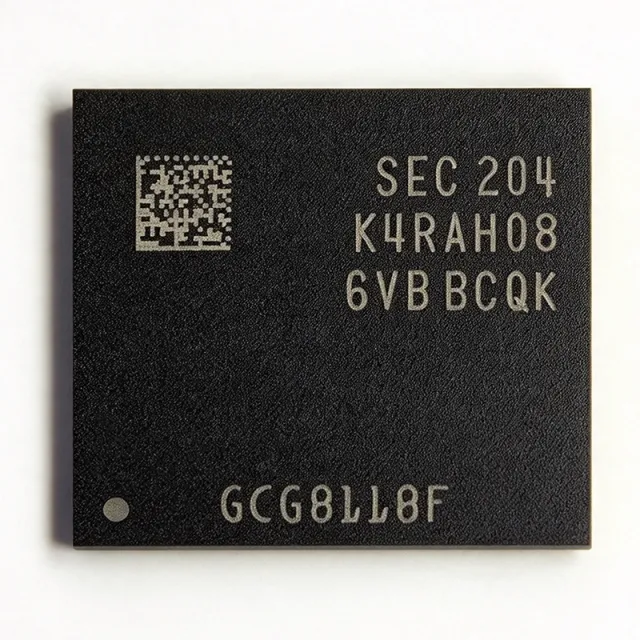
K4RAH086VB-BCQK - DDR5 SDRAM 16Gb 4800Mbps | Samsung
Référence : K4RAH086VB-BCQK ✓ Actif| Qté | Prix unitaire | Total |
|---|---|---|
| 1 | $70.3125 | $70,31 |
| 10 | $50.7813 | $507,81 |
| 100 | $44.9219 | $4 492,19 |
| 500 | $42.9688 | $21 484,40 |
| 1 000 | $41.0156 | $41 015,60 |
K4RAH086VB-BCQK Présentation
DDR5 SDRAM (Double Data Rate Type 5 synchronous dynamic random-access memory) is the fifth generation of the JEDEC DDR memory family. In the system hierarchy it sits as a volatile main-memory component below CPU cache and above storage, supplying the working data set for CPUs, GPUs, SoCs, and AI accelerators. DDR5 doubles the bank groups of DDR4, moves the power management IC onto the module (DM supply), and lowers the operating voltage from 1.2V to 1.1V for roughly 30% better power efficiency.
Key features of the K4RAH086VB-BCQK include 16 Gb density in a 2G x 8 organization, 4800 Mbps per-pin data rate, 1.1V VDD operation, and on-die ECC (link ECC) that improves data reliability without host overhead. The 82-ball FBGA surface-mount package delivers excellent signal integrity and thermal performance for dense DIMM and SO-DIMM layouts, and the part is commercial temperature rated (0C to 95C) per the DDR5 SDRAM standard.
Technically, the device uses Samsung's advanced DRAM process with on-die termination, a DLL-enabled operating mode for the timing parameters in the datasheet, and burst length 32 (BL32) architecture typical of DDR5. Command/address inputs operate in single-data-rate mode with a defined compliance mask; DQ signals run at the full double-data rate of 4800 Mbps. Bank-group interleaving sustains high effective bandwidth across multiple independent banks.
Typical applications include DDR5 UDIMM and RDIMM memory modules for desktops, workstations, and servers; embedded computing modules and industrial controllers requiring high-bandwidth main memory; and AI/HPC accelerator boards where DDR5 bandwidth and efficiency are critical. Per Samsung product literature, it serves data storage, firmware boot, and embedded logging use cases as well.
Design consideration: DDR5 requires a PMIC supplying 1.1V with tight tolerance, accurate fly-by command/address routing with per-byte DQ termination, and PCB stackups controlled to the DDR5 channel impedance targets; verify the controller's supported data rate against the 4800 Mbps grade.
This page synthesizes distributor stock data, drop-in alternatives, comparison tables, and practical design notes not found in the manufacturer datasheet.
Alternatives de remplacement direct pour K4RAH086VB-BCQK — même boîtier, compatible broche à broche. Les références à boîtier différent nécessitant une retouche du PCB sont exclues.
Variantes de cette série
Modèles de la même série directement compatibles avec K4RAH086VB-BCQK (même facteur de forme et même empreinte) — différant par Data Rate, Package, Interface, Operating Temperature, Density.
Outil de comparaison rapide — sélectionnez des références alternatives pour une comparaison côte à côte :
K4RAH086VB-BIWM
✓ En stock
$4.85 / unité
Voir la fiche technique →K4RAH165VB-BCQK
✓ En stock
Contactez-nous pour le prix
Voir la fiche technique →K4RBH046VM-BCCP
✓ En stock
$9.6 / unité
Voir la fiche technique →H5CG48MEBDX014N
✓ En stock
$41.68 / unité
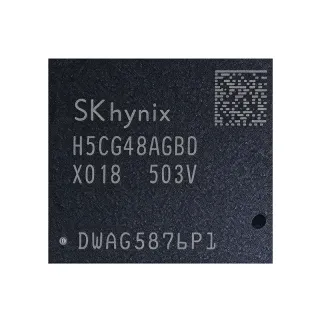
Voir la fiche technique →H5CG48AGBDX018N
✓ En stock
$87.42 / unité
Voir la fiche technique →K4RAH086VB-BCQK Valeurs maximales et caractéristiques électriques
| Type de mémoire | DDR5 SDRAM |
| Density | 16 Gb |
| Organisation de la mémoire | 2G x 8 |
| Débit de données | 4800 Mbps (DDR5-4800) |
| Clock Frequency | 2400 MHz |
| Supply Voltage (VDD) | 1.1 V |
| Interface | Parallel |
| Boîtier | FBGA-82 |
| Type de montage | Surface Mount |
| Température de fonctionnement | 0C to 95C (commercial) |
| ECC | On-die ECC |
| Burst Length | BL32 (DDR5 standard) |
| Memory Format | DRAM (volatile) |
| DLL Mode | DLL Enabled (datasheet timing basis) |
| Product Status | Active |
| Packaging | Tray |
Guide de configuration des broches du K4RAH086VB-BCQK fbga-82
Configuration des broches du K4RAH086VB-BCQK (boîtier fbga-82). Ce circuit intégré numérique comprend des GPIO, des interfaces de communication (UART, SPI, I2C) et des broches d'alimentation. Consultez la fiche technique du fabricant pour les fonctions alternatives des broches et les options de configuration. Indispensable pour la conception de systèmes embarqués et la conception de circuits imprimés.

Aucune donnée de brochage détaillée disponible pour K4RAH086VB-BCQK.
Consultez la fiche technique pour la configuration complète des broches.
Applications typiques
K4RAH086VB-BCQK convient pour 6 applications: DDR5 Memory Modules (UDIMM/RDIMM), High-Performance Computing (HPC), AI Accelerator Boards, Industrial Controllers and Embedded Computing, Desktop and Workstation Platforms, Networking and Communication Equipment.
DDR5 Memory Modules (UDIMM/RDIMM)
The K4RAH086VB-BCQK is a primary die for next-generation DDR5 memory modules, where its 2G x 8 organization and 4800 Mbps data rate deliver PC5-4800 class bandwidth. Samsung DDR5 devices of this die were identified in retail modules such as the G.SKILL Trident Z5 DDR5-5600 kit (per EE Times die analysis), confirming module-level adoption. On a module, eight or more x8 devices form a 64-bit channel; the on-die ECC adds link-level reliability without host overhead. Designers must pair the chips with the module PMIC (5V to 1.1V conversion) and verify SPD data matches the trained data rate.
Recommandé
High-Performance Computing (HPC)
HPC nodes and GPU accelerator boards require main memory with high bandwidth and low power, exactly what DDR5-4800 at 1.1V provides. The K4RAH086VB-BCQK's 4800 Mbps per-pin rate gives a 64-bit channel about 38.4 GB/s, and DDR5's doubled bank groups sustain effective bandwidth under interleaved workloads. Compared to DDR4 at 1.2V, the 1.1V core plus module-side PMIC architecture cuts memory subsystem power roughly 30% (Samsung DDR5 product page), a decisive factor in dense HPC racks. Sourememorychips lists this chip specifically for high-performance computing where bandwidth and efficiency are critical.
Recommandé
AI Accelerator Boards
AI accelerator and inference cards pair compute engines with large DDR5 main memory for model weights and activation buffers. The K4RAH086VB-BCQK fits these designs because 16Gb per device enables high aggregate density (8 devices = 16 GB per channel), and BL32 burst plus bank-group interleaving keeps sustained bandwidth high during streaming access patterns typical of neural network inference. The htelec.com DDR5 comparison guide explicitly recommends 16Gb DDR5 devices of this class for AI computing and high-performance embedded designs. Thermal design must account for concurrent peak bandwidth operation across all channels.
Recommandé
Industrial Controllers and Embedded Computing
Industrial controllers and embedded computing modules use the K4RAH086VB-BCQK for main memory, as listed in the Samsung product overview (data storage, firmware boot, embedded logging, industrial controllers). Its 16Gb x8 organization matches typical COM Express and SMARC module memory sockets, and 1.1V operation reduces module thermal load in fanless enclosures. Designers should confirm the commercial 0C to 95C operating window against enclosure temperature rise; DDR5 training data stored in module flash must be re-validated when substituting vendors. The 4800 Mbps grade balances bandwidth against signal integrity margins on cost-effective PCB stackups.
Recommandé
Desktop and Workstation Platforms
Consumer desktop and workstation platforms using DDR5-4800, the JEDEC standard speed for 12th/13th-generation-class Intel and AMD Ryzen 7000-class memory controllers, are the highest-volume application for this die. The K4RAH086VB-BCQK's 2G x 8 organization directly populates UDIMM designs at 16 GB per 8-chip module. On-die ECC improves stability for long uptime workloads without OS overhead. Repair and rework markets also consume this exact chip: AliExpress repair kits include the K4RAH086VB-BCQK for module component-level repair, reflecting its wide installed base in DDR5 systems.
Recommandé
Networking and Communication Equipment
Routers, switches, and 5G baseband cards need packet-buffer memory with high sustained bandwidth and power efficiency. The K4RAH086VB-BCQK provides 38.4 GB/s per 64-bit channel at 4800 Mbps while operating at 1.1V, reducing thermal budget in sealed networking chassis compared to DDR4 solutions at 1.2V. The doubled bank groups of DDR5 reduce row-conflict stalls during randomized packet processing, and on-die ECC protects against soft errors in long-uptime telecom deployments. The commercial 0-95C rating suits well-ventilated equipment slots; designers should validate sustained bandwidth under worst-case traffic profiles.
Recommandé
Récapitulatif des produits recommandés
Données de référence d'ingénierie pour K4RAH086VB-BCQK — comparaison, recommandations de conception et informations de conformité.
Guide de sélection
Comparaison avec les alternatives
| Paramètre | Ce produit | K4RAH086VB-BIWM | K4RAH165VB-BCQK | K4RBH046VM-BCCP | H5CG48MEBDX014N | H5CG48AGBDX018N |
|---|---|---|---|---|---|---|
| Package | FBGA-82 | FBGA-82 - same | FBGA-82 - same | FBGA-82 - same | FBGA-82 - same | FBGA-82 - same |
| Brand | Samsung Electronics | Samsung Electronics | Samsung Electronics | Samsung Electronics | SK Hynix | SK Hynix |
| Memory Type | DDR5 SDRAM | DDR5 SDRAM | DDR5 SDRAM | DDR5 SDRAM | DDR5 SDRAM | DDR5 SDRAM |
| Density | 16 Gb | 16 Gb | 16 Gb | 32 Gb | 16 Gb | 16 Gb |
| Supply Voltage | 1.1 V | 1.1 V | 1.1 V | 1.1 V | 1.1 V | 1.1 V |
Principaux différenciateurs
- Mainstream DDR5-4800 volume grade with broad distributor stock (vs K4RAH086VB-BIWM)
- x8 organization simplifies standard channel designs (vs K4RAH165VB-BCQK)
- Samsung single-vendor family scaling from 16Gb to 32Gb (vs K4RBH046VM-BCCP)
- Second-source path available via SK Hynix (vs H5CG48MEBDX014N)
Notes de conception
DDR5 moves power conversion onto the module or board via a dedicated PMIC that converts the 5V or 12V input to the 1.1V VDD/VDDQ rails. The K4RAH086VB-BCQK requires tight voltage tolerance on 1.1V; ripple and transient response directly affect write leveling and training margins at 4800 Mbps. Size the PMIC for per-device peak current at full channel bandwidth and add bulk capacitance near the PMIC plus local decoupling at each device's VDD balls, following the DDR5 reference design decoupling guidance.
At 4800 Mbps, DDR5 command/address runs in single-data-rate fly-by topology while DQ/DQS run double-data-rate per-byte. Route CA lines as a matched group to the fly-by termination, keep length matching within the controller's specified skew windows, and use ODT settings from the Samsung datasheet's DLL-enabled timing tables as the starting point for training. Verify eye diagrams at temperature extremes; the commercial 0C to 95C rating of the K4RAH086VB-BCQK defines the validation range.
Substituting vendors (Samsung to SK Hynix H5CG48MEBDX014N, for example) changes drive strength, ODT calibration behavior, and SPD contents; DDR5 read/write training must be re-run and SPD data reprogrammed before the system boots. Also do not substitute x16 (K4RAH165VB) for x8 (K4RAH086VB) parts - the DQ organization and ball map differ. Mixing vendors on a single channel is a common cause of training failures even when both parts individually pass validation.
Estimated: a single 16Gb DDR5 device dissipates roughly 0.5-1 W at full 4800 Mbps traffic (typical DDR5 per-device active power, input estimate from standard class figures). In dense 8-16 device channels this aggregates to several watts per module edge; ensure airflow across the DRAM array or use heatspreaders on performance modules. Junction temperature must stay within the 0-95C commercial range - derate the data rate if thermal simulation shows approach to the upper limit in fanless designs.
Informations de conformité
RoHS/REACH certificates not present in reviewed distributor data as of 2026-09-04; request compliance certificates from Samsung or distributor at RFQ time. Not automotive AEC-Q100 qualified (commercial DRAM product).