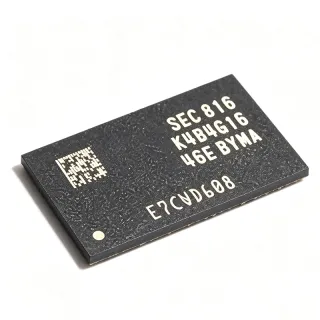
K4A8G165WB-BCPB - 8Gb DDR4 SDRAM 2133Mbps x16 | Samsung
MPN: K4A8G165WB-BCPB ✓ Active| Qty | Unit Price | Extended |
|---|---|---|
| 1 | $2.89 | $2.89 |
| 10 | $2.74 | $27.40 |
| 100 | $2.6 | $260.00 |
| 500 | $2.46 | $1,230.00 |
| 1,000 | $2.31 | $2,310.00 |
K4A8G165WB-BCPB Overview
DDR4 SDRAM is the fourth generation of double data rate synchronous dynamic random access memory, the dominant main-memory technology in embedded systems, industrial PCs, networking equipment, and consumer electronics. Within the memory hierarchy, DDR4 sits above DDR3L by offering lower operating voltage (1.2V vs 1.5V), higher data rates, and bank-group architecture that improves burst performance. The x16 organization allows single-chip deployment in memory systems that do not require x8 or x4 ECC configurations.
Key features of the K4A8G165WB-BCPB include 8Gb density on Samsung's B-die process, 2133 Mbps/pin bandwidth, and 1.2V core supply delivering roughly 25% lower power than DDR3 at comparable speeds. The device supports DDR4 bank-group architecture with 4 groups, on-die termination (ODT), and standard DDR4 command timing as defined in the Samsung datasheet.
The B-die architecture uses a refined CMOS process to achieve high cell density with stable retention characteristics. Internal bank grouping reduces effective tRFC overhead per burst, improving random-access efficiency. VDDQ is also 1.2V, simplifying power-tree design with a single rail when current limits permit.
Typical applications include industrial control main memory, network appliance buffering, set-top boxes, smart TVs, and embedded ARM/x86 systems using DDR4 controllers with 16-bit memory buses.
Design consideration: DDR4 routing requires length-matched fly-by or point-to-point topologies with careful Vref and ODT calibration; consult the Samsung datasheet timing tables and your SoC memory controller guide before layout.
This page synthesizes distributor pricing, drop-in alternatives, and practical design notes not found in the manufacturer datasheet. Pricing as of 2026-09-04.
Drop-in alternatives for K4A8G165WB-BCPB — same package, pin-to-pin compatible. Different-package parts requiring PCB rework are excluded.
Variants in this series
Same-series models that are drop-in compatible with K4A8G165WB-BCPB (same form factor and footprint) — differing in Data Rate, Package, Operating Temperature, Interface, Refresh.
Quick Comparison Tool — Select alternative parts for side-by-side comparison:
K4A8G165WB-BCRC
✅ Drop-In✓ In Stock
$12.57 / Unit
View Datasheet →K4A8G165WB-BCTD
✅ Drop-In✓ In Stock
$37 / Unit
View Datasheet →K4A8G165WB-BCWE
✅ Drop-In✓ In Stock
$6.55 / Unit
View Datasheet →K4A8G165WC-BCTD
✅ Drop-In✓ In Stock
$41.2 / Unit
View Datasheet →MT40A256M16GE-075E:B
✅ Drop-In✓ In Stock
$3.95 / Unit
View Datasheet →K4A8G165WB-BCPB Maximum Ratings & Electrical Characteristics
| Memory Type | DDR4 SDRAM |
| Density | 8 Gb |
| Organization | 512M x 16 |
| Data Rate | 2133 Mbps |
| Supply Voltage (VDD) | 1.2 V |
| I/O Voltage (VDDQ) | 1.2 V |
| Operating Temperature | 0C to +85C |
| Package | 96FBGA (TFBGA) |
| Number of Terminals | 96 |
| Package Shape | Rectangular, bottom terminal position |
| Die Generation | 8Gb B-die |
| Mounting Type | Surface Mount |
| Interface | DDR4 (synchronous, double data rate) |
| Bank Groups | DDR4 bank-group architecture |
| RoHS Status | Compliant (per Lisleapex listing) |
K4A8G165WB-BCPB rectangular, bottom terminal position Pin Configuration Guide
Pin configuration for K4A8G165WB-BCPB (rectangular, bottom terminal position package). This digital IC includes GPIO, communication interfaces (UART, SPI, I2C), and power pins. Refer to the manufacturer datasheet for alternate pin functions and configuration options. Essential for embedded system design and PCB layout.

No detailed pinout data available for K4A8G165WB-BCPB.
Refer to the datasheet for full pin configuration.
Typical Applications
K4A8G165WB-BCPB is suitable for 6 applications: Industrial Control Main Memory, Networking Appliance Buffer Memory, Smart TV and Set-Top Box, Embedded ARM/x86 Systems, Test and Measurement Instrumentation, IoT Gateways and Edge Computing.
Industrial Control Main Memory
The K4A8G165WB-BCPB fits industrial controllers and IPCs that need 8Gb of main memory on a 16-bit DDR4 bus. Its 0C to +85C rating covers standard industrial enclosures, and 1.2V operation cuts memory-rail power versus DDR3 by roughly 25%, reducing heat load in sealed cabinets. Used as a single-chip 512M x 16 memory behind an ARM or x86 DDR4 controller at 2133 Mbps, it provides balanced bandwidth for deterministic control loops. Designers should implement fly-by or point-to-point routing with ODT calibration per the Samsung datasheet and SoC memory guidelines to meet signal-integrity margins at speed.
Recommended
Networking Appliance Buffer Memory
Network switches, routers, and security appliances use DDR4 for packet buffering and lookup tables. The K4A8G165WB-BCPB's 8Gb density and 2133 Mbps/pin rate provide approximately 4.2 GB/s peak bandwidth on a x16 bus, enough for buffering bursts in gigabit-class systems. The x16 organization suits controllers with 16-bit memory channels common in network SoCs. DDR4 bank-group architecture improves random access efficiency over DDR3, which matters for queue management workloads. Layout should keep trace lengths matched within datasheet skew limits and use solid ground reference planes to control impedance on the 96FBGA ballout.
Recommended
Smart TV and Set-Top Box
Consumer video platforms require 8Gb-class DDR4 for frame buffers, graphics, and application memory. The K4A8G165WB-BCPB's 1.2V supply and commercial 0-85C rating align with set-top box thermal envelopes, and the 96FBGA package enables compact two- or four-chip POP-adjacent layouts. At 2133 Mbps, a single x16 device delivers sufficient bandwidth for 1080p decode pipelines, while dual chips reach 4K-class buffers. Consumer cost targets favor this speed bin over higher-priced 2666/3200 Mbps parts. Board designers must follow DDR4 eye-mask compliance at the DRAM balls and verify Vref training in the SoC boot firmware.
Recommended
Embedded ARM/x86 Systems
Embedded compute modules (SOMs, COM Express, custom carrier boards) based on DDR4-capable SoCs frequently deploy one or two K4A8G165WB-class chips as primary system memory. The 512M x 16 organization maps cleanly onto 16-bit memory controllers without ECC, and the B-die's stable characteristics support the long production lifecycles embedded products demand. At 2133 Mbps with CL15-class timings, the device balances performance and power for fanless systems. Firmware teams must implement DDR4 initialization, ZQ calibration, and training per the Samsung datasheet sequence; switching to the BCRC drop-in later requires only a speed-bin update in device-tree or BIOS settings.
Recommended
Test and Measurement Instrumentation
Oscilloscopes, logic analyzers, and data-acquisition systems use DDR4 DRAM for deep capture memory. The K4A8G165WB-BCPB provides 8Gb per chip, allowing multi-gigabyte acquisition buffers by paralleling chips on 16-bit controllers. Its 2133 Mbps sustained rate supports streaming capture at several hundred MB/s per device, and bank-group architecture reduces effective turnaround penalties during sequential writes. Instruments operating in lab environments fit the 0-85C rating. Because continuous streaming stresses refresh scheduling, designers should implement controller-level refresh-aware traffic shaping and consult the datasheet tRFC and tREFI tables for the exact operating temperature.
Recommended
IoT Gateways and Edge Computing
Edge AI and IoT gateways running Linux with local inference need gigabyte-class memory near the network edge. The K4A8G165WB-BCPB supplies 1GB per chip at 1.2V, and two chips achieve 2GB on a 32-bit DDR4 bus, sufficient for containerized edge workloads. Power-conscious gateway designs benefit from DDR4's reduced idle current versus DDR3L, extending thermally limited passive-cooling designs. The 96FBGA rectangular package suits compact module PCBs. For edge products facing supply-chain risk, qualifying the pin-compatible K4A8G165WB-BCRC as a second source protects against B-die allocation constraints without PCB redesign.
Recommended
Recommended Products Summary
Engineering reference data for K4A8G165WB-BCPB — comparison, design guidance, and compliance information.
Selection Guide
Comparison with Alternatives
| Parameter | This Product | K4A8G165WB-BCRC | K4A8G165WB-BCTD | K4A8G165WB-BCWE | K4A8G165WC-BCTD | MT40A256M16GE-075E:B |
|---|---|---|---|---|---|---|
| Package | 96FBGA (TFBGA) | 96FBGA - same | 96FBGA - same | 96FBGA - same | 96FBGA - same | 96FBGA (JEDEC) - same footprint |
| Brand | Samsung Electronics | Samsung Electronics | Samsung Electronics | Samsung Electronics | Samsung Electronics | Micron Technology |
| Density | 8 Gb | 8 Gb | 8 Gb | 8 Gb | 8 Gb | 8 Gb |
| Organization | 512M x 16 | 512M x 16 | 512M x 16 | 512M x 16 | 512M x 16 | 256M x 16 x 8 banks (8 Gb x16) |
| Supply Voltage | 1.2 V | 1.2 V | 1.2 V | 1.2 V | 1.2 V | 1.2 V |
| Die Revision | 8Gb B-die | 8Gb B-die | 8Gb B-die | 8Gb B-die | 8Gb C-die | Micron rev.B die |
Key Differentiators
- Lowest-cost 2133 Mbps speed bin (vs K4A8G165WB-BCRC)
- Mature B-die process stability (vs K4A8G165WC-BCTD)
- Same-brand drop-in upgrade path (vs MT40A256M16GE-075E:B)
Design Notes
Route DDR4 address/command in fly-by topology with length-matched stubs and keep DQ/DQS byte-lane lengths matched within the SoC memory controller skew budget (typically +/-25 mil per group). Reference all DDR4 traces to a solid ground plane, maintain 40-ohm single-ended / 80-ohm differential impedances, and enable on-die termination (ODT) per the Samsung datasheet speed-bin table for 2133 Mbps. Run IBIS-based simulation against the Samsung DDR4 IBIS model before fabricating the board.
The K4A8G165WB-BCPB uses 1.2V for both VDD and VDDQ. Size the VDD rail using the datasheet IDD tables at 2133 Mbps for your access pattern (IDD0/IDD4R/IDD4W) rather than a single typical number; add 10-20% margin for refresh-heavy duty cycles. Decouple each supply ball pair with at least 0.1uF ceramic plus bulk capacitance near the package. Estimated: a single chip at ~500 mA average draws ~0.6W - well within a single LDO or buck channel, but parallel designs scale linearly.
Do not substitute the x8 K4A8G085WB-BCPB for this x16 part without redesign - the data-bus width and ballout differ. When swapping to the faster BCRC or C-die WC parts, update boot firmware speed bins and re-run read/write training; DDR4 initialization sequences are timing-table specific. Also note the 96FBGA package has balls on the bottom only - ball A1 is identified via the package marking/chamfer orientation in the datasheet mechanical drawing, not a visible dot. Inspect reflow profiles per JEDEC lead-free limits for FBGA packages.
Compliance Information
RoHS-certified per Lisleapex product listing. Samsung current DDR4 production is lead-free. Request formal material declarations from Samsung or your distributor for REACH, halogen-free, and conflict-minerals documentation per date code.