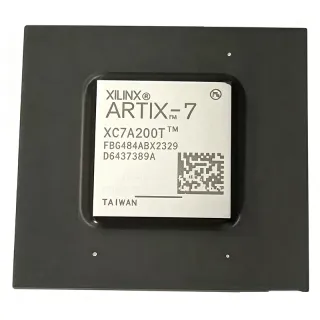
A3PE600L-FGG484M - ProASIC3EL Flash FPGA 600K | Microchip
MPN: A3PE600L-FGG484M ✓ Active| Qty | Unit Price | Extended |
|---|---|---|
| 1 | $118 | $118.00 |
| 10 | $109.5 | $1,095.00 |
| 100 | $98.4 | $9,840.00 |
| 500 | $89 | $44,500.00 |
| 1,000 | $79.9 | $79,900.00 |
A3PE600L-FGG484M Overview
An FPGA (Field-Programmable Gate Array) is a semiconductor device containing a fabric of programmable logic blocks and interconnects that designers configure to implement custom digital circuits. Unlike SRAM-based FPGAs, the ProASIC3 family stores its configuration in nonvolatile on-chip flash, so the device powers up instantly as a single-chip solution with no external boot PROM - a key advantage in the power-management and programmable-logic hierarchy for cost- and board-space-sensitive designs.
Key features include a 1.2 V to 1.5 V core voltage supporting low-power operation, flash-based LiveSystem ProASIC3EL architecture fabricated in 130 nm CMOS process technology, reprogrammability with secure configuration storage, and abundant embedded features suited to industrial and defense designs. Datasheet records for this military-temperature family indicate each device is tested from -55 C to +125 C and is not susceptible to neutron-induced configuration loss, a radiation-tolerance attribute valued in aerospace programs.
Technically, the ProASIC3EL fabric uses fine-grained Versatile logic elements (VersaTiles) with distributed flash switches that also serve as user-visible memory, eliminating configuration-scratch vulnerability inherent to SRAM FPGAs. The low static power of the flash switch technology, combined with the L-grade low-power option, reduces standby current compared with SRAM equivalents of similar density.
Typical applications include military and avionics systems, industrial automation controllers, communications infrastructure glue logic and bridge functions, and secure single-chip designs where configuration bitstream protection matters.
For design, confirm supply sequencing of the 1.2 V/1.5 V core and 2.5 V/3.3 V I/O banks and use Microchip Libero SoC design suite for synthesis and programming file generation.
This page synthesizes distributor pricing, drop-in alternatives such as the A3PE600L-FG484M, and practical design notes not found in the manufacturer datasheet alone.
Drop-in alternatives for A3PE600L-FGG484M — same package, pin-to-pin compatible. Different-package parts requiring PCB rework are excluded.
Variants in this series
Same-series models that are drop-in compatible with A3PE600L-FGG484M (same form factor and footprint) — differing in Package, Family, Configuration Memory, Operating Temperature, System Gates.
Quick Comparison Tool — Select alternative parts for side-by-side comparison:
A3PE600L-FG484M
✅ Drop-In✓ In Stock
$44.9 / Unit
View Datasheet →A3PE600L-1FGG484M
✅ Drop-In📋 Reference alternative (not in catalog)
A3PE600L-1FG484M
✅ Drop-In📋 Reference alternative (not in catalog)
A3PE600-FGG484I
✅ Drop-In ⚠️ Specs Unverified✓ In Stock
$44.03 / Unit
View Datasheet →A3PE3000L-FGG484
✅ Drop-In ⚠️ Specs Unverified✓ In Stock
Contact for price
View Datasheet →A3PE600L-FGG484M Maximum Ratings & Electrical Characteristics
| Family | ProASIC3EL |
| Logic Elements | 7K (per distributor listing) |
| System Gates | 600K |
| User I/O | 270 |
| User Flash Memory | 110592 bits |
| Core Voltage | 1.2 V to 1.5 V |
| Process Technology | 130 nm CMOS flash |
| Configuration Memory | On-chip Flash (nonvolatile, reprogrammable) |
| Package | 484-Ball FBGA (484-BGA) |
| Mounting Type | Surface Mount |
| Flash*Freeze Technology | Supported (ProASIC3/EL military datasheet) |
| Neutron-Induced Configuration Loss | Not susceptible (per datasheet) |
| Device Screening | Each device tested from -55C to 125C (per datasheet) |
| Programming Tool | Microchip Libero SoC |
A3PE600L-FGG484M 484-ball fbga (484-bga) Pin Configuration Guide
Pin configuration for A3PE600L-FGG484M (484-ball fbga (484-bga) package). This digital IC includes GPIO, communication interfaces (UART, SPI, I2C), and power pins. Refer to the manufacturer datasheet for alternate pin functions and configuration options. Essential for embedded system design and PCB layout.

No detailed pinout data available for A3PE600L-FGG484M.
Refer to the datasheet for full pin configuration.
Typical Applications
A3PE600L-FGG484M is suitable for 6 applications: Military and Avionics Systems, Industrial Automation and Control, Communications Infrastructure, Secure Single-Chip Designs, Aerospace New-Design Migration, Medical and Test Instrumentation.
Military and Avionics Systems
The A3PE600L-FGG484M fits military and avionics designs because the Military ProASIC3/EL datasheet documents device testing from -55C to +125C and states the flash-based configuration is not susceptible to neutron-induced configuration loss - eliminating the configuration-scrubbing and external PROM overhead of SRAM FPGAs in radiation environments. With ~600K gates and 270 user I/Os, it implements interface bridging, bus translation, and sensor aggregation at 1.2 V to 1.5 V core power, reducing weight and power versus multi-chip solutions. Instant-on flash configuration supports deterministic power-up in flight-critical subsystems, and the 484-FBGA package provides dense, high-reliability interconnect.
Recommended
Industrial Automation and Control
In industrial controllers, motor-interface boards, and factory automation backplanes, the A3PE600L-FGG484M implements glue logic, PWM generation, encoder interfaces, and safety interlocks. The low 1.2 V/1.5 V core voltage and low static power of the 130 nm flash fabric reduce cabinet heat and allow passively cooled enclosures. Instant-on operation matters where deterministic behavior at power-up is required for machine safety sequencing. Its 270 I/Os handle dense sensor and actuator wiring, and the reprogrammable flash fabric lets one PCB design serve multiple product variants via configuration updates, cutting inventory and field-upgrade cost across long-lifetime industrial equipment.
Recommended
Communications Infrastructure
Line cards, backplane bridges, and telecom control planes use the A3PE600L-FGG484M for protocol adaptation, serial-interface bridging, and system supervision. The 270 user I/Os support wide parallel buses and multiple I/O banks operating at 2.5 V and 3.3 V, letting one device interface legacy 5V-tolerant-class logic families and modern low-voltage rails. Flash configuration eliminates boot delay, so links re-establish within milliseconds of power application - valuable in redundant switchover schemes. The 600K-gate capacity accommodates FIFOs, error-checking logic, and register files, while the 110592-bit distributed user flash stores board identity and provisioning data alongside the design.
Recommended
Secure Single-Chip Designs
Anti-tamper and secure-boot applications favor the A3PE600L-FGG484M because configuration resides in nonvolatile on-chip flash rather than external SRAM, removing the bitstream-capture attack surface of SRAM FPGAs and eliminating the external boot flash that leaks the design. Microchip's flash FPGA security features support design protection for deployments in payment terminals, secure gateways, and defense electronics. The 600K-gate fabric implements cryptographic wrapper logic, authentication state machines, and secure sensor interfaces, while instant-on behavior removes the boot-window vulnerability where an unconfigured device could be probed between power-up and configuration load.
Recommended
Aerospace New-Design Migration
Engineering teams migrating legacy Actel ProASICplus or gate-array designs choose the A3PE600L-FGG484M as a modern, reprogrammable replacement that preserves instant-on, single-chip operation. The 484-ball FBGA footprint is shared across the ProASIC3EL family from A3PE600L to A3PE3000L, so the same PCB supports density upgrades from 600K to 3M gates without respin - a major benefit for low-volume aerospace programs where NRE and qualification dominate cost. The L-grade low-power option trims standby current for battery-backed avionics and orbiting payloads, and flash fabric immunity to neutron-induced configuration loss simplifies radiation assessments.
Recommended
Medical and Test Instrumentation
Bench instruments, patient-monitoring front ends, and imaging subsystems use the A3PE600L-FGG484M for timing generation, data-path formatting, and interface consolidation. The low 1.2 V to 1.5 V core and flash-based low static power help meet thermal and battery budgets in portable diagnostics, while 270 I/Os connect ADCs, memory, and host interfaces on one device. Instant-on configuration ensures measurement chains are ready the moment power is applied, supporting turnkey instrument startup sequences. Reprogrammability allows one hardware platform to be firmware-differentiated across instrument models, reducing qualification effort and sparing inventory for regulated medical product lines.
Recommended
Recommended Products Summary
Engineering reference data for A3PE600L-FGG484M — comparison, design guidance, and compliance information.
Selection Guide
Comparison with Alternatives
| Parameter | This Product | A3PE600L-FG484M | A3PE600L-1FGG484M | A3PE600-FGG484I | A3PE3000L-FGG484 |
|---|---|---|---|---|---|
| Package | 484-Ball FBGA (FGG484) | 484-Ball FBGA (FG484) - same footprint | 484-Ball FBGA (FGG484) - same footprint | 484-Ball FBGA (FGG484) - same footprint | 484-Ball FBGA (FGG484) - same footprint |
| Brand | Microchip Technology (Microsemi/Actel) | Microchip Technology | Microchip Technology | Microchip Technology | Microchip Technology |
| System Gates | 600K | 600K | 600K | 600K | 3000K |
| Core Voltage | 1.2 V to 1.5 V | 1.2 V to 1.5 V | 1.2 V to 1.5 V | 1.2 V to 1.5 V | 1.2 V to 1.5 V |
| Ball Finish | Lead-free (GG) | Lead (Sn/Pb) | Lead-free (GG) | Lead-free (GG) | Lead-free (GG) |
Key Differentiators
- Military temperature screening with neutron-tolerant flash configuration (vs A3PE600-FGG484I)
- Cost-optimized 600K density in a shared 484-FBGA footprint (vs A3PE3000L-FGG484)
- Lead-free ball finish for RoHS-constrained builds (vs A3PE600L-FG484M)
Design Notes
The A3PE600L supports a 1.2 V to 1.5 V core voltage; the L-grade low-power option trades some performance for reduced static current. Power the core and I/O banks per the ProASIC3/EL family datasheet power-up requirements, decoupling each supply ball with 0.1 uF ceramics placed within 2 mm of the FBGA via. Budget I/O bank currents per bank rather than per device, since 270 I/Os switching simultaneously can dominate total power. Run Libero SmartPower estimates before layout to size regulators - flash FPGAs have near-zero configuration current but non-trivial standby at 1.2 V.
The 484-ball FBGA (FGG484) requires a fine-pitch BGA footprint with via-in-pad or dog-bone escape on outer rows and microvias or buried vias for inner balls - typically a 6-8 layer stack for full escape. Follow the land pattern in the Microchip ProASIC3 package datasheet exactly; the footprint is shared with A3PE3000L-FGG484, which enables density migration without respin. Use sequential ball-map assignment in Libero to minimize layer count. Confirm solder reflow profile suits the lead-free (SnAgCu) ball finish of the FGG version.
Do not confuse suffixes when ordering: FG vs FGG differ in ball finish (RoHS impact), the -1 suffix changes speed grade, and A3PE600 (no L) vs A3PE600L differ in core voltage option - substituting the wrong variant can violate a 1.5 V core rail. Verify JTAG chain configuration before programming: FlashPro expects the correct device ID, and military-temperature parts are programmed identically to commercial ones. Always re-run timing analysis after substituting between standard and -1 speed grades, as Fmax margins change.
Compliance Information
FGG suffix denotes lead-free ball finish (RoHS-oriented); verified from FindIC comparison of FG vs FGG variants. Other compliance statuses not stated in provided data.