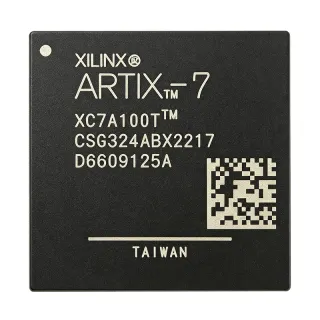
M1AFS1500-1FGG256I - 1.5M Gate Fusion FPGA, ARM Cortex-M1 | Microchip
MPN: M1AFS1500-1FGG256I ✓ Active| Qty | Unit Price | Extended |
|---|---|---|
| 1 | $185 | $185.00 |
| 10 | $171.2 | $1,712.00 |
| 100 | $158.6 | $15,860.00 |
| 500 | $147.3 | $73,650.00 |
| 1,000 | $136.9 | $136,900.00 |
M1AFS1500-1FGG256I Overview
A field-programmable gate array (FPGA) is a semiconductor device containing a fabric of configurable logic blocks, routing resources, and I/O cells that the designer programs after manufacturing. FPGAs sit within the broader hierarchy of programmable logic devices, above CPLDs in capacity and flexibility, and the Fusion family is unusual in that it is a mixed-signal FPGA: it monolithically integrates configurable analog blocks, large flash memory, clock management circuitry, and flash-based programmable logic in a single die, reducing bill-of-materials count versus discrete MCU-plus-FPGA two-chip solutions.
Key features of the M1AFS1500-1FGG256I include the soft ARM Cortex-M1 processor core running in the fabric for embedded control, 1.5 million system gates of flash-based programmable logic, and instant-on operation: as soon as system power is applied and within normal operating specifications, Fusion devices are working, thanks to their nonvolatile flash fabric. Security is addressed with a 128-bit flash-based lock and industry-leading AES decryption used to secure programmed intellectual property and configuration data.
The device is fabricated on a 130 nm flash-based process with a 1.5 V core supply, a technology Microchip (formerly Actel/Microsemi) uses to deliver inherent single-chip configuration without external boot flash. The flash fabric is inherently more secure than SRAM FPGAs because configuration data is stored on-chip and does not need to be loaded from an external device at power-up, eliminating the primary snooping window of SRAM-based competitors.
Typical applications include industrial automation and motor control, where the mixed-signal analog blocks interface directly with sensors; portable and battery-powered instrumentation benefiting from instant-on and low power; and secure embedded systems where IP protection via AES decryption and flash locking is mandatory.
Designers should plan power-rail sequencing around the 1.5 V core and I/O bank requirements, and use Microchip Libero SoC design software for synthesis, place-and-route, and programming of both fabric and Cortex-M1 firmware.
This page synthesizes distributor inventory and pricing signals, drop-in same-package alternatives from the XAIPART catalog, and practical design notes not found in the manufacturer datasheet.
Drop-in alternatives for M1AFS1500-1FGG256I — same package, pin-to-pin compatible. Different-package parts requiring PCB rework are excluded.
Variants in this series
Same-series models that are drop-in compatible with M1AFS1500-1FGG256I (same form factor and footprint) — differing in Family, System Gates, Package, Technology, Speed Grade.
Quick Comparison Tool — Select alternative parts for side-by-side comparison:
M1AFS1500-1FGG256
✅ Drop-In✓ In Stock
$172.23 / Unit
View Datasheet →M1AFS1500-2FGG256I
✅ Drop-In📋 Reference alternative (not in catalog)
M1AFS1500-1FG256I
✅ Drop-In✓ In Stock
$205 / Unit
View Datasheet →M1AFS1500-2FGG256
✅ Drop-In✓ In Stock
$124.5 / Unit
View Datasheet →M1AFS1500-FG256I
✅ Drop-In✓ In Stock
$341.46 / Unit
View Datasheet →M1AFS1500-FG256K
✅ Drop-In✓ In Stock
$341.46 / Unit
View Datasheet →M1AFS600-1FG256
✅ Drop-In✓ In Stock
$69.15 / Unit
View Datasheet →M1AFS1500-1FGG256I Maximum Ratings & Electrical Characteristics
| Family | Fusion (M1 series, mixed-signal FPGA) |
| System Gates | 1.5 million |
| Processor Core | ARM Cortex-M1 (soft core in fabric) |
| User I/O | 119 |
| Flash Configuration Memory | 276480 bits |
| Logic Cells | 38400 |
| Core Supply Voltage | 1.5 V |
| Process Technology | 130 nm flash-based |
| Package | 256-LBGA (FBGA), 17x17 mm, 1.0 mm ball pitch |
| Operating Temperature | -40C to +85C (industrial, I suffix) |
| Speed Grade | -1 (standard) |
| Configuration Type | Flash-based, instant-on, single chip |
| Security | 128-bit flash lock, AES decryption |
| Analog Features | Configurable analog blocks (mixed-signal) |
| Clock Management | Integrated CCC (clock conditioning circuits) |
| Mounting Type | Surface Mount |
M1AFS1500-1FGG256I 256-lbga (fbga), 17x17 mm, 1.0 mm ball pitch Pin Configuration Guide
Pin configuration for M1AFS1500-1FGG256I (256-lbga (fbga), 17x17 mm, 1.0 mm ball pitch package). This digital IC includes GPIO, communication interfaces (UART, SPI, I2C), and power pins. Refer to the manufacturer datasheet for alternate pin functions and configuration options. Essential for embedded system design and PCB layout.

No detailed pinout data available for M1AFS1500-1FGG256I.
Refer to the datasheet for full pin configuration.
Typical Applications
M1AFS1500-1FGG256I is suitable for 6 applications: Industrial Automation and Motor Control, Secure Embedded Systems, Portable and Battery-Powered Instrumentation, Test and Measurement Equipment, Aerospace and Defense Subsystems, Building Automation and Smart Sensors.
Industrial Automation and Motor Control
The M1AFS1500-1FGG256I fits industrial automation because the Fusion architecture integrates configurable analog blocks for direct current and voltage sense acquisition alongside 1.5 million gates of fabric for PWM generation and fieldbus logic, with the ARM Cortex-M1 running the control loop. The -40C to +85C industrial rating tolerates factory-floor ambient conditions, and flash-based instant-on configuration brings outputs to a defined state within milliseconds of power application. Because configuration is stored in on-chip flash with 128-bit AES lock, proprietary motion-control IP cannot be extracted from the board, and no external boot flash is required on the control card.
Recommended
Secure Embedded Systems
For secure embedded designs, the M1AFS1500-1FGG256I offers a structural security advantage: its 128-bit flash-based lock and AES decryption secure programmed IP and configuration data, and because the flash fabric is nonvolatile, no bitstream is ever transmitted over a bus at power-up. The ARM Cortex-M1 soft processor runs application firmware inside the same secured die, and the 1.5 million gate capacity accommodates cryptographic acceleration alongside application logic. The industrial temperature grade and single-chip configuration simplify conformal-coated or tamper-evident assemblies where external configuration memory would be an attack surface.
Recommended
Portable and Battery-Powered Instrumentation
Handheld instruments benefit from the instant-on behavior of the M1AFS1500-1FGG256I: per the datasheet, Fusion devices are working as soon as system power is applied, eliminating the boot delay of SRAM FPGAs and improving perceived responsiveness. The 130 nm flash process with 1.5 V core keeps static power low for battery operation, and the mixed-signal analog blocks replace discrete ADCs and comparators, shrinking the analog front end of portable meters and data loggers. The 256-ball 17x17 mm LBGA balances logic density against board area in handheld form factors, while the industrial temperature rating covers outdoor field use.
Recommended
Test and Measurement Equipment
In benchtop and modular test equipment, the M1AFS1500-1FGG256I provides 119 user I/Os for interfacing with front-end signal conditioning, backplane communication, and display subsystems, while the ARM Cortex-M1 executes instrument state machines and communication stacks such as UART/SPI bridges. The integrated clock conditioning circuits generate the low-jitter sampling clocks that measurement accuracy depends on, and the flash fabric permits field firmware updates via encrypted AES bitstreams for calibration or feature upgrades after shipment. The 276480-bit on-chip flash also holds lookup tables used for linearization and correction coefficients.
Recommended
Aerospace and Defense Subsystems
Flash-based FPGAs are intrinsically more tolerant of the single-event effects encountered in aerospace than SRAM fabrics, since configuration cells do not upset in the same way, making the M1AFS1500 family a fit for configuration-controlled defense subsystems. The AES bitstream decryption and 128-bit lock protect mission-specific algorithms, and single-chip instant-on startup satisfies time-critical power-up requirements in munitions and avionics ancillary boxes. The military K temperature-range ordering variant in the same 256-ball footprint supports extended-environment builds without a board respin, protecting long-lived platform programs from obsolete-code risk.
Recommended
Building Automation and Smart Sensors
Smart building sensors and controllers use the M1AFS1500-1FGG256I to combine the ARM Cortex-M1 running network protocol stacks with fabric-implemented custom peripherals for HVAC, lighting, and occupancy sensing. The Fusion configurable analog front ends digitize thermistor, humidity, and current-loop signals directly, reducing external component count on cost-sensitive nodes. Instant-on operation means outputs resume their defined safe state within milliseconds of a power blip, an important reliability criterion for actuator control, and AES-protected configuration prevents unauthorized cloning of installed controller firmware in tenant buildings.
Recommended
Recommended Products Summary
Engineering reference data for M1AFS1500-1FGG256I — comparison, design guidance, and compliance information.
Selection Guide
Comparison with Alternatives
| Parameter | This Product | M1AFS1500-1FGG256 | M1AFS1500-2FGG256I | M1AFS1500-1FG256I | M1AFS600-1FG256 |
|---|---|---|---|---|---|
| Package | 256-LBGA (FG256) | 256-LBGA (FG256) - same | 256-LBGA (FG256) - same | 256-LBGA (FG256) - same | 256-LBGA (FG256) - same |
| Brand | Microchip Technology | Microchip Technology | Microchip Technology | Microchip Technology | Microchip Technology |
| System Gates | 1.5 million | 1.5 million | 1.5 million | 1.5 million | 600000 |
| Speed Grade | -1 (standard) | -1 | -2 (faster) | -1 | -1 |
| Processor Core | ARM Cortex-M1 (soft core) | ARM Cortex-M1 (soft core) | ARM Cortex-M1 (soft core) | ARM Cortex-M1 (soft core) | ARM Cortex-M1 (soft core) |
Key Differentiators
- Instant-on flash configuration, no external boot flash (vs SRAM-based competitor FPGAs)
- Higher logic capacity in same footprint (vs M1AFS600-1FG256)
- Integrated mixed-signal analog reduces BOM (vs Logic-only FPGAs such as ProASIC3 in the same package)
- Industrial temperature rating (vs M1AFS1500-1FGG256)
Design Notes
The Fusion fabric operates from a 1.5 V core supply on a 130 nm flash process, with separate I/O bank supplies set by the chosen I/O standard. Power the 1.5 V rail from a low-noise LDO or buck regulator and decouple each supply ball with 0.1 uF ceramics placed within 2 mm, plus bulk 10 uF per rail. Confirm exact rail sequencing requirements in the manufacturer datasheet power-up section before finalizing the power tree, since Fusion instant-on behavior depends on supplies reaching specification cleanly.
Estimated: a 256-ball LBGA at moderate fabric utilization typically dissipates well under 1 W on a 1.5 V core, but dynamic power scales with clock frequency and toggle rate. Model your design in Microchip Libero SoC power analysis before committing to thermal strategy. For most industrial ambient conditions up to +85C, a solid ground-plane copper pour under the package provides adequate heat spreading; verify junction temperature stays within the datasheet maximum using theta-JA from the package thermal appendix.
The 256-ball FG256 uses a 1.0 mm ball pitch, allowing conventional 4/4 mil (0.1 mm) BGA escape routing on a 6-layer board with two microvias per ball row. Dedicate layer 2 to a solid ground plane to control return paths for the 119 user I/Os and to thermally couple the package. Keep the analog block inputs on short, guarded traces away from switching regulator nodes. Follow the Libero SoC pin-report file when defining ball assignments to avoid bank voltage conflicts.
Do not substitute speed grades without re-running timing closure: the -1 grade will not meet timing on designs closed at -2. The commercial-temperature M1AFS1500-1FGG256 is not a substitute in environments below 0C or above +70C. Finally, programming requires a Microchip FlashPro programmer and Libero SoC; SRAM-FPGA JTAG configuration flows do not apply, so plan production programming fixtures around flash-based device requirements early in NPI.
Compliance Information
Compliance status not stated in provided web data. The FGG ordering suffix conventionally denotes RoHS/lead-free packaging on Microchip FPGAs, but confirm on the official Microchip product page before making compliance claims.